There was a vibrant and thriving amateur football scene in and around Ashton under Lyne in the years leading up to the outbreak of war. By 1914 teams from the district were playing in at least 10 leagues, and competing for a number of local cups including the Lady Aitken Challenge Cup and the Harrison Cup in the Ashton and District League, the John Wood Cup in the Hooley Hill Sunday School League and the Reporter Challenge Cup in the Ashton Lads’ League. Additionally, there was an Ashton Senior Cup for the top-level teams and an Ashton Junior Cup for the rest, as well as an annual invitational Ashton Charity Cup.
A number of local teams competed at the professional or semi-professional level in the Central League and the two divisions of the Lancashire Combination League. On March 7, 1914 Stalybridge Celtic, (playing at Bower Fold), were placed 5th in the Central League, above both Manchester United and Manchester City reserves. While in the Lancashire Combination League, Hurst FC[1], (playing at Hurst Cross), were mid-table in Division 1, above Hyde and in Division 2, a Stalybridge Celtic reserves team were placed 7th, just outside the top third, but behind Denton.
At the amateur level, arguably the best players competed in the first and second divisions of the Ashton & District League which had 1,270 players registered in 1914.[2] The quality of football in the league was so good, and local interest so strong, that the 1914 final of the Lady Aitken Challenge Cup, contested between Droylsden and Mossley, (played at Hurst Cross), netted gate receipts of £168 12s 4d which was reported to be a record for any amateur cup final in and around Manchester.[3] Private 1150 Fred Armitage, formerly of Hurst FC, played in that final for the victorious Mossley team.
The Hooley Hill Sunday School League also had teams of reasonable quality with the limitation that squads had to be formed from actual members of the particular Sunday School. The 1914 Colonel John Wood, M.P. Challenge Cup, contested between Carrbrook St. James and Hooley Hill United Methodists (known as the “Independents”) was played at Stalybridge Celtic’s football ground at Bower Fold and attracted a fairly good crowd. Private 1217 Harold Cook, described in the local newspapers as one of the smartest junior footballers in the district and a prolific goal scorer, played for the narrowly defeated Independents in that two-legged final.
At youth level Ashton, Stalybridge and Dukinfield all had their own “Lads’ Leagues” with Ashton also having a Junior League and a Schoolboys League. The Reporter Group of Newspapers sponsored the Reporter Challenge Cup, contested for in the Ashton Lads’ League which was initially devised “in order to encourage sport among youths”.
Egypt 1915
In April 1915, the Ashton Reporter published a letter from Lance-Corporal 2232 George Jacob Howell, who was previously employed on the highways of the Ashton Corporation but was also a well-known referee (affiliated with the Manchester County F.A.) overseeing matches in the Ashton and District League and the Hooley Hill Sunday School League. At 32 years of age, Howell was an Old Volunteer and one of the handful of men who attested on September 8, 1914 immediately before the battalion left for Egypt.
His letter bragged that the battalion’s A Company had “the best team in Egypt at the present time”, a claim which was not obviously backed-up by their limited fixture list: 9th Battalion B Company (twice) 2-1, 2-0; 9th Battalion D Company (twice), 0-0, 2-0; Royal Army Medical Corps, 4-0; 5th East Lancs Battalion 4-3, 6-0, and Australians, 5-0.
Obligingly, he provided a team photo and a list of players:
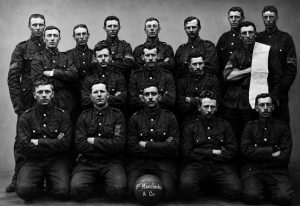
9th Manchesters, A Company Football Team April 1915
Top row, reading from left to right: Sergt. Scott (Committeeman), G. Howell (Ashton and Hooley Hill referee), J. Seddon (Denton Rovers), J. Martin (Waterloo), J. Turner (Reddish), Sergt. Grantham (Committeeman), and Corporal Travis (Ashton).
Middle row: W. Murphy (Ashton Oak), J. Williams (Haughton Rovers), J. Ratcliffe (Haughton Rovers), H. Allen (Dukinfield Hall), and A. Lees (Trainer).
Bottom row: Lance-Corpl. Parkins (Denton Rovers), J. Earnshaw (Haughton Rovers), “Sandy” Jackson (Denton, Hurst and Celtic), A. Broadhurst (Ashton St. Peter’s), and H. Broadhurst (Ashton St. Peter’s).
Without a doubt, the best player on the team was Pte. 2160 Thomas “Sandy” Jackson sitting front-row center with the ball. He started his senior playing career with Hurst FC (now Ashton United) in 1910 but switched to Stalybridge Celtic, playing for them from 1911-1913, and finally to Denton in 1914. He was a proper player, deployed at inside half-back and a regular goal scorer, widely reported in the press during the pre-war years, particularly Celtic’s 1912 season.
During 1913-14 Ashton St. Peter’s, Haughton Rovers and Waterloo were all playing in the Ashton and District League, 1st Division while Reddish were in Division 2. Players from those teams included: Pte. 2126 Pte James Martin, Pte J Turner, Pte 1201 James Williams, Pte 1147 James Ratcliffe, L/Cpl. 1000 James Earnshaw, and two brothers Pte 1184 Albert Broadhurst and Drummer 1160 Harold Broadhurst. Pte. 1303 Harry Allen played for Dukinfield Hall Primitives in the West Division of the Hooley Hill and District Sunday School League.
Pte 1916 John Seddon, L/Cpl. 1281 John Travis, Pte William Murphy and L/Cpl. 497 Alfred Parkins made up the rest of the team while Sgt 164 Alfred Scott and Sgt 969 Harry Grantham along with Pte 1243 Arnold Lees, managed and coached them.
Shortly after the article was published the East Lancashire Division deployed to Gallipoli.
Gallipoli
Throughout the campaign the Ashton Reporter would regularly add short biographical notes about the subject of the letter or article being published, sometimes providing a reference to their prior footballing prowess.
Private 1217 Harold Cooke, wounded June 9, 1915. Described in the local newspapers as one of the smartest junior footballers in the district and a prolific goal scorer, played for the Independents in the final of the Colonel John Wood Cup in 1914.
Private 2192 John (Jack) Jones, Killed in Action June 13, 1915. Played with the Dukinfield Primitive Methodist Football Club in the Hooley Hill and District Sunday School League, West Division.
Lance-Corporal Gerald Massey, Killed in Action June 19, 1915. Played with the Ashton United Methodist Football Club in the Hooley Hill and District Sunday School League, West Division.
Private 1803 James Ryder, Killed in Action June 19, 1915. Played for Holy Trinity Boy’s Brigade Football Club.
Corporal 508 Harry Gibson. Killed in Action June 19, 1915. Was secretary of the St. Gabriel’s Church, Cockbrook football club who played in the Hooley Hill and District Sunday School League, East Division.
Lance-Corporal 1769 Herbert Barratt, Died of Wounds June 28, 1915. Played for Dukinfield Celtic of the Ashton Lads’ League when they won the Reporter Cup in May 1912.
Private 2202 John (Jack) Hague, Died of Disease (Enteric Fever) July 3, 1915. Played for Hurst United Football Club of the Ashton Lads’ League, North Division.
Private 1150 Fred Armitage, Wounded (bullet to the wrist) July 9, 1915. Similar to “Sandy” Jackson, he was a talented player who started out with Dukinfield St. Marks but quickly graduated to a much higher-level with Hurst FC and then turned out regularly as half-back for Mossley in the Ashton and District League, Division 1. He was a member of the Mossley side which won the Lady Aitken Challenge Cup in 1914 and who came 2nd in the league’s Division 1 in the 1913-14 season.
Private 2236 Albert Hesketh. A well-known footballer who played for Ashton and Dukinfield clubs.
Private 2742 James Speddings, Killed in Action August 8, 1915. He was just 16 years old. Well-known in junior football circles, having played in a number of matches in the Dukinfield Lads League.
Corporal 180 Samuel Bayley, awarded the Distinguished Conduct Medal for actions at the Battle of Krithia Vineyard, August 7-9, 1915. A member of the Ebenezer Baptist Sunday School (Cross Leech Street), Stalybridge and the goalkeeper of the football club. Although apparently not quite good enough to get on the A Company football team in Egypt in 1915.
Company Sergeant Major 806 Cornelius Finch was secretary to the Dukinfield Association Football Club which played in the Ashton and District League, Division 1. He was reported to have five committeemen in his Company: Privates 2142 James McDonald, 2385 Frank Scrambler, 1613 Edward (Ted) Jones, 1187 William Kinder and 1465 James Pye. Private McDonald later succeeded Sergeant-Major Finch in the office of secretary to the Dukinfield F.C.
Private 2499 Percy Taylor, wounded in the left leg and right thigh on September 2, 1915 resulting in amputation of his leg on the Hospital Ship Delta, en-route to England. “He was a member of the United Methodist Church, Stamford Street, and took a great interest in the football club which played in the Hooley Hill and District Sunday School League, West Division. He was a capable and clever player, and well-liked by the team.”
Private 2897 Harry Clegg, Killed in Action September 4, 1915. Attended St. Gabriel’s Sunday School, Ashton and was a member of the St. Gabriel’s football team, (who played in the Hooley Hill and District Sunday School League, East Division) and a member of the cricket team.
Private 2710 Frederick John Bacon, Died of Disease (Enteric Fever) on September 28, 1915. Reportedly “has done much good work on the football field, both at Dukinfield and the Celtic ground at Stalybridge.”
Lance-Sergeant 2139 Gilbert Higham, Died of Wounds on October 7, 1915. Was well known in the local Sunday school football circles, having played for the Stalybridge Unitarians, (who played in the Hooley Hill and District Sunday School League, First Division), until just before the war broke out.
Private 3241 Alfred Metcalf, Killed in Action December 19, 1915. Was associated with the Hooley Hill Independent School, and belonged to the football team, having played for the Reporter Challenge Cup.
Private 2968 Joe Downs, Killed in Action December 19, 1915. A well-known footballer in the district as goalkeeper for the United Methodist Sunday School, Booth-street, Stalybridge who played in the Hooley Hill and District Sunday School League, East Division.
Dardanelles Cup
In October 1915, 8th Corps announced that a “Dardanelles Cup” would be contested between football teams from the 42nd (East Lancashire) Division, 52nd (Lowland) Division, Royal Naval Division and ‘Other Units’. The competition would be played across four groups, the winners of each group meeting in the semi-finals.[4] Within the 42nd Division, initial rounds were played to determine brigade champions each of who would then compete to become Division champions. The 10th Manchesters were the 126th Brigade winners defeating the 9th Manchesters in the second round 4-3 followed by a 3-2 victory over the 5th East Lancs Regiment, who had been hammered 6-0 by the 9th Manchesters’ A Company in Egypt.
There is no record of who made up the 9th Battalion football team but Pte Fred Armitage, the Mossey FC stalwart, was certainly not present as he had been wounded in the wrist on July 9 and repatriated to England on August 6, 1915. “Sandy” Jackson had also sustained a bullet wound to his right hand in July but there is no record of him being repatriated. Similarly, Harold Cooke of the Independents had been wounded on June 9 but was not repatriated.
The 10th Manchesters progressed to become the 42 Division champions but were knocked out in the semi-finals 2-0 by the ultimate Cup winners. The final was played at Mudros on January 13, 1916, the Anson Battalion of the Royal Naval Division beating the 5th Battalion Highland Light Infantry of the 52nd Division.
The 10th Manchesters were finally presented with their Division winners medals at a battalion parade in August 1916 in Pelusium, Egypt.
Egypt 1916
In mid-1916 the battalion fielded a football team in a cup competition sponsored by the Y.M.C.A. and contested between teams from the 42nd Division. The 9th Manchesters won the cup by beating teams over three rounds, a semi-final and final. Major-General Sir William Douglas presented the cup to Lieut. Arthur Norman Lechler of the 9th Battalion team on behalf of the Y.M.C.A.[5]
The battalion’s results were:
1st round: v. 4th East Lancashire Regiment; won 7-0.
2nd round: v. 5th East Lancashire Regiment; won 2-1.
3rd round: v. 5th Manchester Regiment; draw 1-1 followed by a 2-1 victory in the replay.
Semi-final: v. Cumberland R.F.A.: won 2-0.
Final: v. 1st East Lancashire Ambulance; won 4-0.
The fixtures imply that the other team of the 126th Infantry Brigade, the 10th Manchesters, went out in the first round to the 5th East Lancs, a team they had beaten 3-2 in the Dardanelles Cup.
The 9th Manchesters team included the ubiquitous “Sandy” Jackson from A Company’s undefeated pre-Gallipoli team:
Goal, Martin (formerly of Ashton Oak); right full-back, Lee (Ashton St. Peter’s); left full-back. 1491 Fred Genders (Audenshaw C.L.B.): right half-back, Eastham (Charlestown Mission); centre half-back T. Ratcliffe (Haughton Rovers): left half-back, J Davies (Mossley A.F.C.): right outside. F. Cooper (Hooley Hill Albion); right inside, “Sandy” Jackson (Hurst and Stalybridge Celtic): centre forward. Lieut. Lechler (Manchester University); left inside, W. Drinkwater (Ashton P.S.A.); left outside, A. Jones (Hulme Athletic).
Post-War Football
The 9th Battalion Manchester Regiment was reduced to a training cadre in April 1918 after the 66th Division’s losses in the 3rd Battle of the Somme. After the war, permission to reconstruct the battalion was not given until September 1919 and even then, orders to reform were not issued until a year later. During the interim, former officers and men of the battalion kept in touch through reunion dinners and other social events. Nevertheless, an impromptu football team was evidently assembled and invited to compete in the Ashton Charity Cup of 1919, an annual competition whose net proceeds were subsequently distributed to local worthy causes. The battalion’s team was about to be peripherally involved in a local footballing controversy.
National Gas Engine AFC, (known locally as “The Nash”), were founded in August, 1918, as the works team for the National Gas Engine Company which had provided one officer and several men for the 9th Manchesters during the war.[6] The intention was to field a side in the Manchester Amateur League and it was reported that the business employed several well-known players and would be able to turn out two good teams each week.
The National Gas Engine Company, knowing that success on the football field would generate positive publicity for the business was willing and able to spend money to help ensure that success. One of the first times it did so was during that inaugural season of 1918-19.
The Nash, made a strong start by finishing third in the Manchester Amateur League and reaching the last four of the league cup. They also reached the semi-finals of the Ashton Charity Cup where they found themselves facing Stalybridge Celtic Reserves, who had reached the semis after beating Mossley in front of 6,000 spectators at Bower Fold.[7] Meanwhile, the 9th Battalion team beat Hurst FC reserves, at Hurst Cross, in front of a crowd of 4,000 in the other semi-final.
Celtic, backed by wealthy mill-owner Herbert Rhodes, were a powerful and ambitious club who would go on to become founder-members of the Football League’s new third division (North) in 1921. National responded to the challenge creatively, by drafting in two Manchester City forwards — Albert Fairclough and Horace Barnes — and won 3-2 to register a major upset. Fairclough was a competent professional but Barnes was one of the stars of the day. In 1914 City had signed him from Derby County for a record £2,500 and he went on to score 120 goals in 218 appearances. Match reports of their semi-final noted him “playing magnificently” and scoring all three goals in the National’s victory over Celtic.
The executive committee of the Ashton Charity Cup met immediately after the match and while admitting that they had sanctioned “guest players” in The Nash’s first round tie against New Moss Colliery and acknowledging that Celtic, although not agreeing to Barnes and Fairclough playing had agreed to abide by the result, nevertheless ruled that Barnes and Fairclough were ineligible, and ordered a replay in which National should field “eleven bona-fide” players.[8]
But National refused to comply, arguing there was nothing in the rules to preclude what they had done. Their intransigence caused them to be summarily expelled from the competition and Stalybridge Celtic Reserves took their place in the final where they thrashed the 9th Battalion Manchester Regiment 6-0 at Hurst Cross, watched by 7,000 spectators.
Undeterred, National bypassed the Charity Cup Committee and filed an appeal with the governing football associations. Just one week later a special joint-commission of the Manchester and Cheshire County FAs formed an Appeals Committee to hear National’s complaint. The Appeals Committee overruled the Charity Cup Committee’s earlier decision, stating that National had been within their rights to field Barnes and Fairclough since the Committee had previously allowed National to play two “imported players” in their victory against New Moss Colliery and had failed to rescind the rule that allowed them to do so. The final was ordered to be replayed and the Nash beat the doubly-unfortunate 9th Manchesters 3-1, (also at Hurst Cross but this time in front of a lessor crowd of 3,000), to lift their first ever trophy.[9]
Despite all the controversy, with such well attended games, the fundamental goal of the competition was met and the local community benefited from the subsequently distributed gate proceeds, swelled by the gate receipts from the second final.
Footnotes:
[1] Hurst FC went on to become Ashton United FC.
[2] “Ashton and District Football League, The Annual Report”, Ashton Reporter, 23 May 1914.
[3] “Lady Aitken Cup”, Ashton Reporter 2 May, 1914.
[4] Details taken from an article written by Bernard de Broglio, “The Dardanelles Cup,” printed in The Gallipolian, No. 144, Autumn 2017.
[5] “1/9th’s Football Success”, Ashton Reporter, July 8, 1916.
[6] The National Gas Engine Co. Ltd. was founded by Mr. Henry Neild Bickerton in 1889. Henry’s nephew, Edward Balmford was commissioned into the second line 9th Battalion Manchester Regiment on May 5, 1915 and deployed to Gallipoli with the first line battalion on June 20.
[7] Manchester Evening News – Saturday 12 April 1919.
[8] “Ashton Charity Cup”, Manchester Evening News – Saturday 3 May 1919.
[9] “Cup Final Sequel”, Manchester Evening News – Friday 23 May 1919.
Acknowledgements:
The original idea, and several short sections of the Post War Football text, came with kind permission from “Ashton National: A Potted History of the Original Nash”, accessed November 2025.