The following newspaper article was published in the The (Canterbury) Press, Volume LI, Issue 15344, 30 July 1915, Page 8. See Copyright notice at the bottom of the page.
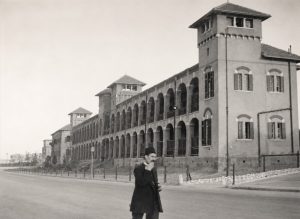
Ras el Tin Military Hospital (aka 21 British General Hospital), Alexandria
“EGYPTIAN” HOSPITALS: THE CARE OF OUR GALLANT WOUNDED
(By H. T. Ferrar, M.A., F.G.S., late of the Egyptian Civil Service.)
Before the outbreak of war there were a certain number of European hospitals in Egypt. These were either the military hospitals for the British Army of Occupation and the Egyptian Army, or they were civil hospitals maintained by the civil communities of the different nationalities in such towns as Cairo and Alexandria, Port Said, and Suez. All these are now being utilised by the British military authorities in order that those members of the New Zealand and Australian forces who have been wounded in the recent fighting at the Dardanelles may have proper care and treatment.
In addition to those hospitals already established in Egypt, several have been improvised owing to the great number of casualties. These temporary hospitals are but briefly notified in the cablegrams which we receive, but an intimate knowledge of the country enables me to identify them and to supply a short description, which must be of interest to those who have wounded friends or relatives undergoing hospital treatment in Egypt.
The Abbassia Hospital was built by the British Government to provide additional hospital accommodation for the Army of Occupation. It is a sand-brick building, constructed on approved and up-to-date lines, and is situated in the desert, a few miles east of Cairo, near the disused overland post-road to Suez. This hospital is one of the buildings which constitute the new Abbassia Barracks, where some of the British troops are quartered. Having thick masonry walls, it is warm in winter and cool in summer. It is protected by wide verandahs from excess of sun and dust-laden wind, and its windows, fitted with metallic gauze screens, do not allow the ingress of flies or mosquitoes. Thus the in this hospital are not placed beneath mosquito nets, and probably are as comfortable here as in any other hospital in Egypt. All the doctors belong to the Royal Army Medical Corps, the nurses are certificated Army nurses, and the chambermaids’ work is done by black boys from Upper Egypt.
The Anglo-American Hospital, situated on an island (Gezira) in the Nile, opposite Cairo, is a private hospital, maintained by voluntary subscriptions from the English and American residents, and by donations from British and other visitors during the winter tourist season. The medical staff includes British doctors, both in the Egyptian Government service and in private practice. The nursing staff are ladies recruited, usually from the larger London hospitals. As before, the housemaids’ work is done by Berberine boys from Upper Egypt. The building was divided into two wings, one for ladies and the other for Anglo-Saxons in commerce in Cairo or in tho Civil Service. It is a masonry building with a wide verandah on its north or windward side, and its windows are fitted with metallic gauze mosquito screens. It possesses an operating theatre, and its rooms were designed so that usually each patient had a room to herself or himself, but in times of stress two or more patients were placed in the same room. The writer of this article can vouch for its comfort, having been an inmate there on four different occasions.
The Citadel Hospital is part of the fort built by Salah-el-Din (Saladin) on a spur of the Moqattam Hills, overlooking Cairo. Being high up, it is well ventilated and as it has proved a satisfactory hospital for a number of years it is bound to possess all modern conveniences. Formerly, it was used exclusively by that regiment of the Army of Occupation which happened to be quartered in the citadel, but now its use has been extended so as to provide accommodation for New Zealand and other wounded soldiers. The medical and nursing staffs are, like those at tho Abbassia Hospital, members of the Royal Army Medical Corps.
The Deaconess’ Hospital (Cairo) is a well-equipped hospital near the Nile, in the European quarter of Cairo, and is one of the permanent civil hospitals mentioned above. This hospital is used occasionally by British residents, but, as a rule, the inmates here are subjects of one or other of the great European Powers. The nurses here are trained Sisters of Mercy, and the hospital is highly commended by any British residents who have been there.
Gezira Palace was a Khedival palace, and afterwards a large and fashionable hotel when the war broke out. It is a fine masonry building situated on the island (Gezira) in the Nile opposite Cairo. It stands on the riverbank, and is surrounded by its own grounds, which abut on the polo ground and racecourse of the British residents’ sports club, the Khedivial Sporting Club. The houses in the vicinity are occupied by the more prominent residents of Cairo, and in short, the vicinity is ideal, especially from the point of view of a wounded soldier. Having been an hotel, there will be many conveniences here which could not be found in other of the improvised hospitals. This one may be what has been called Australian General Hospital No. II. Gezira, the Ghezires (sic) Hospital of the cablegrams, and if this is so the professional staff will be drawn from the ranks of the Australian Army Medical Corps.
Heliopolis Hotel likewise may be another name for the West Australian General Hospital No. I. (There are at least twenty-one improvised military hospitals, and it will be some time before the cablegrams allow of their identification.) The Heliopolis Hotel is a magnificent sand-brick building in the new desert suburb of that name, and is within a mile of the New Zealanders’ first Egyptian camp at Zeitoun. The hotel was sumptuously furnished, and could accommodate a thousand guests. Since the building has been equipped as an hotel it is certain that there will be a great number of well-sprung beds available, and that the culinary and other conveniences will be adequate to the present requirements. The spacious gardens will enable those men whom it is possible to move to breathe the pure air of the desert and hence make rapid recovery.
Kasr el Aini Hospital is one of the Egyptian Government hospitals under the Public Health Department. The director, the resident physician, the resident surgeon, and the nurses are English, but since this hospital was also a medical school for local students, some of the staff are Egyptians, who, however, usually hold diplomas obtained in Europe. It is probable that the native section of the hospital remains unchanged, and that the lecture rooms and laboratories of the students have been converted into wards for our wounded. These lecture rooms form open quadrangles, into which the prevailing breezes from the Mediterranean sea find easy ingress. The windows and doors are provided with gauze mosquito-screens. The hospital is situated near the Nile, and half a mile to the South of General Maxwell’s house and the British Residency.
Luna Park, Cairo’s “White City,” with skating rink, switchback railway et cetera, is situated a few hundred yards from the Heliopolis Hotel. Photographs of the interior of this property published in the “Weekly Press” of July 6th showed that the beds provided here are made from the split midribs of date-palm leaves. Such beds, called angareeb, are very comfortable, for the flexibility of the woody fibres and the absence of rigid joints, allow the mattress to “give” beneath the weight of the body. They are practically basket or wicker-work stretchers and British residents often use them as spare beds or as verandah settees. It is probable that only minor wounds will be treated in this improvised Hospital.
Pont de Kubba (or Koubbeh) is a suburb of Cairo on the now well known Zeitoun railway line. There are many huge blocks of residential flats in this district, and it is likely that one of those buildings has been converted into a temporary hospital. If this is not so, the only other suitable building in the locality is the old Abbassia Observatory, formerly a Khedivial palace. This building is surrounded by a high wall and the garden so enclosed would secure quiet resting places for those whose wounds allowed them some freedom of action.
Mena House, the last of the Cairo hospitals specified in the cablegrams, was an hotel, but on the arrival of the Australian Field Force it was converted into their base hospital. It is situated on the edge of the Libyan desert at the end of the Pyramids tram line, and beneath the shadow of the Great Pyramid. It is connected to Cairo by both telephone and telegraph wires. It is probable that this hospital has been maintained continuously under the Australian Army Medical Corps. Having been used as an hospital for some six months prior to the attack on Gallipoli Peninsula, all shortcomings will have been remedied and extra comforts will have been provided ere the first wounded soldiers returned from the firing-line.
ALEXANDRIA.
Seven hospitals in Alexandria have been mentioned by name, but as yet no reference has been made to some seventeen Military Hospitals, namely, those numbered III. to XVIII. and No. XX. No doubt many of these are placed in Alexandria and reserved mainly for the wounded British, Indian, and French troops. Alexandria is a noted health resort and is the seat of Government during the Egyptian summer. The proximity of the sea renders its temperature more equable than that of Cairo. As in Cairo, so in Alexandria, convalescent cases win find many residents ready to offer the hospitality of their homes until their names are removed from the sick list. All the suburban portion of this city stands on its north-east side upon a ridge of soft limestone rock. Tho cultivated delta of the Nile, here mainly market gardens, extends along the south side of this ridge, while on the north side the sea provides one long succession of delightful bathing beaches. An asphalted carriage road bordered by shady trees and an efficient electric tram service, the Alexandria. Ramleh Railway, connects these suburbs with one another and with the centre of the city.
Glymenopoulo, one of these suburban districts, lies quite near Alexandria, and is characterised by the number of great houses which are divided into residential flats. It is probably one of these spacious buildings which has been converted into a temporary hospital.
Ras el Tin Military Hospital is situated near the terminus of the Ramleh tram line at Ras el Tin, the Cape of Figs. The building is probably what was the summer palace of the ex-Khedive Abbas II., pictures of which may be seen on the new issue of the Egyptian three-milliene stamps. As it is built on the very sea front, and some distance from any other large structures, it will form an almost ideal hospital. Of course, the large halls it is bound to contain will entail large wards, which may not be as comfortable as smaller wards containing fewer beds.
Ramleh Casino and San Stefano Casino are probably one and the same hospital. Ramleh, the fashionable residential suburb of Alexandria, adjoins San Stefano, with its Casino and other seaside attractions. In reality the Casino is a large hotel on the sea front, and is noted for its enclosed swimming bath. Convalescent men will find this establishment has more attractions than other hospitals less favourably situated.
Alexandria Hospital, perhaps identical with Military General Hospital No. XXI., like Kasr el Aini, is an Egyptian Government hospital and school of medicine under the Public Health Department. Its staff will be mainly British, and it will be well equipped with medical stores.
Deaconess’ Hospital, also called Military Hospital No.XIX., needs little further notice than to say that it is under the same administration as the Deaconess’ Hospital, Cairo. The Sisters of Mercy in both establishments are usually of Austrian or German nationality.
The Greek Hospital is maintained by the Greek community of Alexandria, which is richer and in point of view of numbers, is greater than that of any other of the European communities which inhabit this city. The hospital is bound to be well appointed, and except for the food, which may be prepared in a manner too nearly resembling Neapolitan for our tastes, the patients here should have all the comforts they require.
Before concluding these notes on the hospital accommodation in Egypt, it may be of interest to record that the allied Red Cross ship Goorka, which transports the wounded from Gallipoli to Alexandria, is one of the ships of the Union Castle Line fleet. This line of steamers carries the mails and passengers between Southampton and the South African ports. The ships are all well found, and in some cases the accommodation is luxurious. Relations and friends may therefore rest assured that our wounded will have the best possible care and attention during the two or three days’ voyage across the Mediterranean.
Copyright Notice:
Stuff Ltd is the copyright owner for the Press. You can reproduce in-copyright material from this newspaper for non-commercial use under a Creative Commons Attribution-NonCommercial-ShareAlike 4.0 International licence (CC BY-NC-SA 4.0). You do not have to comply with the license for elements of the material in the public domain.