The Geneva Convention for Hospital Ships

It is widely understood that Hospital Ships were entitled to safe passage and exempt from attack by enemy naval forces. It is useful therefore to examine the specific rules and regulations that were required to be met by both sides.

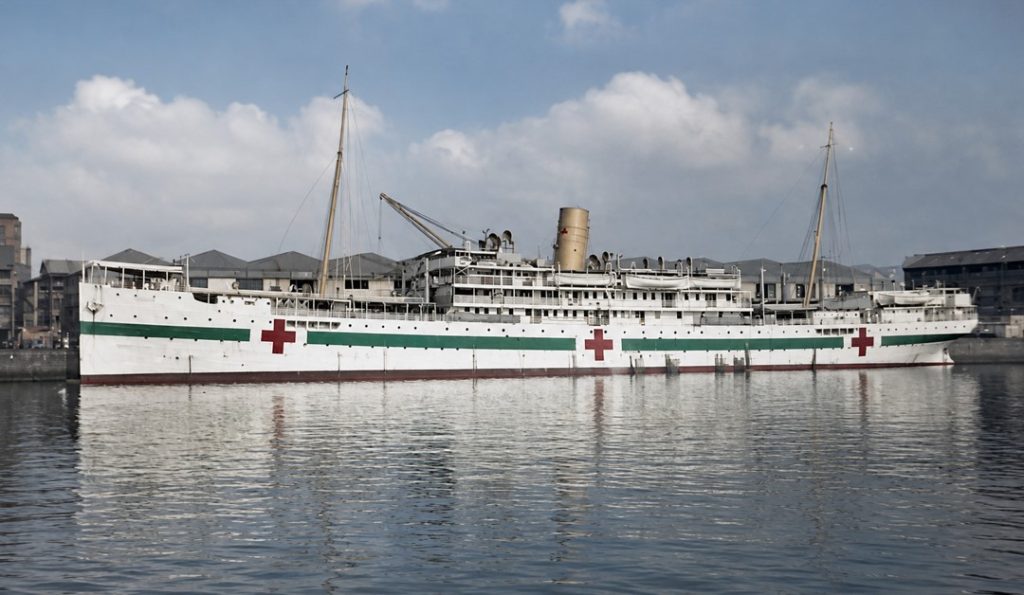
HMHT Vita

Hospital Ship VITA


Convention (X) for the Adaptation to Maritime Warfare of the Principles of the Geneva Convention. The Hague, 18 October 1907.

The Second Hague Peace Conference of 1907 revised and enlarged Convention (III) of 1899 concerning the adaptation to maritime warfare of the principles of the Geneva Convention of 1864. Most of the 14 articles of the 1899 Convention were taken over without change in the 1907 version, but several new articles were added. The number of articles doubled to 28. The new Convention was based on the Geneva Convention of 1906 whereas the earlier one had been based on the less developed Convention of 1864. New provisions are contained especially in articles 5-9, 13, 15-17, and 19-23. The Convention remained in force during both World Wars. It was replaced in 1949 by Geneva Convention (II).

D. Schindler and J. Toman, The Laws of Armed Conflicts, Martinus Nijhoff Publishers, 1988, pp.314-318.

Preamble

[List of Contracting Parties]

Animated alike by the desire to diminish, as far as depends on them, the inevitable evils of war;

And wishing with this object to adapt to maritime warfare the principles of the Geneva Convention of 6 July 1906.

Have resolved to conclude a Convention for the purpose of revising the Convention of 29 July 1899, relative to this question, and have appointed the following as their Plenipotentiaries:

[Here follow the names of Plenipotentiaries]

Who, after having deposited their full powers, found in good and due form, have agreed upon the following provisions:

Article 1

Military hospital ships, that is to say, ships constructed or assigned by States specially and solely with a view to assisting the wounded, sick and shipwrecked, the names of which have been communicated to the belligerent Powers at the commencement or during the course of hostilities, and in any case before they are employed, shall be respected, and cannot be captured while hostilities last.

These ships, moreover, are not on the same footing as warships as regards their stay in a neutral port.

Article 2

Hospital ships, equipped wholly or in part at the expense of private individuals or officially recognized relief societies, shall likewise be respected and exempt from capture, if the belligerent Power to whom they belong has given them an official commission and has notified their names to the hostile Power at the commencement of or during hostilities, and in any case before they are employed.

These ships must be provided with a certificate from the competent authorities declaring that the vessels have been under their control while fitting out and on final departure.

Article 3

Hospital ships, equipped wholly or in part at the expense of private individuals or officially recognized societies of neutral countries shall be respected and exempt from capture, on condition that they are placed under the control of one of the belligerents, with the previous consent of their own Government and with the authorization of the belligerent himself, and that the latter has notified their names to his adversary at the commencement of or during hostilities, and in any case, before they are employed.

Article 4

The ships mentioned in Articles 1, 2, and 3 shall afford relief and assistance to the wounded, sick, and shipwrecked of the belligerents without distinction of nationality.

The Governments undertake not to use these ships for any military purpose.

These vessels must in no wise hamper the movements of the combatants.

During and after an engagement they will act at their own risk and peril.

The belligerents shall have the right to control and search them; they can refuse to help them, order them off, make them take a certain course, and put a commissioner on board; they can even detain them, if important circumstances require it.

As far as possible, the belligerents shall enter in the log of the hospital ships the orders which they give them.

Article 5

Military hospital ships shall be distinguished by being painted white outside with a horizontal band of green about a metre and a half in breadth.

The ships mentioned in Articles 2 and 3 shall be distinguished by being painted white outside with a horizontal band of red about a metre and a half in breadth.

The boats of the ships above mentioned, as also small craft which may be used for hospital work, shall be distinguished by similar painting.

All hospital ships shall make themselves known by hoisting, with their national flag, the white flag with a red cross provided by the Geneva Convention, and further, if they belong to a neutral State, by flying at the mainmast the national flag of the belligerent under whose control they are placed.

Hospital ships which, in the terms of Article 4, are detained by the enemy must haul down the national flag of the belligerent to whom they belong.

The ships and boats above mentioned which wish to ensure by night the freedom from interference to which they are entitled, must, subject to the assent of the belligerent they are accompanying, take the necessary measures to render their special painting sufficiently plain.

Article 6

The distinguishing signs referred to in Article 5 can only be used, whether in time of peace or war, for protecting or indicating the ships therein mentioned.

Article 7

In the case of a fight on board a warship, the sick wards shall be respected and spared as far as possible.

The said sick wards and the material belonging to them remain subject to the laws of war; they cannot, however, be used for any purpose other than that for which they were originally intended, so long as they are required for the sick and wounded.

The commander, however, into whose power they have fallen may apply them to other purposes, if the military situation requires it, after seeing that the sick and wounded on board are properly provided for.

Article 8

Hospital ships and sick wards of vessels are no longer entitled to protection if they are employed for the purpose of injuring the enemy.

The fact of the staff of the said ships and sick wards bring armed for maintaining order and for defending the sick and wounded, and the presence of wireless telegraphy apparatus on board, is not a sufficient reason for withdrawing protection.

Article 9

Belligerents may appeal to the charity of the commanders of neutral merchant ships, yachts, or boats to take on board and tend the sick and wounded.

Vessels responding to the appeal, and also vessels which have of their own accord rescued sick, wounded, or ship-wrecked men, shall enjoy special protection and certain immunities. In no case can they be captured for having such persons on board, but, apart from special undertakings that have been made to them, they remain liable to capture for any violations of neutrality they may have committed.

Article 10

The religious, medical, and hospital staff of any captured ship is inviolable, and its members cannot be made prisoners of war. On leaving the ship they take away with them the objects and surgical instruments which are their own private property.

This staff shall continue to discharge its duties while necessary, and can afterwards leave, when the commander-in-chief considers it possible.

The belligerents must guarantee to the said staff, when it has fallen into their hands, the same allowances and pay which are given to the staff of corresponding rank in their own navy.

Article 11

Sailors and soldiers on board, when sick or wounded, as well as other persons officially attached to fleets or armies, whatever their nationality, shall be respected and tended by the captors.

Article 12

Any warship belonging to a belligerent may demand that sick, wounded, or shipwrecked men on board military hospital ships, hospital ships belonging to relief societies or to private individuals, merchant ships, yachts, or boats, whatever the nationality of these vessels, should be handed over.

Article 13

If sick, wounded, or shipwrecked persons are taken on board a neutral warship, every possible precaution must be taken that they do not again take part in the operations of the war.

Article 14

The shipwrecked, wounded, or sick of one of the belligerents who fall into the power of the other belligerent are prisoners of war. The captor must decide, according to circumstances, whether to keep them, send them to a port of his own country, to a neutral port, or even to an enemy port. In this last case, prisoners thus repatriated cannot serve again while the war lasts.

Article 15

The shipwrecked, sick, or wounded, who are landed at a neutral port with the consent of the local authorities, must, unless an arrangement is made to the contrary between the neutral State and the belligerent States, be guarded by the neutral State, so as to prevent them again taking part in the operations of the war.

The expenses of tending them in hospital and interning them shall be borne by the State to which the shipwrecked, sick, or wounded persons belong.

Article 16

After every engagement, the two belligerents, so far as military interests permit, shall take steps to look for the shipwrecked, sick, and wounded, and to protect them, as well as the dead, against pillage and ill-treatment.

They shall see that the burial, whether by land or sea, or cremation of the dead shall be preceded by a careful examination of the corpse.

Article 17

Each belligerent shall send, as early as possible, to the authorities of their country, navy, or army the military marks or documents of identity found on the dead and the description of the sick and wounded picked up by him.

The belligerents shall keep each other informed as to internments and transfers as well as to the admissions into hospital and deaths which have occurred among the sick and wounded in their hands. They shall collect all the objects of personal use, valuables, letters, etc., which are found in the captured ships, or which have been left by the sick or wounded who died in hospital, in order to have them forwarded to the persons concerned by the authorities of their own country.

Article 18

The provisions of the present Convention do not apply except between Contracting Powers, and then only if all the belligerents are parties to the Convention.

Article 19

The commanders-in-chief of the belligerent fleets must see that the above articles are properly carried out; they will have also to see to cases not covered thereby, in accordance with the instructions of their respective Governments and in conformity with the general principles of the present Convention.

Article 20

The signatory Powers shall take the necessary measures for bringing the provisions of the present Convention to the knowledge of their naval forces, and especially of the members entitled thereunder to immunity, and for making them known to the public.

Article 21

The Signatory Powers likewise undertake to enact or to propose to their legislatures, if their criminal laws are inadequate, the measures necessary for checking in time of war individual acts of pillage and ill-treatment in respect to the sick and wounded in the fleet, as well as for punishing, as an unjustifiable adoption of naval or military marks, the unauthorized use of the distinctive marks mentioned in Article 5 by vessels not protected by the present Convention.

They will communicate to each other, through the Netherlands Government, the enactments for preventing such acts at the latest within five years of the ratification of the present Convention.

Article 22

In the case of operations of war between the land and sea forces of belligerents, the provisions of the present Convention do not apply except between the forces actually on board ship.

Article 23

The present Convention shall be ratified as soon as possible.

The ratifications shall be deposited at The Hague.

The first deposit of ratifications shall be recorded in a ‘ procès-verbal ‘ signed by the representatives of the Powers taking part therein and by the Netherlands Minister for Foreign Affairs.

Subsequent deposits of ratifications shall be made by means of a written notification addressed to the Netherlands Government and accompanied by the instrument of ratification.

A certified copy of the ‘ procès-verbal ‘ relative to the first deposit of ratifications, of the notifications mentioned in the preceding paragraph, as well as of the instruments of ratification, shall be at once sent by the Netherlands Government through the diplomatic channel to the Powers invited to the Second Peace Conference, as well as to the other Powers which have adhered to the Convention. In the cases contemplated in the preceding paragraph the said Government shall inform them at the same time of the date on which it received the notification.

Article 24

Non-signatory Powers which have accepted the Geneva Convention of 6 July 1906 may adhere to the present Convention.

The Power which desires to adhere notifies its intention to the Netherlands Government in writing, forwarding to it the act of adhesion, which shall be deposited in the archives of the said Government.

The said Government shall at once transmit to all the other Powers a duly certified copy of the notification as well as of the act of adhesion, mentioning the date on which it received the notification.

Article 25

The present Convention, duly ratified, shall replace as between Contracting Powers, the Convention of 29 July 1899, for the adaptation to maritime warfare of the principles of the Geneva Convention.

The Convention of 1899 remains in force as between the Powers which signed it but which do not also ratify the present Convention.

Article 26

The present Convention shall come into force, in the case of the Powers which were a party to the first deposit of ratifications, sixty days after the date of the ‘ procès-verbal ‘ of this deposit, and, in the case of the Powers which ratify subsequently or which adhere, sixty days after the notification of their ratification or of their adhesion has been received by the Netherlands Government.

Article 27

In the event of one of the Contracting Powers wishing to denounce the present Convention, the denunciation shall be notified in writing to the Netherlands Government, which shall at once communicate a duly certified copy of the notification to all the other Powers, informing them at the same time of the date on which it was received.

The denunciation shall only have effect in regard to the notifying Power, and one year after the notification has reached the Netherlands Government.

Article 28

A register kept by the Netherlands Ministry for Foreign Affairs shall give the date of the deposit of ratifications made in virtue of Article 23, paragraphs 3 and 4 , as well as the date on which the notifications of adhesion (Article 24, paragraph 2 ) or of denunciation (Article 27, paragraph 1) have been received.

Each Contracting Power is entitled to have access to this register and to be supplied with duly certified extracts from it.

In faith whereof the Plenipotentiaries have appended their signatures to the Convention.

Done at The Hague, 18 October 1907, in a single copy, which shall remain deposited in the archives of the Netherlands Government, and duly certified copies of which shall be sent, through the diplomatic channel, to the Powers which have been invited to the Second Peace Conference.

[Here follow signatures]


Acknowledgement:

Reproduced from:

https://ihl-databases.icrc.org/en/ihl-treaties/hague-conv-x-1907

Egyptian Hospitals: The Care of Our Gallant Wounded

The following newspaper article was published in the The (Canterbury) Press, Volume LI, Issue 15344, 30 July 1915, Page 8. See Copyright notice at the bottom of the page.

21BGH Alexandria Officers Section

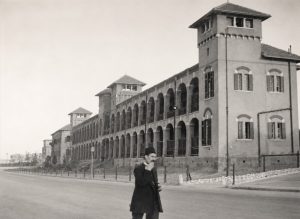
Ras el Tin Military Hospital (aka 21 British General Hospital), Alexandria


“EGYPTIAN” HOSPITALS: THE CARE OF OUR GALLANT WOUNDED

(By H. T. Ferrar, M.A., F.G.S., late of the Egyptian Civil Service.)


Before the outbreak of war there were a certain number of European hospitals in Egypt. These were either the military hospitals for the British Army of Occupation and the Egyptian Army, or they were civil hospitals maintained by the civil communities of the different nationalities in such towns as Cairo and Alexandria, Port Said, and Suez. All these are now being utilised by the British military authorities in order that those members of the New Zealand and Australian forces who have been wounded in the recent fighting at the Dardanelles may have proper care and treatment.

In addition to those hospitals already established in Egypt, several have been improvised owing to the great number of casualties. These temporary hospitals are but briefly notified in the cablegrams which we receive, but an intimate knowledge of the country enables me to identify them and to supply a short description, which must be of interest to those who have wounded friends or relatives undergoing hospital treatment in Egypt.

The Abbassia Hospital was built by the British Government to provide additional hospital accommodation for the Army of Occupation. It is a sand-brick building, constructed on approved and up-to-date lines, and is situated in the desert, a few miles east of Cairo, near the disused overland post-road to Suez. This hospital is one of the buildings which constitute the new Abbassia Barracks, where some of the British troops are quartered. Having thick masonry walls, it is warm in winter and cool in summer. It is protected by wide verandahs from excess of sun and dust-laden wind, and its windows, fitted with metallic gauze screens, do not allow the ingress of flies or mosquitoes. Thus the in this hospital are not placed beneath mosquito nets, and probably are as comfortable here as in any other hospital in Egypt. All the doctors belong to the Royal Army Medical Corps, the nurses are certificated Army nurses, and the chambermaids’ work is done by black boys from Upper Egypt.

The Anglo-American Hospital, situated on an island (Gezira) in the Nile, opposite Cairo, is a private hospital, maintained by voluntary subscriptions from the English and American residents, and by donations from British and other visitors during the winter tourist season. The medical staff includes British doctors, both in the Egyptian Government service and in private practice. The nursing staff are ladies recruited, usually from the larger London hospitals. As before, the housemaids’ work is done by Berberine boys from Upper Egypt. The building was divided into two wings, one for ladies and the other for Anglo-Saxons in commerce in Cairo or in tho Civil Service. It is a masonry building with a wide verandah on its north or windward side, and its windows are fitted with metallic gauze mosquito screens. It possesses an operating theatre, and its rooms were designed so that usually each patient had a room to herself or himself, but in times of stress two or more patients were placed in the same room. The writer of this article can vouch for its comfort, having been an inmate there on four different occasions.

The Citadel Hospital is part of the fort built by Salah-el-Din (Saladin) on a spur of the Moqattam Hills, overlooking Cairo. Being high up, it is well ventilated and as it has proved a satisfactory hospital for a number of years it is bound to possess all modern conveniences. Formerly, it was used exclusively by that regiment of the Army of Occupation which happened to be quartered in the citadel, but now its use has been extended so as to provide accommodation for New Zealand and other wounded soldiers. The medical and nursing staffs are, like those at tho Abbassia Hospital, members of the Royal Army Medical Corps.

The Deaconess’ Hospital (Cairo) is a well-equipped hospital near the Nile, in the European quarter of Cairo, and is one of the permanent civil hospitals mentioned above. This hospital is used occasionally by British residents, but, as a rule, the inmates here are subjects of one or other of the great European Powers. The nurses here are trained Sisters of Mercy, and the hospital is highly commended by any British residents who have been there.

Gezira Palace was a Khedival palace, and afterwards a large and fashionable hotel when the war broke out. It is a fine masonry building situated on the island (Gezira) in the Nile opposite Cairo. It stands on the riverbank, and is surrounded by its own grounds, which abut on the polo ground and racecourse of the British residents’ sports club, the Khedivial Sporting Club. The houses in the vicinity are occupied by the more prominent residents of Cairo, and in short, the vicinity is ideal, especially from the point of view of a wounded soldier. Having been an hotel, there will be many conveniences here which could not be found in other of the improvised hospitals. This one may be what has been called Australian General Hospital No. II. Gezira, the Ghezires (sic) Hospital of the cablegrams, and if this is so the professional staff will be drawn from the ranks of the Australian Army Medical Corps.

Heliopolis Hotel likewise may be another name for the West Australian General Hospital No. I. (There are at least twenty-one improvised military hospitals, and it will be some time before the cablegrams allow of their identification.) The Heliopolis Hotel is a magnificent sand-brick building in the new desert suburb of that name, and is within a mile of the New Zealanders’ first Egyptian camp at Zeitoun. The hotel was sumptuously furnished, and could accommodate a thousand guests. Since the building has been equipped as an hotel it is certain that there will be a great number of well-sprung beds available, and that the culinary and other conveniences will be adequate to the present requirements. The spacious gardens will enable those men whom it is possible to move to breathe the pure air of the desert and hence make rapid recovery.

Kasr el Aini Hospital is one of the Egyptian Government hospitals under the Public Health Department. The director, the resident physician, the resident surgeon, and the nurses are English, but since this hospital was also a medical school for local students, some of the staff are Egyptians, who, however, usually hold diplomas obtained in Europe. It is probable that the native section of the hospital remains unchanged, and that the lecture rooms and laboratories of the students have been converted into wards for our wounded. These lecture rooms form open quadrangles, into which the prevailing breezes from the Mediterranean sea find easy ingress. The windows and doors are provided with gauze mosquito-screens. The hospital is situated near the Nile, and half a mile to the South of General Maxwell’s house and the British Residency.

Luna Park, Cairo’s “White City,” with skating rink, switchback railway et cetera, is situated a few hundred yards from the Heliopolis Hotel. Photographs of the interior of this property published in the “Weekly Press” of July 6th showed that the beds provided here are made from the split midribs of date-palm leaves. Such beds, called angareeb, are very comfortable, for the flexibility of the woody fibres and the absence of rigid joints, allow the mattress to “give” beneath the weight of the body. They are practically basket or wicker-work stretchers and British residents often use them as spare beds or as verandah settees. It is probable that only minor wounds will be treated in this improvised Hospital.

Pont de Kubba (or Koubbeh) is a suburb of Cairo on the now well known Zeitoun railway line. There are many huge blocks of residential flats in this district, and it is likely that one of those buildings has been converted into a temporary hospital. If this is not so, the only other suitable building in the locality is the old Abbassia Observatory, formerly a Khedivial palace. This building is surrounded by a high wall and the garden so enclosed would secure quiet resting places for those whose wounds allowed them some freedom of action.

Mena House, the last of the Cairo hospitals specified in the cablegrams, was an hotel, but on the arrival of the Australian Field Force it was converted into their base hospital. It is situated on the edge of the Libyan desert at the end of the Pyramids tram line, and beneath the shadow of the Great Pyramid. It is connected to Cairo by both telephone and telegraph wires. It is probable that this hospital has been maintained continuously under the Australian Army Medical Corps. Having been used as an hospital for some six months prior to the attack on Gallipoli Peninsula, all shortcomings will have been remedied and extra comforts will have been provided ere the first wounded soldiers returned from the firing-line.

ALEXANDRIA.

Seven hospitals in Alexandria have been mentioned by name, but as yet no reference has been made to some seventeen Military Hospitals, namely, those numbered III. to XVIII. and No. XX. No doubt many of these are placed in Alexandria and reserved mainly for the wounded British, Indian, and French troops. Alexandria is a noted health resort and is the seat of Government during the Egyptian summer. The proximity of the sea renders its temperature more equable than that of Cairo. As in Cairo, so in Alexandria, convalescent cases win find many residents ready to offer the hospitality of their homes until their names are removed from the sick list. All the suburban portion of this city stands on its north-east side upon a ridge of soft limestone rock. Tho cultivated delta of the Nile, here mainly market gardens, extends along the south side of this ridge, while on the north side the sea provides one long succession of delightful bathing beaches. An asphalted carriage road bordered by shady trees and an efficient electric tram service, the Alexandria. Ramleh Railway, connects these suburbs with one another and with the centre of the city.

Glymenopoulo, one of these suburban districts, lies quite near Alexandria, and is characterised by the number of great houses which are divided into residential flats. It is probably one of these spacious buildings which has been converted into a temporary hospital.

Ras el Tin Military Hospital is situated near the terminus of the Ramleh tram line at Ras el Tin, the Cape of Figs. The building is probably what was the summer palace of the ex-Khedive Abbas II., pictures of which may be seen on the new issue of the Egyptian three-milliene stamps. As it is built on the very sea front, and some distance from any other large structures, it will form an almost ideal hospital. Of course, the large halls it is bound to contain will entail large wards, which may not be as comfortable as smaller wards containing fewer beds.

Ramleh Casino and San Stefano Casino are probably one and the same hospital. Ramleh, the fashionable residential suburb of Alexandria, adjoins San Stefano, with its Casino and other seaside attractions. In reality the Casino is a large hotel on the sea front, and is noted for its enclosed swimming bath. Convalescent men will find this establishment has more attractions than other hospitals less favourably situated.

Alexandria Hospital, perhaps identical with Military General Hospital No. XXI., like Kasr el Aini, is an Egyptian Government hospital and school of medicine under the Public Health Department. Its staff will be mainly British, and it will be well equipped with medical stores.

Deaconess’ Hospital, also called Military Hospital No.XIX., needs little further notice than to say that it is under the same administration as the Deaconess’ Hospital, Cairo. The Sisters of Mercy in both establishments are usually of Austrian or German nationality.

The Greek Hospital is maintained by the Greek community of Alexandria, which is richer and in point of view of numbers, is greater than that of any other of the European communities which inhabit this city. The hospital is bound to be well appointed, and except for the food, which may be prepared in a manner too nearly resembling Neapolitan for our tastes, the patients here should have all the comforts they require.

Before concluding these notes on the hospital accommodation in Egypt, it may be of interest to record that the allied Red Cross ship Goorka, which transports the wounded from Gallipoli to Alexandria, is one of the ships of the Union Castle Line fleet. This line of steamers carries the mails and passengers between Southampton and the South African ports. The ships are all well found, and in some cases the accommodation is luxurious. Relations and friends may therefore rest assured that our wounded will have the best possible care and attention during the two or three days’ voyage across the Mediterranean.

Copyright Notice:

Stuff Ltd is the copyright owner for the Press. You can reproduce in-copyright material from this newspaper for non-commercial use under a Creative Commons Attribution-NonCommercial-ShareAlike 4.0 International licence (CC BY-NC-SA 4.0). You do not have to comply with the license for elements of the material in the public domain.

Deputy Judge Advocate General, MEF War Diary 1915

Below is the transcription of the Deputy Judge Advocate General, Gallipoli MEF War Diary 1915, (WO 154/116). Included in the papers was a pamphlet titled: Instructions For the Use of Officers in Connection with Field General Courts Martial, and was issued with General Routine Orders, dated May 11th, 1915. This is provided as an appendix at the end of the diary transcription.

The PDF version of the War Diary transcription is available to download here and the pamphlet is available here. The originals are available at the British National Archives.

G.H.Q. April 30th.

There have been 100 Courts Martial proceedings up to date, of which 42 were held in March and 58 in April. (N.B. Up to April 25th, out of 95 cases, 61 were on Australians, 17 on the 29th Division, and the balance from other units). I joined G.H.Q. on April 3rd, having up till that time since February 22nd been attached to the Base Headquarter Staff. “Rules for the guidance of Officers called upon to convene Field General Courts Martial” were prepared and issued with General Routine Orders. These were based on those in use in France, with a few additions.

Court Martial Warrants.

Warrants delegating the power to convene and confirm General Courts Martial were sent to the Australian Army Corps and two Divisional Commanders on 6th April, on which date the G.O.C. in Chief left Alexandria.

Australian Cases.

On the 19th, the A.G.’s branch having arrived at Mudros and the Staff being complete again, the G.O.C. in Chief reduced some unduly severe sentences on 19 Australians who had been tried on March 11th there, and whose cases had arrived at Alexandria too late to be dealt with before his departure. These cases were mostly of 3 mos F.P. No 1, and were all reduced to 5 weeks F.P. No 1, this amounting to their immediate release. The evidence showed a lack of control and discipline; action was accordingly taken. The majority of the cases were committed when either under the influence of liquor, or in order to procure it.

Suspension of Sentences.

On April 23rd notification was received as to the Suspension of Sentences Act, which was put into immediate operation, and the powers of a “Competent Authority” delegated as a preliminary measure to Divisional Commanders. An explanatory circular was sent to all concerned, and a General Routine Order published on the matter.

Routine Orders.

Other Routine Orders published during the month included G.R.O. 60, declaring the Old Gabbary Prison to be a Military Prison in the Field; G.R.O. 67, delegating to Divisional Commanders the powers under Section 183 of the Army Act with regard to the reduction of N.C.O.’s and G.R.O. 91 relating to amendments to Section 184 of the Army Act. After discussion of the above amendments, and seeing that the aim of the amendments was the maintenance of discipline, it was decided that the Royal Naval Division should be brought under the provisions of the Army Act, it being impossible to preserve “command and discipline” without the means of enforcing them.

It was recognized at the same time that in order to preserve the men’s rights as to “punishment”, (which was excluded) that where the punishments varied, the men of the Royal Naval Division should be dealt with on the scale made applicable to them under the Naval Discipline Act.

Omission in K.R.

It was further noted that whereas the new subsections provided for reciprocal powers of command by W.O.’s and N.C.O.’s (including sergeants), there is nothing in the Admiralty Instructions or King’s Regulations dealing with the matter, Paragraph 1767 only dealing with some of the higher grades of Warrant Officers.

Clive Hodgson
Captain. D.J.A.G.

G.H.Q. May 31st.

There were 82 cases of Courts Martial in the month, 56 of these came from the Gallipoli Peninsula and 26 from the Base. There were eight sentences of death for cowardice but none of these were carried out, the G.O.C. in chief taking into his consideration the hardships that the men had undergone, and for the reasons shown in G.R.O. 131 of May 9th.

There were also a certain number of cases of self mutilation, but after one outburst of this the offence ceased. The difficulty of obtaining satisfactory evidence in cases of this kind was shown on several occasions. Several men were also tried for absence without leave, they having got away and drifted down to the beaches, which at this time were almost blocked with stores and men of various units.

Owing to the difficulties of obtaining rest and sleep there were a good number of cases of men asleep on duty, but on the whole, considering the inevitable confusion and difficulties attaching to this month’s work, crimes were remarkably few. Six of the cases of cowardice came from Regular soldiers, at least half of whom had shown by their previous record that they were not ordinarily other than brave men. One had led his platoon in the charge which cleared the village of Seddil Bahr and the others had later that same night, though under arrest, been sent up with their own acquiescence with ammunition to the trenches under heavy fire, which they did more than once. They had been without rest for five days, including the landing from the “River Clyde”.

Some drastic sentences on Australians were reduced, and a new pamphlet was issued with General Routine Orders on May 11th for the guidance of Officers in connection with Field General Courts Martial. In this pamphlet several matters were dealt with which experience showed were not properly understood, and its influence was soon apparent in the records of proceedings as well as in the sentences, which at the beginning, especially among the Australians, were so drastic and severe as to completely defeat their object, the same men appearing time after time! and the large majority of sentences having to be reduced.

Remission of Sentences. (21st May).

On this date the power to remit suspended sentences was delegated to Brigadiers, who were required to send a report as to the circumstances under which action was taken.

Armistice. 24th May.

An Armistice was arranged at Anzac, which was carried out in due form, and scrupulously observed by the enemy.

Crime at the Base.

At the end of the month it appeared that there was a large amount of crime of a serious nature at the Base, especially drunkenness and robbery from shops. As it was clear that Courts Martial were not being sufficiently severe, the G.O.C. Base was informed that a notification as to the prevalence of these crimes must be published in accordance with K.R. 583 (xi). At the end of the month there were only four men in the Gabbary Prison, all committed on charges of theft.

Release of Prisoners.

A favourable report having been received from the Governor, and in consideration of the sentence passed upon them having been very severe, three of the men (Australians) were released on their petition, having served two months of their sentence.

Clive Hodgson
Captain. D.J.A.G.

G.H.Q. June 30th.

The force having largely increased there were 237 cases of men being tried by Courts Martial, 91 of which came from the front and 146 from the Base.

Crime among the troops at Gallipoli continued small, and there were few serious cases. In the period from the 25th April to the end of June, (apart from cases which owing to the great delay in communication arrived later than the end of the month) only 50 per cent of the cases received came from the troops in the firing line. Of the other cases, twenty-three on Australians, 22 from various units and 47 from the 52nd Division came from the Base, the cases in the 52nd Division practically all consisting of absentees from a transport. The men concerned seemed to have made every attempt to rejoin. As a consequence of this, further orders were issued by the I.G.C., dealing with the picketing of the Docks, which, owing to their great size are difficult to police.

22nd June.

A War Office pamphlet re Field General Courts Martial was circulated.

Legal Position of Royal Naval Division. 4th June.

Owing to a War Office telegram advising that the Royal Naval Division were not under Military Law, a new G.R.O. No 240 was issued, cancelling G.R.O. 91. This was followed by a letter from the G.O.C. of the Division on June 6th which contained the following remarks “As I understand it, No 91 placed the whole of the Royal Naval Division under the Army Act, a simple and convenient plan, but this is now amended so that as regards powers of punishment the Royal Naval Division other than Royal Marine Light Infantry remain under the Naval Discipline Act.”

“I submit this is unworkable in practice. As regards minor punishment Naval punishments are perhaps suited for ship life, but certainly not in the field. Field Punishment is illegal. I fancy there is only one officer who has ever sat on a Naval Court Martial. There is no such thing as a Field General Court Martial; This I suggest is an insuperable difficulty; the principle that punishment in the field should follow on the heels of the offence is impossible under such conditions”.

A copy of this letter and of correspondence with the Vice Admiral on the subject was forwarded to the War Office, with a representation as to the position. Meantime, as the G.O.C. of the Royal Naval Division had not been supplied with a copy of the Naval Discipline Act as amended, a copy was sent to him, together with some “Notes on Naval Courts Martial” prepared for the guidance of Officers of the Division.

It appears very unfortunate that the G.O.C. in Chief has not disciplinary powers over a part of his own force, especially as, since the enemy’s submarine activity has begun, there are now no facilities for obtaining Naval Officers to form a Court. It is equally impossible to spare the officers of the Royal Naval Division from the trenches. In one case which has just been reported the C.O. and 2nd in command are necessary witnesses, while the Vice Admiral is away and there are no available ships from which Officers can be spared.

Clive Hodgson
Captain. D.J.A.G.

G.H.Q. July 31st.

The policy of suspending sentences whenever possible has proceeded with excellent results. Out of the 72 cases where sentence has been suspended only one man (a regular soldier) has seriously misused the leniency shown, while the only other man in this category has just been found guilty of drunkenness after nearly 3 mos good conduct. It is curious to note that both these two Irishmen were originally sentenced to death, but their sentence was reduced by the G.O.C. in Chief. The first was on the earlier occasion selected as one of the worst cases. He was within a fortnight found guilty of neglecting his duty, and within a month was condemned to death for a second offence of this nature. The sentence was carried out. It is remarkable that a man should have twice within the month after his eleventh-hour reprieve committed acts which called for the severest penalty.

There were 317 cases dealt with during the month, of which 173 were held during the month and 143 others from earlier months, which have been recorded. Of the July cases received to date 96 came from the Base and 77 from the Peninsula. It is not till the third week of any month that the total of Courts Martial held during the previous month can be made out, this being due to the delays in communication and the time taken in receiving cases from the Base, whence more than half the cases come.

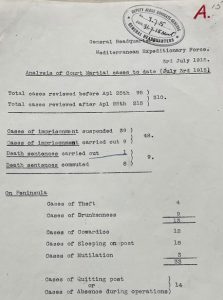
Table “A”.

A table, “A”, is appended showing the distribution of offences for the 10 weeks from April 25th up to July 3rd. In the three months since May there have been recorded 271 cases from the Base as against 224 on the Peninsula.

Cases of men sleeping on their post continued frequent, though in nearly every case it was shown to be directly due to exhaustion of the men, who are living under a hot sun in trenches from the moment they arrive.

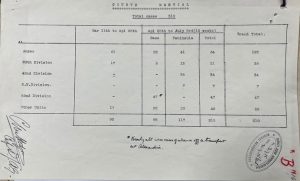
Table “B”.

A further table is appended showing the figures up to the end of the tenth week of operations. It will be noted that in that period there were 117 cases on the Peninsula against 98 at the Base, though half of these latter were for the same offence, as noted.

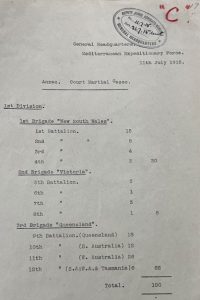
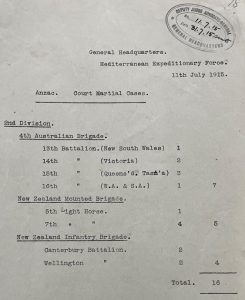
Table “C”.

Another table, “C”, shows the distribution of crime in the Australian and New Zealand Army Corps up to July 11th. The high percentage of offences in third Brigade is mainly due to the fact this Brigade was left at Mudros, and the men were continually breaking camp there, an offence accompanied by drunkenness. The N.C.O.’s were very lax, and suitable disciplinary measures were taken. The Brigade is a mixed one, mainly recruited from country districts, and has latterly improved, though it still furnishes the majority of cases.

Legal Position of Naval Division.

A representation was received from the Base asking for instructions as to the treatment of men of the Royal Naval Division on whom Courts Martial might be necessary, and pointing out that as His Majesty’s Ships call very infrequently at Alexandria, it is practically impossible to assemble a Court Martial. A reply was sent stating that the matter had been referred to the Army Council and to the Lords Commissioners of the Admiralty, and that it was hoped a satisfactory solution might soon be arrived at.

The G.O.C. of the Royal Naval Division applied on 9th July for two Naval Courts Martial, one on an officer; one has been proposed by the Vice Admiral at Mudros on August 5th or 6th, but it is very doubtful whether it can be held. In the interim, one of the principal witnesses in each case has been invalided.

It further appears from the correspondence between the Vice Admiral and G.O.C. Royal Naval Division relative to these cases that the necessary examination of the ships’ books cannot be carried out as they are not available here.

Field Punishment. July 25th.

The question of the advisability of suspending Field Punishment No 1 was put to the Army Corps Commanders, and as the result of their unanimous agreement it was prohibited on the Gallipoli Peninsula from July 25th. In view of the fact that it exposed the men to undue punishment, there being practically no situation on the Peninsula secure from shell fire, it was held that such a punishment was too severe, as well as being unfair to the men.

Modification of Sentences.

At the same time, owing to the heat of the climate, F.P. No 1 was prohibited till the hour of 6 p.m. (18:00) in other stations in the command. This was agreed to by the Medical Authorities. A circular letter had some time previously been sent through G.O.C.’s Divisions directing the attention of C.O.’s and presidents of Courts Martial to the necessity of paying particular regard to the locality and heat of the climate when awarding punishment.

Delays in assembling Courts Martial.

The difficulty of assembling Courts Martial promptly still continues, and is quite inevitable under the present military conditions. As it is impossible for troops on the mainland to obtain any rest such as is procurable in France or Belgium, the policy of interfering as little as possible with proceedings has been adhered to. It is very creditable to Officers, especially in view of the composition of the force, that Courts Martial have been conducted as well as is the case. It is interesting in this connection to note that the worst conducted cases come from the Base.

Clive Hodgson
Captain. D.J.A.G.

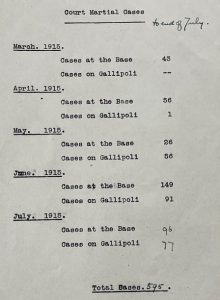
Table

Court Martial Cases to end of July.

DJAG Table

N.B. July totals incomplete for reasons mentioned in text.

Clive Hodgson
Captain. D.J.A.G.

Table A

Analysis of Court Martial cases to date (July 3rd 1915)

DJAG Table

Clive Hodgson
Captain. D.J.A.G.

Table B

Court Martial Cases

DJAG Table

* Nearly all were cases of absence off a transport at Alexandria

Clive Hodgson
Captain. D.J.A.G.

Table C

ANZAC Court Martial Cases

DJAG Table

Clive Hodgson
Captain. D.J.A.G.

Table

ANZAC Court Martial Cases

DJAG Table

G.H.Q., IMBROS, Sept.30th, 1915

I arrived at Imbros on 18th September to take up the appointment of Deputy Judge Advocate General, and took over on the following day.

At present the general standard of efficiency in Court Martial work seems to be very much below that in France, owing to the scarcity of regular officers who have any experience, both in units and on staffs.

Charges of sleeping on post represent a very large proportion of the cases on the Peninsula – and it seems that the excessive periods of duty for which sentries are posted is to a considerable extent the cause of the prevalence of this offence.

The total number of cases for the month of August was 258

W. Percy Capt.
D.J.A.G.

G.H.Q. Imbros, 31-10-15.

In view of that fact that G.R.O.’s. in M.E.F. on the subject of Courts Martial appear to be somewhat confusing (and in some cases actually misleading) and that procedure under the Suspension of Sentences Act did not appear to be understood, a new G.R.O. on Courts  Martial was drawn up (G.R.O.530) which was practically a transcript of 2nd Army Orders in France, and this was issued on October 2nd.

Sleeping on post.

Throughout the month of October charges of sleeping on post continued to supply a large percentage of the cases brought to trial, and the number of such trials in each Bde. in the month of September (97) was nearly equalled. This was certainly largely due to the conditions of health on the peninsula but was unduly augmented by bad regimental arrangements, and the want of frequent reliefs. A table showing the numbers of such trials in the months of July, August and September is attached. X

Self-Injury.

This offence is steadily becoming more prevalent, and is becoming so common as to demand drastic action, especially in view of the fact that a very small proportion of the cases in which this offence has in fact been committed are brought to trial.

The present conditions render the offence extremely difficult to deal with. It is impossible to keep and treat a large number of cases close to the firing line with a view to return the offenders to duty at an early date, as in France, and in the great majority of cases in which a man is invalided from the Peninsula he does not return at all. The temptation is therefore greater in this force than in France, and the benefits to be gained by commission of the offence are more easily achieved. For these reasons this matter was brought to the notice of the D.A.G. by me and an order on the subject drafted for approval. [Appendix 1, No 2]

This offence could in all probability have been put down at once had the maximum punishment allowed by the Army Act permitted the infliction of the extreme penalty in one clearly proved case. The maximum penalty (2 years I.H.L.) is wholly inadequate, and it is difficult to understand why the punishment of death should be sanctioned by the Army Act in the case of absence with the intention to avoid some particular service (constructive desertion), and yet no greater punishment than 2 years I.H.L. provided for in the case of an offence which is committed with the most deliberate intention of the avoidance of all further service.

Suspension of Sentences.

Suspension continues to be carried out in the vast majority – perhaps in almost too great a majority of cases.

General efficiency of Court-Martial Procedure.

There is still excessive delay in bringing soldiers to trial, and in the forwarding of proceedings, and although every effort is being made to reduce it as much as possible the present condition of communications, etc., render it to some extent unavoidable.

The general standard of efficiency in Courts Martial is not high, but shows some improvement. The majority of officers composing courts show an almost complete lack of acquaintance with the elements of the laws of evidence, and with the procedure of Courts Martial. On the other hand, an unnecessary degree of formality is often demanded by Brigade and Divisional Staffs, whereas the essentials of proof of a charge are neglected and overlooked.

Inoperative sentences are very common, e.g. ‘confinement to camp’, ‘admonished’, ‘reduction to and from acting rank’, etc., but as under present conditions is it impossible to collect officers for Court Martial instruction as in France, the only means of effecting any improvement is by means of written instructions and copious supplied of “Notes on Field General Courts Martial”, which do not serve the same purpose.

The number of trials in the month of September was 307.

W. Percy Captain
D.J.A.G.

Imbros, Nov. 30th, 1915.

One of the chief difficulties with regard to the procedure of F.G.C.M. lies not in irregularities in the conduct of proceedings but in the difficulty which is experienced in inducing the various staffs to dispense with the formalities of peace time procedure.

The appearance of such inapplicable forms as A.F.B. 116, and the return of proceedings for wholly unnecessary alterations, are of frequent occurrence, and these things seem often to have more attention paid to them than the essential proofs of an offence at the trial. The delays occasioned in this way are most objectionable and subversive of the whole object of F. G.C.M. especially under present conditions as sea communication is irregular, and papers are not infrequently lost altogether. A very general improvement in these matters is however noticeable.

On 30th November I moved to Mudros and took up my quarters on H.M.T. Minnetonka in Mudros Harbour.

The total number of trials by Courts Martial for the month of October was 427.

W. Percy Capt.
D.J.A.G.

Mudros Harbour 31-12-15.

Death Sentences.

During the month of December, two Death Sentences were ordered by the Commander-in-Chief to be carried out: 1st, No. 16734 Pte. H. Salter, 6th East Lancashire Regiment, tried on November 22nd for Desertion; 2nd, No. 227 Pte. J. Downey, 6th Leinster Regiment sentenced on 1st December for Wilful Defiance. The latter was a case from Salonika and it was particularly requested by the G.O.C. there that this sentence should be carried out in view of the marked tendency towards insubordination which had recently been evident from the proceedings of Courts Martial in that command.

These are the only two death sentences that have been carried out in M.E.F. since I joined the Force in September, and only one had been carried out prior to that.

Between the 25th April and the 31st December 101 men had been sentenced to Death, but in every case except the three mentioned above the Commander-in-Chief has refused to confirm death sentence.

Salonika.

On 22nd December I proceeded to Salonika to confer with Captain Peel, appointed legal D.A.A.G. to that command, and returned to Mudros 2 days later.

Mudros Harbour, 31-12-15.

Salonika Army and Dardanelles Army.

=*=*=*=*=*=*=*=*=*=*=*=*=*=*=*=*=*=

On the departure of G.H.Q. from Mudros, instructions were sent to the G.O’s.C. Salonika Army and Dardanelles Army that for the future, owing to the time it must necessarily take for proceedings to reach G.H.Q., Army Commanders would avail themselves of the powers of confirming death sentences, etc. under R.P. 120 (D) proviso (II).

The total number of cases received in this office in the month of November was 414, but proceedings of nearly a hundred Courts Martial were sent by A.H.Q. Salonika by an error straight to the J.A.G., London. Steps were taken to supply 3rd Echelon with records of these cases.

W. Percy
Captain.
D.J.A.G.

Appendix – 1

INSTRUCTIONS FOR THE USE OF OFFICERS IN CONNECTION
WITH FIELD GENERAL COURTS MARTIAL.

TO BE LAID BEFORE THE PRESIDENT.

ISSUED WITH GENERAL ROUTINE ORDERS.

May 11th, 1915.

(1.)  CONVENING.

A Field General Court Martial may be convened by an Officer in command of any Corps or portion of a Corps or by any Officer in immediate command of a body of forces when it is not practicable to convene a General Court Martial.

N.B.  A Commanding Officer is an Officer who under normal circumstances has power to “tell off” a soldier (e.g., a C.O., or Officer commanding a detachment.)    R.P. 129.

  1. COMPOSITION OF COURT (R.P. 106).

(a.)  Normally not less than three Officers (see para. 12a.).

(b.)  A convening Officer must not appoint as President any Officer below the rank of Field Officer unless he (the convening Officer) is himself below that rank.

(c.)  Each Officer should have held a commission for at least one year.

(d.)  R.P. 22a and 23 must be complied with.

  1. CHARGES.

The statement of an offence may be made briefly in any language sufficient to describe or disclose an offence under the Army Act. Each charge should state one offence only, and the particulars of the offence must be shown.    (R.P. 108.)

  1. OATH.

The President, members, and witnesses must be duly sworn, and this fact must be recorded on the proceedings.

The forms of oath for members of the Court and witnesses are to be found on page 633 of the Manual of Military Law.

  1. EVIDENCE.

The Provost Marshal, or Assistant Provost Marshal, if present, and failing them, the President must take down all material evidence in writing and attach it to the proceedings.    (R.P. 107.)

    1. The evidence of all witnesses should be read over to them at its conclusion before they leave the Court, (R.P. 83 B), and the President should insert a statement in the proceedings that this has been done.
    2. When it is necessary to prove that a soldier was a defaulter at the time of the commission of an offence or that any special force order existed, the certified record must be given in evidence. (K.R. 581a.)
    3. If it is not practicable to appoint another officer, the prosecutor may give evidence himself, but must be the first witness. (R.P. 39c.)
  1. FINDING.

The finding of the Court on each charge will usually be recorded simply as a finding of “Guilty” or “Not Guilty” unless a special finding is absolutely necessary. If the evidence is not fully sufficient to prove the commission of an offence the court will acquit the accused.    (See also R.P. 117.)

  1. CONVICTION.

An accused charged before a Court Martial with any offence under the Army Act may, on failure of proof of an offence being committed under circumstances involving a higher degree of punishment, be found guilty of having committed a cognate lesser offence.    (A.A. 56.)

    1. If the court find a soldier guilty of a offence they must take evidence of and record the character, age, service and any recognised acts of gallantry or distinguished conducts of the accused, as well as such other matters as are material. The accused may always call witnesses as to these matters in his defence. (R.P. 46.)
  1. SENTENCE.

(a.)  Of death or penal servitude.

A sentence of death requires the concurrence of all members of the court.    A.A. 49 (2).    If there are only two officers on the Court, the sentence cannot exceed 2 years imprisonment or 3 months field punishment.

(b.)  The limits of sentences that may be passed upon a soldier are.

(i)    Penal servitude (not less than 3 years).

(ii)   Imprisonment (with or without hard labour, for not more than 2 years).

(iii)  Detention (not more than 2 years).

(iv)   Field Punishment (not more than 3 months).

(v)    Stoppages of pay (not more than 3 months).

  1. In passing sentence a court martial will have regard not only to the nature and degree of the crime and the previous character of the accused, but also to any matters in extenuation or aggravation of the offence.

Any statements which have a bearing on the sentence should be investigated, as well as any matters which appear to call for disciplinary action. (K.R. 589a.)

The proper amount of punishment to be awarded is the least amount by which discipline can be efficiently maintained.

  1. CONFIRMATION.

(a)  The proceedings will usually be sent for confirmation through the Headquarters of the unit to the proper confirming authority, as laid down in Divisional or Brigade Orders.

(b)  With reference to the proviso in para. 15, if the Court was convened by an officer in command of a portion of a corps the proceedings may be confirmed by the senior officer present (being a field officer) or if there is not a field officer present, by any field officer to whom it may be possible to take the proceedings.

(c)  The Provost Marshal, Assistant Provost Marshal or Prosecutor cannot confirm the proceedings.

    1. No sentence of death or penal servitude shall be carried into effect unless or until it has been confirmed by the G.O.C., subject only to the proviso that where the confirming officer is of opinion that owing to the nature of the country, the great distance, or the operations of the enemy it is not practicable to delay the case, the above sentences may be carried out if confirmed by the general or field officer commanding the force with which the person under the sentence is present. (R.P. 120 D. ii. A.A. 54.)
  1. SUSPENSION OF SENTENCES ACT, 1915.

Where a soldier is sentenced to penal servitude or imprisonment the confirming authority may, when confirming the sentence, direct that the soldier be not committed to prison until the orders of the G. O. C.-in-Chief have been obtained.

  1. If the sentence has been suspended the confirming officer shall appoint a day within the following three months on which the case shall be reconsidered with a view to a remission of the sentence. Such remission may be made by a general officer holding a warrant to convene General Courts Martial. The G. O. C.-in-Chief has power, on representation being made to him, to terminate the suspension of any sentence.


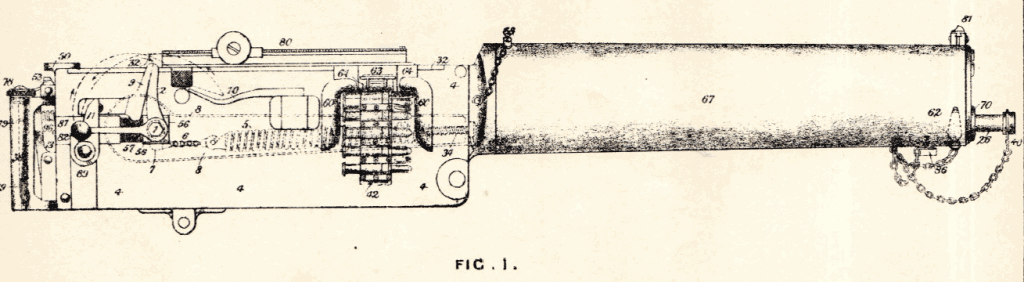
.303 Maxim Machine Gun Operation (1901)

NOMENCLATURE OF PARTS OF GUN

Barrel. With asbestos packing; gun metal valve; side plates, left and right; side plate spring; connecting rod spring; protector for muzzle with chain and S hook.

Barrel Casing. With ejector tube spring; steam tube with slide valve; keeper screw; packing gland; asbestos packing; two screwed plugs, each with chain, S hooks, and stud; cork plug with chain and S hooks.

Breech Casing. With buffer spring; check lever with collar and split pin; slides, right and left; trigger bar; fusee spring box.

Cover. With joint pin, collar, and fixing pin; cover lock, with piston, spring, and stop screw; ammunition label with four rivets; cover springs.

Crank. With crank pin and fixing pin; connecting rod; crank handle and fixing pin; fusee with chain, spring, and adjusting screw.

Feed Block. With slide; top and bottom levers with spring fixing pin; top and bottom pawls, with axis pin; slide springs; feed block spring; band roller with axis pin, collar, and fixing pin.

Lock. Consisting of casing with side levers and screwed head; extractor levers, right and left; extractor with spring and fixing pin; gib with gib spring and cover; extractor stop with keeper and fixing pins; sear with spring and axis pin; trigger with axis and fixing pins; tumbler with axis pin; firing pin; lock spring, with axis and fixing pins; keeper bracket.

Rear Cross piece.  With fixing pin; firing lever with spring, axis, and fixing pins; safety catch and axis pin; piston and spring; shutter with pivot screw; milled heads with leather washers and oil brushes.

Sight, Fore. With fixing screw.

Sight, Tangent. Consisting of stem, graduated plate, and two fixing screws; slide with pinion, pawl, and fixing pin; tangent sight slide spring; milled head and fixing screw; axis pin; tangent sight spring and piston.

GENERAL DESCRIPTION

The gun may be considered as divided into two portions: the non-recoiling and the recoiling. It is worked automatically by two forces: the explosion of the charge, which forces the recoiling portion backwards, and a strong spring, (called the fusee spring), which carries it forwards. The non-recoiling portion consists of the barrel casing and breech casing, and is attached to the mounting by the crosshead and elevating joint pins.

Maxim Machine Gun

The barrel casing is of gun-metal, holding about seven pints of water to keep the barrel cool when firing; it has three openings, one on the upper right side near the breech for filling, one underneath near the muzzle for drawing off the water, and the third (also near the muzzle) for allowing the steam but not the water to escape. The first two are closed with screwed plugs, the last is always open and connected with the steam tube. To prevent the escape of water, there is at the forward end of the barrel casing, asbestos packing, which is held in position round the barrel by the packing gland. At the rear end of the barrel there is a cannelure, also filled with asbestos packing, which prevents the escape of water when the gun is working and a gun-metal valve immediately in front of the block at the breech. which prevents the escape of water when the gun is not firing and the barrel home.

In addition, a cork plug is provided which can be inserted in the steam escape hole when the gun is travelling, in order to prevent waste of water from jolting. The plug should always be taken out before commencing to fire, and put in again before the gun changes position.

Under the barrel casing is the ejector tube through which the empty cartridge cases are ejected from the gun. The tube is fitted with a spring which prevents these cases falling backwards into the gun when firing.

When the barrel casing is filled with water about 2,000 rounds may be discharged at short intervals, without replenishing, but this depends on the rapidity with which the gun is fired.

Deliberate fire about 70 rounds per minute; rapid fire 450 rounds per minute.

The water commences to boil when the gun has fired with its greatest rapidity about 600 rounds; after this, if the firing is continued, the amount of water evaporated is about 1 pint for each 1,000 cartridges.

The steam tube is fitted in the barrel casing above the barrel, and is secured in its proper position by means of a keeper screw in the front of the barrel casing; it consists of two tubes, one fixed, having a hole near to each end, the other arranged to slide freely outside of it and termed the slide valve. If the gun is fired at elevation this valve slides backwards, and, closing up the hole at rear end of tube, prevents the water entering; at the same time, it leaves the front hole uncovered, which, being above the water level, allows the steam to enter the fixed tube and to escape through a hole bored in the solid part of the front end of barrel casing with which the tube is connected. Similarly, if the gun is fired at depression the valve slides forward and allows the steam but not the water to escape.

The breech casing consists of two outside plates, a bottom plate, and the rear cross piece, the whole being closed by a cover.

The outside plates are dovetailed into the barrel casing, and together with the cover are secured by means of the cover joint pin. On the outside of the right-hand plate there are the following fittings: a socket and stud for securing and supporting the buffer spring, the resistance piece, and the check lever, which pivots on a stud and is secured by a collar and split pin. On the outside of the left-hand plate are three studs for holding the fusee spring box, the rear one being on the slide mentioned below; also, there are two other studs on this plate provided for fixing a shoulder piece to the gun if required. In both plates are slots, in which the crank bearings move, partly closed by slides; on the inside of both are solid cams which control the path of the extractor.

The bottom plate is secured by rivets to the two outside plates; along the bottom lies the trigger bar, and underneath is a bracket to which is attached the elevating gear by means of the elevating joint pin.

The outside plates are connected at the rear end by the rear cross piece, into which they both dovetail; this piece is fitted with hollow handles for traversing, which are also used for carrying oil, these are closed by milled heads into which are fitted camel hair brushes, a firing lever the lower end of which is attached to the trigger bar, while the upper end is provided with a double button for firing, an automatic safety catch which is so arranged that unless it is held up the firing lever cannot be pressed forward, and a pivoted shutter which when moved to the right or left, uncovers an aperture through which (when the lock is removed and the crank handle vertical) the barrel can be inspected or cleaned from the rear.”

The cover is fitted with springs to ensure the extractor dropping on recoil, a gun metal block to keep the lock down when back, and at the rear end a lock to fasten it. On the upper surface is the tan- gent sight, which is graduated up to 2,500 yards.

The recoiling portion (which is mounted inside the non-recoiling portion) consists of the barrel and two side plates which carry the lock and the crank.

The barrel is coated with copper to protect it from rust; the gun- metal valve referred to above, which prevents the escape of water to the rear, is fitted just in front of the breech end, which is formed in the shape of a block; this block has a stud on each side which are called the barrel trunnions, and by means of them the barrel is attached to the side plates.

The side plates are each provided with a hole to receive the barrel trunnions and also guides in which the flanges of the lock move; in addition, each has a bearing through which the crank passes, thus connecting the latter with the barrel, these bearings move in slots in the breech casing. The left side plate is fitted with a connecting rod spring which holds the connecting rod upright when the lock is removed, and the right-side plate is fitted with a side plate spring near the barrel, the use of which is explained later. The left side plate is prolonged to the front, and has a recess in which the bottom lever of the feed block engages.

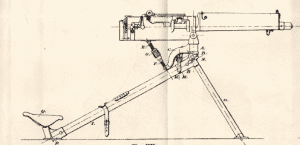
Maxim Machine Gun & Tripod

The crank is fitted on the right with a handle which has a curved projecting arm, and on the left with a fusee, to which is attached a chain; the remainder of the crank is inside the breech casing, while in the centre there is a connecting rod which is free to revolve on the crank pin.

On the left of breech casing there is a strong spiral spring, called the fusee spring, the rear end of which is connected by the fusee chain and fusee with the crank, the fore end is attached to the breech. casing by means of the fusee spring box and adjusting screw.

The action of recoil extends the fusee spring, winds the chain which is attached to it about the fusee, so that when the crank handle. is resting on the buffer spring, the fusee spring is not only extended about one inch by the recoil of the barrel, but the winding of the chain on the fusee causes a still further extension.

As soon as the recoil is exhausted, the action of the fusee spring is to pull the recoiling portion into the firing position and to unwind the chain off the fusee, thereby causing the crank handle to fly back. and strike the check lever, which is so constructed that when the crank handle reaches the stop, it is prevented from rebounding. The shape given to the buffer spring causes the crank handle when it strikes the former to assist the fusee spring in its action.

The lock is attached to the connecting rod by the screwed head, and when in the firing position closes the breech. In this position it is held by the side levers, the crank (which bears against stops on the side plates), and connecting rod, which are slightly above the horizontal, to prevent the breech being opened at the moment of explosion. The lock has a reciprocating motion communicated to it by the rotation of the crank, and is kept in position during its back- ward and forward movements by means of flanges working in guides on the side plates, and by the gunmetal block underneath the cover.

The extractor is attached to the fore end of the lock by guide ribs, upon which it slides, and is fitted with extractor spring, fixing pin, gib, gib spring, and cover. The projections on the extractor spring and gib, together with the cartridge grooves, form recesses which retain the cartridges in position.

The extractor is moved upwards by means of side and extractor levers, and when in its highest position, is retained there by means of a side plate spring, which ensures the hole for the firing pin being opposite the centre of the base of the cartridge when the lock is home. The upward and downward movements of the extractor are regulated by guide ribs and stops; the upper stop forms part of the lock casing, and the lower one is removable.

The gun is supplied with cartridges from a belt which passes through the feed block, on the top of the gun, from right to left. This belt is formed by two pieces of webbing connected together by eyelets and brass strips; the projecting ones showing how far the cartridges should be inserted in the belt, the latter is made thick at the edge next the bullets by being folded over a piece of cord, so that the cartridges may be kept parallel in passing through the feed block, and lie even in the ammunition belt boxes.

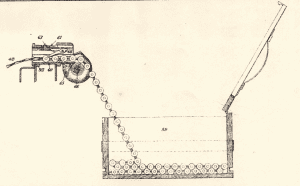
Maxim Machine Gun Ammunition Belt

The feed block is provided with a slide to which are attached two pawls with springs for the purpose of moving the cartridges from right to left; the slide has a transverse motion given to it by means of two levers which are fitted together, the top lever has a slot which engages a stud on the slide, and on the bottom lever is a stud which engages in a recess in the left side plate, thus the slide is connected with the recoiling portion. There are also in the feed block two stationary pawls which project up under the belt and prevent it slipping back- wards during firing. To facilitate the entrance of the cartridges the feed block is provided with a band roller, and in addition has steel guides fitted above and below in the cartridge way, which ensure the cartridges coming to the exact position where they can be seized by the extractor; they are prevented from being pushed too far through to the left by means of the cartridge and bullet stops which are inside the feed block.

Weight of gun 60 lbs.

ACTION OF MECHANISM

Suppose the gun to have just fired; the explosion causes the recoiling portion to move backwards through a distance of about one inch, thereby driving the projecting arm of crank handle against the resistance piece, which latter, resisting this backward motion, forces the curve on the projecting arm of the crank handle to roll on itself, thus rotating the crank (thereby drawing back the lock), and causing the crank handle to strike the buffer spring; thus the greatest portion of the energy of recoil is transferred to the crank. The travel of the recoiling portion to the rear also moves the upper pawls in the feed block to the right so as to engage behind a fresh cartridge in the belt. When the lock moves backward the extractor withdraws the empty case from the barrel and a fresh cartridge from the belt in feed block. The extractor is kept in position by means of its horns, which move along the upper surface of the solid cams on the breech casing until the cartridge is clear of the belt; when it arrives at the rear end of these cams, it falls partly by its own weight, and partly by the action of the cover springs, thus bringing the cartridge drawn from the feed block in line with the barrel and the empty case drawn from the barrel in line with the ejector tube. When the lock is quite back it is kept in position by the block fixed to the cover, as its flanges are then clear of the guides on the side plates.

When the force of recoil is expended the action of the fusee spring comes into play, carrying the recoiling portion forward and revolving the crank by the unwinding of the fusee chain, thereby forcing the lock to the front. As the recoiling portion travels forward, it moves the upper pawls on the feed block slide to the left, and thus brings up automatically a fresh cartridge into position in the feed block, and a second cartridge in front of the bottom pawls. As the lock moves forward into the firing position, the live cartridge and the empty case are respectively placed in the barrel chamber and ejector tube, the extractor is moved upwards by the side levers acting on the extractor levers, thereby leaving the empty case in the ejector tube, where it is held by the ejector tube spring until pushed out by the next case, and causing the gib to slide over the base of the live cartridge in the chamber, thus bringing the firing pin hole opposite to the cap, and engaging a fresh cartridge which has been automatically moved up into position in the feed block. The turning of the crank handle on to the buffer spring not only draws the lock away from the barrel, but also gives a downward motion to the connecting rod and screwed head, which latter bearing on the tail end of the tumbler, rotates it on its axis, and the head of the tumbler being engaged in a recess in the firing pin, forces the latter to the rear, compressing the lock spring. When the bent of the tumbler has moved above the bent of the trigger, the latter is forced by the lock spring under the bent, and is thus able to hold the tumbler in the cocked position. The continued motion of the tumbler carries back the firing pin until the sear, (which is above and is acted upon by the sear spring), is forced into the bent of the firing pin and retains it. The firing pin is thus prevented from flying forward by two actions -viz., the sear and the trigger. In this position the trigger may be disengaged from the tumbler, but the sear will still prevent the firing pin from moving forward.

On the crank handle returning to the check lever the lock moves to the front, and the connecting rod and screwed head have an upward motion, so that when the lock is in the forward position the screwed head lifts the sear, thereby disengaging it from the firing pin, which then moves slightly forward until stopped by the bent of the tumbler engaging the bent of the trigger. If now the double button, on firing lever is pressed forward, the trigger bar is drawn backwards, at the same time a projection on the latter engages and draws with it the tail end of the trigger, thereby releasing the tumbler, the lock spring then propels the firing pin on to the cap and explodes the cartridge. If the gun has been set for rapid fire and the pressure on the firing lever is maintained as the lock moves forward, the lower end of the trigger comes in contact with the projection on the trigger bar, and its bent is thus withdrawn from the tumbler before the extractor has reached the firing position; the firing pin is therefore held only by the sear, and when the latter is lifted by the screwed head, the firing pin is released, and is thrown forward on to the cap by the action of the lock spring. The release of the sear from the firing pin is so timed that it cannot take place until the lock is in the firing position.


Acknowledgement:

This excerpt was transcribed from a PDF copy of the Handbook for the 0.303″ Maxim Machine Gun (Magazine Rifle Chamber), 1901 downloaded from the Vickers MG Collection & Research Association  website.

License:

The PDF was digitized by the Vickers MG Collection & Research Association and is shared for purposes and education and research and the Creative Commons License CC BY-NC-ND 4.0 has been applied to it. The license conditions can be found at https://creativecommons.org/licenses/by-nc-nd/4.0/

Army Orders of 1916

In order to free younger men for service overseas the Army introduced Class W, Army Reserve, and Class W (T.) Territorial Force Reserve via Army Order 203 of 1916. This Class was also used for Boy Soldiers too young to continue serving in overseas combat zones.

Separately, Army Order 209 of 1916 introduced a bounty to be paid to those men who became time expired while on active service but who were compelled (or volunteered) to continue to serve for the duration of the war. Many men of the 9th Manchesters who originally attested (or re-engaged) between 1911-13 were eligible for this bonus and such payment, typically of £15, is noted in any surviving service or pension records.

A.0. 203. 1916.
Class W, Army Reserve, and Class W (T.) Territorial Force Reserve.-

1. Under powers conferred by Section 12 of the Military Service Act, 1916 (Session 2), the Army Council have decided to establish a new class of the Army Reserve, and a new class of the Territorial Force Reserve, for all soldiers whose services are deemed to be more valuable to the country in civil than in military employment. These will be designated Class W, Army Reserve, and Class W (T.), Territorial Force Reserve respectively.

2. Class W, Army Reservists, and Class W (T.), Territorial Force Reservists, will receive no pay or other emoluments from Army Funds, and will not wear uniform.

3. Such Reservists will be liable at any time to be re-called for service with the Colours, either individually or collectively, and by means of either individual or public notification.

4. From the time the soldier is transferred to the Reserve until the notification of his recall to the Colours is issued, he will not be subject to military discipline.

5. The Army Council will, from time to time, issue instructions, according to the military requirements, as to the individuals or classes of men to be transferred to Class W, Army Reserve, and Class W (T.), Territorial Force Reserve. The general procedure to be followed in dealing with such transfers, also the method of recalling the reservist to the Colours, will be published separately.

A.0. 209. 1916
Bounty to Soldiers retained in the Service or recalled to the Colours under the provisions of the Military Service Act, 1916 (Session 2), and to soldiers who have voluntarily undertaken to continue to serve, re-enlisted, re-engaged, etc.-

1.-It has been decided that a bounty at the rates stated in paragraph 2 below shall be paid to any warrant officer, non-commissioned officer, or man, whether serving on a Regular, Special Reserve, or Territorial Force attestation the depot of whose unit is situated in the United Kingdom, who-

(i) on the expiration of his current engagement (including the extra year under Section 87 (1) of the Army Act, or, in the case of the Territorial Force, Section IX. (5) of the Territorial and Reserve Forces Act, 1907) is retained in the Service for the duration of the war, under the provisions of the Military Service Act, 1916 (Session 2).

(ii) has been discharged from the military service of 1916 the Crown since the commencement of the present war, on *TERMINATION OF HIS ENGAGEMENT, and is recalled to the Colours under that Act.

(iii) has already agreed to continue in the Service for the duration of the war under the provisions of Section 87 (3) of the Army Act and Army Order 252 or 253 of 1915 or re-engaged under Army Order 49 of 1916, provided that if he has already received a bounty under Army Order 86 of 1916 such bounty will be taken in diminution of the amount admissible under this Army Order.

(iv) has been discharged from the military service of the Crown since the commencement of the present war on *TERMINATION OF ENGAGEMENT and has voluntarily re-attested or re-enlisted for the duration of the war, or re-enlisted under the provisions of Army Order 79 of 1916 or may if liable to service under the Military Service Act, 1916 (Session 2), re-enlist before he is recalled to the Colours under that Act, or, not having attained the age of 41 years before the date appointed under the above-quoted Act, but being ordinarily resident in Ireland and not therefore liable to recall under its provisions, has voluntarily re-enlisted or may in future voluntarily re-enlist.

* The expression “TERMINATION OF ENGAGEMENT” wherever it appears in this Army Order shall be held to apply only to an engagement terminated under the provisions of King’s Regulations, paragraph 392 (xxi), (xxii), (xxiii), (xxiv), (xxvi) or (xxvii), or Territorial Force Regulations, paragraph 156 (1) or (2).

2. The bounty shall be at the following rates:-

(i) For a warrant officer, non-commissioned officer, or man, whose original engagement on his current attestation (or, in the case of a discharged man re-enlisted or recalled to the service, on the attestation from. which he has been discharged since the commencement of the war), was for a period of less than 12 years . . . . £15.

(ii) For a warrant officer, non-commissioned officer, or man, who has completed an original engagement of 12 years on his current attestation (or, in the case of a discharged man re-enlisted or recalled to the service, on the attestation from which he has been discharged since the commencement of the war) together with any subsequent period or periods of extension which do not bring his service on his last attestation (including the extra year under Section 87 (1) Army Act, or, in the case of the Territorial Force, Section IX (5) of the 1916 Territorial and Reserve Forces Act, 1907) to a total of 22 years . . . . £20.

Men of Section D, Army Reserve, come under this heading.

(iii) For a warrant officer, non-commissioned officer, or man, who has completed an original engagement of 12 years on his current attestation (or in the case of a discharged man re-enlisted or recalled to the service on the attestation from which he has been discharged since the commencement of the war), together with such extension as will, including the extra year under Section 87 (1), Army Act, or, in the case of the Territorial Force, Section IX (5) of the Territorial and Reserve Forces Act, 1907, complete a total of 22 or more years on his last attestation . . . . £25.

3. In the case of a man retained in the service, or re-engaging, one-third of the bounty admissible as above is payable in cash on his commencing the extended period of service for which he is liable under the Military Service Act, 1916 (Session 2), i.e., on completion of his current engagement together with the extra year for which he was liable under Section 87 (1) of the Army Act, or, in the case of the Territorial Force, Section IX (5) of the Territorial and Reserve Forces Act, 1907. The balance with interest at 5 per cent. is payable on the man’s discharge from the service, or will in the event of his death while serving be credited to his estate.

4. A man recalled to the colours or re-enlisted and entitled to bounty as above will be given the option of drawing the whole or any part of the bounty in cash on being called up, any balance then undrawn being paid with interest on discharge or death as provided in paragraph 3 above.

5. A man who has already re-enlisted, re-engaged or agreed to continue in the Service will become entitled to any bounty admissible under this Army Order, on the date of this Army Order, if the engagement on which he was serving at the commencement of the war (including the extra year under Section 87 (1) Army Act, or, in the case of the Territorial Force, Section IX (5) of the Territorial and Reserve Forces Act, 1907) has expired. If it has not expired he will become entitled to the bounty on his commencing the extended period of his service, as in paragraph 3 above. The bounty will be issued under the same conditions as those laid down in paragraph 3, except that the £5 or £10 1916 due to a man who has already drawn £15 under Army Order 86 of 1916, will be paid with 5 per cent. interest on discharge, or on his death, as provided in paragraph 4.

6. A man who on being recalled to the service is at once passed into the Reserve or demobilized under the provision of Section 10 of the Military Service Act, 1916 (Session 2), will not be eligible for the above bounty unless or until he is called to the Colours for military service. A man who has been attested voluntarily shall not be eligible for the bounty until he is called up and finally approved for continuous service.

7. The provisions of this Army Order do not apply to any warrant officer, non-commissioned officer or man-

(i) Who was not serving on an Army engagement on 4th August, 1914.

(ii) Who, having attained the age of 41 years before the date appointed in the Act, is not liable for service under the Act, but may after the date of this Army Order, voluntarily re-enlist for the duration of the war, or on the termination of his engagement agree to continue in the service for the duration of the war.

(iii) Who is serving in or recalled to a unit whose depôt is outside the United Kingdom, except in the case of a soldier transferred from a unit whose depôt is within the United Kingdom, to serve with a unit whose depôt is outside. Further instructions will be issued regarding other men retained with the Colours under the Act in units whose depôts are outside the United Kingdom.

8. Army Order 86 of 1916 is hereby cancelled.

9. The privileges granted by Army Orders 49 and 79 of 1916 as regards re-engagement and re-enlistment to complete 21 years’ service with a view to pension will remain open to men dealt with in paragraph 1 of this Army Order, and their claim to the bounty granted by this Army Order shall not be affected if they re-engage or re-enlist under Army Orders 49 and 79 of 1916.

Note.

I.-

(i) Claims for bounties authorized by this Army Order will be rendered on Army Form W 3458. In the case of a soldier who has re-engaged or agreed to continue in the service, or who has been retained under the Military Service Act the claim will be rendered by the officer commanding the unit as soon as possible after the date on which but for such re-engagement, agreement or retention the soldier would have become due 1916 for discharge.

(ii) In the case of a soldier re-enlisted or recalled to the service the claim will be rendered by the officer commanding the unit to which the soldier is posted.

(iii) Army Form W 3458 will be forwarded in the first instance to the officer in charge records, who will transmit the form to the regimental paymaster accompanied by a statement on Army Form B 200 of the soldier’s service, including service on any previous engagement.

(iv) The paymaster will credit the soldier’s ledger account with the amount available for immediate payment and will, inform the officer commanding the unit that he has done so. No payment in respect of the bounty will be made to the soldier until the notification from the paymaster is received.

(v) Cash issues in respect of the bounty will be included with issues of current pay in Form I of the pay and mess book or on the acquittance roll, as the case may be. If the soldier is paid on the pay book the portion of the bounty available for immediate issue will be recorded therein.

(vi) The Army Form W 3458, with the counterfoil certificate from officer in charge records of entry in the soldiers’ documents, will be filed in a separate series in the pay office. The initial and final credits to the man’s account will be recorded on the Army Form at the time they are given.

(vii) Where a portion only of the bounty is authorized for immediate payment the charge against Vote 1 E will be supported by a reference to the Army Form, and to the per contra credit to Vote 1 C 2. The charge against Vote 1 E for the balance, or for the whole bounty if credited in one sum, will be supported by the Army Form itself.

II. The bounties referred to in the above Army Order are admissible for a man coming under paragraph 1, who on retention or rejoining the Colours is posted to an officer cadet unit with a view to obtaining a commission, but not to men who receive direct commissions (e.g., as temporary quartermaster, &c.), and are not therefore retained or recalled to the service as soldiers.

III. Supplies of Army Form W 3458 will be distributed to all concerned at an early date.


Army Council Instructions of 1916

In order to officially address the issue of underage boys serving overseas, War Office letter 9/Gen. No./5388D. (A.G. 2B) of 6th September, 1915 was issued followed by Army Council Instruction 1186 of 1916 which collectively laid out the appropriate rules and regulations to be followed. This was followed on October 6, 1916 by Army Council Instruction 1905 which replaced and cancelled the previous two sets of instructions.

Army Council Order 1186 of 1916

13th JUNE.
1186. Disposal of soldiers whose discharge is applied for on account of being under age.


The following amended instructions are notified for the guidance of all concerned in dealing with the cases of soldiers whose discharge, or transfer to a Home Service unit, is applied for by their parents or legal guardians on the ground that the man is too young to serve under his present circumstances and conditions:-


1. When the soldier is serving at Home.
(a) If under 17 years of age. – His discharge will be carried out by his C.O. under para. 392 (vi) (a) King’s Regulations. His documents will be sent to the Officer i/c Records, who will notify the Recruiting Officer nearest the place at which the man resides of his discharge.
(b) over 17 but under 18 years of age. – He will be transferred, if he be willing in the case of a Regular soldier, to Class W., Army Reserve, and in the case of a T.F. soldier to Class W. (T.), T.F. Reserve. The Officer i/c Records will recall the man to the Colours on attaining the age of 18 years, but in no case is the man to be recalled to the Colours before he has been in the Reserve for a period of three months after his transfer has taken place.
(c) If over 18 but under 19 years of age. – He will be posted to a Reserve unit until such time as he attains the age of 19 years.


2. When the soldier is serving with an Expeditionary Force.
(a) If under 18 years of age. – He will be sent home, if he be willing, and dealt with as in para. 1. If not sent home, he will be dealt with as in section (b) of this paragraph.
(b) If over 18 but under 19 years of age. – He will not be sent home but will be posted to a Training or other unit behind the firing line, under arrangements to be made by the G.O.C.-in-C.
In all cases to be dealt with as above, notification will be sent by the Officer i/c Records to the D.A.G., 3rd Echelon, G.H.Q.


3. When the soldier is serving abroad but not with an Expeditionary Force.
(a) If under 18 years of age. – He will be sent home, if he be willing, and dealt with as in para. 1. If not sent home, he will be dealt with as in section (b) of this paragraph.
(b) If over 18 but under 19 years of age. – He will not be sent home but will be trained under local arrangements.
In all cases to be dealt with as above, notification will be sent by the Officer i/c Records to the C.-in-C. or G.O.C. as the case may be.


4. Any applications received from parents or guardians by Os.C. units should be at once forwarded to the Officer i/c Records concerned, who will take the initial action in each case in conformity with paras. 1, 2 and 3, and inform the applicant.


5. Before any action is taken, the real age of the soldier will be verified by reference to his birth certificate.


6. The instructions contained in W.O. Circular Letter 9/Gen. No./5388 D. (A.G. 2B) of 6th Sept., 1915, are hereby cancelled.
9/Gen. No./5388 (A.G. 2B (s).)

Army Council Order 1905 of 1916


6th OCTOBER.

1905. Disposal of soldiers whose release from the Service is applied for on account of being under age.

The following revised instructions are notified for the guidance of all concerned in dealing with the case of a soldier whose release from the Service, or transfer to a Home Service unit, is applied for on the ground that he is too young to serve :-

1. When the soldier is serving at Home.

(a) If under 18 years of age. – He will be dealt with under authority of the G.O.C.-in-C. of the Command in which he is serving, as follows:-

If serving with a unit affiliated to the :- He will be posted to a unit of the :-
Scottish Command …

Northern Command …

Western Command …

Southern Command …

Eastern Command …      }

London District …             }

64th Division.

65th Division.

68th Division.

67th Division.

69th Division

Note.-In posting it should be arranged, so far as possible, that:-

A man of Scotch Nationality be sent to the 64th or 65th Division, and
A man of Welsh Nationality to a Welsh Unit of the 68th Division, but
A man of Irish Nationality who wishes to join an Irish regiment will be sent to the depôt of the regiment he selects, and will be posted accordingly.

(b) If over 18 1/2 but under 19 years of age. – He will be posted to a Reserve unit.

In the case of postings under (a) and (b) the following entry will be made on the soldier’s attestation or record of service paper :-

“Posted, under A.C.I. 1905 of 1916, to ….. Date ……”

The posting will be notified in Part II of Orders.

2. When the soldier is serving with an Expeditionary Force.
(a) If under 17 years of age. – He will be sent home and dealt with as in para. 1 (a).
(b) If over 17 but under 18 1/2 years of age. – He will be sent home, if he be willing, and dealt with as in para. 1 (a). If not willing to be sent home, his services will be utilized either behind the firing line, or he will be sent home at the discretion of the G.O.C.-in-C. and dealt with as in para. 1 (a).
(c) If over 18 1/2 but under 19 years of age. – He will not be sent home but will be posted to a Training or other unit behind the firing line, under arrangements to be made by the G.O.C.-in-C.
In all cases to be dealt with as above, notification will be sent by the Officer i/c Records to the D.A.G., G.H.Q., 3rd Echelon.

3. When the soldier is serving abroad but not with an Expeditionary Force.
(a) If under 18 years of age – He will be sent home and dealt with as in para. 1 (a).
(b) If over 18 but under 19 years of age. – He will not be sent home but will be trained under local arrangements.
In all cases to be dealt with as above, notification will be sent by the Officer i/c Records to the C.-in-C. or G.O.C., as the case may be.

4. Applications for the release of a soldier received by Os.C. units will be dealt with as follows:-
(a) When serving at home. – If the soldier is over 17 years of age, a report will be rendered to the G.O.C.-in-C. through the usual channels.
(b) When serving with an Expeditionary Force. – The application will be dealt with under the orders of the Commander of the Force.
(c) When serving abroad but not with an Expeditionary Force – The application will be dealt with under the orders of the C.-in-C. or G.O.C. as the case may be.

5. Applications received through any channel other than those mentioned above will be forwarded to the Officer i/c Records concerned, who will take the initial action in each case in conformity with paras. 1, 2 and 3 of this Instruction, and inform the applicant.

6. Before any action is taken, the real age of the soldier will be verified by reference to his birth certificate.

7. The instructions contained in W.O. letter 9/Gen. No./5388D. (A.G. 2B) of 6th September, 1915, and A.C.I. 1186 of 1916 are hereby cancelled.

9/Gen. No./5388 (D.R. 2).

Territorial Force Efficiency Medal

The institution of the Territorial Force Efficiency Medal was notified in Army Order 128 of June 1908. The award of Medals was published in Army Orders. The first awards described as “Territorial Force Efficiency Medal’ appear in Army Order 304 of December 1908.
Territorial Force Efficiency Medal
Territorial Force Efficiency Medal. Hsq7278, CC BY-SA 4.0, via Wikimedia Commons


Grant of an Efficiency Medal to the Territorial Force. 
1. His Majesty the King has been graciously pleased to approve of a medal for efficiency being granted to non-commissioned officers and men of the Territorial Force under the following conditions:-
(a) The medal may be granted to all men who enlist into the Territorial Force and who complete 12 years’ service with a minimum of 12 trainings.
(b) Past service in the Imperial Yeomanry or Volunteers will be admissible provided that the whole period of service upon which the claim is based has been continuous.
(c) The medal may also be granted to all non-commissioned officers and men of the Imperial Yeomanry serving on the 31st March, 1908, who join the Territorial Force and who complete 10 years’ service with a minimum of 10 trainings, under the conditions contained in paragraph 371, Imperial Yeomanry Regulations.
(d) The medal may further be granted to all non-commissioned officers and men of the Volunteer Force serving on the 31st March, 1908, who join the Territorial Force and who complete 12 years’ service with a minimum of 12 trainings.
2. The medal will bear on the obverse the effigy of His Majesty the King, and on the reverse the words ‘Territorial Force Efficiency Medal’.
3. The colour of the riband to be worn with the medal will be green, with a yellow stripe down the centre.
4. The form of application (Army Form E 562) which provides for a record and certificate of efficient service, will be signed by the commanding officer. This form will be submitted through the usual channel of correspondence to the general officer commanding-in-chief the command in which the unit is stationed.
5. Commanding officers will forward with Army Form E 562 a nominal roll, on Army Form E 563, arranged alphabetically. This roll will be forwarded in duplicate, one copy being retained by the general officer commanding-in-chief, and the other forwarded to the Secretary, War Office, with his recommendation.
6. The general officer commanding-in-chief will submit the nominal rolls to the Secretary, War Office, on the 1st March, 1st June, 1st September, and 1st December in each year.
7. The decision of the general officer commanding-in-chief upon the validity, or otherwise of any claim for the medal, will be final.
8. Names of recipients will be announced quarterly in Army Orders, after the publication of which, Army Form E 562 will be returned by the general officer commanding-in-chief to the headquarters of the various units of record and retention.
From its institution in 1908 until it was superseded by the Territorial Efficiency Medal, in 1922, there were a number of amendments, rulings or other decisions published in Army Orders:


A.O. 293 of August 1915:
Territorial Force Efficiency Medal. With reference to paragraph 523, Territorial Force Regulations, it has been decided that a period of embodied service of not less than two months in each calendar year shall be allowed to reckon as an equivalent of the ‘training’ for that year.
In no case, however, will more than one such qualifying period (whether ‘training’ or the alternative minimum period of embodiment) be allowed to count in any one calendar year for the purpose of this paragraph.


A.O. 470 of December 1915:
Territorial Force Regulations-Amendments.– 1. Paragraph 515 (i) add- ‘also periods of mobilized service whether on the active service list of the Territorial Force or on the general list of the Territorial Force Reserve which was instituted after the moblization of 1914’.
2. Insert new paragraph-
523A. As regards (d) and (e) of paragraph 523, if a soldier was actually serving in the Territorial Force Reserve on the date on which mobilization was ordered and he was called up and held to serve, the period of his service in the Territorial Force Reserve, although not counting towards the qualifying period, will not be considered to be a break in the continuity of the qualifying period.


A.O. 228 of June 1916:
Territorial Force Efficiency Medal.-
The period during which a non-commissioned officer or man of the Territorial Force is released from military service for the purpose of being employed on munition work, during the continuance of the present war, will not be counted as qualifying service for the Territorial Force Efficiency Medal, but, on the other hand, it will not be considered to be a break in the continuity of the qualifying period.

A.O. 326 of November 1918:
Service to count as two-fold.
III.—Territorial Force Efficiency Medal.— 
1. His Majesty the King has been graciously pleased to approve that warrant officers, non-commissioned officers and men of the Territorial Force (including the Territorial Force Reserve) who were embodied under Army Order 31 of 1914 and who, either before or after the date of embodiment, signed an agreement to serve outside the United Kingdom, shall be allowed to count embodied service in the ranks (including service with the Royal Navy, Regular Army and Royal Air Force) two-fold as qualifying service for the award of the Territorial Force Efficiency Medal.
2. In the case of these warrant officers, non-commissioned officers and men, service in the ranks with any of His Majesty’s forces during the present war, which is of not less than two months in each calendar year, shall be allowed to count as an equivalent of two annual ‘trainings’ but not more than two ‘trainings’ (including equivalent service), shall be reckoned in any one calendar year for the purpose of this Army Order.
3. Continuity of qualifying service shall be admitted in the case of any of these warrant officers, non-commissioned officers and men who, having been discharged from the Territorial Force during the present war by reason of wounds or illness contracted on service, subsequently, during the present period of embodiment, re-enlisted into the Force voluntarily after recovery.
4. Sub-paragraphs (e) and (g) of paragraph 523, Territorial Force Regulations, as amended by Army Order 83 of 1915, will be modified accordingly as regards the references to service in the Regular Army.


A.O. 322 of September 1919:
3. For paragraphs 523 and 523A (promulgated by Army Order 470 of 1915) substitute-
Efficiency Medal.
523. A medal designated the ‘Territorial Force Efficiency Medal’ will be granted to warrant officers, N.C.Os. and men of the Territorial Force who complete 12 years’ continuous service,* with a minimum of 12 trainings, and who are recommended by their C.O., subject to the conditions mentioned
below:-
Qualifying service.
(a) Service in the Imperial Yeomanry or the Volunteer Force,† before the formation of the Territorial Force, will be admissible for every year in which a man was returned as efficient, provided that he was serving on the 31st March, 1908, and enlisted in the Territorial Force before the 30th June, 1908.
An Imperial Yeoman who enlisted into the same arm of the Territorial Force may be awarded the medal after 10 years’ service and 10 trainings in that arm.
(b) Men in the possession of the Imperial Yeomanry Long Service and Good Conduct Medal or the Volunteer Long Service Medal, in respect of their services in the Imperial Yeomanry or Volunteer Force, may also be granted the Territorial Force Efficiency Medal, provided that they have fulfilled the required conditions for award of that medal, and that no particular period of service is counted for more than one medal.
Provision of clasp
(c) Men already in possession of the Efficiency Medal, who either received it in respect of their past Imperial Yeomanry or Volunteer service on enlistment into the Territorial Force, or have earned it subsequent to such enlistment, and who have served for a further period which would qualify them for the award of a second Efficiency Medal, may be awarded a clasp to be worn with the original medal.
No particular period of service will be allowed to count as qualifying service for both medal and clasp.
(d) Service qualifying for the Colonial Auxiliary Forces, or the Royal Navy Volunteer Reserve, Long Service Medals, will be admissible provided that the last 5 years have been served in the Territorial Force.
(e) Commissioned service will be admissible in the case of those men who were commissioned after service in the ranks of the Territorial Force during the period of embodiment of the force subsequent to the Royal Proclamation of the 4th August, 1914, and who within 3 months of the date of relinquishing their commissions re-enlist in the ranks of the Territorial Force. Such officers who relinquished their commissions owing to wounds, or sickness contracted on service during the above- mentioned period of embodiment, will also be allowed to count such commissioned service as qualifying service towards the award of the medal.
f) Service in a Cadet unit will not be admissible except when rendered in the ranks of a Cadet Corps or Cadet Battalion which belonged to the organization existing prior to the 21st May, 1910, and then only provided that a Cadet enlisted into the Territorial Force within 6 months of leaving his Cadet unit, and that no service rendered before the age of 15 or after the age of 17 is permitted to count.
Breaks in service.
(g) Continuity of service in the Imperial Yeomanry, Volunteer Force, Colonial Auxiliary Forces, or Royal Naval Volunteer Reserve must not have been broken for periods of more than 12 months at a time, and in the case of the Imperial Yeomanry and Volunteer Force such breaks must have been prior to the 31st March, 1908. (See sub-paragraph (l).)
(h) Men of the Territorial Force (including the Territorial Force Reserve) who were serving in the force on the 4th August, 1914, and were embodied under the Royal Proclamation of that date, and who before the 11th November, 1918, signed an agreement to serve outside the United Kingdom, will be allowed to count embodied service (including service specified in sub-paragraphs (e) and (j) double towards qualifying service.
Continuity of qualifying service will be admitted in the case of any of these men, who, having been discharged from the Territorial Force subsequent to the 4th August, 1914, by reason of wounds or illness contracted on service, subsequently during the period of embodiment re-enlisted into the force voluntarily after recovery.
(j) Men of the Territorial Force who are permitted to enlist in the Royal Navy, the Regular Army, or the Royal Air Force, for the period of a war may count such service as qualifying for the award of the medal, and if within 3 months of the date on which they ceased to be required for service with such force, these men re-enlist into the Territorial Force, their service will be deemed to be continuous.
Embodied service in lieu of trainings.
(k) A period of embodied service of not less than two months in each calendar year, reckoned from 1st January to 31st December, will be allowed to count as the equivalent of the training for that year, or, in the case of the men referred to in sub-paragraph (h), as the equivalent of two trainings. In no case, however, will more than one such qualifying period (whether training or the alternative minimum period of embodiment) be allowed to count in any one calendar year.
Inadmissible service.
(l) Service in the Regular Army will not be considered as qualifying service, except as provided for in sub-paragraph (j), but will not be reckoned in the breaks mentioned in sub-paragraph (g).
(m) Commissioned service is not admissible as qualifying service, except as specified in sub-paragraph (g).
(n) Service in the Territorial Force Reserve, the Technical Reserve or the National Reserve, is not admissible, but if a man were actually serving in the Territorial Force Reserve on the date on which embodiment was ordered and was called up and held to serve, the period of his service in the Territorial Force Reserve, although not counting towards the qualifying period, will not be considered to be a break in the continuity of the qualifying period.
(o) Men of the Territorial Force who are released from military service for the purpose of being employed on work of national importance* during the continuance of a war, will not count the period of such release as qualifying service for the medal, but they will not be considered to have broken their continuity of service.
*No break in service, however short, in the Territorial Force, is allowable except as provided in sub-paragraphs (h), (j) and (n).
† In the event of difficulty being experienced in obtaining the date of discharge of an applicant from the old Volunteer Forces, the officer submitting the claim should call upon him to produce for inspection the discharge certificate awarded to him under Army Order 130 of 1908.


A.O. 426 of November 1919:
Territorial Force Regulations-Amendments.-Paragraph 523 (as amended by Army Order 322 of 1919). For last line of sub-paragraph (f) substitute- ’15 or after the minimum age laid down at the time for enlistment in the Territorial Force is permitted to count.’.
For sub-paragraph (j) substitute-
(j) Men who enlist in the Royal Navy, the Regular Army or the Royal Air Force for the period of a war, including men of the Territorial Force who are permitted so to enlist, may count such service as qualifying for the award of the medal provided, in the case of men other than men of the Territorial Force, that they subsequently enlist in the Territorial Force without break in continuity of service.
Add new sub-paragraph-
(jj) Continuity of qualifying service will be admitted in the case of all men of the Territorial Force who serve in any of His Majesty’s Forces during a war, and of men who enlist in the Royal Navy, the Regular Army or the Royal Air Force for the period of a war, provided that they re-enlist (or enlist, as the case may be) in the Territorial Force within three months from the date of their discharge from any of the forces or from the date of the re-opening of recruiting for unembodied service in the Territorial Force, whichever is later.


A.O. 439 of December 1919:
Riband of the Territorial Force Efficiency Medal.-
1. His Majesty the King has been graciously pleased to approve of the design of the riband suspending the Territorial Force Efficiency medal being altered to green with yellow edges.
2. The new riband will be taken into wear by all officers, non-commissioned officers and men who are in possession of the medal and are now serving.


A.O. 241 of May 1921:
Territorial Force Regulations-Amendments.-
1. Paragraph 474, note (c), as amended by Army Order 77 of 1921. Delete ‘and’ and after ‘R.A.S.C.’ insert ‘and R.A.O.C.’.
2. Paragraph 523, as amended by Army Orders 322 and 426 of 1919 and 375 and 414 of 1920. Insert new sub-paragraph-
(p) Men of the Territorial Force will not count periods of desertion or absence without leave during embodiment or training either in camp or barracks towards the qualifying period for the award of the medal. They will not however be deemed to have broken their service, provided that they continue to serve after their offence has been dealt with.


A.O. 335 of July 1921:
For paragraph 523, as amended by Army Orders 322 and 426 of 1919; 173, 375 and 414 of 1920; and 187 and 241 of 1921, substitute-
Efficiency Medal.
523. A medal designated the ‘Territorial Force Efficiency Medal,’ will be granted to warrant officers, N.C.Os. and men of the Territorial Force provided that-
(i) They complete 12 years’ qualifying service, and
(ii) They attend a minimum of 12 trainings and are recommended by their C.O., and
(iii) There has been no break in the continuity of their service except between 4th August, 1914, and 31st December, 1921, and as specified in sub- paragraphs (A) (i) (b), (A) (ii), (A) (iv), and (F).
Imperial Yeomanry and Volunteer service.
(A) Other service as specified below only may be counted towards the qualifying period-
(i) Service in the Imperial Yeomanry or Volunteer Force, before the formation of the Territorial Force, for every year during which a man was returned as efficient, provided that-
(a) He was serving on 31st March, 1908, and enlisted into the Territorial Force before 30th June, 1908; and,
(b) There was no break of service in the Imperial Yeomanry or Volunteer Force of more than 12 months.
(c) None of the service has previously been counted as qualifying for the grant of the Imperial Yeomanry or Volunteer Long Service Medal.
An Imperial Yeoman who enlisted into the same arm of the Territorial Force may be awarded the medal after 10 years’ service and 10 trainings in that arm.
Colonial and Royal Naval Volunteer Reserve Service
(ii) Service qualifying for the Colonial Auxiliary Forces or the Royal Naval Volunteer Reserve Long Service Medals, provided that the last 5 years have been served in the Territorial Force, and that the former service has not been broken for periods of more than 12 months.
Commissioned service
(iii) Commissioned service in the case of those men who were commissioned after service in the ranks of the Territorial Force during the period of embodiment of the force consequent on the Royal Proclamation of 4th August, 1914, and who, having relinquished their commissions, re-enlist in the ranks of the Territorial Force prior to 1st January, 1922. Such officers as were compelled to relinquish their commissions owing to wounds or sickness contracted on service during the above-mentioned period of embodiment, will also be allowed to count such commissioned service as qualifying service towards the award of the medal without re-enlistment.
Cadet service
(iv) Service in a cadet unit, only when rendered in the ranks of a cadet corps or cadet battalion which belonged to the organization existing prior to 21st May, 1910, and then only provided that the cadet enlisted into the Territorial Force within 6 months of leaving his cadet unit, and that no service rendered before the age of 15 years or after the minimum age laid down at the time for enlistment in the Territorial Force is permitted to count.
(v) Service in the Royal Navy, the Army or the Royal Air Force, only during the period 4th August, 1914, to 31st December, 1921.
Embodied service counting double.
(B) Men of the Territorial Force (including the Territorial Force Reserve) who were serving in the force on 4th August, 1914, and were embodied under the an agreement to serve outside the United Kingdom, will be allowed to count Royal Proclamation of that date, and who before 11th November, 1918, signed embodied service, including service in sub-paragraphs (A) (iii) and (A) (v), double towards qualifying service.
Service in lieu of training.
(C) A period of embodied service of not less than 2 months in each calendar year, reckoned from 1st January to 31st December, will be allowed to count as the equivalent of the training for that year, or, in the case of men referred to in sub-paragraph (B), as the equivalent of two trainings. In no case, however, may more than one training (or two in the case of men referred to in sub- paragraph (B)) be allowed to count in any one calendar year.
Men in possession of Imperial Yeomanry or Volunteer Long Service Medal
(D) Men in possession of the Imperial Yeomanry Long Service and Good possession of Conduct Medal or the Volunteer Long Service Medal in respect of their services in the Imperial Yeomanry or Volunteer Force, may also be granted the Efficiency Medal, provided that they have fulfilled the required conditions for award of that medal, and that no particular period of service is counted for more than one medal.
Clasp.
(E) Men already in possession of the Efficiency Medal, who either received it in respect of their past Imperial Yeomanry or Volunteer service on enlistment into the Territorial Force, or have earned it subsequent to such enlistment, and who have served for a further period which would qualify them for the award of a second Efficiency Medal, may be awarded a clasp to be worn with the original medal. No particular period of service will be allowed to count as qualifying service for both medal and clasp.
Inadmissible as qualifying service but not counting in break of continuity of service.
(F) The following periods, although inadmissible as qualifying service, will not be reckoned as breaking continuity of service:-
(i) Service in the Royal Navy, the Army or Royal Air Force, otherwise than between 4th August, 1914, and 31st December, 1921.
(ii) Intervals in service in the Royal Navy, the Army, Royal Air Force or the Territorial Force during the period 4th August, 1914, to 31st December, 1921.
(iii) Service of men of the Territorial Force whilst released from military service for the purpose of being employed on work of national importance, which will be defined as occasion arises, during the period of embodiment.
(iv) Service in the Territorial Force Reserve, if a man is embodied whilst so serving and is held to serve with the Territorial Force.
(v) Periods of desertion or absence without leave of men of the Territorial Force during an embodiment or training either in camp or barracks, provided that they continue to serve after their offence has been dealt with.


Territorial Efficiency Medal

This Medal was the successor to the Territorial Force Efficiency Medal. By Army Order 396 of September 1921, the Territorial Force became the Territorial Army. The same conditions of award applied for the Territorial Efficiency Medal as for those on 1 October 1921, following the “Territorial Army and Militia Act, 1921′.

The award of Medals was published in Army Orders. The first awards described as “Territorial Efficiency Medal’ appear in Army Order 51 of February 1922.

WW1 Recruiting

General Annual Reports on The British Army (including the Territorial Force from the date of Embodiment) for the Period from 1st October 1913, to 30th September, 1919

During the period October 1913 to 4th August, 1914, recruiting had been proceeding in a normal manner, and the numbers taken into the Army indicate that if war had not broken out the number of recruits for the year would have been normal. On 4th August, 1914, however, war was declared, the Expeditionary Force was prepared forthwith for embarkation overseas, and the reserves and special reserves, amounting to about 200,000 men, were called up; the members of the Territorial Force, the majority of whom were then under canvas, were also mobilized to the extent of about 250,000.

An Army Order was issued on 4th August, authorizing the immediate enlistment of specialists for certain arms, such as artificers, motor cyclists, hospital subordinates, motor-car drivers, etc. The next step which was taken was the promulgation of an Army Order on 6th August, permitting ex-soldiers of the Regular Army to re-enlist in the Special Reserve for one year or for the duration of the war. On the same date another Army Order was issued authorizing civilians to be recruited for the Army for a period of three years or the duration of the war. The contract admitted of the soldier being discharged on the completion of his three years’ service or earlier if war had ceased, but this provision was subsequently cancelled by the Military Service Acts. Under the Army Order, the standards for physique were similar to those in existence for the Regular Army and the conditions of service were for service in any part of the world during the period. On 8th August, the Secretary of State for War announced that the minimum immediate requirements were 100,000 recruits who were required to form the first new army, and this number was easily obtained within a few days. Men, ready and anxious to serve their country, waited for hours, frequently all night, to obtain admission to the recruiting offices, and the machinery for dealing with the vast numbers of recruits proved to be totally inadequate. Steps were immediately taken to open recruiting offices all over the country whereby the congestion at the central offices was somewhat relieved. Local authorities placed at the disposal of the War Office public buildings, such as Town Halls, libraries, baths, etc., to enable the recruiting staff to carry out their functions with the least possible delay.

The next difficulty arose in the matter of training. The large numbers of men without military experience who were being placed in billets and camps throughout the Kingdom were without instructors or non-commissioned officers. Consequently, an Army Order was issued on 17th August, 1914, authorizing the re-enlistment of ex-non-commissioned officers of the Regular Army, upon the understanding that they would be utilized in any part of the world, that they would be promoted forthwith to the rank held upon their previous discharge, and, if possible, would be posted to a unit of their former corps.

Recruiting proceeded rapidly, and on more than one occasion the numbers attested in one day exceeded the total numbers attested annually under normal conditions.

Recruiting had, indeed, become so brisk that the difficulties of housing, feeding and clothing the men became unmanageable and it was deemed advisable that a “brake should be put on.” On 11th September, 1914, the standard of physique was raised, and this measure immediately had the effect of damming the stream.

The necessary re-organization having been completed, the restrictions in regard to standards of physique were removed. Once, however, the dam had been placed across the stream, the flow was very considerably reduced, and it became necessary to adopt special measures to stimulate recruiting.

A Parliamentary Recruiting Committee was accordingly established, and speakers were drawn from every class of the community, and included many officers who had been wounded overseas. The object of this Committee was to bring home clearly to the male population of the country the definite need of the nation to create as large an Army as possible, in order that the war might be brought to a speedy determination. By means of this Committee, some 20,000 speeches were delivered, and the horrors which were being suffered by the French and Belgian populations within the war areas were brought home as vividly as possible to those in this country who had suffered no inconvenience from the war in the shape of pillage, plunder or destruction, and who had hardly been affected by difficulties of food supply. As a consequence of this propaganda both municipalities and individuals came forward with offers to raise local battalions or units, notable among these being Newcastle, Manchester, Glasgow, Salford and Hull. Special battalions such as the Sportsmen’s and Public Schools’ were also formed.

Simultaneously during this recruiting campaign, the officers and men of the Territorial Force, who had no obligation to serve overseas, were asked to volunteer for general service, and the response was practically unanimous.

It must be remembered, however, that during the earlier period of the war, large numbers of men joined the Territorial Force for “home defence.” These were mostly men on whom dependents relied for support; at that period allowances were somewhat inadequate to meet the rising prices of the day, and many employers were unable to pay employees who had enlisted the half wages commonly paid by rich firms.

Recruiting for the Territorials had proceeded simultaneously with recruiting for the new armies, and by July 1915, more than two million volunteers had been enlisted for services in the Regular and Territorial Forces.

In June, 1915, however, the numbers of recruits began to diminish in proportion to the requirements, and the maximum age standard was raised from 38 to 40 years of age, and the minimum height standard for infantry was lowered to 5 feet 2 inches.

It must be remembered that considerable numbers of men who had offered their services to the country in the Army since the outbreak of war, had been rejected for either height or age, and had consequently sought work other than in their own profession, work in which they felt they would be doing good service to the country, by supplying the Army with its necessary munitions and equipment. Having settled into these occupations, however, it became difficult for them to be released for military service when the restrictions which had previously debarred them were removed. May of these men after a short period had become practically indispensable in their new occupation.

On 15th July, 1915, the National Registration Act passed through both Houses of Parliament and received the Royal Assent. This Act thenceforth formed the basis of organized recruiting throughout the country. The occupation of every male and female between the ages of 15 and 65 was recorded and it then became possible for the first time to ascertain the numbers of men of military age in the country, irrespective of their medical classification, and also to determine how many men were actually employed in occupations which were directly of military service or otherwise. From this registration, a proportion was quickly arrived at to enable the Government to ensure that none of the essential industries, i.e., coal mining, shipbuilding, munitions, etc., were depleted of the necessary numbers required to keep the ever-increasing Army fully supplied with all its requirements, to ensure that the Fleet was also maintained in a state of efficiency, and that the merchant shipping losses were repaired with the least possible delay.

On the completion of the registration, the cards of men between 18 and 40 years of age were handed over to the Recruiting Authorities and the Recruiting Committee undertook the work of canvasing all such men who were registered as being employed in occupations which were not considered “reserved occupations.” Subsequently cards were prepared for record purposes of all men who came within the ages laid down in the National Registration Act, viz. 15 and 65 years.

Every effort was made to recruit more men voluntarily during the latter part of 1915 by parades, recruiting marches, speeches, demonstrations, etc., but the need still being great, in October 1915, the Earl of Derby was appointed Director-General of Recruiting, and he at once instituted the system of group-recruiting, men so attested being commonly known as “Derby Recruits.” This system allowed men to attest and to be forthwith transferred to the Reserve, to be called up as and when their services were required. It had become evident, about this time, that conscription was probably inevitable, and the “Derby system” was instituted in the hope that such large numbers would become available that conscription could be avoided. The men attested under the scheme were classified into 46 groups, according to age and to their married or single state, and were called up by the War Office authorities, by groups, according to requirements. The scheme, however, was only in operation for a period of two months, during which time nearly two and a quarter million men were attested. Of this very large number, many were never called to the Colours for various reasons, one of the chief being that a large number who had attested were already in reserved occupations. As, however, on the closing of the recruiting campaign, it was found that a large number of single men, of military age, had neither attested nor enlisted, the Government introduced a measure called the Military Service Bill, 1916, rendering all single men between the ages of 18 and 41 Liable to compulsory service.

As the Government had originally aimed at a policy of winning the war by voluntary recruitment, the provisions of the Act were not put into force for a time, and the groups under the “Derby system” were re-opened, with the satisfactory result that there were few single men left to be brought into the Army compulsorily.

In June 1916, the powers under the Act were extended to apply to married men, and from that time forward all men of military age became liable to compulsory service.

The difficulties of compulsorily taking men from their occupations into the Army were very numerous, many businesses being run single-handed, and considerable hardship would have resulted had the Act been rigorously put into force without some form of appeal.

Local Tribunals were therefore set up throughout the country, to which all men who were called up were entitled to appeal, and the method adopted on a successful appeal was to place the man in a lower group, thus granting him temporary exemption from military service. During the period of exemption, he was required to either secure his business against the future or to make such arrangements as would enable him to join the military forces on the calling up of his new group. Appeals by employers were also allowed on behalf of men whom they considered it essential to retain in order to maintain their business. The organization of compulsory service in itself proved no small task, but the connection between the War Office and Local Tribunals was such that it was deemed advisable during 1917 to remove the calling up of recruits from the War Office to a branch of the Government created to deal with the man-power situation of the whole nation. Accordingly, the recruiting administration was reorganized, and from 1st November 1917, to 15th January 1919, was under the control of the Minister of National Service.

Recruiting was only one phase of the Ministry’s activities, the object being to obtain a maximum result from the man and woman power of the nation. In this connection, the Ministry had to hold the balance between the demands of the Army, the Navy and the Royal Air Force for men, munitions, ships, coal, etc., and to maintain the agencies of production, distribution and supply, upon which depended the daily life of the civilian population of the country. This task would have been difficult if the conditions had been fixed, but, as it was, the respective claims were constantly changing.

Detailed investigations were made from time to time into the state of industry and labour throughout the country, and, in view of the fact that the complexity of the problem of organizing resources increased as the amount of reserve in civil life decreased, these investigations called for constant additions in the details of information required.

The General Annual Report of the British Army 1913

From October 1, 1912 to September 30, 1913, 104 men were recruited into the 9th Battalion Manchester Regiment representing 77.6% of all recruits in Ashton. Of the 196 total recruits (Territorial and Regular Army), only 2 men were discharged within 3 months for medical disability. On October 1, 1913, 726 men of the 9th Battalion were born in the district.

The General Annual Report of the British Army 1913

The General Annual Report of the British Army 1913

Average total recruiting numbers (Territorial and Regular Army) over the five years were approximately 199 men each year, (standard deviation of 21.48).

Territorial and Reserve Forces Act, 1907

An Act to provide for the reorganization of His Majesty’s military forces and for that purpose to authorize the establishment of County Associations, and the raising and maintenance of a Territorial Force, and for amending the Acts relating to the Reserve Forces. [2nd August, 1907]

Be it enacted by the King’s most Excellent Majesty, by and with the advice and consent of the Lords Spiritual and Temporal, and Commons, in this present Parliament assembled, and by the authority of the same, as follows:

Part I

County Associations

1. Establishment of associations.
1. For the purposes of the reorganization under this Act of His Majesty’s military forces other than the regulars and their reserves, and of the administration of those forces when so reorganized, and for such other purposes as are mentioned in this Act, an association may be established for any county in the United Kingdom, with such powers and duties in connection with the purposes aforesaid as may be conferred on it by or under this Act.
2. Associations shall be constituted, and the members thereof shall be appointed and hold office in accordance with schemes to be made by the Army Council.
3. Every such scheme shall provide –

a. For the date of the establishment of the association:
b. For the incorporation of the association by an appropriate name, with power to hold land for the purposes of this Act without license in mortmain:
c. For constituting the lieutenant of the county, or failing him such other person as the Army Council may think fit, president of the association:
d. For the appointment of such number of officers representative of all arms and branches of the Territorial Force raised under this Act within the county (not being less than one half of the whole number of the association) as may be specified in the scheme:
e. For the appointment by the Army Council, where it appears desirable, and after consultation with, and on the recommendation of, the authorities to be represented, of representatives of county and county borough councils and universities wholly or partly within the county:
f. For the appointment of such number of co-opted members as the scheme may prescribe, including, if thought desirable, representatives of the interests of employers and workmen:
g. For the appointment by the Army Council during the first three years after the passing of this Act, and subsequently for the election of a chairman and vice-chairman by the association, and for defining their powers and duties:
h. For the mode of appointment, term of office, and rotation of members of the association, and the filling of casual vacancies:
i. For the appointment by the association, subject to the approval of the Army Council, of a secretary and other officers of the association, and the accountability of such officers, and for the provision of offices:
j. For the procedure to be adopted, including the appointment of committees and the delegation to committees of any of the powers of or duties of the association:
k. For enabling such general officers of any part of His Majesty’s forces, and not being members of the association, as may be specified in the scheme, or officers deputed by them, to attend the meetings of the association and to speak, but not to vote:
l. For dividing the county, where on account of its size of population it seems desirable to do so, into two or more parts, and for constituting sub-associations for the several parts, and for apportioning amongst the several sub-associations all or any of the powers and duties of the association, and regulating the relations of sub-associations to the association and to one another.

4. A scheme may contain any consequential, supplemental, or transitory provisions which may appear to be necessary or proper for the purposes of the scheme, and also as respects any matter for which for which provision may be made by regulations under this Act and for which it appears desirable to make special provision affecting the association established by the scheme.
5. All schemes made in pursuance of this Part of this Act shall be laid before the Houses of Parliament.
6. Until an Order in Council has been made under this Act for transferring to the Territorial Force the units of the Yeomanry and Volunteers of any county, references in this section to the Territorial Force shall as respects that county be construed as including references to the Yeomanry and Volunteers.

2. Powers and Duties of associations.
1. It shall be the duty of an association when constituted to make itself acquainted with and conform to the plan of the Army Council for the organization of the Territorial Force within the county and to ascertain the military resources and capabilities of the county, and to render advice and assistance to the Army Council and to such officers as the Army Council may direct, and an association shall have, exercise, and discharge such powers and duties connected with the organization and administration of His Majesty’s military forces as may for the time being be transferred or assigned to it by order of His Majesty signified under the hand of a Secretary of State or, subject thereto, by regulations under this Act, but an association shall not have any powers of command or training over any part of His Majesty’s military forces.
2. The powers and duties so transferred or assigned may include any powers conferred on or vested in His Majesty, and any powers or duties conferred or imposed on the Army Council or a Secretary of State, by statute or otherwise, and in particular respecting the following matters:-

a. The organization of the units of the Territorial Force and their administration (including maintenance) at all times other than when they are called out for training or actual military service, or when embodied:
b. The recruiting for the Territorial Force both in peace and in war, and defining the limits of recruiting areas:
c. The provision and maintenance of rifle ranges, buildings, magazines, and sites of camps for the Territorial Force:
d. Facilitating the provision of areas to be used for manoeuvres:
e. Arranging with employers of labour as to holidays for training, and ascertaining the times of training best suited to the circumstances of civilian life:
f. Establishing or assisting cadet battalions and corps and also rifle clubs, provided that no financial assistance out of money voted by Parliament shall be given by an association in respect of any person in a battalion or corps in a school in receipt of a parliamentary grant until such person has attained the age of sixteen:
g. The provision of horses for the peace requirements of the Territorial Force:
h. Providing accommodation for the safe custody of arms and equipment:
i. The supply of the requirements on mobilisation of the units of the Territorial Force within the county, in so far as those requirements are directed by the Army Council to be met locally, such requirements where practicable to be embodied in regulations which shall be issued to county associations from time to time, and on the first occasion not later than the first day of January one thousand nine hundred and nine:
j. The payment of separation and other allowances to the families of men of the Territorial Force when embodied or called out on actual military service:
k. The registration in conjunction with the military authorities of horses for any of His Majesty’s forces:
l. The care of reservists and discharged soldiers.

3. Expenses of association.
1. The Army Council shall pay to an association, out of money voted by Parliament for army services, such sums as, in the opinion of the Army Council, are required to meet the necessary expenditure connected with the exercise and discharge by the association of its powers and duties.
2. An association shall submit to the Army Council annually, at the prescribed time, and may submit at any other time for any special purpose, in the prescribed form and manner, a statement of its necessary requirements, and all payments to an association by the Army Council shall be made upon the basis of such statements in so far as they are approved by the Army Council.
3. Subject to regulations under this Act, all money so paid to an association shall be applicable to any of the purposes specified in the approved statements in accordance with which the money has been granted, but not otherwise except with the written consent of the Army Council:
Provided that nothing in this section shall be construed as enabling the Army Council to give their consent to the application of money to any purpose to which, apart from this section, it could not lawfully be applied, or to give their consent, without the authority of the Treasury, in any case in which, apart from this section, the authority of the Treasury would be required.
4. All other money received by an association (except such money, if any, as may be received by it for special purposes) shall be available for the purposes of any of its powers and duties.
5. An association shall cause its accounts to be made up annually and audited in such manner as may be prescribed, and shall send copies of its accounts as audited, together with any report of the auditors thereon, to the Army Council.
6. Regulations made for the purposes of this section shall be subject to the consent of the Treasury.
7. The members of an association shall not be under any pecuniary liability for any act done by them in their capacity as members of such association in carrying out the provisions of this Act.

4. Regulations.
1. Subject to the provisions of this Act, the Army Council may make regulations for carrying this Part of this Act into effect, and may by those regulations, amongst other things, provide for the following matters:-

a. For regulating the manner in which powers are to be exercised and duties performed by associations, and for specifying the services to which money [aid by the Army Council is to be applicable:
b. For authorizing and regulating the acquisition by or on behalf of an association of land for the purposes of this Act and the disposal of any land so acquired:
c. For authorizing and regulating the borrowing of money by an association:
d. For authorizing the acceptance of any money or other property, and the taking over of any liability, by an association, and for regulating the administration of any money or property so acquired and the discharge of any liability so taken over:
e. For facilitating the co-operation of an association with any other association, or with any local authority or other body, and for providing by the constitution of joint committees or otherwise for co-operative action in the organization and administration of divisions, brigades, and other military bodies, and for the provision of assistance by one association to another:
f. For affiliating cadet corps and battalions, rifle clubs, and other bodies to the Territorial Force or any part thereof:
g. For or in respect of anything by this Part of this Act directed or authorized to be done or provided by regulations or to be done in the prescribed manner:
h. For the application for the purposes of this Part of this Act, as respects any matters to be dealt with by regulations, of any provision in any Act of Parliament dealing with the like matters, with the necessary modifications or adaptations, and in particular of any provisions as to the acquisition of land by on behalf of volunteer corps.

2. All regulations made in pursuance of this Part of this Act shall be applicable to all associations, except in so far as may be otherwise provided by the regulations or by any scheme made under this Part of this Act.
3. All regulations made under this Part of this Act shall be laid before both Houses of Parliament as soon as may be after they are made.

5. Joint committees of associations.
1. Any county associations may from time to time join in appointing out of their respective bodies a joint committee for any purpose in respect of which they are jointly interested.
2. Any association appointing a joint committee under this subsection may delegate to it any power which such association might exercise of the purpose for which the committee is appointed.
3. Subject to the terms of delegation any such joint committee shall be defrayed by the associations by whom it has been appointed, in such proportion as may be agreed between them, and the accounts of such joint committees and their officers shall for the purposes of the provisions of this Act be deemed to be accounts of the associations appointing them and of their officers.

Part II

TERRITORIAL FORCE

Raising and Maintenance of Force

6. Raising and number of Territorial Force.
It shall be lawful for His Majesty to raise and maintain a force, to be called the “Territorial Force”, consisting of such number of men as may from time to time be provided by Parliament.

7. Government, discipline, and pay of Territorial Force.
1. Subject to the provisions of this Part of this Act, it shall be lawful for His Majesty, by order signified under the hand of a Secretary of State, to make orders with respect to the government, discipline and pay and allowances of the Territorial Force, and with respect to all other matters and things relating to the Territorial Force, including any matter by this Part of this Act authorized to be prescribed or expressed to be subject to orders or regulations.
2. The said orders may provide for the formation of men of the Territorial Force into regiments, battalions, or other military bodies, and for the formation of such regiments, battalions, or other military bodies into corps, either alone or jointly with any other part of His Majesty’s forces, and for appointing, transferring, or attaching men of the Territorial Force to corps, and for posting, attaching, or otherwise dealing with such men within the corps; and may provide for the constitution of a permanent staff, including adjutants and staff sergeants who shall, except in special circumstances certified by the general officer commanding be members of His Majesty’s regular forces; and may regulate the appointment, rank, duties and numbers of officers and non-commissioned officers of the Territorial Force.
3. Subject to the provisions of any such order, the Army Council may make general or special regulations with respect to any matter with respect to which His Majesty may make orders under this section.
4. Provided that the said orders or regulations shall not –

a. affect or extend the term for which, or the area within which, a man of the Territorial Force is liable under this Part of this Act to serve; or
b. authorize a man of the Territorial Force when belonging to one corps to be transferred without his consent to another corps; or
c. when the corps of a man of the Territorial Force includes more than one unit, authorize him when not embodied to be posted, without his consent, to any unit other than that to which he was posted on enlistment; or
d. when a corps of a man if the Territorial Force includes any battalion or other body of the regular forces, authorize him to be posted without his consent to that battalion or body.

5. Where a man of the Territorial Force was enlisted or re-engaged before the date of any order or regulation under this Part of this Act, nothing in such order or regulation shall render him liable without his consent to be appointed, transferred or attached to any military body to which he could not without his consent have been appointed, transferred or attached if the said order or regulation had not been made.
6. Orders and regulations under this section may provide for the formation of a reserve division of the Territorial Force, and may relax or dispense with any of the provisions of this Act relating to the training of the men of the Territorial Force so far as regards their application to men in the reserve division, and may, notwithstanding anything in this section, authorize a man in the reserve division to be transferred from one corps to another, so, however that a man in the reserve division shall not, without his consent, be transferred to a corps of another arm.
7. All orders and general regulations made under this section shall be laid before both Houses of Parliament as soon as may be after they are made.

8. First appointments to lowest rank of officers of the Territorial Force.
Subject to any directions which may be given by His Majesty, first appointments to the lowest rank of officer in any unit of the Territorial Force shall be given to persons recommended by the president of the association for the county, if a person approved by His Majesty is recommended by the president for any such within thirty days after the notice of a vacancy for the appointment has been given to the president in the prescribed manner, provided he fulfils all the prescribed conditions as to age, physical fitness, and educational qualifications; and, where a unit comprises men of the Territorial Force of two or more counties the recommendations for such appointments shall be made by the presidents of the associations for the respective counties in such rotation or otherwise as may be prescribed.

9. Enlistment, term of service and discharge.
1. Subject to the provisions of this Part of this Act, all men of the Territorial Force shall be enlisted by such persons and in such manner and subject to such regulations as may be prescribed:
Provided that every man enlisted under this Part of this Act –

a. Shall be enlisted for a county for which an association has been established under this Act and shall be appointed to serve in such corps for that county or for an area comprising the whole or part of that county as he may select, and, if that corps comprises more than one unit within the county, shall be posted to such one of those units as he may select:
b. Shall be enlisted to serve for such a period as may be prescribed, not exceeding four years, reckoned from the date of his attestation:
c. May be re-engaged within twelve months before the end of his current term of service for such a period as may be prescribed not exceeding four years from the end of that term, and on re-engagement shall make the prescribed declaration before a justice of the peace or an officer, and so from time to time.

2. A man enlisted in the Territorial Force, until duly discharged in the prescribed manner, shall remain subject to this Part of this Act as a man of the Territorial Force.
3. Any man of the Territorial Force shall, except when a proclamation ordering the Army Reserve to be called out on permanent service is in force, be entitled to be discharged before the end of his current term of service on complying with the following conditions:-

i. Giving his commanding officer three months’ notice in writing, or such less notice as may be prescribed, of his desire to be discharged; and
ii. Paying for the use of the association of the county for which he was enlisted such sum as may be prescribed not exceeding five pounds; and
iii. Delivering up in good order, fair wear and tear only excepted, all arms, clothing, and appointments, being public property, issued to him, or, in cases where for any good and sufficient cause the delivery of the property aforesaid is impossible, on paying the value thereof:

Provided that it shall be lawful for the association for the county, or for any officer authorized by the association, in any case in which it appears that the reasons for which the discharge is claimed are of sufficient urgency or weight, to dispense either wholly or in part with all of the above conditions.
4. A man of the Territorial Force may be discharged by his commanding officer for disobedience to orders by him while doing any military duty, or for neglect of duty, or for misconduct by him as a man of the Territorial Force, or for other sufficient cause, the existence and sufficiency of such cause to be judged by the commanding officer:
Provided that any man so discharged shall be entitled to appeal to the Army Council who may give such direction in any such case as they may think just and proper.
5. Where the time at which a man of the Territorial Force would otherwise be entitled to be discharged occurs while a proclamation ordering the Army Reserve to be called out on permanent service is in force, he may be required to prolong his service for such further period, not exceeding twelve months, as the competent military authority may order.

10. Application of certain sections of the Army Act.
1. The following sections of the Army Act shall apply to the Territorial Force (that is to say):-

Section eighty (relating to the mode of enlistment and attestation);
Section ninety-six (relating to the claims of masters to apprentices);
Section ninety-eight (imposing a fine for unlawful recruiting);
Section ninety-nine (making recruits punishable for false answers);
So much of section one hundred as relates to the validity of attestation and enlistment re-engagement;
Section one hundred and one (relating to the competent military authority); and

So much of section one hundred and sixty-three as relates to attestation paper, or a copy thereof, or a declaration, being evidence.
And the said sections shall apply in like manner as if they were herein re-enacted, with substitution-

a) Of “Territorial Force” for “regular forces”, and of “man of the Territorial Force” for “soldier”; and
b) (In section one hundred) of “has not within three months claimed his discharge on any ground on which he is entitled under this subsection to do so” for “has received pay as a soldier of the regular forces during three months.”

2. A recruit may be attested by any lieutenant or deputy lieutenant of any county in the United Kingdom, or by an officer of the regular or Territorial forces, and the sections of the Army Act in this section mentioned, and also section thirty-three of the same Act, shall as applied to the Territorial Force be construed as if a justice of the peace in those sections included such lieutenant, deputy lieutenant or officer.

11. Enlistment of men discharged with disgrace from Army or Navy, or contrary to rules.
1. If a person-

a. Having been discharged with disgrace from any part of His Majesty’s forces, or having been dismissed with disgrace from the Navy, has afterwards enlisted in the Territorial Force without declaring the circumstances of his discharge or dismissal; or
b. Is concerned when subject to military law in the enlistment for service in the Territorial Force of any man, when he knows or has reasonable cause to believe such man to be so circumstanced that by enlisting he commits an offence against the Army Act or this Act; or
c. Willfully contravenes when subject to military law any enactments, orders, or regulations which relate to the enlistment or attestation of men in the Territorial Force.

he shall be guilty of an offence, and shall, whether otherwise subject to military law or not, be liable to be tried by court martial, and on conviction to suffer such punishment as is imposed for the like offence by section thirty-two or thirty-four of the Army Act, as the case may be, and may be taken into military custody.
2. For the purpose of this section the expression “discharged with disgrace” means discharged with ignominy, discharged as incorrigible and worthless, or discharged for misconduct, or discharged on account of a conviction for felony or a sentence of penal servitude.

12. Enlistment into army reserve.
If a man of the Territorial Force enlists into the army reserve without being discharged from the Territorial Force, the terms and conditions of his service whilst he remains in the army reserve shall be those applicable to him as a man belonging to the army reserve, and not those applicable to him as a man of the Territorial Force.

13. Area of service of Territorial Force.
1. Any part of the Territorial Force shall be liable to serve in any part of the United Kingdom, but no part of the Territorial Force shall be carried or ordered to go out of the United Kingdom.
2. Provided that it shall be lawful for His Majesty, if he thinks fit, to accept the offer of any part or men of the Territorial Force, signified through their commanding officer, to subject themselves to the liability-

a. To serve in any place outside the United Kingdom; or
b. To be called out for actual military service for purposes of defence at such places in the United Kingdom as may be specified in their agreement, whether the Territorial Force is embodied or not;

and, upon any such offer being accepted, they shall be liable, whenever required during the period to which the offer extends, to serve or be called out accordingly.
3. A person shall not be compelled to make such an offer, or be subjected to such liability as aforesaid, except by his own consent, and a commanding officer shall not certify any voluntary offer previously to his having explained to every person making the offer that the offer is to be purely voluntary on his part.

Training

14. Preliminary training of recruits of Territorial Force.
1. Every man of the Territorial Force shall, by way of preliminary training, during the first year of his original enlistment –

a. If so provided by Order in Council, be trained at such places within the United Kingdom, at such times, and for such periods, not exceeding in the whole the number of days specified by the Order in Council, as may be prescribed, and may for that purpose be called out once or oftener; and
b. Whether such an Order in Council has been made or not, attend the number of drills and fulfil the other conditions prescribed for a recruit of his arm or branch of the service.

2. The requirement to attend training and drills, and to fulfil conditions under this section, shall be in addition to the requirement to attend training and drills and to fulfil conditions for the purpose of annual training.

15. Annual training.
1. Subject to the provisions of this section, every man of the Territorial Force shall, by way of annual training –

a. Be trained for not less than eight nor more than fifteen, or in the case of the mounted branch eighteen, days every year at such times and at such places in any part of the United Kingdom as may be prescribed, and may for that purpose be called out once or oftener in every year:
b. Attend the number of drills and fulfil the other conditions relating to training prescribed for his arm or branch of the service:

Provided that the requirements of this section may be dispensed with in whole or in part –

i. as respects any unit, by the prescribed general officer; and
ii. as respects an individual man, by his commanding officer subject to any general directions by the prescribed general officer.

2. His Majesty in Council may-

a. Order that the period of annual training in any year of all or part of the Territorial Force be extended, but so that the whole period id annual training be not more than thirty days in any year; or
b. Order that the period of annual training in any year of all or part of the Territorial Force be reduced to such time as to His Majesty may seem fit; or
c. Order that in any year the annual training of all or part of the Territorial Force may be dispensed with.

3. Nothing in this section shall be construed as preventing a man, with his own consent, in addition to annual training, being called up for the purpose of duty or instruction in accordance with orders and regulations under this Part of this Act.

16. Laying of draft Orders in Council relating to training before Parliament.
Before any Order in Council is made under this Act providing for preliminary training or extending the period of annual training the draft thereof shall be laid before each House of Parliament for a period of not less than forty days during the Session of Parliament, and, if either of those Houses before the expiration of forty days presents an address to His Majesty against the draft or any part thereof, no further proceedings shall be taken, without prejudice to the making of a new draft Order.

Embodiment

17. Embodiment of Territorial Force.
1. Immediately upon and by virtue of the issue of a proclamation ordering the Army Reserve to be called out on permanent service, it shall be lawful for His Majesty to order the Army Council from time to time to give, and when given to revoke or vary, such directions as may seem necessary or proper for embodying all or any part of the Territorial Force, and in particular to make such special arrangements as they think proper with regard to units or individuals whose services may be required in other than a military way.
Provided that, where under any such proclamation directions have been issued for calling out all the men belonging to the first class of Army Reserve, the Army Council shall, within one month after such directions have been issued, issue directions for embodying all the men belonging to the Territorial Force, unless an address has been presented to His Majesty by both Houses of Parliament praying that such directions as last foresaid be not issued, and such directions shall not, unless the emergency so requires, be given until Parliament has had an opportunity of presenting such an address.
2. Whenever, in consequence of the calling out of the whole of the first class of the Army Reserve, directions are required under this section to be given for embodying the Territorial Force, if Parliament be then separated by such adjournment or prorogation as will not expire within ten days, a proclamation shall be issued for the meeting of Parliament within ten days, and Parliament shall accordingly meet and sit upon the day appointed by such proclamation, and shall continue to sit and act in like manner as if it had stood adjourned or prorogated to the same day.
3. Every order and all directions given under this section shall be obeyed as if enacted in this Act, and, where such directions for the time being direct the embodiment of any part of the Territorial Force, every officer and man belonging to that part shall attend at the place and time fixed by those directions, and after that time shall be deemed to be embodied, and such officers and men are in this Act referred to as embodied or as the embodied part or parts of the Territorial Force.

18. Disembodying of Territorial Force.
1. It shall be lawful for His Majesty by proclamation to order that the Territorial Force be disembodied, and thereupon the Army Council shall give such directions as may seem necessary or proper for carrying the said proclamation into effect.
2. Until any such proclamation of His Majesty has been issued the Army Council may from time to time, as they may think expedient for the public service, give such directions as may seem necessary or proper for disembodying any embodied part of the Territorial Force, and for embodying any part of the Territorial Force not embodied, whether previously disembodied or otherwise.
3. After the date fixed by the directions of disembodiment of any part of the Territorial Force, the officers and men belonging to that part shall be in the position of officers and men of the Territorial Force not embodied.

Notices

19. Services and publication of notices.
Notices required in pursuance of this Part of this Act or of the orders and regulations in force thereunder to be given to men of the Territorial Force shall be served or published in such manner as may be prescribed, and, if so served or published, shall be deemed to be sufficient notice, and every constable and overseer shall, when so required by or on behalf of the Army Council, conform with the orders and regulations for the time being in force under this Part of this Act with respect to the publication and service of notices, and in default shall be liable on conviction under the Summary Jurisdiction Acts to a fine not exceeding twenty pounds.

Offences

20. Punishment for failure to attend on embodiment.
1. Any man of the Territorial Force who without leave lawfully granted, or such sickness or other reasonable excuse as may be allowed in the prescribed manner, fails to appear at the time and place appointed for assembling on embodiment, shall be guilty, according to the circumstances, of deserting within the meaning of section twelve, or of absenting himself without leave within the meaning of section fifteen, of the Army Act, and shall, whether otherwise subject to military law or not, be liable to be tried by court-martial, and convicted and punished accordingly, and may be taken into military custody.
2. Sections one hundred and fifty-three and one hundred and fifty-four of the Army Act shall apply with respect to deserters and desertion within the meaning of this section in like manner as they apply with respect to deserters and desertion within the meaning of those sections, and any person who, knowing any man of the Territorial Force to be a deserter within the meaning of this section or of the Army Act, employs or continues to employ him, shall be deemed to aid him on concealing himself within the meaning of the first-mentioned section.
3. Where a man of the Territorial Force commits the offence of desertion under this section the time which elapsed between the time of his committing the offence and the time of his apprehension or voluntary surrender shall not be taken into account in reckoning his service for the purpose of discharge.

21. Punishment for failure to fulfil training conditions.
Any man of the Territorial Force who without leave lawfully granted, or such sickness or other reasonable excuse as may be allowed in the prescribed manner, fails to appear at the time and place appointed for preliminary training, or for annual training, or fails to attend the number of drills and fulfil the other conditions relating to preliminary or annual training prescribed for his arm or branch of the service, shall be liable to forfeit to His Majesty a sum of money not exceeding five pounds recoverable on complaint to a court of summary jurisdiction by the prescribed officer, and any sums recovered by such officer shall be accounted for by him in the prescribed manner.

22. Wrongful sale, etc. of public property.
If any person designedly makes away with, sells or pawns, or wrongfully destroys or damages or negligently loses anything issued to him as an officer or man of the Territorial Force, or wrongfully refuses or neglects to deliver up on demand anything issued to him as an officer or man of the Territorial Force, the value thereof shall be recoverable from him on complaint to a court of summary jurisdiction by the county association; and he shall also, for any such offence of designedly making away with, selling or pawning, or wrongfully destroying as aforesaid, be liable on conviction under the Summary Jurisdiction Act to a fine not exceeding five pounds.

Civil Rights and Exemptions

23. Civil rights and exemptions.
1. The acceptance of a commission as an officer of the Territorial Force shall not vacate the seat of any member returned to serve in Parliament.
2. An officer or man of the Territorial Force shall not be liable to any penalty or punishment for or on account of his absence during the time he is voting at any election of a member to serve in Parliament, or during the time he is going to or returning from such voting.
3. If a sheriff is an officer of the Territorial Force, then during embodiment he shall be discharged from personally performing the office of sheriff, and the under sheriff shall be answerable for the execution of the said office in the name of the high sheriff; and the security given by the under sheriff and his pledges to the high sheriff shall stand as a security to the King and to all persons whomsoever for the due performance of the office of sheriff during such time.
4. An officer or man of the Territorial Force shall not be compelled to serve as a peace officer or parish officer, and shall be exempt from serving on any jury, and a field officer of the Territorial Army shall not be required to serve in the office of high sheriff.

Legal Proceedings

24. Trial of offences and application of penalties.
1. Any offence under this Part of this Act, and any offence under the Army Act if committed by a man of the Territorial Force when not embodied, which is cognizable by a court-martial shall also be cognizable by a court of summary jurisdiction, and on conviction by such a court shall be punishable with imprisonment for a term not exceeding three months or with a fine not exceeding twenty pounds, or with both such imprisonment and fine, but nothing in this provision shall affect the liability of a person charged with any such offence to be taken into military custody.
2. Any offence which under this Part of this Act is punishable on conviction by court-martial, shall for all purposes of and incidental to the arrest, trial and punishment if the offender, including the summary dealing with the case by his commanding officer, be deemed to be an offence under the Army Act, with this modification, that any reference in that Act to forfeiture and stoppages shall be construed to refer to such forfeitures and stoppages as may be prescribed.
3. Any offence which under this Part of this Act is punishable on conviction by a court of summary jurisdiction may be prosecuted, and any fine recoverable on such conviction may be recovered, in manner prescribed by sections one hundred and sixty-six, one hundred and sixty-seven and one hundred and sixty-eight of the Army Act, in like manner as if these sections were herein re-enacted and in terms made applicable to the Part of this Act, subject to the following modifications (namely) –

Every fine imposed under this Part of this Act on a man of the Territorial Force, or recovered on a prosecution instituted under this Part of this Act, shall, notwithstanding anything in any Act or charter or in the said sections to the contrary, be paid to the association of the county for which the man was enlisted.

4. Where a man of the Territorial Force is subject to military law and is illegally absent from his duty, a court of inquiry under section seventy-two of the Army Act may be assembled after the expiration of twenty-one days from the date of such absence, notwithstanding that the period during which he was subject to military law is less than twenty-one days or has expired before the expiration of twenty-one days.

25. Supplemental provisions as to trial of offences.
1. A person charged with an offence which under this Part of this Act is cognizable both by a court-martial and by a court of summary jurisdiction shall not be liable to be tried both by a court-martial and by a court of summary jurisdiction, but may be tried by either of them, as may be prescribed:

Provided that a man who has been dealt with summarily by his commanding officer shall be deemed to have been tried by court-martial.

2. Proceedings against an offender before either a court-martial or his commanding officer, or a court of summary jurisdiction, in respect of an offence punishable under this Part of this Act, and alleged to have been committed by him when a man of the Territorial Force, may be instituted whether the term of his service in the Territorial Force has or has not expired, and may, notwithstanding anything in any other Act, be instituted at any time within two months after the time at which the offence becomes known to his commanding officer if the alleged offender is then apprehended, or, if he is not then apprehended, then within two months after the time at which he is apprehended.
3. Where an offender has on several occasions been guilty of desertion, fraudulent enlistment, or making a false answer, he may for the purposes of any proceedings against him be deemed to belong to any one or more of the corps to which he has been appointed or transferred as well as to the corps to which he properly belongs, and it shall be lawful to charge the offender with any number of the above-mentioned offences at the same time, whether they are offences within the meaning of the Army Act or offences within the meaning of this Part of this Act, and to give evidence of such offences against him, and, if he has been convicted or more than one offence, to punish him accordingly as if he had been previously convicted of any such offence.

26. Evidence.
1. Section one hundred and sixty-four of the Army Act (which relates to evidence of the civil conviction or acquittal of a person subject to military law) shall apply to a man of the Territorial Force who is tried by a civil court, whether he is or is not at the time of such trial subject to military law.
2. Section one hundred and sixty-three of the Army Act (relating to evidence) shall apply to all proceedings under this Part of this Act.

Miscellaneous

27. Exercise of powers vested in holder of military office.
1. Any power or jurisdiction given to, and act or thing to be done by, to, or before any person holding any military office may, in relation to the Territorial Force, be exercised by or done by, to, or before any other person for the time being authorized in that behalf, according to the custom of the Service.
2. Where by this Part of this Act, or by any order or regulation in force under this Part of this Act, any order is authorized to be made by any military authority, such order may be signified by an order, instruction, or letter under the hand of any officer authorized to issue orders on behalf of such military authority, and an order, instruction, or letter purporting to be signed by any officer appearing therein to be so authorized shall be evidence of his being so authorized.

28. Application of enactments.
1. The Army Act shall apply to the Territorial Force and officers and men thereof in like manner as it applies to the Militia, and officers and men of the Militia, except that men of the Territorial Force shall, in addition, be subject to military law when called out on actual military service for purposes of defence, and shall be liable to dismissal as punishment, and for that purpose the amendments contained in the First Schedule to this Act shall be made in the Army Act.
2. For the purposes of section one hundred and forty-three of the Army Act and of all other enactments relating to such duties, tolls, and ferries as are in that section mentioned, officers and men belonging to the Territorial Force, when going to or returning from any place at which they are required to attend, and for non-attendance at which they are liable to be punished, shall be deemed to be officers and soldiers of the regular forces on duty.
3. His Majesty may by Order in Council apply, with the necessary adaptations, to the Territorial Force or the officers or men belonging to that force any enactment relating to the Militia, Yeomanry, or Volunteers, or officers or men of the Militia, Yeomanry, or Volunteers, other than enactments with respect to the raising, service, pay, discipline, or government of the Militia, Yeomanry, or Volunteers, and every such order in council shall be laid before both Houses of Parliament.

Transitory

29. Transitory provisions.
1. Where an association has been established under this Act for any county His Majesty may by Order in Council transfer to the Territorial Force such units of the Yeomanry and Volunteers or part thereof raised in the county as may be specified in the Order, and every such unit or part thereof shall from the date mentioned in the Order be deemed to have been lawfully formed under this Part of this Act as an unit of the Territorial Force as provided by the Order, and the provisions of this Part of this Act shall apply to it accordingly.
2. Every officer and man of an unit or part thereof mentioned in any such Order shall, from the date mentioned in that Order, be deemed to be an officer or man of the Territorial Force. Provided that nothing in this section or in any Order made thereunder shall, without his consent, affect the conditions or area of service of any person commissioned, enlisted, or enrolled before the passing of this Act.
3. An Order in Council under this section may provide –

a. For the application to officers and men who become subject thereto of the provisions of this Act as to conditions and area of service and for the continuance of the application to officers and men who remain subject thereto of the provisions as to conditions and area of service previously in force as respects those officers and men:
b. For transferring to the association any property vested in a Secretary of State for the purposes of any unit to which the Order relates:
c. For transferring to the association any property belonging to or held for the benefit of any such unit, so, however, that all property so transferred shall, as from the date of the transfer, be held by the association for the benefit in like manner of the corresponding unit of the Territorial Force or for other such purposes as the association, with the consent of such corresponding units, to be ascertained in the prescribed manner, shall direct; and any question which may arise as to whether any property is transferred to an association, or as to the trusts or purposes upon or for which it is or ought to be held, shall be referred for the decision of a Secretary of State whose decision shall be final. The corresponding unit of the Territorial Force shall, in the event of any such transfer, become entitled, notwithstanding the terms of any trust, limitation, or condition affecting the property so transferred to the estate or interest in such property of the unit to the property of which the order relates; but, subject to this provision, the interest of any beneficiary other than such unit shall not, without the consent of such beneficiary, be affected. The order may, if it be deemed proper, having regard to the special circumstances of any case, provide for the appointment of special trustees to act together with or to the exclusion of the association in regard to any such property and such special trustees may be the existing trustees of such property:
d. For transferring to the association any liabilities of any such unit which the association is willing to assume, and providing for the discharge of any such liabilities which are so transferred:
e. For transferring to the association any land or interest in land acquired by the council of a county or borough on behalf of any volunteer corps to which the order relates, and any outstanding liabilities of the council incurred in respect thereof, if the council and the association consent:

and may contain such supplemental, consequential, and incidental provisions as may appear necessary or proper for the purposes of the Order.

4. Every Order in Council made under this section shall be laid before both Houses of Parliament.

Part III

RESERVE FORCES

30. Enlistment and terms of service of special reservists, 45 & 46 Vict. C. 48.
1. The power of enlisting men into the first class of the army reserve under the Reserve Forces Act, 1882, shall extend to the enlistment of men who have not served in His Majesty’s regular forces, and men so enlisted who have not served in the regular forces are in the Part of this Act referred to as special reservists, and a special reservist may be re-engaged, and when re-engaged shall continue subject to the terms of service applicable to special reservists.
2. A special reservist may, in addition to being called out for annual training, be called out for a special course or special courses of training at such place or places within the United Kingdom at such time or times and for such period or periods, not exceeding in the whole six months, as may be prescribed, in like manner and subject to the like conditions as he may be called out for annual training, and may during any such course be attached to or trained with any body of His Majesty’s forces.
3. Notwithstanding the provisions of section eleven of the Reserve Forces Act, 1882, any special reservists may be called out for annual training for such period or periods as may be prescribed by any order or regulations under the Reserve Forces Act, 1882.
4. Provided that where one of the conditions on which a man was enlisted or re-engaged is that he shall not be called out for training, whether special or annual, for a longer period than the period specified in his attestation paper, he shall not be liable under this section to be called out for any longer period.
5. Where a proclamation ordering the army reserve to be called out on permanent service has been issued, it shall be lawful for His Majesty at any time thereafter by proclamation to order that all special reservists shall cease to be so called out, and thereupon a Secretary of State shall give such directions as may seem necessary or proper for carrying the said proclamation into effect.
6. A special reservist who enlists into the regular forces shall upon such enlistment be deemed to be discharged from the army reserve.

31. Agreements as to extension of service.
A Secretary of State may, by regulations under the Reserve Forces Act, 1882, authorize any special reservist having the qualifications prescribed by those regulations to agree in writing that, if the time when he would otherwise be entitled to be discharged occurs whilst he is called out on permanent service, he will continue to serve until the expiration of a period, whether definite or indefinite, specified in the agreement, and, if any man who enters into such an agreement is so called out he shall be liable to be detained in service for the period specified in his agreement in the same manner in all respects as if he his term of service were still unexpired.

32. Liability of reservists to be called out.
1. A special reservist shall, if he so agrees in writing, be liable during the whole of his service in the army reserve, or during such part of that service as he so agrees, to be called out on permanent service without such proclamation or communication to Parliament as is mentioned in section twelve of the Reserve Forces Act, 1882, and the calling out of men under this section shall not involve the meeting of Parliament as required by section thirteen of that Act:
Provided that-

a. The number of men so liable shall not at any time exceed four thousand:
b. The power of calling out of men under this section shall not be exercised except when they are required for service outside the United Kingdom when war-like operations are in preparation or in progress:
c. Any agreement under this section may provide for the revocation thereof by such notice in writing as may be therein stated:
d. Any exercise of the power of calling out men under this section shall be reported to Parliament as soon as may be:
e. The number of men for the time being called out under this section shall not be reckoned in the number of the forces authorized by the Annual Army Act for the time being in force.

2. Six thousand shall be substituted for five thousand as the maximum number of men liable to be called out under section one of the Reserve Forces and Militia Act, 1898, and the liability to be called out under that section may, if so agreed, extend to the first two years of a man’s service in the first class of the army reserve.
3. In paragraph (5) of section one hundred and seventy-six of the Army Act the words “under His Majesty’s proclamation” shall be repealed.

33. Power to form battalions, etc. of reservists.
Orders and regulations under the Reserve Forces Act, 1882, may provide for the formation of special reservists into regiments, battalions or other military bodies, and for the formation of such regiments, battalions or other military bodies into corps, either alone or jointly with any other part of His Majesty’s forces, and for appointing, transferring, or attaching special reservists to such corps, and for posting, attaching, or otherwise dealing with special reservists within such corps.

34. Transfer of Militia battalions to reserve.
1. His Majesty may by Order in Council transfer to the Army Reserve such battalions of the Militia as may be specified in the order, and every battalion so transferred shall from the date mentioned in the order be deemed to have been lawfully formed under this Part of this Act as a battalion of special reservists.
2. As from the said date every officer of any battalion so transferred shall be deemed to be an officer in the reserve of officers, and every man in such battalion shall be deemed to be a special reservist, and the order may contain such provisions as may seem necessary for applying the provisions of the Reserve Forces Acts, 1882 to 1906, as amended by this Act, to those officers and men:
Provided that, unless any officer or man in any battalion so transferred indicates his assent to such transfer certified by his commanding officer, nothing in the order shall affect his existing conditions of service.
3. All Orders in Council made under this section shall be laid before both Houses of Parliament.

35. Amendment of 45 & 46 Vict. C. 48, s. 6 (4).
Subsection (4) of section six of the Reserve Forces Act, 1882, which makes a certificate purporting to be signed by an officer appointed to pay men belonging to the army reserve evidence in certain cases, shall, where a person other than an officer is appointed to pay men belonging to the army reserve, apply to certificates purporting to be signed by such person.

36. Commissions reserve of officers not to vacate seat in Parliament.
The acceptance of a commission as an officer in the reserve of officers shall not vacate the seat of any member returned to serve in Parliament.

Part IV

SUPPLEMENTAL

37. Provisions as to orders, schemes, and regulations.
1. Every Order in Council or scheme required by this Act to be laid before each House of Parliament shall be so laid within forty days next after it is made, if Parliament is then sitting, if not, within forty days after the commencement of the then next ensuing session; and, if an address is presented to His Majesty by either House of Parliament within the next subsequent forty days, praying that any such order or scheme may be annulled, His Majesty may thereupon by Order in Council annual the same, and the order or scheme so annulled shall thenceforth become void and of no effect, but without prejudice to the validity of any proceedings which may in the meantime have been taken under the same.
2. All Orders in Council, orders, schemes, and regulations made under this Act may be varied or revoked by subsequent Orders in Council, orders, schemes, and regulations made in the like manner and subject to the like conditions.

38. Definitions.
The expression “county” means a county or riding of a county for which a lieutenant is appointed, and includes the City of London; and each county of a city or county of a town mentioned in the first column of the Second Schedule to this Act shall be deemed to form part of the county set opposite thereto in the second column of that schedule;

The expression “man of the Territorial Force” includes a non-commissioned officer;

The expression “prescribed” means prescribed by orders or regulations;
Other expressions have the same meaning as in the Army Act.

39. Special provisions as to special places.
1. The Lord Warden of the Cinque Ports may ex-officio be a member of the association of the county of Kent or of the county of Sussex, or both, as may be provided by schemes under this Act.
2. The Warden of the Stannaries may ex-officio be a member of the association of the county of Cornwall or of the county of Devon, or of both, as may be provided by the schemes under this Act.
3. The Lord Mayor of the City of London shall ex-officio be president of the association of the City of London.
4. The Governor or Deputy Governor of the Isle of Wight shall ex-officio be a member of the association of the county of Southampton.
5. Nothing in this Act shall affect the raising and levying of the Trophy Tax as heretofore in the City of London, but the proceeds of the Tax so levied may be applied by His Majesty’s Commissioners of Lieutenancy for the City of London, if the Royal London Militia Battalion is re-constituted as a battalion of the Army Reserve, for any purposes connected with that battalion, and may also, if His Majesty’s Commissioners of Lieutenancy for the City of London is their discretion see fit, be applied for the purposes of any of the powers and duties of the association of the City of London under this Act.

40. Application to Scotland and the Isle of Man.
1. In the application of this Act to Scotland the following modifications shall be made:-

a. This Act shall apply to a county or a city in like manner as to any other county: Provided that on the representation or with the consent of the corporation of any county of a city it shall be lawful for His Majesty, by order signified under the hand of a Secretary of State, at any time after the passing of this Act, to declare that such county of a city shall for the purposes of this Act be deemed to form part of the county set opposite thereto in the second column of the Third Schedule to this Act and to provide for all matters which may appear necessary or proper for giving full effect to the order;
b. The expression “county borough council” means the town council of a royal, parliamentary, or police burgh with a population of or exceeding twenty thousand according to the census for the time being last taken;
c. The expression “land” includes heritages;
d. The expression “overseer” means an inspector of poor.

2. This Act shall apply to the Isle of Man as if it formed part of, and were included in the expression the United Kingdom, subject to the following modifications:-

a. The Isle of Man shall be deemed to be a separate county;
b. References to the Governor of the Island shall be substituted for references to the lieutenant of a county;
c. References to a High Bailiff or two justices of the peace and to conviction by such Bailiff or justices shall be substituted for references to a court of summary jurisdiction and to conviction under the Summary Jurisdiction Acts;
d. References to the Tynwald Court shall be substituted for references to Parliament in the section of this Act relating to civil rights and exemptions.

41. Short title.
This Act may be cited as the Territorial and Reserve Forces Act, 1907, and so far as it relates to the reserve forces may be cited with the Reserve Forces Acts, 1882 to 1906, as the Reserve Forces Acts, 1882 to 1907.


SCHEDULES

FIRST SCHEDULE

AMENDMENT OF ARMY ACT

Section Amendment
S. 13 (1) (a) and (b) After the word “Militia” there shall be inserted the words “or Territorial Force.”
S. 115 (7) After the words “whenever” there shall be inserted the words “a proclamation ordering the Army Reserve to be called out on permanent service or”
S. 115 (8) After the words “then if” there shall be inserted the words “a proclamation ordering the Army Reserve to be called out on permanent service or”
S. 175 After paragraph (3) there shall be inserted the following paragraph :–

“(3a) Officers of the Territorial Force other than members of the permanent staff”

S. 176 After paragraph (6) there shall be inserted the following paragraph :-

“6(a) All non-commissioned officers and men belonging to the Territorial Force –

(a) When they are being trained or exercised, either alone or with any portion of the regular forces or otherwise; and

(b) When attached to or otherwise acting as part of or with any regular forces; and

(c) When embodied; and

(d) When called out for actual military service for purposes of defence in pursuance of any agreement.”

S. 181 (4) The words “the unit if the Territorial Force” shall be inserted after the words “officer commanding,” where those words first occur, and the words “an unit of the Territorial Force,” shall be inserted after those words where they secondly occur, and the words “Territorial Force,” shall be inserted after the words “an officer, non-commissioned officer, or man of the”
S. 181 (4) (a) After the word “any” there shall be inserted the words “man of the Territorial Force or”
S. 181 (4) (b) and (c) The word “Militia” shall be repealed in both places where that word occurs and the words “of the Territorial Force or Militia” shall be inserted after the word “man” in both places where it occurs.
S. 181 (6) After the word “Volunteers” there shall be inserted the words “of the Territorial Force.”
S. 181 (12) After the word “means” there shall be inserted the words “the Territorial Force.”


SECOND SCHEDULE

Name of Cities and Towns County
ENGLAND
County of the city of Chester Chester
County of the city of Exeter Devon
County of the city of Gloucester Gloucester
County of the city of Bristol Gloucester
County of the city of Canterbury Kent
County of the city of Lincoln Lincoln
County of the city of Norwich Norfolk
County of the town of Newcastle-upon-Tyne Northumberland
Borough and town of Berwick-upon-Tweed Northumberland
County of the town of Nottingham Nottingham
County of the town of Southampton Southampton
County of the city of Lichfield Stafford
County of the city of Worcester Worcester
County of the city of York West Riding of York
County of the town of Kingston-upon-Hull East Riding of York
County of the town of Carmarthen Carmarthen
County of the town of Haverfordwest Pembroke
IRELAND
County of the city of Waterford Waterford
County of the town of Londonderry Londonderry


THIRD SCHEDULE

SCOTLAND

Name of County of City County
County of the city of Edinburgh Edinburgh
County of the city of Glasgow Lanark
County of the city of Dundee Forfar
County of the city of Aberdeen Aberdeen


Ismailia February 3, 1915

The following is a transcription of a newspaper article describing the Turkish attack on the Allied Forces defending the Suez Canal on the night of February 2/3, 1915. All images have been added by the author and were not part of the original newspaper articles.

Ismailia

Ismailia on the Suez Canal. [Source: Australian War Memorial]

ON THE CANAL

THE FULL STORY OF THE FIGHTING

Al Mokattam publishes the following details on the German-Turkish expedition against Egypt, which, says our contemporary, fill in and complete the story as given in the official communiques.

It is now proved that the expedition which attacked the Canal in the first week of February wished to cross at all costs. The Turkish Army had camped in two places 40 miles east of the station of Serapeum, at Mon Dorat, and Makshid. Their base of operations was in a deep valley. When they advanced to the west, they divided into two columns, the smaller marching on Kantara and the larger on Serapeum by the way of Kataib El-Nakhl. This second column was 20,000 strong. British airmen scouts saw this column and informed their headquarters.

Kantara

Aerial View of Kantara [Source: Australian War Memorial]

When this force was at a distance of seven miles from the canal it moved backward and forward for reasons which are still unknown, but as soon as the wind blew from the south the attacking army marched towards the canal.

Pontoon bridge across the Suez Canal at Serapeum

Pontoon bridge across the Suez Canal at Serapeum. [Source: Australian War Memorial]

The influence of German generalship was evident in all the units of that force; one of the proofs of their vigilance is that an English flying machine which flew over the Turkish army was repeatedly shot at but without any effect.

Toussoum Station

Toussoum Station. [Source: Australian War Memorial]

The Turkish army continued to march forward during the whole night until it came near the canal where it divided into two parts; the larger stopped at a distance of two miles from the canal to wait in reserve and the second which was composed of a whole brigade marched forward to prepare a place on the bank of the canal for the troops to cross at. This force had a number of boats each of which was carried by 40 men. It began attacking about 3:30am at a point to the south of the station of Toussoum and at a mile from it. The night was dark and the enemy had chosen three points at which to cross the canal. On the east bank, opposite the station of Toussoum, some English sentries who were stationed there saw, on the night of 2-3 February last, shadows advancing which they knew must be the enemy. They therefore fired their rifles to warn the British forces that the enemy was advancing. Shortly after they began firing on the British forces, and thus both sides of the canal were as if on fire. The enemy made a great noise and was seen pushing the first boat into the water, and it was followed by the 2nd, 3rd and 4th.

The enemy placed three Maxim guns at that point to protect the boats crossing the Canal.

The Egyptian and territorial artillery took part in the battle, and the prow of the first boat was hit with a shrapnel shell which killed the soldiers and sank the boat. The second and third boats were then pushed from the shore and shot at, the shells smashing in their sides. They soon capsized and most of the troops in them were drowned a few only escaping with their lives. The rest of the boats met with the same fate with the exception of two which were not launched. About 20 men crossed to the west bank of the Canal by throwing themselves into the water to escape the fire which was poured on them, and surrendered to the British troops after having tried to dig holes in which to hide themselves until the battle was over, being afraid that the British troops would kill them if discovered. Being unable to dig these holes they sat where they were until discovered by British troops who took them prisoners.

Captured Turkish Pontoon Boats

Captured Turkish Pontoon Boats. [Source: Australian War Memorial]

From the shells of the enemy’s guns, it was evident that they had no guns of greater calibre than 6 inches. It appears that the enemy had a good supply of ammunition for it did not spare it but rained it over our trenches though without hitting them. A shell exploded close to one of the British guns but it killed no one and although the enemy tried to discover the position of our artillery they failed.

At dawn the battle raged over a distance of two and a half miles, that is to say between the stations of Serapeum and Toussuom. The enemy fought bravely against the Egyptian, Territorial, Indian and New Zealand troops. The greater part of the enemy’s forces were opposite the station of Toussuom where they outnumbered our troops by ten to one, and yet the British troops stood their ground and prevented the enemy from moving forward. This proves that the military authorities had taken all the necessary steps for defence and were aware of all the difficulties in the way of an invading force crossing the Canal.

Signs of disorder among the enemy began to appear, and they retreated behind the earthworks they had hastily thrown up on the eastern bank of the Canal. But the British artillery continued to shell them in their retreat and inflicted heavy losses upon them.

TERRITORIAL ARTILLERY IN ACTION

One of the territorial batteries, commanded by Major Dobson, particularly distinguished itself. It is worthy of note that the officer controlling fire of this battery climbed up a palm-tree close by to be able the better to guide the battery and remained at his post an hour and a half under heavy fire. At last when no longer able to maintain his position he came down and climbed another palm-tree and remained there till the battle was over.

The enemy tried to attack us again but the Indian troops repulsed them with heavy losses.

The British troops took many prisoners; one officer confessed that they wanted to take our troops by surprise, but admitted that they found them very much on the qui vive. [on the alert]

Turkish Prisoners at Kasr-el-Nil Barracks

Turkish Prisoners at Kasr-el-Nil Barracks. [Source: Australian War Memorial]

The British and French cruisers and battleships fired on the enemy’s reserve – which was at a distance of two miles on the eastern bank of the Canal – obliging them to retreat at 6pm. Some of the enemy’s troops continued hiding on the night of Wednesday on the eastern bank of the Canal, and kept up a desultory fire on our troops.

On the following day (Thursday), a part of the enemy was seen entrenched on the eastern bank. Two companies of Indian troops then crossed the Canal and attacked them, and as soon as reinforcements arrived the enemy was surrounded and thus obliged to surrender. These soldiers were 250 in number and were among the enemy’s best troops.

It now appears that the name of the German officer who was found killed on the field of battle and had a white flag and some seditious writings in his possession was von der Hagen. He was buried on a height on the east bank, and the Turkish troops were buried lower down at the point at which they tried to cross the canal.

THE HARDINGE’S PILOT’S BRAVERY

The cruisers and battleships fired on the enemy from Lake Timsah. The pilot of one of them, the converted cruiser Hardinge, Captain Dario, had, while on the bridge his leg shattered and his arm badly wounded. Those who saw the conduct of this pilot said that it was worthy of the highest admiration, for when shot, he caught hold of the railing and looking at his leg to ascertain the amount of injury done to him, refused to be carried to his cabin and asked for a long chair to be brought him saying that he still had strength enough to take the ship to port. But the doctor ordered him to be taken to his cabin notwithstanding his protests.

The authorities estimate the force of the enemy which attacked the canal at nearer 30,000 than 20,000 men, and the number of the wounded and prisoners is 5,000.

The enemy has retired to the east and is beyond the scope of our aeroplanes which is 60 miles.


FIGHTING NEAR TOR

TURKISH FORCE ANNIHILATED

Cairo, Sunday

A small British force landed in the Sinai Peninsula north of Tor and surprised a body of 200 Turks who were preparing to attack Tor. The Turks were annihilated. We captured 100 prisoners and 60 dead were counted on the field. The enemy’s camp and stores were destroyed. Fifty Turks, commanded by two German officers, previously reconnoitered the position which they believed was undefended, but retired when they found it was garrisoned by 200 Egyptians.

Reuter