Below is the transcription of the Deputy Judge Advocate General, Gallipoli MEF War Diary 1915, (WO 154/116). Included in the papers was a pamphlet titled: Instructions For the Use of Officers in Connection with Field General Courts Martial, and was issued with General Routine Orders, dated May 11th, 1915. This is provided as an appendix at the end of the diary transcription.
The PDF version of the War Diary transcription is available to download here and the pamphlet is available here. The originals are available at the British National Archives.
G.H.Q. April 30th.
There have been 100 Courts Martial proceedings up to date, of which 42 were held in March and 58 in April. (N.B. Up to April 25th, out of 95 cases, 61 were on Australians, 17 on the 29th Division, and the balance from other units). I joined G.H.Q. on April 3rd, having up till that time since February 22nd been attached to the Base Headquarter Staff. “Rules for the guidance of Officers called upon to convene Field General Courts Martial” were prepared and issued with General Routine Orders. These were based on those in use in France, with a few additions.
Court Martial Warrants.
Warrants delegating the power to convene and confirm General Courts Martial were sent to the Australian Army Corps and two Divisional Commanders on 6th April, on which date the G.O.C. in Chief left Alexandria.
Australian Cases.
On the 19th, the A.G.’s branch having arrived at Mudros and the Staff being complete again, the G.O.C. in Chief reduced some unduly severe sentences on 19 Australians who had been tried on March 11th there, and whose cases had arrived at Alexandria too late to be dealt with before his departure. These cases were mostly of 3 mos F.P. No 1, and were all reduced to 5 weeks F.P. No 1, this amounting to their immediate release. The evidence showed a lack of control and discipline; action was accordingly taken. The majority of the cases were committed when either under the influence of liquor, or in order to procure it.
Suspension of Sentences.
On April 23rd notification was received as to the Suspension of Sentences Act, which was put into immediate operation, and the powers of a “Competent Authority” delegated as a preliminary measure to Divisional Commanders. An explanatory circular was sent to all concerned, and a General Routine Order published on the matter.
Routine Orders.
Other Routine Orders published during the month included G.R.O. 60, declaring the Old Gabbary Prison to be a Military Prison in the Field; G.R.O. 67, delegating to Divisional Commanders the powers under Section 183 of the Army Act with regard to the reduction of N.C.O.’s and G.R.O. 91 relating to amendments to Section 184 of the Army Act. After discussion of the above amendments, and seeing that the aim of the amendments was the maintenance of discipline, it was decided that the Royal Naval Division should be brought under the provisions of the Army Act, it being impossible to preserve “command and discipline” without the means of enforcing them.
It was recognized at the same time that in order to preserve the men’s rights as to “punishment”, (which was excluded) that where the punishments varied, the men of the Royal Naval Division should be dealt with on the scale made applicable to them under the Naval Discipline Act.
Omission in K.R.
It was further noted that whereas the new subsections provided for reciprocal powers of command by W.O.’s and N.C.O.’s (including sergeants), there is nothing in the Admiralty Instructions or King’s Regulations dealing with the matter, Paragraph 1767 only dealing with some of the higher grades of Warrant Officers.
Clive Hodgson
Captain. D.J.A.G.
G.H.Q. May 31st.
There were 82 cases of Courts Martial in the month, 56 of these came from the Gallipoli Peninsula and 26 from the Base. There were eight sentences of death for cowardice but none of these were carried out, the G.O.C. in chief taking into his consideration the hardships that the men had undergone, and for the reasons shown in G.R.O. 131 of May 9th.
There were also a certain number of cases of self mutilation, but after one outburst of this the offence ceased. The difficulty of obtaining satisfactory evidence in cases of this kind was shown on several occasions. Several men were also tried for absence without leave, they having got away and drifted down to the beaches, which at this time were almost blocked with stores and men of various units.
Owing to the difficulties of obtaining rest and sleep there were a good number of cases of men asleep on duty, but on the whole, considering the inevitable confusion and difficulties attaching to this month’s work, crimes were remarkably few. Six of the cases of cowardice came from Regular soldiers, at least half of whom had shown by their previous record that they were not ordinarily other than brave men. One had led his platoon in the charge which cleared the village of Seddil Bahr and the others had later that same night, though under arrest, been sent up with their own acquiescence with ammunition to the trenches under heavy fire, which they did more than once. They had been without rest for five days, including the landing from the “River Clyde”.
Some drastic sentences on Australians were reduced, and a new pamphlet was issued with General Routine Orders on May 11th for the guidance of Officers in connection with Field General Courts Martial. In this pamphlet several matters were dealt with which experience showed were not properly understood, and its influence was soon apparent in the records of proceedings as well as in the sentences, which at the beginning, especially among the Australians, were so drastic and severe as to completely defeat their object, the same men appearing time after time! and the large majority of sentences having to be reduced.
Remission of Sentences. (21st May).
On this date the power to remit suspended sentences was delegated to Brigadiers, who were required to send a report as to the circumstances under which action was taken.
Armistice. 24th May.
An Armistice was arranged at Anzac, which was carried out in due form, and scrupulously observed by the enemy.
Crime at the Base.
At the end of the month it appeared that there was a large amount of crime of a serious nature at the Base, especially drunkenness and robbery from shops. As it was clear that Courts Martial were not being sufficiently severe, the G.O.C. Base was informed that a notification as to the prevalence of these crimes must be published in accordance with K.R. 583 (xi). At the end of the month there were only four men in the Gabbary Prison, all committed on charges of theft.
Release of Prisoners.
A favourable report having been received from the Governor, and in consideration of the sentence passed upon them having been very severe, three of the men (Australians) were released on their petition, having served two months of their sentence.
Clive Hodgson
Captain. D.J.A.G.
G.H.Q. June 30th.
The force having largely increased there were 237 cases of men being tried by Courts Martial, 91 of which came from the front and 146 from the Base.
Crime among the troops at Gallipoli continued small, and there were few serious cases. In the period from the 25th April to the end of June, (apart from cases which owing to the great delay in communication arrived later than the end of the month) only 50 per cent of the cases received came from the troops in the firing line. Of the other cases, twenty-three on Australians, 22 from various units and 47 from the 52nd Division came from the Base, the cases in the 52nd Division practically all consisting of absentees from a transport. The men concerned seemed to have made every attempt to rejoin. As a consequence of this, further orders were issued by the I.G.C., dealing with the picketing of the Docks, which, owing to their great size are difficult to police.
22nd June.
A War Office pamphlet re Field General Courts Martial was circulated.
Legal Position of Royal Naval Division. 4th June.
Owing to a War Office telegram advising that the Royal Naval Division were not under Military Law, a new G.R.O. No 240 was issued, cancelling G.R.O. 91. This was followed by a letter from the G.O.C. of the Division on June 6th which contained the following remarks “As I understand it, No 91 placed the whole of the Royal Naval Division under the Army Act, a simple and convenient plan, but this is now amended so that as regards powers of punishment the Royal Naval Division other than Royal Marine Light Infantry remain under the Naval Discipline Act.”
“I submit this is unworkable in practice. As regards minor punishment Naval punishments are perhaps suited for ship life, but certainly not in the field. Field Punishment is illegal. I fancy there is only one officer who has ever sat on a Naval Court Martial. There is no such thing as a Field General Court Martial; This I suggest is an insuperable difficulty; the principle that punishment in the field should follow on the heels of the offence is impossible under such conditions”.
A copy of this letter and of correspondence with the Vice Admiral on the subject was forwarded to the War Office, with a representation as to the position. Meantime, as the G.O.C. of the Royal Naval Division had not been supplied with a copy of the Naval Discipline Act as amended, a copy was sent to him, together with some “Notes on Naval Courts Martial” prepared for the guidance of Officers of the Division.
It appears very unfortunate that the G.O.C. in Chief has not disciplinary powers over a part of his own force, especially as, since the enemy’s submarine activity has begun, there are now no facilities for obtaining Naval Officers to form a Court. It is equally impossible to spare the officers of the Royal Naval Division from the trenches. In one case which has just been reported the C.O. and 2nd in command are necessary witnesses, while the Vice Admiral is away and there are no available ships from which Officers can be spared.
Clive Hodgson
Captain. D.J.A.G.
G.H.Q. July 31st.
The policy of suspending sentences whenever possible has proceeded with excellent results. Out of the 72 cases where sentence has been suspended only one man (a regular soldier) has seriously misused the leniency shown, while the only other man in this category has just been found guilty of drunkenness after nearly 3 mos good conduct. It is curious to note that both these two Irishmen were originally sentenced to death, but their sentence was reduced by the G.O.C. in Chief. The first was on the earlier occasion selected as one of the worst cases. He was within a fortnight found guilty of neglecting his duty, and within a month was condemned to death for a second offence of this nature. The sentence was carried out. It is remarkable that a man should have twice within the month after his eleventh-hour reprieve committed acts which called for the severest penalty.
There were 317 cases dealt with during the month, of which 173 were held during the month and 143 others from earlier months, which have been recorded. Of the July cases received to date 96 came from the Base and 77 from the Peninsula. It is not till the third week of any month that the total of Courts Martial held during the previous month can be made out, this being due to the delays in communication and the time taken in receiving cases from the Base, whence more than half the cases come.
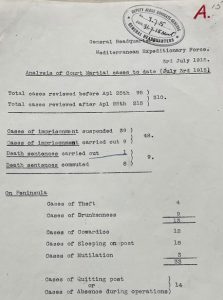
Table “A”.
A table, “A”, is appended showing the distribution of offences for the 10 weeks from April 25th up to July 3rd. In the three months since May there have been recorded 271 cases from the Base as against 224 on the Peninsula.
Cases of men sleeping on their post continued frequent, though in nearly every case it was shown to be directly due to exhaustion of the men, who are living under a hot sun in trenches from the moment they arrive.
Table “B”.
A further table is appended showing the figures up to the end of the tenth week of operations. It will be noted that in that period there were 117 cases on the Peninsula against 98 at the Base, though half of these latter were for the same offence, as noted.
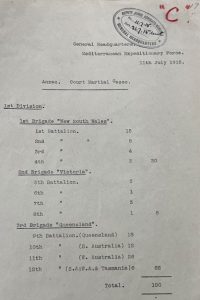
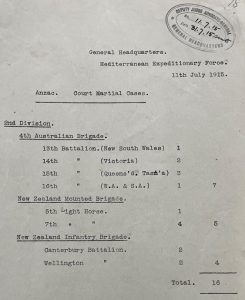
Table “C”.
Another table, “C”, shows the distribution of crime in the Australian and New Zealand Army Corps up to July 11th. The high percentage of offences in third Brigade is mainly due to the fact this Brigade was left at Mudros, and the men were continually breaking camp there, an offence accompanied by drunkenness. The N.C.O.’s were very lax, and suitable disciplinary measures were taken. The Brigade is a mixed one, mainly recruited from country districts, and has latterly improved, though it still furnishes the majority of cases.
Legal Position of Naval Division.
A representation was received from the Base asking for instructions as to the treatment of men of the Royal Naval Division on whom Courts Martial might be necessary, and pointing out that as His Majesty’s Ships call very infrequently at Alexandria, it is practically impossible to assemble a Court Martial. A reply was sent stating that the matter had been referred to the Army Council and to the Lords Commissioners of the Admiralty, and that it was hoped a satisfactory solution might soon be arrived at.
The G.O.C. of the Royal Naval Division applied on 9th July for two Naval Courts Martial, one on an officer; one has been proposed by the Vice Admiral at Mudros on August 5th or 6th, but it is very doubtful whether it can be held. In the interim, one of the principal witnesses in each case has been invalided.
It further appears from the correspondence between the Vice Admiral and G.O.C. Royal Naval Division relative to these cases that the necessary examination of the ships’ books cannot be carried out as they are not available here.
Field Punishment. July 25th.
The question of the advisability of suspending Field Punishment No 1 was put to the Army Corps Commanders, and as the result of their unanimous agreement it was prohibited on the Gallipoli Peninsula from July 25th. In view of the fact that it exposed the men to undue punishment, there being practically no situation on the Peninsula secure from shell fire, it was held that such a punishment was too severe, as well as being unfair to the men.
Modification of Sentences.
At the same time, owing to the heat of the climate, F.P. No 1 was prohibited till the hour of 6 p.m. (18:00) in other stations in the command. This was agreed to by the Medical Authorities. A circular letter had some time previously been sent through G.O.C.’s Divisions directing the attention of C.O.’s and presidents of Courts Martial to the necessity of paying particular regard to the locality and heat of the climate when awarding punishment.
Delays in assembling Courts Martial.
The difficulty of assembling Courts Martial promptly still continues, and is quite inevitable under the present military conditions. As it is impossible for troops on the mainland to obtain any rest such as is procurable in France or Belgium, the policy of interfering as little as possible with proceedings has been adhered to. It is very creditable to Officers, especially in view of the composition of the force, that Courts Martial have been conducted as well as is the case. It is interesting in this connection to note that the worst conducted cases come from the Base.
Clive Hodgson
Captain. D.J.A.G.
Table
Court Martial Cases to end of July.
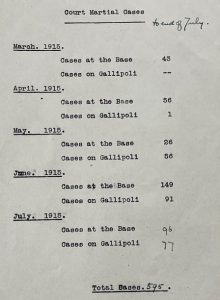
N.B. July totals incomplete for reasons mentioned in text.
Clive Hodgson
Captain. D.J.A.G.
Table A
Analysis of Court Martial cases to date (July 3rd 1915)
Clive Hodgson
Captain. D.J.A.G.
Table B
Court Martial Cases
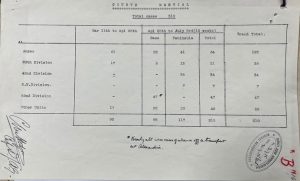
* Nearly all were cases of absence off a transport at Alexandria
Clive Hodgson
Captain. D.J.A.G.
Table C
ANZAC Court Martial Cases
Clive Hodgson
Captain. D.J.A.G.
Table
ANZAC Court Martial Cases
G.H.Q., IMBROS, Sept.30th, 1915
I arrived at Imbros on 18th September to take up the appointment of Deputy Judge Advocate General, and took over on the following day.
At present the general standard of efficiency in Court Martial work seems to be very much below that in France, owing to the scarcity of regular officers who have any experience, both in units and on staffs.
Charges of sleeping on post represent a very large proportion of the cases on the Peninsula – and it seems that the excessive periods of duty for which sentries are posted is to a considerable extent the cause of the prevalence of this offence.
The total number of cases for the month of August was 258
W. Percy Capt.
D.J.A.G.
G.H.Q. Imbros, 31-10-15.
In view of that fact that G.R.O.’s. in M.E.F. on the subject of Courts Martial appear to be somewhat confusing (and in some cases actually misleading) and that procedure under the Suspension of Sentences Act did not appear to be understood, a new G.R.O. on Courts Martial was drawn up (G.R.O.530) which was practically a transcript of 2nd Army Orders in France, and this was issued on October 2nd.
Sleeping on post.
Throughout the month of October charges of sleeping on post continued to supply a large percentage of the cases brought to trial, and the number of such trials in each Bde. in the month of September (97) was nearly equalled. This was certainly largely due to the conditions of health on the peninsula but was unduly augmented by bad regimental arrangements, and the want of frequent reliefs. A table showing the numbers of such trials in the months of July, August and September is attached. X
Self-Injury.
This offence is steadily becoming more prevalent, and is becoming so common as to demand drastic action, especially in view of the fact that a very small proportion of the cases in which this offence has in fact been committed are brought to trial.
The present conditions render the offence extremely difficult to deal with. It is impossible to keep and treat a large number of cases close to the firing line with a view to return the offenders to duty at an early date, as in France, and in the great majority of cases in which a man is invalided from the Peninsula he does not return at all. The temptation is therefore greater in this force than in France, and the benefits to be gained by commission of the offence are more easily achieved. For these reasons this matter was brought to the notice of the D.A.G. by me and an order on the subject drafted for approval. [Appendix 1, No 2]
This offence could in all probability have been put down at once had the maximum punishment allowed by the Army Act permitted the infliction of the extreme penalty in one clearly proved case. The maximum penalty (2 years I.H.L.) is wholly inadequate, and it is difficult to understand why the punishment of death should be sanctioned by the Army Act in the case of absence with the intention to avoid some particular service (constructive desertion), and yet no greater punishment than 2 years I.H.L. provided for in the case of an offence which is committed with the most deliberate intention of the avoidance of all further service.
Suspension of Sentences.
Suspension continues to be carried out in the vast majority – perhaps in almost too great a majority of cases.
General efficiency of Court-Martial Procedure.
There is still excessive delay in bringing soldiers to trial, and in the forwarding of proceedings, and although every effort is being made to reduce it as much as possible the present condition of communications, etc., render it to some extent unavoidable.
The general standard of efficiency in Courts Martial is not high, but shows some improvement. The majority of officers composing courts show an almost complete lack of acquaintance with the elements of the laws of evidence, and with the procedure of Courts Martial. On the other hand, an unnecessary degree of formality is often demanded by Brigade and Divisional Staffs, whereas the essentials of proof of a charge are neglected and overlooked.
Inoperative sentences are very common, e.g. ‘confinement to camp’, ‘admonished’, ‘reduction to and from acting rank’, etc., but as under present conditions is it impossible to collect officers for Court Martial instruction as in France, the only means of effecting any improvement is by means of written instructions and copious supplied of “Notes on Field General Courts Martial”, which do not serve the same purpose.
The number of trials in the month of September was 307.
W. Percy Captain
D.J.A.G.
Imbros, Nov. 30th, 1915.
One of the chief difficulties with regard to the procedure of F.G.C.M. lies not in irregularities in the conduct of proceedings but in the difficulty which is experienced in inducing the various staffs to dispense with the formalities of peace time procedure.
The appearance of such inapplicable forms as A.F.B. 116, and the return of proceedings for wholly unnecessary alterations, are of frequent occurrence, and these things seem often to have more attention paid to them than the essential proofs of an offence at the trial. The delays occasioned in this way are most objectionable and subversive of the whole object of F. G.C.M. especially under present conditions as sea communication is irregular, and papers are not infrequently lost altogether. A very general improvement in these matters is however noticeable.
On 30th November I moved to Mudros and took up my quarters on H.M.T. Minnetonka in Mudros Harbour.
The total number of trials by Courts Martial for the month of October was 427.
W. Percy Capt.
D.J.A.G.
Mudros Harbour 31-12-15.
Death Sentences.
During the month of December, two Death Sentences were ordered by the Commander-in-Chief to be carried out: 1st, No. 16734 Pte. H. Salter, 6th East Lancashire Regiment, tried on November 22nd for Desertion; 2nd, No. 227 Pte. J. Downey, 6th Leinster Regiment sentenced on 1st December for Wilful Defiance. The latter was a case from Salonika and it was particularly requested by the G.O.C. there that this sentence should be carried out in view of the marked tendency towards insubordination which had recently been evident from the proceedings of Courts Martial in that command.
These are the only two death sentences that have been carried out in M.E.F. since I joined the Force in September, and only one had been carried out prior to that.
Between the 25th April and the 31st December 101 men had been sentenced to Death, but in every case except the three mentioned above the Commander-in-Chief has refused to confirm death sentence.
Salonika.
On 22nd December I proceeded to Salonika to confer with Captain Peel, appointed legal D.A.A.G. to that command, and returned to Mudros 2 days later.
Mudros Harbour, 31-12-15.
Salonika Army and Dardanelles Army.
=*=*=*=*=*=*=*=*=*=*=*=*=*=*=*=*=*=
On the departure of G.H.Q. from Mudros, instructions were sent to the G.O’s.C. Salonika Army and Dardanelles Army that for the future, owing to the time it must necessarily take for proceedings to reach G.H.Q., Army Commanders would avail themselves of the powers of confirming death sentences, etc. under R.P. 120 (D) proviso (II).
The total number of cases received in this office in the month of November was 414, but proceedings of nearly a hundred Courts Martial were sent by A.H.Q. Salonika by an error straight to the J.A.G., London. Steps were taken to supply 3rd Echelon with records of these cases.
W. Percy
Captain.
D.J.A.G.
Appendix – 1
INSTRUCTIONS FOR THE USE OF OFFICERS IN CONNECTION
WITH FIELD GENERAL COURTS MARTIAL.
TO BE LAID BEFORE THE PRESIDENT.
ISSUED WITH GENERAL ROUTINE ORDERS.
May 11th, 1915.
(1.) CONVENING.
A Field General Court Martial may be convened by an Officer in command of any Corps or portion of a Corps or by any Officer in immediate command of a body of forces when it is not practicable to convene a General Court Martial.
N.B. A Commanding Officer is an Officer who under normal circumstances has power to “tell off” a soldier (e.g., a C.O., or Officer commanding a detachment.) R.P. 129.
- COMPOSITION OF COURT (R.P. 106).
(a.) Normally not less than three Officers (see para. 12a.).
(b.) A convening Officer must not appoint as President any Officer below the rank of Field Officer unless he (the convening Officer) is himself below that rank.
(c.) Each Officer should have held a commission for at least one year.
(d.) R.P. 22a and 23 must be complied with.
- CHARGES.
The statement of an offence may be made briefly in any language sufficient to describe or disclose an offence under the Army Act. Each charge should state one offence only, and the particulars of the offence must be shown. (R.P. 108.)
- OATH.
The President, members, and witnesses must be duly sworn, and this fact must be recorded on the proceedings.
The forms of oath for members of the Court and witnesses are to be found on page 633 of the Manual of Military Law.
- EVIDENCE.
The Provost Marshal, or Assistant Provost Marshal, if present, and failing them, the President must take down all material evidence in writing and attach it to the proceedings. (R.P. 107.)
-
- The evidence of all witnesses should be read over to them at its conclusion before they leave the Court, (R.P. 83 B), and the President should insert a statement in the proceedings that this has been done.
- When it is necessary to prove that a soldier was a defaulter at the time of the commission of an offence or that any special force order existed, the certified record must be given in evidence. (K.R. 581a.)
- If it is not practicable to appoint another officer, the prosecutor may give evidence himself, but must be the first witness. (R.P. 39c.)
- FINDING.
The finding of the Court on each charge will usually be recorded simply as a finding of “Guilty” or “Not Guilty” unless a special finding is absolutely necessary. If the evidence is not fully sufficient to prove the commission of an offence the court will acquit the accused. (See also R.P. 117.)
- CONVICTION.
An accused charged before a Court Martial with any offence under the Army Act may, on failure of proof of an offence being committed under circumstances involving a higher degree of punishment, be found guilty of having committed a cognate lesser offence. (A.A. 56.)
-
- If the court find a soldier guilty of a offence they must take evidence of and record the character, age, service and any recognised acts of gallantry or distinguished conducts of the accused, as well as such other matters as are material. The accused may always call witnesses as to these matters in his defence. (R.P. 46.)
- SENTENCE.
(a.) Of death or penal servitude.
A sentence of death requires the concurrence of all members of the court. A.A. 49 (2). If there are only two officers on the Court, the sentence cannot exceed 2 years imprisonment or 3 months field punishment.
(b.) The limits of sentences that may be passed upon a soldier are.
(i) Penal servitude (not less than 3 years).
(ii) Imprisonment (with or without hard labour, for not more than 2 years).
(iii) Detention (not more than 2 years).
(iv) Field Punishment (not more than 3 months).
(v) Stoppages of pay (not more than 3 months).
- In passing sentence a court martial will have regard not only to the nature and degree of the crime and the previous character of the accused, but also to any matters in extenuation or aggravation of the offence.
Any statements which have a bearing on the sentence should be investigated, as well as any matters which appear to call for disciplinary action. (K.R. 589a.)
The proper amount of punishment to be awarded is the least amount by which discipline can be efficiently maintained.
- CONFIRMATION.
(a) The proceedings will usually be sent for confirmation through the Headquarters of the unit to the proper confirming authority, as laid down in Divisional or Brigade Orders.
(b) With reference to the proviso in para. 15, if the Court was convened by an officer in command of a portion of a corps the proceedings may be confirmed by the senior officer present (being a field officer) or if there is not a field officer present, by any field officer to whom it may be possible to take the proceedings.
(c) The Provost Marshal, Assistant Provost Marshal or Prosecutor cannot confirm the proceedings.
-
- No sentence of death or penal servitude shall be carried into effect unless or until it has been confirmed by the G.O.C., subject only to the proviso that where the confirming officer is of opinion that owing to the nature of the country, the great distance, or the operations of the enemy it is not practicable to delay the case, the above sentences may be carried out if confirmed by the general or field officer commanding the force with which the person under the sentence is present. (R.P. 120 D. ii. A.A. 54.)
- SUSPENSION OF SENTENCES ACT, 1915.
Where a soldier is sentenced to penal servitude or imprisonment the confirming authority may, when confirming the sentence, direct that the soldier be not committed to prison until the orders of the G. O. C.-in-Chief have been obtained.
- If the sentence has been suspended the confirming officer shall appoint a day within the following three months on which the case shall be reconsidered with a view to a remission of the sentence. Such remission may be made by a general officer holding a warrant to convene General Courts Martial. The G. O. C.-in-Chief has power, on representation being made to him, to terminate the suspension of any sentence.