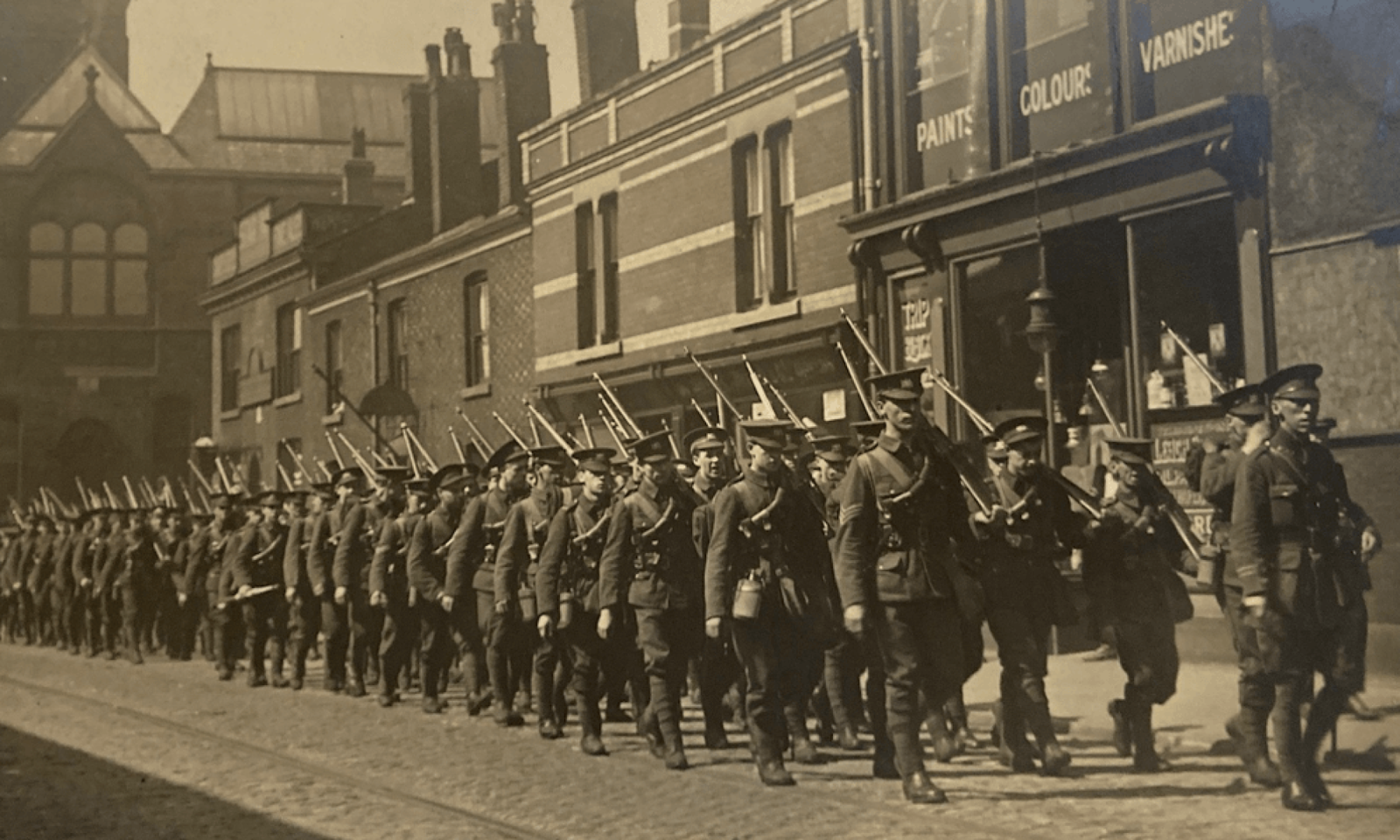
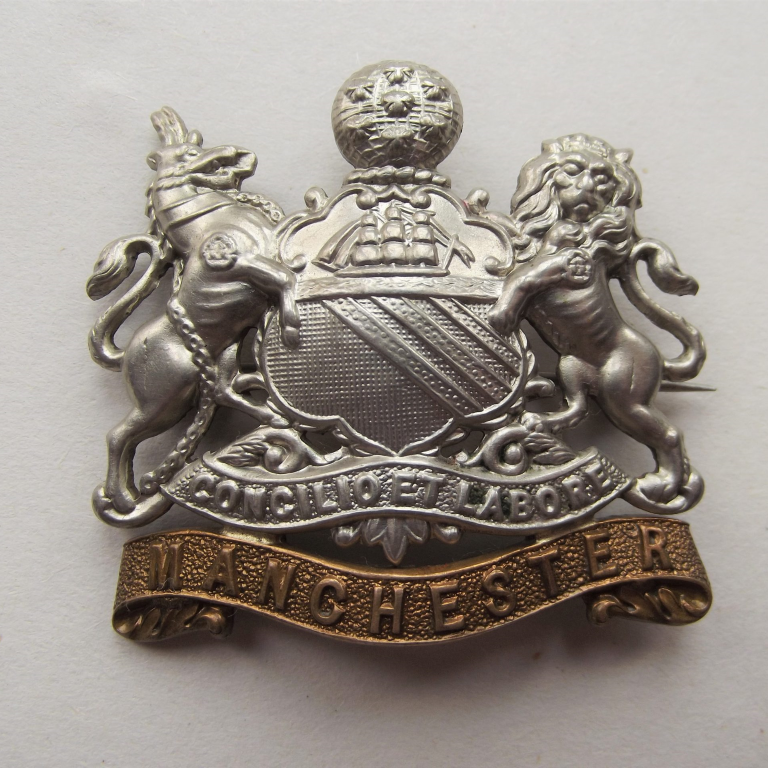
Thomas Burgess was born on June 14, 1862 in Ashton under Lyne to Thomas Burgess Snr and Esther Shaw Torrington. He was raised and educated in Ashton and by 1881 was employed as a Brass Moulder. In July 1883 he married Sarah Lees and their son Harold was born 15 months later. By 1891 he was the landlord of the Collier’s Arms pub in Ashton and Thomas and Sarah had adopted a daughter.
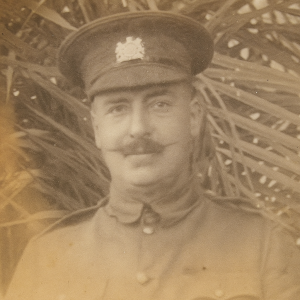
Early Military Service:
Thomas Burgess enlisted in the 3rd Volunteer Battalion, The Manchester Regiment on 29 May 1885,[1] being allotted the service number 5107 and posted to “A” Company. By 1894, he had attained the rank of Corporal.
A marksman of some distinction, Corporal Burgess won a Battalion Musketry Medal in 1894, and in 1901 secured a further award as Best Shot in his Company. His steady progress continued, and by 1903 he had been promoted to Quartermaster Sergeant (QMS).
In that same year, he competed for the Ladies’ Cup, which required firing ten rounds from the magazine at 200 yards upon a disappearing target. Tying with Sergeant Chadderton, both men achieved perfect scores; Burgess prevailed in the ensuing shoot-off to win the trophy outright.
He was a member of the battalion Shooting Team of 1904–05 and led one of the two teams in 1906 which captured the inter-battalion Clapham Cup for a third time, a notable achievement among the six Volunteer units of the Manchester Regiment which competed for it each year.
On April 8, 1905, after 20 consecutive years of efficient service, QMS Burgess was awarded the Volunteer Long Service Medal by the battalion’s commanding officer, Colonel J.W. Pollitt. He remained a member of the Volunteers until the Haldane Reforms of 1908, when the unit was reconstituted as the 9th Battalion, The Manchester Regiment (Territorial Force).
On 11 April 1908, Burgess enlisted into the new formation, retaining his rank of Quartermaster Sergeant in “A” Company, and receiving the new service number 160.
Service During the Great War:
On the 5th of August 1914, Quartermaster Sergeant Burgess was mobilised with the battalion at the outbreak of war. Later that month the unit proceeded to Chesham Fold Camp, Bury, and on 10 September 1914 embarked for Egypt, disembarking at Alexandria on 27 September, 1914. QMS Burgess was one of three senior warrant officers named on the disembarkation register.
The battalion, now reorganised from eight to four companies, was stationed at Kasr-el-Nil Barracks, Cairo, where in mid-October, Burgess sustained an injury after misjudging a flight of steps, aggravating an old groin complaint.
He was admitted to the Citadel Hospital, Cairo, remaining there approximately six weeks before rejoining his unit sometime in December 1914. On January 31 1915 the battalion moved to Heliopolis where they went under canvas for the first time overseas. His medical report notes that despite recovering from his fall he suffered from lumbago, myalgia and chronic epididymitis.
In March 1915, Burgess was again admitted to hospital, now suffering from nephritis. On 18 March 1915, he was medically evacuated to England, where he was treated at the 2nd Western General Hospital, Manchester. Declared permanently unfit for overseas service, he was discharged from the 1/9th Battalion, Manchester Regiment (Territorial Force) on 11 June 1915, under Paragraph 392 of King’s Regulations (1912) after just over 30 years continuous and exemplary service.
Further Service at Home:
Undeterred by his medical discharge, Burgess re-enlisted the very next day in the 3/9th Battalion, Manchester Regiment, and was given the service number 3854.
He assumed responsibility for the Armoury Stores, equipping new recruits, under the command of Lieutenant-Colonel Edward Garside, with whom he had served for fifteen years. He remained at the Armoury when the 3/9th moved to Southport in July 1915, now falling under the command of Captain Ralph Lees, and in addition to equipping new recruits he also drilled them before they departed to join the battalion.
The 3/9th Battalion moved successively to Southport and then Codford, becoming the 9th (Reserve) Battalion in April 1916. In September 1916, it amalgamated with the reserve battalions of the 8th and 10th Manchesters to form the 8th (Reserve) Battalion, The Manchester Regiment, stationed at Ripon from January 1917.
During the Territorial Force renumbering of February 1917, QMS Burgess received the new six-digit number 351880.
He was finally discharged for a second and last time on 4 May 1917, again under Paragraph 392 of King’s Regulations (1912).
Civilian Life:
By 1901 Thomas was a father of two boys and a licensed victualler of the Railway Hotel, Audenshaw. In 1906 he was elected to the Audenshaw District Council, representing the West Ward as an Independent. He was also a member of the Ashton Lodge of Freemasons, serving as Worshipful Master in 1911. By 1913, Thomas Burgess was Chairman of the Audenshaw District Council and a Justice of the Peace. He retained the Council chairmanship while he was serving overseas in Egypt and was re-elected unopposed in 1915 just before he returned home.
By 1921 Thomas and Sarah were still living at and operating the Railway Hotel, Audenshaw but by 1927 they had retired to Bournemouth where on August 20 Thomas died of cardiogenic shock caused by a perforated gastric ulcer. Quartermaster Sergeant Thomas Burgess was 65 years old.
Awards and Recognition:
For his long and faithful service, Quartermaster Sergeant Burgess was awarded the Volunteer Long Service Medal in 1905, and subsequently the Territorial Efficiency Medal in May 1922 — a fitting recognition of more than thirty years of continuous and exemplary military service.
- Volunteer Long Service Medal (Edward VII) – Engraved “5107 Q. M. SJT. T. BURGESS. 3RD V. B. MANCH. REGT”.
- Territorial Efficiency Medal (George V) – Engraved: “351880 W.O. CL. II. T. BURGESS. 9-MANCH. R.”
- 1894 “A” Company, 3rd VBMR Shooting Club, Class B star won by Corpl. Burgess.
- “A” Company Best Shot for 1901, O.R. Sgt. Burgess.
- 3rd V.B. The Manchester Regt. Winners of the Clapham Cup 1904-1905.
All these medals were donated to the Manchester Regiment Museum, Tameside Local Studies and Archives, Central Library, Old Street, Ashton under Lyne, OL6 7SG in June 2013.
Notes:
[1] 22 years 317 days before he enlisted in the 9th Battalion, Manchester Regiment (TF).