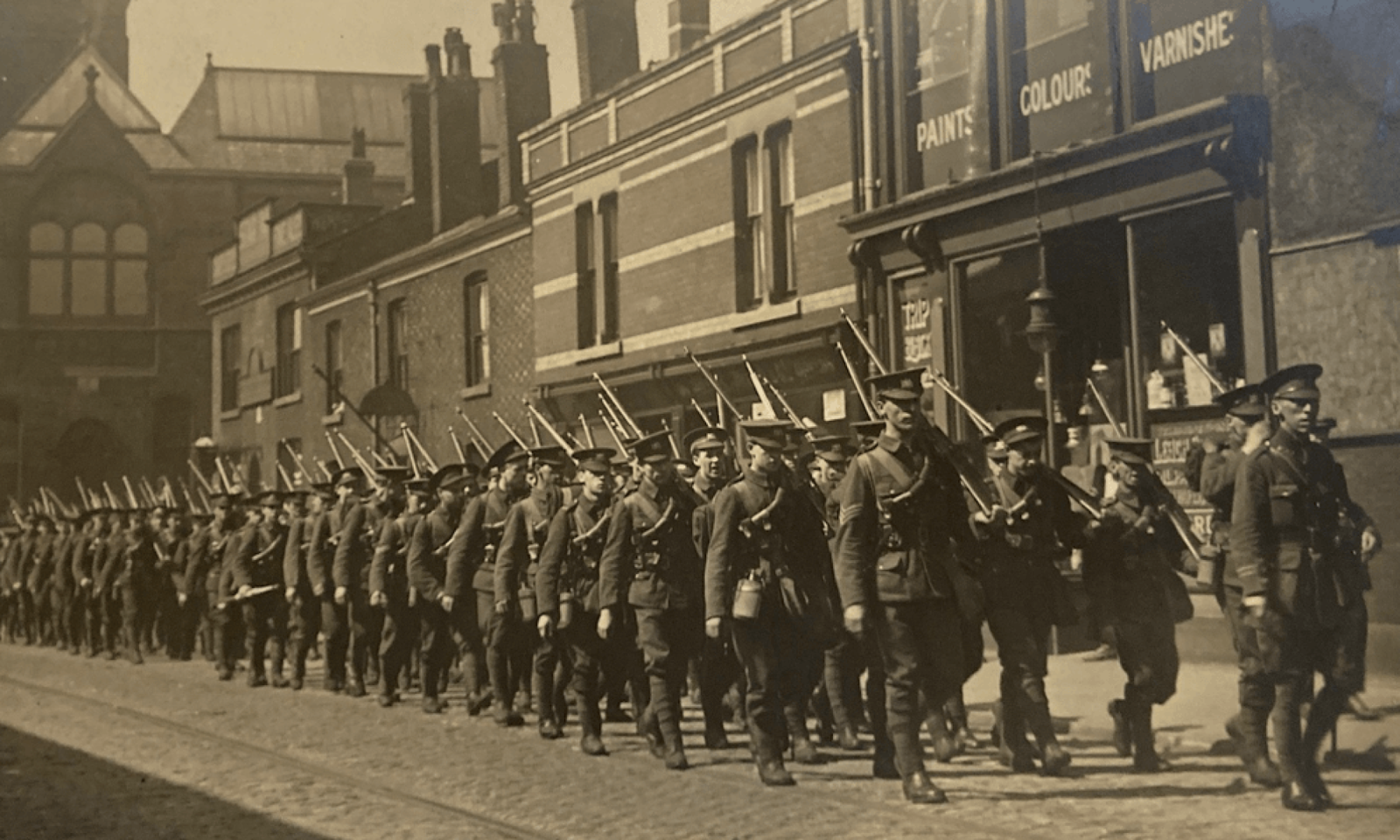
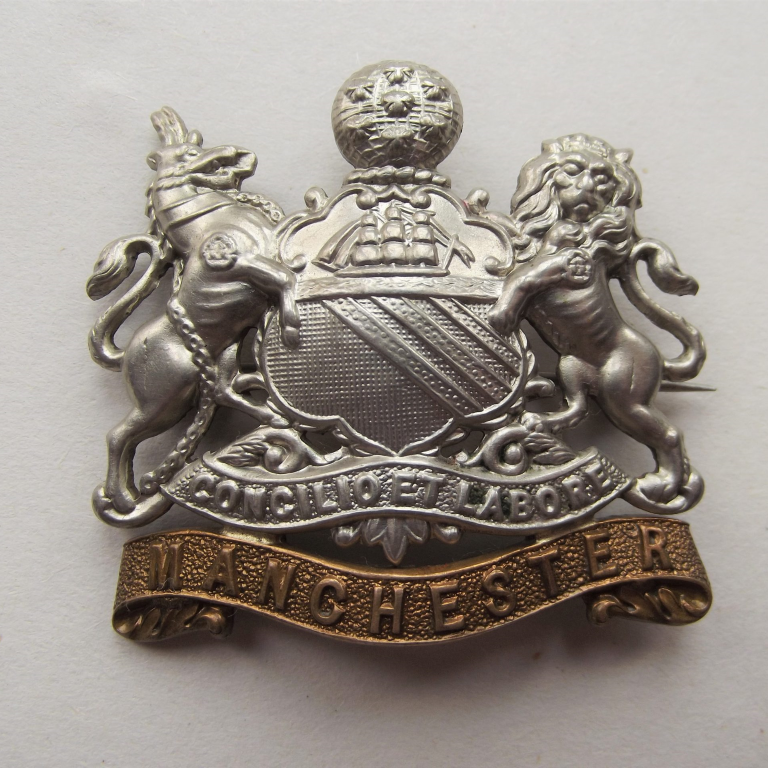
1/9th Battalion, The Manchester Regiment, Territorial Force
Shortly after the outbreak of war the 9th Manchesters, as part of the East Lancs Division, mobilised and deployed to Egypt to protect the Suez Canal, to train and to acclimate to North African temperatures.
On May 9th, 1915 they landed at Sedd-el-Bahr under heavy fire at Gallipoli. They remained in Gallipoli for almost 8 months, leaving on December 29, 1915.
In January 1916 the 1/9th Manchesters deployed to Egypt and spent the year there reconstituting their ranks with fresh recruits from England while guarding the Suez Canal from Turkish attack.
In March 1917 they deployed to France where they remained for the duration of the war.
On the 4th March, 1917 the 9th Battalion, Manchester Regiment embarked on HMT Arcadian bound for France. They disembarked at Marseilles on 11th March and moved by train to Pont Remy.
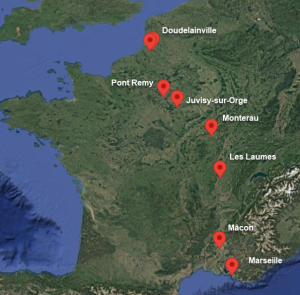
From Pont Remy the 42nd Division was moved to an area ten miles east of Amiens, there the 9th Battalion was issued with rifles and steel helmets. They began training on the tactics of trench warfare. Trench digging and route marches were also the order of the day.
Prior to the formation of the Territorial Force on April 1, 1908, the NCOs and enlisted men of the Volunteers were entitled to the Volunteer Long Service Medal (VLSM) after 20 consecutive years of approved service.
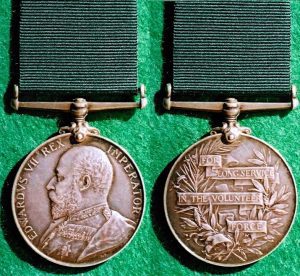
With the advent of the Territorial Force the Territorial Force Efficiency Medal (TFEM) replaced the Volunteer Long Service Medal under modified qualifying terms and conditions, the most notable of which was a reduction to 12 consecutive years of approved service. And in 1922, the Territorial Force Efficiency Medal was itself replaced by the Territorial Efficiency Medal (TEM).
The oldest other ranks member of the 9th Battalion Manchester Regiment to serve in Gallipoli was 57 years old Quartermaster Sergeant (Q.M.S.) George Boocock, a 32-year veteran and Old Volunteer.
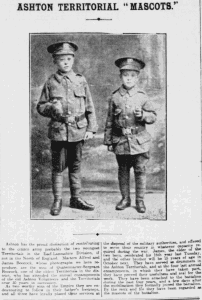
At the other end of the spectrum, a number of very young men enlisted and found themselves deployed overseas to Egypt in September 1914 and then to Gallipoli in May 1915. Two of them were Alfred and James Boocock, the only surviving sons of Q.M.S. Boocock, who were treated as the battalion’s “mascots”.
32 Officers and men of the 1/9th Battalion Manchester Regiment were subjected to Courts Martial while serving in Gallipoli and at least two more were Court Martialed in Egypt in 1916.
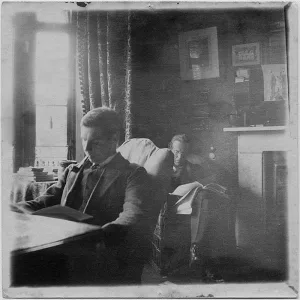
The range of offences was quite broad resulting in punishments ranging from the loss of one day’s pay to a sentence of death. 2/Lt. Dale, a trained lawyer in civilian life, was acquitted of all charges.
Prior to the outbreak of war the battalion had 3 senior NCO members of the permanent staff, 2 Quartermaster Sergeants and 1 senior sergeant in each of the 8 companies.
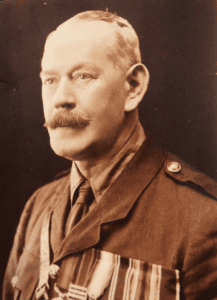
By the time the battalion landed in Gallipoli, the battalion had an RSM and Quartermaster Sergeant and each of the 4 companies had a Company Sergeant Major and a Company Quartermaster Sergeant.
In May 1914 Lieutenant Frederick Arthur Makin was appointed as officer in charge of the machine gun section which at that time consisted of 16 men and two .303 calibre Maxim Machine Guns.
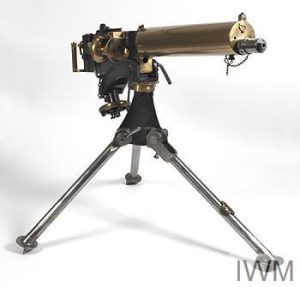
Maxim Machine Guns were operated by a crew of four to six men: The Gunner fired the gun; the Reloader quickly reloaded the gun when the 250 round ammunition belt was expended; the Spotter identified and directed fire…
In addition to the enlisted men of the 1/9th Battalion Manchester Regiment, five Territorial Force (TF) Royal Army Medical Corps (RAMC) enlisted men from the 1/2nd East Lancs Field Ambulance were attached to the battalion and accompanied them to Egypt and Gallipoli.
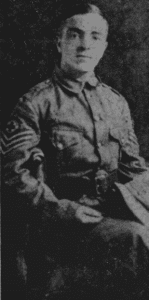
Two of these men were cousins and both were commended for bravery in Gallipoli for tending to the wounded while under fire. One had a brother serving as a regular soldier in the battalion who died of wounds received at Gallipoli.
On August 15, 1914 the Reporter newspaper stated that 18 men of the No. 3 Section, East Lancashire Divisional Signal Company were attached to the 9th Battalion, Manchester Regiment for pay, rations, and discipline. All of these men were members of the 4th Battalion East Lancs Regiment.
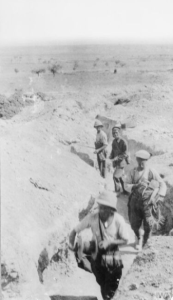
Two of them, Sgt. William Watters and Sapper Henry Pinder, were both decorated for gallantry and provided exemplary service during the war and their stories are worth recording.
The number of family connections within the battalion exploded by almost 450% during 1914 with brothers, fathers and sons, cousins, nephews and uncles along with brothers-in-law all represented in the mix of men and boys who joined during 1914.
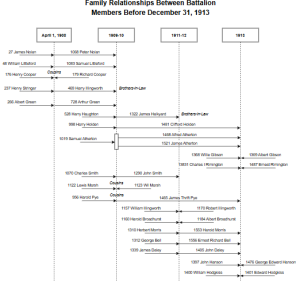
Although several of the brothers who joined the battalion in 1914 were simply the younger brothers of a previously serving older brother, in the early part of the year it was more often a case of a younger brother being the first family member to join and the older brother joining later, as overseas departure approached, possibly to “look out for”, or perhaps not be outdone by, their more reckless younger sibling.
The battalion had no fewer than 8 Commanding Officers during the Gallipoli Campaign, necessitated due to wounds, sickness and death. Nevertheless, the men of the battalion always considered Lt.-Col. DH Wade to be the true CO.
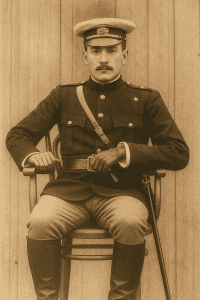
After the war, the 9th Battalion, Manchester Regiment was re-formed and Lt.-Col. DH Wade once again became the CO. After him, four junior officers of the battalion who deployed to Gallipoli subsequently went on to command it.
There was a vibrant and thriving amateur football scene in and around Ashton under Lyne in the years leading up to the outbreak of war. By 1914 teams from the district were playing in at least 10 leagues, and competing for a number of local challenge cups.
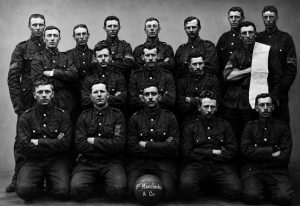
Several of the members of the 9th Manchesters played amateur football in the local leagues, some of them at a reasonably high-level.
2nd and 3rd Line Battalions
2/9th Battalion, Manchester Regiment
The 2nd-line (or reserve) Territorial Force division had no existence before the outbreak of the Great War. On the 15th August, 1914, instructions were issued by the War Office to separate the home-service men of those Territorial Force units which had volunteered for service abroad; the home-service men were to be formed into reserve units.
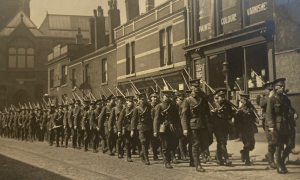
The reserve battalions’ primary purpose was to act as feeding battalions for the first line infantry units, providing much needed drafts of men to replace their mounting casualties in Gallipoli. In this capacity the 2/9th Battalion, Manchester Regiment supplied significant reinforcements for the 1/9th Battalion during the campaign.
3/9th Battalion, Manchester Regiment
During the week of December 29, 1914 Captain Ralph Lees, in command of the Depot at Ashton, received orders to raise an additional 240 men for the newly reorganized 9th Reserve Battalion, Manchester Regiment in training at Southport. These men were recruited in just over a week and were initially based at the Armoury in Ashton under Lyne.
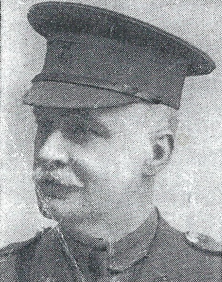
On January 25th, 1915, Major (temp Lieut.-Col.) Edward Garside, having relinquished his temporary appointment as brigade major to the 2nd/East Lancs Brigade, was appointed to the command of the battalion depot at the Armoury and of the newly formed company of 240 men who were in training there.