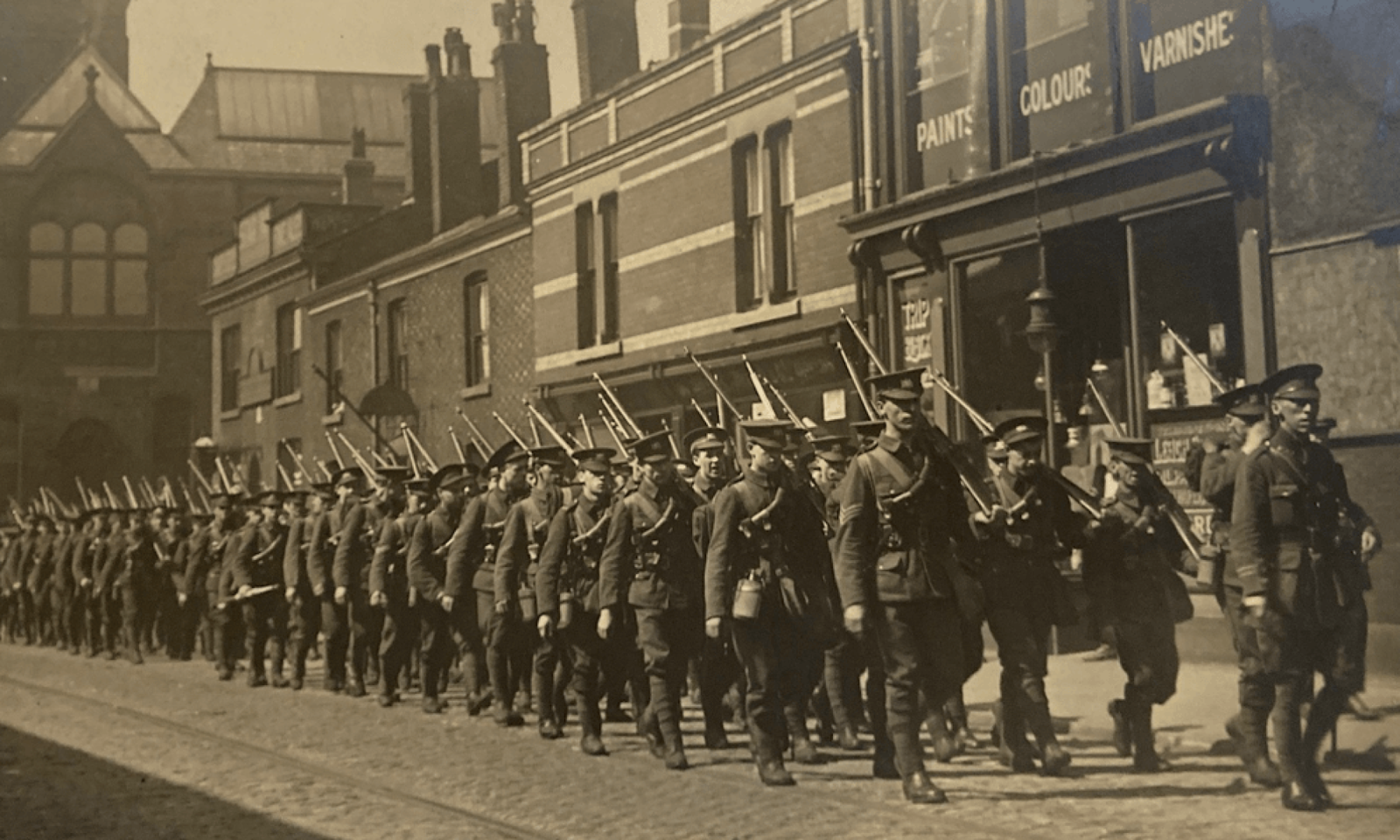
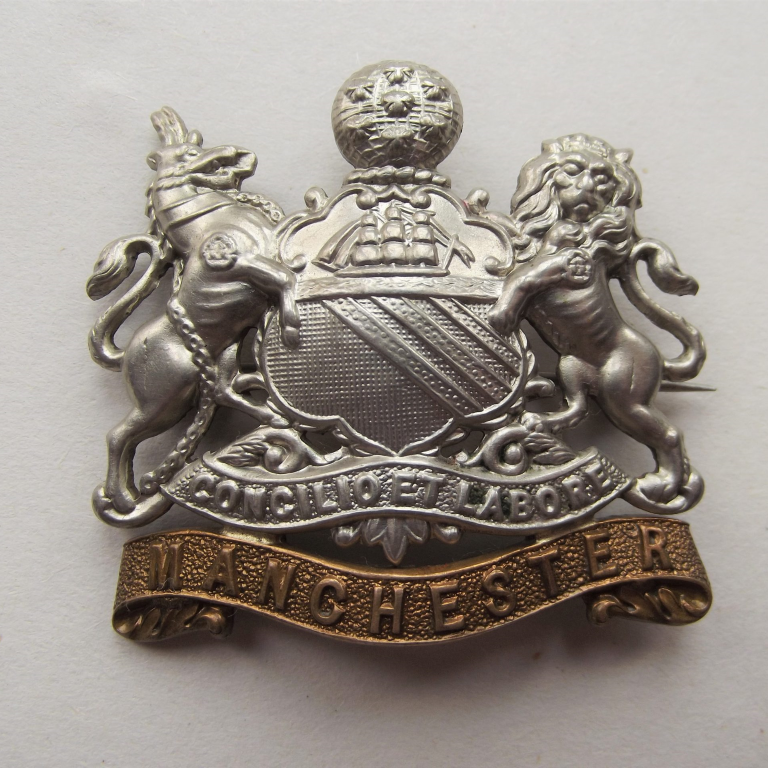
In 1914 the East Lancashire Divisional Engineers were constituted as follows:
1st East Lancashire Field Company
2nd East Lancashire Field Company
1st East Lancashire Divisional Signal Company:
No 1 (Cable) Section at Seymour Grove
No 2 (Lancashire Fusiliers) Section
No 3 (East Lancashire) Section
No 4 (Manchester) Section
Sections 2, 3 and 4 of the Divisional Signal Company were created to serve each of the three brigades that made up the East Lancashire Division. The East Lancashire Brigade included the 4th and 5th Battalions East Lancashire Regiment and the 9th and 10th Battalions Manchester Regiment.
On August 15, 1914 the Reporter newspaper stated that 18 men of the No. 3 Section, East Lancashire Divisional Signal Company were attached to the 9th Battalion, Manchester Regiment for pay, rations, and discipline. The names given in the newspaper were:
Sergeant W. Walters, Lance-Corporal J. W. Challinor, Corporal J. Ardess, Privates H. Pinder, R. Noblett, H. Lomax, E. Bleasdale, L. Watson, E. Lewis, R. H. Boucher, J. Blackburn, A. Ling, W. Yates, H. Hunt, C. Heap, T. E. Riding, G. A. Hunt, and C. Allen.
It’s likely those men were:
| Rank | No. | Forename | Middle | Surname |
| Sgt | 244 | WILLIAM | WATTERS | |
| Pte | 1064 | ERNEST | CHARLES | LEWIS |
| Dvr | 1153 | HERBERT | HUNT | |
| Cpl | 1233 | JOSEPH | ARDIS | |
| L/Cpl | 1247 | JAMES | WILLIAM | CHALLINOR |
| Pnr | 1248 | RUDOLPH | HENRY | BOUCHER |
| Pte | 1321 | THOMAS | EDWARD | RIDING |
| Pnr | 1322 | CHRISTOPHER | HEAP | |
| Pnr | 1329 | LEONARD | WATSON | |
| Spr | 1330 | HENRY | PINDER | |
| Spr | 1340 | JOHN | BLACKBURN | |
| Pte | 1350 | WALTER | YATES | |
| Pte | 1363 | CHARLEY | ALLEN | |
| Pnr | 1546 | SYDNEY | ALBERT | LING |
| Spr | 1579 | ARTHUR | LOMAX | |
| Pte | 1581 | GEORGE | ALBERT | HUNT |
| Spr | 1610 | RICHARD | NOBLETT | |
| Spr | 1845 | EDWIN | BLEASDALE |
All of these men appear to have come from Darwen and were members of the 4th Battalion East Lancs Regiment. And with the exception of Noblett and Watters, their 4-digit service numbers were those of the 4th East Lancs Regiment rather than the Royal Engineers, Territorial Force. This block of men includes three with surviving service records and two more with surviving pension records. From these remaining documents we can infer some things about the group as a whole.
Sgt. Watters’ service record shows that he was an Old Volunteer, joining the 1st Volunteer Battalion East Lancashire Regiment (Service Number 2414) on Feb 21, 1906. He transferred to the 4th East Lancs Regiment Territorial Force on April 3, 1908 and was assigned the service number 244. On September 10, 1914 he was both attached and simultaneously transferred to the East Lancs Royal Engineers Signal Company retaining his service number but this was now an RE (TF) number.
A review of 1247 James William Challinor’s service record shows that he attested on April 10, 1912 into the 4th Battalion East Lancs Regiment. He was embodied on August 5, 1914 and on September 10, 1914 was attached to the East Lancs Signal Company. 1248 Rudolph Henry Boucher’s service record shows that he followed the same path on identical dates. 1330 Henry Pinder’s pension record shows that he attested on August 28, 1912 into the East Lancs Regiment and states that he too was embodied on August 5 and then attached to the Royal Engineers TF on September 10, 1914. It should be noted here that September 10 was the date the East Lancs Division left England for Egypt but we know that these men were already attached to the No 3 Section, East Lancs Signal Company in mid-August as the local newspapers recorded. Consequently, it’s reasonable to assume that although the official date was the day they embarked for Egypt they had in reality already been assigned to the Signal Company some weeks before that.
Sapper 1610 Richard Noblett does not have a surviving service record but his medal roll indicates that he was one of three men from the Manchester Regiment who transferred to the Royal Engineers TF at the same time. The first of those three men, Harry Leland Pollitt, does have a surviving service record which shows he was an old Volunteer from Eccles who rejoined the 5th Battalion Manchester Regiment on September 14, 1911 and was assigned the Manchester Regiment service number 1295. His original discharge certificate, pre-dating his re-enlistment, shows that he was a trained signaller. He was embodied on August 5, 1914 and attached to the East Lancs Signal Company on August 12. On December 12, 1914 he was transferred to the East Lancs Royal Engineers, TF under authority of the Daily Orders Part II, East Lancs Royal Engineers, Southport. At this point he would have been assigned his new RE (TF) service number of 1608. It’s reasonable to assume that 1610 Richard Noblett was embodied, attached and then transferred to the RE (TF) on or around the same time.
1917 Re-Numbering
Changes to the numbering of the Territorial Force Royal Engineers was promulgated in Army Council Instruction (ACI) 2243 of 1916, published on 1 December 1916 and enacted in early 1917. The block of service numbers from 444001 to 446000 was allocated to the East Lancs Divisional Signal Company. Reviewing the new service numbers allocated to this cohort of men tells us something more about them.
| Rank | Old No. | New No. | Surname | Comment |
| Sgt | 244 | 444007 | WATTERS | RE (TF) Re-numbered |
| Pte | 1064 | – | LEWIS | Wounded. Discharged 1916 |
| Dvr | 1153 | 444596 | HUNT | Transferred to RE (TF) |
| Cpl | 1233 | – | ARDIS | KIA June 4, 1915. Gallipoli |
| L/Cpl | 1247 | 426906 | CHALLINOR | Wounded. Home Service. |
| Pnr | 1248 | 165867 | BOUCHER | Xfer to Regular Army RE |
| Pte | 1321 | 444598 | RIDING | Transferred to RE (TF) |
| Pnr | 1322 | 444599 | HEAP | Transferred to RE (TF) |
| Pnr | 1329 | 444600 | WATSON | Transferred to RE (TF) |
| Spr | 1330 | 444601 | PINDER | Transferred to RE (TF) |
| Spr | 1340 | 444602 | BLACKBURN | Transferred to RE (TF) |
| Pte | 1350 | 444603 | YATES | Transferred to RE (TF) |
| Pte | 1363 | 200134 | ALLEN | Transferred to 2/5th ELR |
| Pnr | 1546 | – | LING | DoW July 5, 1915. Gallipoli |
| Spr | 1579 | 444605 | LOMAX | Transferred to RE (TF) |
| Pte | 1581 | 022657 | HUNT | Transferred to RAOC |
| Spr | 1610 | 444129 | NOBLETT | RE (TF) Re-numbered |
| Spr | 1845 | 444607 | BLEASDALE | Transferred to RE (TF) |
Note that since Sgt Watters and Sapper Noblett were already transferred to the Royal Engineers (TF) their new six-digit service numbers were most likely assigned by tenure according to their old RE (TF) service numbers and so fell outside the block assigned to the other men. All the other men of this group who transferred to the RE (TF) in early 1917 transferred as an almost contiguous block and their new numbers were assigned based on their old 4th East Lancs Regiment numbers.
There are no known surviving records that indicate how long any of these men remained attached to the 9th Manchesters but all deployed to Egypt in 1914 with two losing their lives in Gallipoli and at least two more wounded seriously enough there to be medically evacuated to England. After serving in Gallipoli, a further one was killed in France and four others were decorated for gallantry in the field, one winning the DCM.
Two of these men, Sgt. William Watters and Sapper Henry Pinder, provided exemplary service during the war and their stories are worth recording.
244 William Watters, MM, Croix de Guerre, MiD, TFEM
William Watters was born in Aughnacloy, County Tyrone, Northern Ireland in 1885. By 1891 his family had moved to Ashton under Lyne where Wiiliam’s father was employed as a police constable. By 1897 they had moved again, this time to Darwin where William was employed as a printer and paper stainer at Belgrave Mills, Darwen. William joined the 1st Volunteer Battalion East Lancashire Regiment on February 21, 1906 and subsequently transferred to the newly formed 4th East Lancs Regiment, Territorial Force on April 3, 1908. He initially signed-up for one year but extended his service for 4 years in 1909 and again in 1913. He attended all of the summer training camps and was promoted to Corporal in 1909 and Sergeant on May 15, 1912. In March 1914 he attended a 31-day training course in Visual Signalling (Morse) at the Army School of Signalling, Bulford and was found to be “very satisfactory”. He was mobilised on August 5, 1914 and moved to Chesham Fold Camp, Bury with the 4th Battalion, East Lancs Regiment later that month. On September 1st he signed his E.624 form agreeing to overseas service and on September 10 was transferred to the East Lancs Divisional Signal Company.
He sailed to Egypt with the East Lancs Division and subsequently deployed with them to Gallipoli on May 9, 1915. There he was mentioned in the despatch of Sir Ian Hamilton, Sept 20, 1915 (LG November 5, 1915). The East Lancs Divisional Signal Company left Gallipoli on January 1, 1916 and deployed to Egypt a month later. Sgt. Watters remained with the 42nd Divisional Signal Company for the remainder of the war and was awarded the Belgian Croix de Guerre (LG April 15, 1918), the Military Medal (LG 20 August, 1919) and the Territorial Force Efficiency Medal (Army Orders February 1919).
On June 18, 1918 he was seriously wounded when he received a gunshot wound to the Right arm and his arm was subsequently amputated at the shoulder. He was medically evacuated to England on July 5th and treated at the Whitecross Hospital, Warrington followed by the Alder Hey Military Orthopaedic Hospital, West Derby. He then spent some time at the Signalling School Training Center at Maresfield before being admitted to the Ministry of Pensions, Special Surgical Hospital Blackrock Dublin on December 9, 1920. He was discharged from the Army at the King George V Hospital, Dublin on January 8, 1921.
1330 Henry Pinder, DCM, MM
Henry Pinder was born in Darwen on January 23, 1891. He enlisted in the 4th Battalion, East Lancs Regiment on August 28, 1912 and was assigned the service number 1330. He was embodied on August 5th and then attached to the Royal Engineers TF. Privates Riding, Heap, Watson, Blackburn, Yates and Allen all enlisted in the East Lancs Regiment around this time, their service numbers spanning just 40 men.
Note: Pinder’s pension record states that he was “transferred” to the Royal Engineers on September 10, 1914 but this cannot be true. If he had actually been transferred, as opposed to attached, he would have been assigned an RE (TF) service number, which he was not. His pension record was collated and created when he was demobilsed in 1919 and it’s reasonable to assume that whoever collated his information at that time was not quite as precise with their terminology as they could have been.
He sailed to Egypt with the East Lancs Division and deployed with them to Gallipoli on May 9, 1915. On June 4, 1915 Corporal 1233 Jospeh Ardiss was reported missing in action, (later killed in action), and it appears that 1064 Ernest Charles Lewis was appointed acting Corporal in the field to replace him. Lewis joined the East Lancs Regiment in January 1910 and so had more than two years additional experience than Second Corporal James William Challinor.
On June 30, 1915 Sapper Pinder’s Engineer Pay increased from 6th rate to 4th rate. On August 16, 1915 he was promoted to Second Corporal replacing Second Corporal Challinor who suffered a gunshot wound to the neck and was medically evacuated to the 15th General Hospital in Alexandria. Corporal Challinor was then medically evacuated to England where he remained in hospital until November 15, 1915 when he was released on the obligatory 10 days furlough. The furlough notes that he was classed as permanently unfit for overseas service and he was assigned to the 71st Signal Company and thus assigned a different RE (TF) six-digit service number than his former comrades.
On July 2, 1915 acting Corporal Lewis suffered a gunshot wound to his right leg and was medically evacuated to the UK. Three days later, on July 5, Pioneer 1546 Syndey Albert Ling died of wounds and was buried at Lancashire Landing Cemetery.
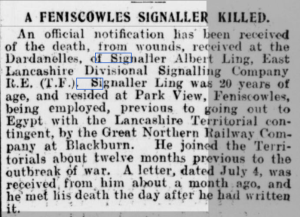
Blackburn Weekly Telegraph – Saturday 21 August 1915
In England, acting Corporal Lewis recovered from his wounds but was classed as permanently unfit for military service and discharged on July 17, 1916. Consequently, he did not receive a six-digit Royal Engineers TF service number in early 1917.
Second Corporal Pinder was appointed acting Corporal, vice acting Corporal Lewis, on January 1, 1916 effectively upon leaving Gallipoli. He remained with the 1/1st East Lancs Division Signal Company in Egypt and on June 1, 1916 was promoted to Sergeant replacing Sergeant 764 Charles Alfred Ormesher (formerly of No 4 Section) who was invalided to England.
In early January 1917 Sgt Pinder injured his right hand and, after being transported by Ambulance Train down the newly laid railway from El Arish to Kantara, was admitted to the 24th Stationary Hospital in Kantara on January 9. He was subsequently transferred, probably by hospital ship up the Suez Canal, to the 31st General Hospital at Port Said 3 days later. On January 15, 1917 he officially transferred to the Royal Engineers (TF) and was allotted the six-digit service number 444601. It’s reasonable to assume that this was the date that all the other 42nd Divisional RE (TF) men transferred and received their numbers.
Sergeant Pinder rejoined the 42nd Divisional Signal Company from hospital on February 9, 1917 and on March 3, 1917 the Division sailed for France. In France he was almost immediately granted 10 days leave to the UK by order of the 126th Infantry Brigade HQ, which suggests that he was still attached to No 3 Section. While in England he took the opportunity to get married:
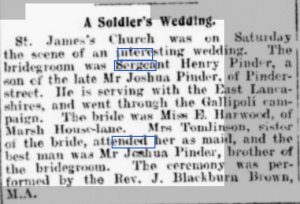
Blackburn Weekly Telegraph – Saturday 07 April 1917
Five months later, on September 18, 1917 he was awarded an additional 30 days home leave, possibly related to an act of gallantry in France.
The London Gazette dated 28 December 1917 announced that Sergeant Pinder had been awarded the Distinguished Conduct Medal, dated January 1, 1918 and a few months later the London Gazette dated April 17, 1918 carried the following citation:
With reference to the announcement of the award of the Distinguished Conduct Medal in the Honours Supplement to the London Gazette dated 1st January, 1918, the following are the acts of gallantry for which the decorations have been awarded:
444601 Sjt. H. Pinder, R.E. (Darwin). For conspicuous gallantry and devotion to duty. He has rendered excellent service during the past year, and has shown great skill and coolness at his work.
5 days after the Gazette was published, on April 22, 1918 he was awarded 14 days leave to the UK.
The London Gazette Aug 29, 1918 then announced his award of the Military Medal:
444601 Sjt. H. Pinder, D.C.M., R.E. (Lancaster).
His pension record added that the Military Medal was awarded by the authority of the 42nd Division Routine Order Number 427, dated May 15, 1918.
On July 22, 1918 he was awarded leave but on August 4, 1918 while still on home leave Sgt Pinder became ill and was admitted to Queen Mary Military Hospital at Whalley suffering from dizziness and shortness of breath which he disclosed he had been suffering from since March. 17 days later he was somewhat recovered and transferred to King’s Lancashire Military Convalescent Hospital in Blackpool. He was eventually transferred and discharged from the Chester War Hospital and subsequently demobilized in early 1919.
Tying Up Some Loose Ends
- Four men, 1321 Thomas Edward Riding, 1330 Henry Pinder, 1581 George Albert Hunt and 1845 Edwin Bleasdale have disembarkation dates of November 5, 1914 listed on their 1914-15 Medal Rolls. Three of those men, Riding, Pinder and Bleasdale had their original dates of September 25, 1914 struck out and the new November date overwritten. This contradicts Pinder’s pension record and his B.103 form which lists his embarkation date as September 10, 1914. In fact, it is quite common to see the date of November 5, 1914 on 1914-15 Medal Rolls for men who were already serving in Egypt (as the East Lancs Division was). The date corresponds to the date that England declared war on Turkey and so, by one reckoning, is the date that men already serving Egypt actually first served overseas in a combat zone.
- The 6-digit number 444597 is not assigned to any man. This number would have been assigned to Rudolph Henry Boucher but he was transferred to the Regular Army Royal Engineers instead of the Territorials. It is possible that Boucher’s transfer to the regular army occurred at or around the same time as the transfer of the other men to the Royal Engineers and so his number was assigned to him but in the event was not actually used. Since these service numbers were allocated by tenure no other man could be retroactively assigned this number after it became “orphaned”.
- The 6-digit numbers assigned to this cohort of men is contiguous from 444596 to 444603 and then 444605 and 444607. The two interlopers were 1568 William Dean who was assigned 444604 and 1786 Charles Entwistle who was assigned 444606. Their original 4-digit service numbers fit neatly into our cohort of men and so they would have been assigned those 6-digit numbers if they were members of the cohort and serving with the 4th East Lancashire Regiment. However, there is no evidence to connect them to the East Lancs Regiment. How then were their numbers assigned into this group?
In 1917 the Royal Engineers (TF) service numbers for the 42nd (East Lancs) Divisional Signal Company needed to be assigned to men who were already serving in the Royal Engineers (TF) and to others, from many different regiments, who had merely been attached to the RE (TF). These six-digit numbers appear to have been assigned first by tenure in the Royal Engineers (TF) to men who had joined directly and men who had been transferred after the outbreak of war. Thus, 244 Sergeant William Watters who transferred on September 10, 1914 was assigned the number 444007 and 1610 Spr Richard Noblett who transferred around December 12, 1915 received 444129. After all these RE (TF) men had been allocated their six-digit numbers the remaining men who had previously only been attached to the RE (TF), now transferred and were allocated numbers sequentially by ascending service number, regardless of their original battalion and regiment. The last of these men was 1884 Robert Harbour who received the number 444609
It’s worth noting that many of the 1914-15 medal rolls do not identify the original battalion and so the British War and Victory medal roll then incorrectly states that the service number was an RE (TF) service number.