There was a vibrant and thriving amateur football scene in and around Ashton under Lyne in the years leading up to the outbreak of war. By 1914 teams from the district were playing in at least 10 leagues, and competing for a number of local cups including the Lady Aitken Challenge Cup and the Harrison Cup in the Ashton and District League, the John Wood Cup in the Hooley Hill Sunday School League and the Reporter Challenge Cup in the Ashton Lads’ League. Additionally, there was an Ashton Senior Cup for the top-level teams and an Ashton Junior Cup for the rest, as well as an annual invitational Ashton Charity Cup.
A number of local teams competed at the professional or semi-professional level in the Central League and the two divisions of the Lancashire Combination League. On March 7, 1914 Stalybridge Celtic, (playing at Bower Fold), were placed 5th in the Central League, above both Manchester United and Manchester City reserves. While in the Lancashire Combination League, Hurst FC[1], (playing at Hurst Cross), were mid-table in Division 1, above Hyde and in Division 2, a Stalybridge Celtic reserves team were placed 7th, just outside the top third, but behind Denton.
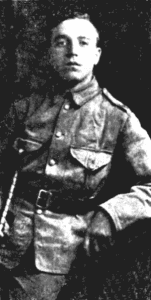
At the amateur level, arguably the best players competed in the first and second divisions of the Ashton & District League which had 1,270 players registered in 1914.[2] The quality of football in the league was so good, and local interest so strong, that the 1914 final of the Lady Aitken Challenge Cup, contested between Droylsden and Mossley, (played at Hurst Cross), netted gate receipts of £168 12s 4d which was reported to be a record for any amateur cup final in and around Manchester.[3] Private 1150 Fred Armitage, formerly of Hurst FC, played in that final for the victorious Mossley team.
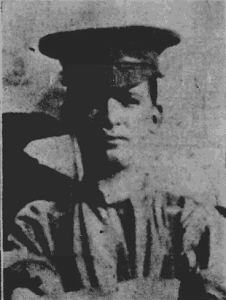
The Hooley Hill Sunday School League also had teams of reasonable quality with the limitation that squads had to be formed from actual members of the particular Sunday School. The 1914 Colonel John Wood, M.P. Challenge Cup, contested between Carrbrook St. James and Hooley Hill United Methodists (known as the “Independents”) was played at Stalybridge Celtic’s football ground at Bower Fold and attracted a fairly good crowd. Private 1217 Harold Cook, described in the local newspapers as one of the smartest junior footballers in the district and a prolific goal scorer, played for the narrowly defeated Independents in that two-legged final.
At youth level Ashton, Stalybridge and Dukinfield all had their own “Lads’ Leagues” with Ashton also having a Junior League and a Schoolboys League. The Reporter Group of Newspapers sponsored the Reporter Challenge Cup, contested for in the Ashton Lads’ League which was initially devised “in order to encourage sport among youths”.
Egypt 1915
In April 1915, the Ashton Reporter published a letter from Lance-Corporal 2232 George Jacob Howell, who was previously employed on the highways of the Ashton Corporation but was also a well-known referee (affiliated with the Manchester County F.A.) overseeing matches in the Ashton and District League and the Hooley Hill Sunday School League. At 32 years of age, Howell was an Old Volunteer and one of the handful of men who attested on September 8, 1914 immediately before the battalion left for Egypt.
His letter bragged that the battalion’s A Company had “the best team in Egypt at the present time”, a claim which was not obviously backed-up by their limited fixture list: 9th Battalion B Company (twice) 2-1, 2-0; 9th Battalion D Company (twice), 0-0, 2-0; Royal Army Medical Corps, 4-0; 5th East Lancs Battalion 4-3, 6-0, and Australians, 5-0.
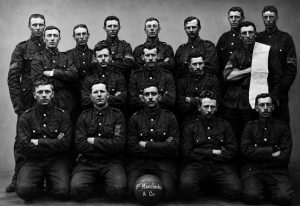
Obligingly, he provided a team photo and a list of players:
9th Manchesters, A Company Football Team April 1915
Top row, reading from left to right: Sergt. Scott (Committeeman), G. Howell (Ashton and Hooley Hill referee), J. Seddon (Denton Rovers), J. Martin (Waterloo), J. Turner (Reddish), Sergt. Grantham (Committeeman), and Corporal Travis (Ashton).
Middle row: W. Murphy (Ashton Oak), J. Williams (Haughton Rovers), J. Ratcliffe (Haughton Rovers), H. Allen (Dukinfield Hall), and A. Lees (Trainer).
Bottom row: Lance-Corpl. Parkins (Denton Rovers), J. Earnshaw (Haughton Rovers), “Sandy” Jackson (Denton, Hurst and Celtic), A. Broadhurst (Ashton St. Peter’s), and H. Broadhurst (Ashton St. Peter’s).
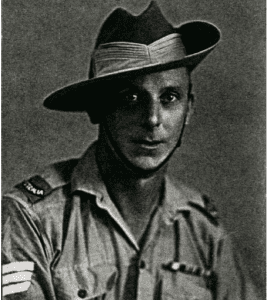
Without a doubt, the best player on the team was Pte. 2160 Thomas “Sandy” Jackson sitting front-row center with the ball. He started his senior playing career with Hurst FC (now Ashton United) in 1910 but switched to Stalybridge Celtic, playing for them from 1911-1913, and finally to Denton in 1914. He was a proper player, deployed at inside half-back and a regular goal scorer, widely reported in the press during the pre-war years, particularly Celtic’s 1912 season.
During 1913-14 Ashton St. Peter’s, Haughton Rovers and Waterloo were all playing in the Ashton and District League, 1st Division while Reddish were in Division 2. Players from those teams included: Pte. 2126 Pte James Martin, Pte J Turner, Pte 1201 James Williams, Pte 1147 James Ratcliffe, L/Cpl. 1000 James Earnshaw, and two brothers Pte 1184 Albert Broadhurst and Drummer 1160 Harold Broadhurst. Pte. 1303 Harry Allen played for Dukinfield Hall Primitives in the West Division of the Hooley Hill and District Sunday School League.
Pte 1916 John Seddon, L/Cpl. 1281 John Travis, Pte William Murphy and L/Cpl. 497 Alfred Parkins made up the rest of the team while Sgt 164 Alfred Scott and Sgt 969 Harry Grantham along with Pte 1243 Arnold Lees, managed and coached them.
Shortly after the article was published the East Lancashire Division deployed to Gallipoli.
Gallipoli
Throughout the campaign the Ashton Reporter would regularly add short biographical notes about the subject of the letter or article being published, sometimes providing a reference to their prior footballing prowess.
Private 1217 Harold Cooke, wounded June 9, 1915. Described in the local newspapers as one of the smartest junior footballers in the district and a prolific goal scorer, played for the Independents in the final of the Colonel John Wood Cup in 1914.
Private 2192 John (Jack) Jones, Killed in Action June 13, 1915. Played with the Dukinfield Primitive Methodist Football Club in the Hooley Hill and District Sunday School League, West Division.
Lance-Corporal Gerald Massey, Killed in Action June 19, 1915. Played with the Ashton United Methodist Football Club in the Hooley Hill and District Sunday School League, West Division.
Private 1803 James Ryder, Killed in Action June 19, 1915. Played for Holy Trinity Boy’s Brigade Football Club.
Corporal 508 Harry Gibson. Killed in Action June 19, 1915. Was secretary of the St. Gabriel’s Church, Cockbrook football club who played in the Hooley Hill and District Sunday School League, East Division.
Lance-Corporal 1769 Herbert Barratt, Died of Wounds June 28, 1915. Played for Dukinfield Celtic of the Ashton Lads’ League when they won the Reporter Cup in May 1912.
Private 2202 John (Jack) Hague, Died of Disease (Enteric Fever) July 3, 1915. Played for Hurst United Football Club of the Ashton Lads’ League, North Division.
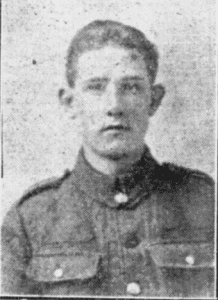
Private 1150 Fred Armitage, Wounded (bullet to the wrist) July 9, 1915. Similar to “Sandy” Jackson, he was a talented player who started out with Dukinfield St. Marks but quickly graduated to a much higher-level with Hurst FC and then turned out regularly as half-back for Mossley in the Ashton and District League, Division 1. He was a member of the Mossley side which won the Lady Aitken Challenge Cup in 1914 and who came 2nd in the league’s Division 1 in the 1913-14 season.
Private 2236 Albert Hesketh. A well-known footballer who played for Ashton and Dukinfield clubs.
Private 2742 James Speddings, Killed in Action August 8, 1915. He was just 16 years old. Well-known in junior football circles, having played in a number of matches in the Dukinfield Lads League.
Corporal 180 Samuel Bayley, awarded the Distinguished Conduct Medal for actions at the Battle of Krithia Vineyard, August 7-9, 1915. A member of the Ebenezer Baptist Sunday School (Cross Leech Street), Stalybridge and the goalkeeper of the football club. Although apparently not quite good enough to get on the A Company football team in Egypt in 1915.
Company Sergeant Major 806 Cornelius Finch was secretary to the Dukinfield Association Football Club which played in the Ashton and District League, Division 1. He was reported to have five committeemen in his Company: Privates 2142 James McDonald, 2385 Frank Scrambler, 1613 Edward (Ted) Jones, 1187 William Kinder and 1465 James Pye. Private McDonald later succeeded Sergeant-Major Finch in the office of secretary to the Dukinfield F.C.
Private 2499 Percy Taylor, wounded in the left leg and right thigh on September 2, 1915 resulting in amputation of his leg on the Hospital Ship Delta, en-route to England. “He was a member of the United Methodist Church, Stamford Street, and took a great interest in the football club which played in the Hooley Hill and District Sunday School League, West Division. He was a capable and clever player, and well-liked by the team.”
Private 2897 Harry Clegg, Killed in Action September 4, 1915. Attended St. Gabriel’s Sunday School, Ashton and was a member of the St. Gabriel’s football team, (who played in the Hooley Hill and District Sunday School League, East Division) and a member of the cricket team.
Private 2710 Frederick John Bacon, Died of Disease (Enteric Fever) on September 28, 1915. Reportedly “has done much good work on the football field, both at Dukinfield and the Celtic ground at Stalybridge.”
Lance-Sergeant 2139 Gilbert Higham, Died of Wounds on October 7, 1915. Was well known in the local Sunday school football circles, having played for the Stalybridge Unitarians, (who played in the Hooley Hill and District Sunday School League, First Division), until just before the war broke out.
Private 3241 Alfred Metcalf, Killed in Action December 19, 1915. Was associated with the Hooley Hill Independent School, and belonged to the football team, having played for the Reporter Challenge Cup.
Private 2968 Joe Downs, Killed in Action December 19, 1915. A well-known footballer in the district as goalkeeper for the United Methodist Sunday School, Booth-street, Stalybridge who played in the Hooley Hill and District Sunday School League, East Division.
Dardanelles Cup
In October 1915, 8th Corps announced that a “Dardanelles Cup” would be contested between football teams from the 42nd (East Lancashire) Division, 52nd (Lowland) Division, Royal Naval Division and ‘Other Units’. The competition would be played across four groups, the winners of each group meeting in the semi-finals.[4] Within the 42nd Division, initial rounds were played to determine brigade champions each of who would then compete to become Division champions. The 10th Manchesters were the 126th Brigade winners defeating the 9th Manchesters in the second round 4-3 followed by a 3-2 victory over the 5th East Lancs Regiment, who had been hammered 6-0 by the 9th Manchesters’ A Company in Egypt.
There is no record of who made up the 9th Battalion football team but Pte Fred Armitage, the Mossey FC stalwart, was certainly not present as he had been wounded in the wrist on July 9 and repatriated to England on August 6, 1915. “Sandy” Jackson had also sustained a bullet wound to his right hand in July but there is no record of him being repatriated. Similarly, Harold Cooke of the Independents had been wounded on June 9 but was not repatriated.
The 10th Manchesters progressed to become the 42 Division champions but were knocked out in the semi-finals 2-0 by the ultimate Cup winners. The final was played at Mudros on January 13, 1916, the Anson Battalion of the Royal Naval Division beating the 5th Battalion Highland Light Infantry of the 52nd Division.
The 10th Manchesters were finally presented with their Division winners medals at a battalion parade in August 1916 in Pelusium, Egypt.
Egypt 1916
In mid-1916 the battalion fielded a football team in a cup competition sponsored by the Y.M.C.A. and contested between teams from the 42nd Division. The 9th Manchesters won the cup by beating teams over three rounds, a semi-final and final. Major-General Sir William Douglas presented the cup to Lieut. Arthur Norman Lechler of the 9th Battalion team on behalf of the Y.M.C.A.[5]
The battalion’s results were:
1st round: v. 4th East Lancashire Regiment; won 7-0.
2nd round: v. 5th East Lancashire Regiment; won 2-1.
3rd round: v. 5th Manchester Regiment; draw 1-1 followed by a 2-1 victory in the replay.
Semi-final: v. Cumberland R.F.A.: won 2-0.
Final: v. 1st East Lancashire Ambulance; won 4-0.
The fixtures imply that the other team of the 126th Infantry Brigade, the 10th Manchesters, went out in the first round to the 5th East Lancs, a team they had beaten 3-2 in the Dardanelles Cup.
The 9th Manchesters team included the ubiquitous “Sandy” Jackson from A Company’s undefeated pre-Gallipoli team:
Goal, Martin (formerly of Ashton Oak); right full-back, Lee (Ashton St. Peter’s); left full-back. 1491 Fred Genders (Audenshaw C.L.B.): right half-back, Eastham (Charlestown Mission); centre half-back T. Ratcliffe (Haughton Rovers): left half-back, J Davies (Mossley A.F.C.): right outside. F. Cooper (Hooley Hill Albion); right inside, “Sandy” Jackson (Hurst and Stalybridge Celtic): centre forward. Lieut. Lechler (Manchester University); left inside, W. Drinkwater (Ashton P.S.A.); left outside, A. Jones (Hulme Athletic).
Post-War Football
The 9th Battalion Manchester Regiment was reduced to a training cadre in April 1918 after the 66th Division’s losses in the 3rd Battle of the Somme. After the war, permission to reconstruct the battalion was not given until September 1919 and even then, orders to reform were not issued until a year later. During the interim, former officers and men of the battalion kept in touch through reunion dinners and other social events. Nevertheless, an impromptu football team was evidently assembled and invited to compete in the Ashton Charity Cup of 1919, an annual competition whose net proceeds were subsequently distributed to local worthy causes. The battalion’s team was about to be peripherally involved in a local footballing controversy.
National Gas Engine AFC, (known locally as “The Nash”), were founded in August, 1918, as the works team for the National Gas Engine Company which had provided one officer and several men for the 9th Manchesters during the war.[6]The intention was to field a side in the Manchester Amateur League and it was reported that the business employed several well-known players and would be able to turn out two good teams each week.
The National Gas Engine Company, knowing that success on the football field would generate positive publicity for the business was willing and able to spend money to help ensure that success. One of the first times it did so was during that inaugural season of 1918-19.
The Nash, made a strong start by finishing third in the Manchester Amateur League and reaching the last four of the league cup. They also reached the semi-finals of the Ashton Charity Cup where they found themselves facing Stalybridge Celtic Reserves, who had reached the semis after beating Mossley in front of 6,000 spectators at Bower Fold.[7] Meanwhile, the 9th Battalion team beat Hurst FC reserves, at Hurst Cross, in front of a crowd of 4,000 in the other semi-final.
Celtic, backed by wealthy mill-owner Herbert Rhodes, were a powerful and ambitious club who would go on to become founder-members of the Football League’s new third division (North) in 1921. National responded to the challenge creatively, by drafting in two Manchester City forwards — Albert Fairclough and Horace Barnes — and won 3-2 to register a major upset. Fairclough was a competent professional but Barnes was one of the stars of the day. In 1914 City had signed him from Derby County for a record £2,500 and he went on to score 120 goals in 218 appearances. Match reports of their semi-final noted him “playing magnificently” and scoring all three goals in the National’s victory over Celtic.
The executive committee of the Ashton Charity Cup met immediately after the match and while admitting that they had sanctioned “guest players” in The Nash’s first round tie against New Moss Colliery and acknowledging that Celtic, although not agreeing to Barnes and Fairclough playing had agreed to abide by the result, nevertheless ruled that Barnes and Fairclough were ineligible, and ordered a replay in which National should field “eleven bona-fide” players.[8]
But National refused to comply, arguing there was nothing in the rules to preclude what they had done. Their intransigence caused them to be summarily expelled from the competition and Stalybridge Celtic Reserves took their place in the final where they thrashed the 9th Battalion Manchester Regiment 6-0 at Hurst Cross, watched by 7,000 spectators.
Undeterred, National bypassed the Charity Cup Committee and filed an appeal with the governing football associations. Just one week later a special joint-commission of the Manchester and Cheshire County FAs formed an Appeals Committee to hear National’s complaint. The Appeals Committee overruled the Charity Cup Committee’s earlier decision, stating that National had been within their rights to field Barnes and Fairclough since the Committee had previously allowed National to play two “imported players” in their victory against New Moss Colliery and had failed to rescind the rule that allowed them to do so. The final was ordered to be replayed and the Nash beat the doubly-unfortunate 9th Manchesters 3-1, (also at Hurst Cross but this time in front of a lessor crowd of 3,000), to lift their first ever trophy.[9]
Despite all the controversy, with such well attended games, the fundamental goal of the competition was met and the local community benefited from the subsequently distributed gate proceeds, swelled by the gate receipts from the second final.
[5] “1/9th’s Football Success”, Ashton Reporter, July 8, 1916.
[6] The National Gas Engine Co. Ltd. was founded by Mr. Henry Neild Bickerton in 1889. Henry’s nephew, Edward Balmford was commissioned into the second line 9th Battalion Manchester Regiment on May 5, 1915 and deployed to Gallipoli with the first line battalion on June 20.
[7] Manchester Evening News – Saturday 12 April 1919.
[8] “Ashton Charity Cup”, Manchester Evening News – Saturday 3 May 1919.
[9] “Cup Final Sequel”, Manchester Evening News – Friday 23 May 1919.
During the week of December 29, 1914 Captain Ralph Lees, in command of the Depot at Ashton, received orders to raise an additional 240 men for the newly reorganized 9th Reserve Battalion, Manchester Regiment in training at Southport. These men were recruited in just over a week, (January 4-13, 1915). Facilities were provided for training the men at the Ashton Golf links, and the Secondary School playing field near the Infirmary. The Brushes shooting range was used for firing practice. Captain George Makin and Lieuts. A.W.F. Connery and N. Wilkinson were transferred from the 2/9th Battalion at Southport to assist Captain Lees in the training of the men.[1]
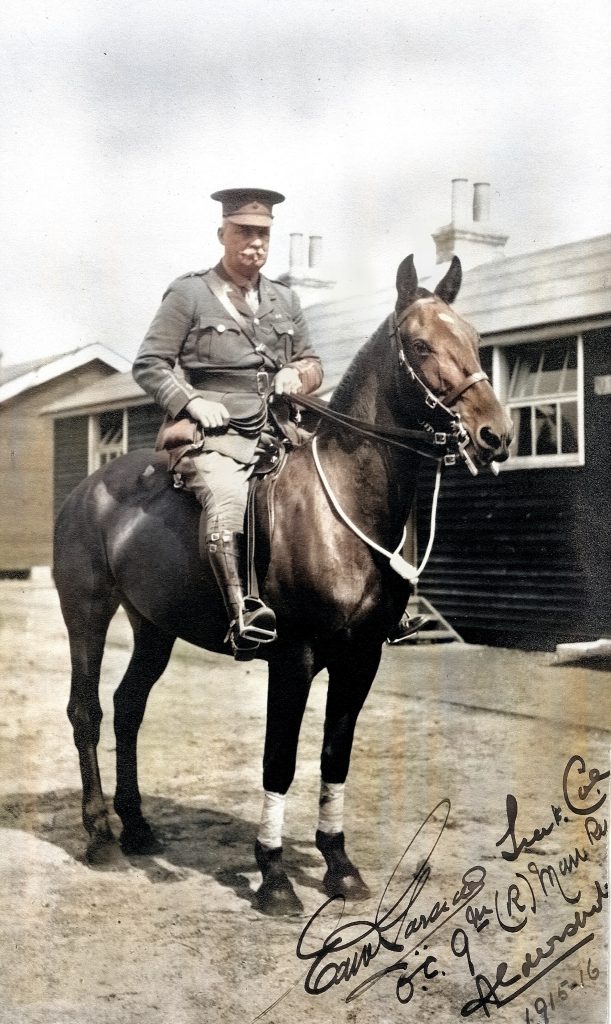
Major Edward Garside
On January 25th, 1915, Major (temp Lieut.-Col.) Edward Garside, having relinquished his temporary appointment as brigade major to the 2nd/East Lancs Brigade, was appointed to the command of the battalion depot at the Armoury and of the newly formed company of 240 men who were in training there.[2]
By Saturday May 1, 1915 the 240 men in training at Ashton had been designated as the nucleus of a new Territorial unit to be formed under the command of Major Garside at the Ashton Armoury. Of the 556 rank and file required, the names of 476 men had been enrolled up to the previous Thursday night, so that, exclusive of the officers, only about 50 or 60 men were required to complete the establishment. It was anticipated that this would be achieved by the end of the week (May 7, 1915).[3]
Move to Southport
By Saturday May 22, 1915 the third Territorial unit was fully established and an additional 100 recruits were being actively sought. These men moved from the Armoury at Ashton under Lyne to Southport on July 7, 1915 under the command of Lieut.-Col. Garside. There were in all 666 men on parade that day.[4]
Supplying Drafts
Meanwhile, in August the 2nd/East Lancashire Brigade was numbered the 198th Brigade and the 2nd/East Lancashire Division was numbered the 66th Division and they now formed part of the Second Army, Central Force. By the end of August all the home service men left the 2/9th Battalion, Manchester Regiment and only those men were retained who had Imperial Service obligations. This effectively ended the 2/9th Battalion’s role as an infantry feeding unit for Gallipoli, and those duties were now taken up by the 3/9th Battalion, Manchester Regiment.
October 22, 1915
On October 22, 1915 the 3/9th Battalion supplied a final large draft of men for the 1/9th Battalion, Manchester Regiment in Gallipoli. The draft consisted of 3 Officers and 134 Other Ranks who left Devonport on October 8, 1915 sailing on the Transport Ship DEMOSTHENES. In fact, embarkation records show that the DEMOSTHENES sailed with 3 Officers and 140 other ranks.
The following list of 121 men were part of this draft.
Rank
No.
Forename
Middle
Surname
Pte
3610
JOSEPH
BEAUMONT
Pte
3208
JOSEPH
WILLIAM SCHOFIELD
EVANS
L/Cpl
3233
ROBERT
HENRY
VINT
Pte
3286
ALBERT
SHAW
Pte
3311
ERNEST
JONES
L/Cpl
3334
THOMAS
RIDLEY
Pte
3341
EDWIN
BEECH
Pte
3353
JOSEPH
HYDE
Pte
3359
HARRY
JONES
Pte
3378
WILLIAM
HADFIELD
Pte
3394
JOHN
STANDRIN
Pte
3194
TOM
PLATT
Pte
3248
WILLIAM
HULIN
Cpl
3392
RICHARD
WRIGHT
Pte
3287
LEONARD
PENNINGTON
Pte
1328
WILLIAM
NOEL
BEACON
Pte
3306
ALBERT
GEORGE
OLD
Pte
3190
RALPH
PLATT
Pte
3192
JAMES
FRATER
Pte
3193
WALTER
SILCOCK
Pte
3196
PERCY
MARLAND
Pte
3201
JOHN
BROCK
Pte
3203
ARTHUR
BOOTH
Pte
3206
JOHN
ALFRED
CHADWICK
Pte
3210
THOMAS
MULLEN
HOWARD
Pte
3211
ROBERT
OGDEN
Pte
3216
WILLIAM
KINDER
Pte
3217
NORMAN
WHITTAKER
Pte
3218
JOHN
EDGAR
NEWTON
L/Cpl
3220
ROBERT
SHANDLEY
Pte
3222
JAMES
FALLON
Pte
3223
JOHN
FLETCHER
Pte
3224
JAMES
BUCKLEY
Pte
3225
HAROLD
MAYALL
L/Cpl
3232
ERNEST
GEORGE SPROSTON
NOKES
Pte
3237
HARRY
NAISH
Pte
3241
ALFRED
METCALF
Pte
3243
DAVID
HANSON
L/Cpl
3246
HARRY
LAWLER
Pte
3255
JAMES
ALBINSON
Pte
3258
ARTHUR
GREEN
Pte
3260
JAMES
WILLIAM
MANSFIELD
Pte
3262
THOMAS
WILMOTT
Pte
3266
HAROLD
TOMLINSON
Pte
3268
JAMES
MARLAND
Pte
3269
ALBERT
THOMAS
Pte
3276
WILLIAM
FREDERICK
POTTER
Pte
3279
HAROLD
SUGDEN
Pte
3281
JAMES
RALPH
FERNLEY
Pte
3283
JAMES
WHITEHEAD
L/Cpl
3284
NIMROD
HAIGH
Pte
3288
THOMAS
PENNY
Pte
3290
SIDNEY
WILLIAMS
Pte
3291
AARON
JONES
L/Cpl
3294
ARTHUR
ROWE
Pte
3295
EDMUND
LOMAX
Pte
3296
FRED
PEMBERTON
Pte
3297
ALBERT
POTTS
Pte
3302
JAMES
WATERFORD
Pte
3305
HARRY
RAYNER
Pte
3312
HAROLD
GREEN
Pte
3314
JAMES
CUNCAR
Pte
3315
HARRY
ROBERTS
Pte
3317
WALTER
DONE
Pte
3320
CAMPBELL
REECE
Pte
3321
JOHN
JAMES
BALLAGHER
Cpl
3322
JOSEPH
SIDNEY
HOLT
Pte
3323
HAROLD
WARBERG
Pte
3329
NORMAN
BRAMWELL
L/Cpl
3335
MARTIN
GATELEY
Pte
3338
WILLIAM
NALLY
Pte
3340
CLARENCE
BOOTH
Pte
3343
JOHN
EDWIN
TATE
Pte
3346
CHARLES
BOTTOMS
Pte
3347
WALTER
EASTWOOD
Pte
3351
ROBERT
WILLIAM
THOMAS
Pte
3355
SAMUEL
ALEXANDER
DAVENPORT
Pte
3356
SAMUEL
LEES
Pte
3357
FRANK
ROBERTS
L/Cpl
3358
HARRY
ANDREW
Pte
3360
ARTHUR
APPERLEY
Pte
3361
ROBERT
HARRISON
Cpl
3364
JAMES
MILLER
Pte
3365
JOHN
DUNKERLEY
Pte
3367
JOHN
GREENHALGH
Pte
3368
LEONARD
BROADHURST
Pte
3369
WILLIAM
WALKER
Pte
3376
MICHAEL
CUNCAR
Pte
3377
JAMES
LEAH
Pte
3379
THOMAS
FARRELL
Pte
3383
WILLIE
GREEN
Pte
3386
JOHN
DORAN
Pte
3387
JOHN
O’BRIEN
Pte
3389
PHILIP
DONNELLY
Pte
3391
HORACE
BENNETT
Pte
3395
FRANK
TAYLOR
Pte
3396
HARRY
GREGORY
Pte
3397
WILLIAM
WILKINSON
Pte
3398
WILLIAM
ALBERT
RUSSELL
Pte
3399
FRANK
HAMER
Pte
3400
JOHN
THOMPSON
Pte
3406
WILLIAM
HACKWELL
Pte
3408
FRED
ALLEN
Pte
3410
EDWARD
MERCER
Sgt
3411
JAMES
CLARE
Cpl
3413
HENRY
OGDEN
Pte
3414
WILLIAM
FEATHERSTONE
Pte
3415
GEORGE
PARKER
L/Cpl
3416
JOHN
HUGHES
Pte
3417
THOMAS
MITCHESON
Pte
3418
RALPH
SCHOFIELD
Pte
3420
HARRY
LOWE
Pte
3422
JOHN
JAMES
BOOTH
Pte
3423
ERNEST
BRADBURY
L/Cpl
3426
IRVINE
SCHOFIELD
Pte
3427
HARRY
MARSLAND
Pte
3608
ALFRED
JONES
Pte
3729
HENRY
THOMPSON
Pte
3765
FRED
WHITEHEAD
DICKINSON
Pte
3802
JAMES
HARRY
BROADBENT
Pte
3301
CHARLES
HENRY
WARD
One of these men, 3301 Pte. Charles Ward, has a Medal Index Card disembarkation date of October 25th but an examination of his service record reveals that his B.103 form was missing the disembarkation date and, upon request, the Manchester Regiment provided the next dated entry which was when he joined ‘B’ Company on October 25th. This neatly illustrates the problems inherent in compiling nominal rolls of men from inconsistently created medal rolls. Nevertheless, he was clearly a member of the October 22, 1915 draft.
On October 26, 1915 a draft of 11 Officers arrived in Gallipoli from England, via Alexandria, along with 110 Other Ranks returning from hospital treatment in Egypt. The Officers embarked HMT SCOTIAN at Devonport on October 13th, 1915 arriving at Mudros on October 24th, finally joining the Battalion on the 26th.
On December 1, 1915 a draft of 7 Other Ranks, (machine gunners), arrived from England having departed Devonport on the transport ship CALEDONIA on November 15.
Rank
No.
Forename
Middle
Surname
Pte
3717
JOHN
BURGESS
L/Cpl
3594
ERNEST
RILEY
Pte
3697
JAMES
GORDON
WHITEHOUSE
Pte
3705
MATTHEW
ELLISON
L/Cpl
3853
ALBERT
SHEPLEY
Pte
1084
JOHN
JACKSON
Pte
3289
CHARLES
HENRY
BROWN
This was the final draft of men supplied from England for the Gallipoli Campaign of the 1/9th Battalion, Manchester Regiment.
Move to Codford
At midnight on Monday December 13, 1915, the battalion entrained for a hutted camp at Codford St. Mary, Wiltshire. Sick and wounded men of the 1/9th Battalion who were medically repatriated to England from Gallipoli, were either discharged being no longer fit for military service or time expired, or after recovering at home, were sent to join the 3/9th Battalion. By Christmas 1915, around 280 such men were reportedly stationed there and formed an “Overseas Company” housed separately from the other members of the 3/9th who had not yet deployed overseas or experienced the hostilities.[5]
“Overseas Company” at Codford, 1916
In January 1916, as officers and men of the 1/9th Battalion continued to join the battalion at Codford, other men of the “Overseas Company” started preparing to be deployed back to the 1/9th Battalion in Egypt and to other units as dictated by the War Office. Lieut.-Col. D.H. Wade, now sufficiently recovered from his wounds from Gallipoli, arrived back in Egypt on January 27, 1916. Others, such as Lieut. F. A. Makin and Captain T. A. Platt were assessed as fit only for permanent home service and so joined the 3/9th Battalion and remained with them.
On March 18, 1916 it was reported that Lieutenant-Colonel R. B. Nowell, was temporarily in command of the 3/9th Manchester Regiment (Ashton Territorials) at Codford, in the absence of Lieut.-Colonel Garside, who was at that time temporarily engaged on other duties. Earlier that week a grand concert was held at Codford to bid farewell to a draft of ex-Gallipoli officers, senior NCOs and men returning to Egypt under the command of Col. Nowell along with men of the 3/9th battalion who were deploying overseas for the first time.
8th (Reserve) Battalion
On April 8, 1916 the 3/9th Battalion officially became known as the 9th (Reserve) Battalion and on September 1, 1916 the 9th and 10th Reserve Battalions were absorbed into the 8th (Reserve) Battalion, then located at Southport. The 8th (Reserve) Battalion, moved to Ripon in January 1917 and then to Filey, (Hunmanby), in June 1917 where they remained for the duration of the war.
The 8th (Reserve) Battalion maintained a presence at Filey from June 1917 until the end of the war and their primary purpose was to train reserve troops prior to their re-deployment on the Western Front. As such, it was also tasked with rehabilitating recuperating men in their transition from military hospital, to convalescent hospital, to Command Depot, to Reserve Battalion and finally re-deployment.
Major Edward Garside, no longer the battalion’s commanding officer, relinquished his temporary rank of Lieut.-Col. on November 2, 1916. On February 24, 1917 the Ashton Reporter noted that: Under the War Office Authority, dated February 9th, 1917, Major Edward Garside, the late commanding officer of the 9th (Res.) Battalion the Manchester Regiment, has been appointed permanent president of the Garrison Quartering Committee, Mersey Defences, and to be temporary Lieut.-Col. whilst so employed. He remained with the Mersey Defences for the duration of the war.
Notes:
[1] “Recruiting Record in Ashton” published January 16, 1915 in the Ashton Reporter.
[2] “Ashton Notes” published February 13, 1915 in the Ashton Reporter.
[3] “Lady Aitken at the Armoury” published May 1, 1915 in the Ashton Reporter.
[4] “3rd Ashton Territorial Battalion goes to Southport” published July 10, 195 in the Ashton Reporter.
[5] “The Ashton Territorial Overseas Men” published January 1, 1916 in the Ashton Reporter.
Acknowledgements:
Photographs of Lieut-Colonel Garside kindly provided by the Garside Family and remain their copyright. Please do not copy them without permission.
On the 9th of May, 1915 the 9th Battalion, Manchester Regiment, Territorial Force landed under heavy fire at Sedd-el-Bahr, (V Beach), and moved quickly from the beach into bivouac (HMT Commodore with the battalion’s Transport section and Brigade HQ arriving on the 10th).
The Nominal Roll of men of the 1/9th Manchesters landing on that day and the next included at least the following 915 men listed below.
In 1914 the East Lancashire Divisional Engineers were constituted as follows:
1st East Lancashire Field Company
2nd East Lancashire Field Company
1st East Lancashire Divisional Signal Company:
No 1 (Cable) Section at Seymour Grove
No 2 (Lancashire Fusiliers) Section
No 3 (East Lancashire) Section
No 4 (Manchester) Section
Sections 2, 3 and 4 of the Divisional Signal Company were created to serve each of the three brigades that made up the East Lancashire Division. The East Lancashire Brigade included the 4th and 5th Battalions East Lancashire Regiment and the 9th and 10th Battalions Manchester Regiment.
On August 15, 1914 the Reporter newspaper stated that 18 men of the No. 3 Section, East Lancashire Divisional Signal Company were attached to the 9th Battalion, Manchester Regiment for pay, rations, and discipline. The names given in the newspaper were:
Sergeant W. Walters, Lance-Corporal J. W. Challinor, Corporal J. Ardess, Privates H. Pinder, R. Noblett, H. Lomax, E. Bleasdale, L. Watson, E. Lewis, R. H. Boucher, J. Blackburn, A. Ling, W. Yates, H. Hunt, C. Heap, T. E. Riding, G. A. Hunt, and C. Allen.
It’s likely those men were:
Rank
No.
Forename
Middle
Surname
Sgt
244
WILLIAM
WATTERS
Pte
1064
ERNEST
CHARLES
LEWIS
Dvr
1153
HERBERT
HUNT
Cpl
1233
JOSEPH
ARDIS
L/Cpl
1247
JAMES
WILLIAM
CHALLINOR
Pnr
1248
RUDOLPH
HENRY
BOUCHER
Pte
1321
THOMAS
EDWARD
RIDING
Pnr
1322
CHRISTOPHER
HEAP
Pnr
1329
LEONARD
WATSON
Spr
1330
HENRY
PINDER
Spr
1340
JOHN
BLACKBURN
Pte
1350
WALTER
YATES
Pte
1363
CHARLEY
ALLEN
Pnr
1546
SYDNEY
ALBERT
LING
Spr
1579
ARTHUR
LOMAX
Pte
1581
GEORGE
ALBERT
HUNT
Spr
1610
RICHARD
NOBLETT
Spr
1845
EDWIN
BLEASDALE
All of these men appear to have come from Darwen and were members of the 4th Battalion East Lancs Regiment. And with the exception of Noblett and Watters, their 4-digit service numbers were those of the 4th East Lancs Regiment rather than the Royal Engineers, Territorial Force. This block of men includes three with surviving service records and two more with surviving pension records. From these remaining documents we can infer some things about the group as a whole.
Sgt. Watters’ service record shows that he was an Old Volunteer, joining the 1st Volunteer Battalion East Lancashire Regiment (Service Number 2414) on Feb 21, 1906. He transferred to the 4th East Lancs Regiment Territorial Force on April 3, 1908 and was assigned the service number 244. On September 10, 1914 he was both attached and simultaneously transferred to the East Lancs Royal Engineers Signal Company retaining his service number but this was now an RE (TF) number.
A review of 1247 James William Challinor’s service record shows that he attested on April 10, 1912 into the 4th Battalion East Lancs Regiment. He was embodied on August 5, 1914 and on September 10, 1914 was attached to the East Lancs Signal Company. 1248 Rudolph Henry Boucher’s service record shows that he followed the same path on identical dates. 1330 Henry Pinder’s pension record shows that he attested on August 28, 1912 into the East Lancs Regiment and states that he too was embodied on August 5 and then attached to the Royal Engineers TF on September 10, 1914. It should be noted here that September 10 was the date the East Lancs Division left England for Egypt but we know that these men were already attached to the No 3 Section, East Lancs Signal Company in mid-August as the local newspapers recorded. Consequently, it’s reasonable to assume that although the official date was the day they embarked for Egypt they had in reality already been assigned to the Signal Company some weeks before that.
Sapper 1610 Richard Noblett does not have a surviving service record but his medal roll indicates that he was one of three men from the Manchester Regiment who transferred to the Royal Engineers TF at the same time. The first of those three men, Harry Leland Pollitt, does have a surviving service record which shows he was an old Volunteer from Eccles who rejoined the 5th Battalion Manchester Regiment on September 14, 1911 and was assigned the Manchester Regiment service number 1295. His original discharge certificate, pre-dating his re-enlistment, shows that he was a trained signaller. He was embodied on August 5, 1914 and attached to the East Lancs Signal Company on August 12. On December 12, 1914 he was transferred to the East Lancs Royal Engineers, TF under authority of the Daily Orders Part II, East Lancs Royal Engineers, Southport. At this point he would have been assigned his new RE (TF) service number of 1608. It’s reasonable to assume that 1610 Richard Noblett was embodied, attached and then transferred to the RE (TF) on or around the same time.
1917 Re-Numbering
Changes to the numbering of the Territorial Force Royal Engineers was promulgated in Army Council Instruction (ACI) 2243 of 1916, published on 1 December 1916 and enacted in early 1917. The block of service numbers from 444001 to 446000 was allocated to the East Lancs Divisional Signal Company. Reviewing the new service numbers allocated to this cohort of men tells us something more about them.
Rank
Old No.
New No.
Surname
Comment
Sgt
244
444007
WATTERS
RE (TF) Re-numbered
Pte
1064
–
LEWIS
Wounded. Discharged 1916
Dvr
1153
444596
HUNT
Transferred to RE (TF)
Cpl
1233
–
ARDIS
KIA June 4, 1915. Gallipoli
L/Cpl
1247
426906
CHALLINOR
Wounded. Home Service.
Pnr
1248
165867
BOUCHER
Xfer to Regular Army RE
Pte
1321
444598
RIDING
Transferred to RE (TF)
Pnr
1322
444599
HEAP
Transferred to RE (TF)
Pnr
1329
444600
WATSON
Transferred to RE (TF)
Spr
1330
444601
PINDER
Transferred to RE (TF)
Spr
1340
444602
BLACKBURN
Transferred to RE (TF)
Pte
1350
444603
YATES
Transferred to RE (TF)
Pte
1363
200134
ALLEN
Transferred to 2/5th ELR
Pnr
1546
–
LING
DoW July 5, 1915. Gallipoli
Spr
1579
444605
LOMAX
Transferred to RE (TF)
Pte
1581
022657
HUNT
Transferred to RAOC
Spr
1610
444129
NOBLETT
RE (TF) Re-numbered
Spr
1845
444607
BLEASDALE
Transferred to RE (TF)
Note that since Sgt Watters and Sapper Noblett were already transferred to the Royal Engineers (TF) their new six-digit service numbers were most likely assigned by tenure according to their old RE (TF) service numbers and so fell outside the block assigned to the other men. All the other men of this group who transferred to the RE (TF) in early 1917 transferred as an almost contiguous block and their new numbers were assigned based on their old 4th East Lancs Regiment numbers.
There are no known surviving records that indicate how long any of these men remained attached to the 9th Manchesters but all deployed to Egypt in 1914 with two losing their lives in Gallipoli and at least two more wounded seriously enough there to be medically evacuated to England. After serving in Gallipoli, a further one was killed in France and four others were decorated for gallantry in the field, one winning the DCM.
Two of these men, Sgt. William Watters and Sapper Henry Pinder, provided exemplary service during the war and their stories are worth recording.
244 William Watters, MM, Croix de Guerre, MiD, TFEM
William Watters was born in Aughnacloy, County Tyrone, Northern Ireland in 1885. By 1891 his family had moved to Ashton under Lyne where Wiiliam’s father was employed as a police constable. By 1897 they had moved again, this time to Darwin where William was employed as a printer and paper stainer at Belgrave Mills, Darwen. William joined the 1st Volunteer Battalion East Lancashire Regiment on February 21, 1906 and subsequently transferred to the newly formed 4th East Lancs Regiment, Territorial Force on April 3, 1908. He initially signed-up for one year but extended his service for 4 years in 1909 and again in 1913. He attended all of the summer training camps and was promoted to Corporal in 1909 and Sergeant on May 15, 1912. In March 1914 he attended a 31-day training course in Visual Signalling (Morse) at the Army School of Signalling, Bulford and was found to be “very satisfactory”. He was mobilised on August 5, 1914 and moved to Chesham Fold Camp, Bury with the 4th Battalion, East Lancs Regiment later that month. On September 1st he signed his E.624 form agreeing to overseas service and on September 10 was transferred to the East Lancs Divisional Signal Company.
He sailed to Egypt with the East Lancs Division and subsequently deployed with them to Gallipoli on May 9, 1915. There he was mentioned in the despatch of Sir Ian Hamilton, Sept 20, 1915 (LG November 5, 1915). The East Lancs Divisional Signal Company left Gallipoli on January 1, 1916 and deployed to Egypt a month later. Sgt. Watters remained with the 42nd Divisional Signal Company for the remainder of the war and was awarded the Belgian Croix de Guerre (LG April 15, 1918), the Military Medal (LG 20 August, 1919) and the Territorial Force Efficiency Medal (Army Orders February 1919).
On June 18, 1918 he was seriously wounded when he received a gunshot wound to the Right arm and his arm was subsequently amputated at the shoulder. He was medically evacuated to England on July 5th and treated at the Whitecross Hospital, Warrington followed by the Alder Hey Military Orthopaedic Hospital, West Derby. He then spent some time at the Signalling School Training Center at Maresfield before being admitted to the Ministry of Pensions, Special Surgical Hospital Blackrock Dublin on December 9, 1920. He was discharged from the Army at the King George V Hospital, Dublin on January 8, 1921.
1330 Henry Pinder, DCM, MM
Henry Pinder was born in Darwen on January 23, 1891. He enlisted in the 4th Battalion, East Lancs Regiment on August 28, 1912 and was assigned the service number 1330. He was embodied on August 5th and then attached to the Royal Engineers TF. Privates Riding, Heap, Watson, Blackburn, Yates and Allen all enlisted in the East Lancs Regiment around this time, their service numbers spanning just 40 men.
Note: Pinder’s pension record states that he was “transferred” to the Royal Engineers on September 10, 1914 but this cannot be true. If he had actually been transferred, as opposed to attached, he would have been assigned an RE (TF) service number, which he was not. His pension record was collated and created when he was demobilsed in 1919 and it’s reasonable to assume that whoever collated his information at that time was not quite as precise with their terminology as they could have been.
He sailed to Egypt with the East Lancs Division and deployed with them to Gallipoli on May 9, 1915. On June 4, 1915 Corporal 1233 Jospeh Ardiss was reported missing in action, (later killed in action), and it appears that 1064 Ernest Charles Lewis was appointed acting Corporal in the field to replace him. Lewis joined the East Lancs Regiment in January 1910 and so had more than two years additional experience than Second Corporal James William Challinor.
On June 30, 1915 Sapper Pinder’s Engineer Pay increased from 6th rate to 4th rate. On August 16, 1915 he was promoted to Second Corporal replacing Second Corporal Challinor who suffered a gunshot wound to the neck and was medically evacuated to the 15th General Hospital in Alexandria. Corporal Challinor was then medically evacuated to England where he remained in hospital until November 15, 1915 when he was released on the obligatory 10 days furlough. The furlough notes that he was classed as permanently unfit for overseas service and he was assigned to the 71st Signal Company and thus assigned a different RE (TF) six-digit service number than his former comrades.
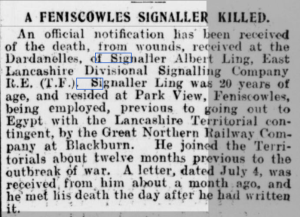
On July 2, 1915 acting Corporal Lewis suffered a gunshot wound to his right leg and was medically evacuated to the UK. Three days later, on July 5, Pioneer 1546 Syndey Albert Ling died of wounds and was buried at Lancashire Landing Cemetery.
Blackburn Weekly Telegraph – Saturday 21 August 1915
In England, acting Corporal Lewis recovered from his wounds but was classed as permanently unfit for military service and discharged on July 17, 1916. Consequently, he did not receive a six-digit Royal Engineers TF service number in early 1917.
Second Corporal Pinder was appointed acting Corporal, vice acting Corporal Lewis, on January 1, 1916 effectively upon leaving Gallipoli. He remained with the 1/1st East Lancs Division Signal Company in Egypt and on June 1, 1916 was promoted to Sergeant replacing Sergeant 764 Charles Alfred Ormesher (formerly of No 4 Section) who was invalided to England.
In early January 1917 Sgt Pinder injured his right hand and, after being transported by Ambulance Train down the newly laid railway from El Arish to Kantara, was admitted to the 24th Stationary Hospital in Kantara on January 9. He was subsequently transferred, probably by hospital ship up the Suez Canal, to the 31st General Hospital at Port Said 3 days later. On January 15, 1917 he officially transferred to the Royal Engineers (TF) and was allotted the six-digit service number 444601. It’s reasonable to assume that this was the date that all the other 42nd Divisional RE (TF) men transferred and received their numbers.
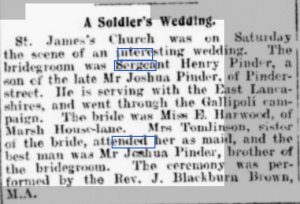
Sergeant Pinder rejoined the 42nd Divisional Signal Company from hospital on February 9, 1917 and on March 3, 1917 the Division sailed for France. In France he was almost immediately granted 10 days leave to the UK by order of the 126th Infantry Brigade HQ, which suggests that he was still attached to No 3 Section. While in England he took the opportunity to get married:
Blackburn Weekly Telegraph – Saturday 07 April 1917
Five months later, on September 18, 1917 he was awarded an additional 30 days home leave, possibly related to an act of gallantry in France.
With reference to the announcement of the award of the Distinguished Conduct Medal in the Honours Supplement to the London Gazette dated 1st January, 1918, the following are the acts of gallantry for which the decorations have been awarded:
444601 Sjt. H. Pinder, R.E. (Darwin). For conspicuous gallantry and devotion to duty. He has rendered excellent service during the past year, and has shown great skill and coolness at his work.
5 days after the Gazette was published, on April 22, 1918 he was awarded 14 days leave to the UK.
His pension record added that the Military Medal was awarded by the authority of the 42nd Division Routine Order Number 427, dated May 15, 1918.
On July 22, 1918 he was awarded leave but on August 4, 1918 while still on home leave Sgt Pinder became ill and was admitted to Queen Mary Military Hospital at Whalley suffering from dizziness and shortness of breath which he disclosed he had been suffering from since March. 17 days later he was somewhat recovered and transferred to King’s Lancashire Military Convalescent Hospital in Blackpool. He was eventually transferred and discharged from the Chester War Hospital and subsequently demobilized in early 1919.
Tying Up Some Loose Ends
Four men, 1321 Thomas Edward Riding, 1330 Henry Pinder, 1581 George Albert Hunt and 1845 Edwin Bleasdale have disembarkation dates of November 5, 1914 listed on their 1914-15 Medal Rolls. Three of those men, Riding, Pinder and Bleasdale had their original dates of September 25, 1914 struck out and the new November date overwritten. This contradicts Pinder’s pension record and his B.103 form which lists his embarkation date as September 10, 1914. In fact, it is quite common to see the date of November 5, 1914 on 1914-15 Medal Rolls for men who were already serving in Egypt (as the East Lancs Division was). The date corresponds to the date that England declared war on Turkey and so, by one reckoning, is the date that men already serving Egypt actually first served overseas in a combat zone.
The 6-digit number 444597 is not assigned to any man. This number would have been assigned to Rudolph Henry Boucher but he was transferred to the Regular Army Royal Engineers instead of the Territorials. It is possible that Boucher’s transfer to the regular army occurred at or around the same time as the transfer of the other men to the Royal Engineers and so his number was assigned to him but in the event was not actually used. Since these service numbers were allocated by tenure no other man could be retroactively assigned this number after it became “orphaned”.
The 6-digit numbers assigned to this cohort of men is contiguous from 444596 to 444603 and then 444605 and 444607. The two interlopers were 1568 William Dean who was assigned 444604 and 1786 Charles Entwistle who was assigned 444606. Their original 4-digit service numbers fit neatly into our cohort of men and so they would have been assigned those 6-digit numbers if they were members of the cohort and serving with the 4th East Lancashire Regiment. However, there is no evidence to connect them to the East Lancs Regiment. How then were their numbers assigned into this group?
In 1917 the Royal Engineers (TF) service numbers for the 42nd (East Lancs) Divisional Signal Company needed to be assigned to men who were already serving in the Royal Engineers (TF) and to others, from many different regiments, who had merely been attached to the RE (TF). These six-digit numbers appear to have been assigned first by tenure in the Royal Engineers (TF) to men who had joined directly and men who had been transferred after the outbreak of war. Thus, 244 Sergeant William Watters who transferred on September 10, 1914 was assigned the number 444007 and 1610 Spr Richard Noblett who transferred around December 12, 1915 received 444129. After all these RE (TF) men had been allocated their six-digit numbers the remaining men who had previously only been attached to the RE (TF), now transferred and were allocated numbers sequentially by ascending service number, regardless of their original battalion and regiment. The last of these men was 1884 Robert Harbour who received the number 444609
It’s worth noting that many of the 1914-15 medal rolls do not identify the original battalion and so the British War and Victory medal roll then incorrectly states that the service number was an RE (TF) service number.
The Ashton Reporter newspaper announced that the 9th Battalion Manchester Regiment appointed Lieutenant Frederick Arthur Makin as officer in charge of the machine gun section in its May 2, 1914 edition. Three months later the same newspaper published the nominal roll of the battalion including the current members of the machine gun section:
No
Rank
First
Middle
Surname
526
Sgt
Thomas
Moss
1364
Cpl
Frank
Howard
1285
Pte
Albert
MacCormack
1199
Pte
Thomas
Radcliffe
1353
Pte
John
William
Dodd
471
Pte
William
Fogg
1371
Pte
Abert
Edward
Neale
1360
Pte
John
Levi
Kendall
1903
Pte
Harold
Ellis
1157
Pte
William
Henry
Illingworth
1349
Pte
Robert
Bell
–
Pte
H
Cook
1354
Pte
William
Loyd
Shuttleworth
1325
Pte
Joseph
Kent
1314
Pte
John
William
Andrews
1274
Pte
John
William
Donnelly
Enlisted Men of the Machine Gun Section, Aug 1914
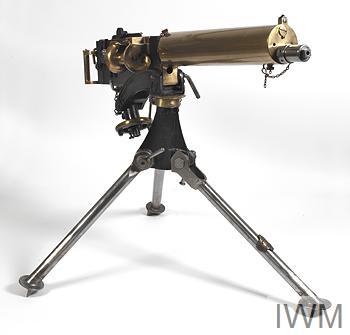
At this time, the battalion’s machine gun section consisted of two .303 calibre Maxim Machine Guns. The British-manufactured Service Maxim was used from late 1890s until its replacement by the Vickers Machine Guns that were introduced into British Service in 1912 and not declared obsolete until 1968. But by the outbreak of war only 109 of the new Vickers Machine Guns had been delivered to the Army.
It’s not possible to know precisely which model of Maxim Machine Gun the battalion was in possession of and so the following description is of a general nature.
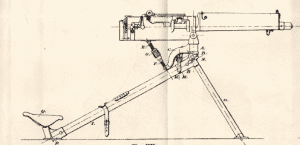
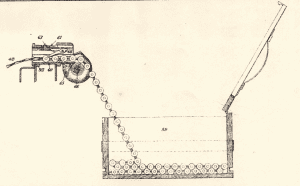
The Maxim Machine Gun operated automatically through a combination of two forces; the recoil generated from the explosion of the powder in each cartridge which pushed backwards and a strong spring which then pushed forwards. A sophisticated set of precisely calibrated and well lubricated mechanical components used this movement to eject the spent cartridge and pull the next live round into position ready to be fired. The gun was belt-fed from 250 round reusable ammunition belts, (made from waterproofed linen with brass strips and eyelets to properly set the ammunition spacing), and was capable of firing 450 rounds per minute (rpm) in rapid fire and a more sedate 70 rpm in controlled fire.
The Maxim was water-cooled, the gun-metal barrel casing holding about seven pints of water to keep the barrel cool when firing. It had three openings, one on the upper right side near the breech for filling, one underneath near the muzzle for drawing off the water, and the third for allowing the steam but not the water to escape. Steam was vented via a flexible tube into a can so that plumes of steam did not give the gun’s position away. When the barrel casing was filled with water about 2,000 rounds could be discharged at short intervals without replenishing, depending on the rapidity of fire. However, once the water started to boil, it evaporated at a rate of around 1 pint for every additional 1,000 rounds fired.
The Maxim Machine Gun was heavy and bulky, weighing 60lbs. When water was added for cooling it added almost another 10lbs. The tripod weighed around 48lbs and a fully loaded belt plus ammunition box weighed around 22lbs.
Maxim Machine Guns were operated by a crew of four to six men: The Gunner fired the gun; the Reloader quickly reloaded the gun when the 250 round ammunition belt was expended; the Spotter identified and directed fire towards enemy targets; the Ammunition and Water Carriers carried and prepared ammunition and water; and Mounters were responsible for moving and mounting the weapon on its tripod.
Gallipoli (May – June 1915)
When the 9th Battalion Manchester Regiment landed at Gallipoli on May 9, 1915 the machine gun section was already short two enlisted men. Pte 471 William Fogg and Pte 1349 Robert Bell were discharged on medical grounds in Egypt before the battalion sailed for Gallipoli.
Additionally, when Lieut. Sydney Marsden was wounded on June 6th, he was reported to be the Officer in charge of the machine gun section and therefore must have replaced Lieut. Makin either in Egypt or shortly after the battalion landed at Gallipoli. Lieut. Makin himself was medically evacuated from the peninsula the following day suffering from typhoid fever. And since Lt. Makin was the natural replacement for Lt. Marsden this caused a problem and the command of the machine gun section passed to Second Lieut. John Matley Robson who had only just arrived in Gallipoli on June 2nd having remained behind in Egypt serving as Officer in Charge of the Base, at Port Said, El Kantara, and Alexandria.
The machine gun section suffered another loss on June 9, 1915 when 1354 Pte. William Loyd Shuttleworth was killed in action. Sergeant 643 Squire Ellor had by this time taken over as senior NCO of the section, (vice Sergeant 526 Thomas Moss), and wrote the following letter to Pte. Shuttleworth’s mother:
“I am sorry to convey this message to you of your brave son’s death. He passed away early this morning. I cannot praise your son’s services enough as a machine gunner. He was a thorough master of his work, and as fearless as anyone in the section. We are very sorry we have had to part with him, but it is God’s will, and we cannot alter His works. Your boy died at his post. Only on Monday night last he kept awake for seven hours attending to two wounded comrades. He said to me that if he had to die, he hoped the Lord would not let him suffer in the way those two men had suffered. He died immediately he was shot. He was a credit to his battalion and his country. May he rest in peace.”
The newspaper report went on to say that Private Shuttleworth formerly worked at Ashton New Moss Colliery, (one of many men in the battalion from the Colliery), and he was killed shortly before his 21st birthday.
8 days later, Pte 1285 Albert MacCormack reported sick with Enteric Fever and was medically evacuated taking no further part in the campaign, eventually being repatriated to England on October 15, 1915.
Meanwhile, 2/Lt. Robson, having been appointed Officer in charge of the machine gun section without any prior experience or training, was ordered to report to the base depot at Gallipoli, behind the firing lines, where he underwent a 10-day course of instruction in the Maxim Machine Gun. He referred to this training in a letter he wrote on June 22, 1915:
“It’s much worse here than in the firing line. Shells are continually dropping round our dug-outs. You can imagine how difficult it is to concentrate your attention on what the instructor is saying when shrapnel and Jack Johnsons are flying round. The battalion has done exceedingly well, and has been praised by the generals, but the cost has been frightful.”
Gallipoli (July 1915)
2/Lt. Robson reported sick with Enteric Fever on July 7, 1915 and was medically evacuated to the 15th General Hospital at Alexandria where he died 10 days later on July 17, 1915. An old Boy of Manchester Grammar School, John Matley Robson was 23 years old. At this point the command of the machine gun section passed to Lieut. George William Handforth who transferred from B Company to C Company to temporarily take over command after they lost their entire group of officers who had landed six weeks earlier.
On July 12, 1915 Private 1501 George Markham, one of the men added to the machine gun section after the battalion arrived in Egypt, was killed in action. Remarkably, there is no mention of his death in the local newspapers save for a short family-supplied death notice:
In loving memory of our dear son and brother of Private Geo. Markham, 1/9th Manchester Regiment (machine gun section), aged 22 years, who fell in action at the Dardanelles July 12th, 1915.
We’ll not forget you, boy, who died for England. We’ll meet you once again in some far place; Where those we’ve loved and lost will greet us grandly. And tell us how you met death face to face.
And in mid-July the machine gun section lost their second gunner when Pte. 1157 William Henry Illingworth became sick from powder fumes from a Turkish lyddite shell and was medically evacuated to St. George’s Hospital, Malta for treatment. He remained in Malta for 3 months, (until at least late October), and likely returned to Gallipoli after he left the Għajn Tuffieħa Convalescent Camp there.
Machine Gun Section Replacements
Throughout their time at Gallipoli a small set of enlisted men were brought into the machine gun section to fill the holes left by the original members who were killed, wounded or sick. Since such assignments were not recorded on any service records or official records the men below are provided solely from newspaper reports.
No
Rank
First
Middle
Surname
643
Sgt
Squire
Ellor
1978
Cpl
Arthur
Spurrett
2049
Cpl
Charles
William
Gibson
2074
Pte
James
Hall
1968
Cpl
Arnold
Willerton
1985
Pte
Leonard
Smart
1534
Pte
Alfred
Edwin
Snape
1501
Pte
George
Markham
1667
Pte
John
Hill
Machine Gun Section Replacements 1915
Gallipoli (August 1915)
In August, the 9th Battalion Manchester Regiment was involved in the Battle of Krithia Vineyard (August 6-13) and the machine gun section suffered more casualties.
1353 John William Dodd, (now promoted to Corporal), suffered a bullet wound to the leg on August 7, 1915 and was medically evacuated to England where he spent time in hospital in Plymouth. He did not return to Gallipoli.
A few days later, on August 12, Corporal 2049 Charles William Gibson was also wounded when he took a bullet to the left knee. He too was medically evacuated to England but died on September 15, 1915 from septic poisoning. The September 25, 1915 edition of the Ashton Reporter in part stated:
Most impressive scenes marked the burial, on Saturday, of Corporal Charles William (Carl) Gibson, 23 years, of 342, Mossley-road, Ashton. Corporal Gibson, who was a fitter by trade, and formerly employed at the Patent Loom and Tape Works, Broadbottom, was wounded during, the severe fighting in the Gallipoli Peninsula on August 12th. He was attached to the machine gun section of the 1/9th Manchester Regiment. He was resting in the trench, and had fallen asleep, when he was struck on the knee by a poisoned bullet. Under a rain of lead his comrades carried him out of the trench. On August 29th he was admitted to the 2nd Military Hospital at Weaste, and after strong hopes had been entertained of his recovery he died on September 15th from septic poisoning and syncope.
The body was conveyed home from Weaste on Friday evening. At the interment on Saturday thousands of townspeople lined the streets. The burial was accompanied by full military honours Comrades of Corporal Gibson acted as bearers, and walked on either side the hearse, which was drawn by four horses. A firing party of 16 wounded and invalided Territorials back from Egypt and the Dardanelles were in command of Captain Lees. Lieut. Colonel D. H. Wade was also present.
On August 29, Pte 1314 John William Andrews, one of the original members of the machine gun section, died of wounds. He was buried the following day by the Reverend J.K. Best on a cliff overlooking Gully Beach.
Gallipoli (September – December)
2/Lt. Percy Ainsworth arrived in Gallipoli on Aug 19, 1915 as part of a draft of 4 Officers and 145 men and was allocated to C Company. On September 17th Capt. (temp) Handforth reported sick to hospital after being sick for some time and 2/Lt. Ainsworth took over command of the machine gun section. 2/Lt Ainsworth remained with the battalion until they evacuated the peninsula on December 27th and there is no indication that anyone else took over his command until he left the battalion in March 1916 when he joined the Royal Flying Corps in Egypt.
On December 12, 1915 the machine gun section suffered its final fatality of the Gallipoli Campaign when 18-year-old Pte 1534 Alfred Edwin Snape was killed in action. Born on December 30, 1896 Alfred joined the 9th Battalion Manchester Regiment a few weeks before his 17th birthday and turned 18 while they were training in Egypt. By the Army’s own regulations, he should not have been serving in a combat role at Gallipoli before his 19th birthday. Alfred had been wounded earlier in the campaign when he took a bullet to the thigh, (breaking a sixpenny piece in his pocket into three pieces), and was medically evacuated to Malta where he spent 3 months recovering. He had recently returned and was killed when a shell burst over his machine gun position. A letter of condolence was sent to his parents by his section NCO, Corporal 1968 Arnold Willerton, (himself only 18 years old when he landed in Gallipoli).
Egypt 1916
The 9th Battalion Manchester Regiment evacuated Gallipoli on December 27, 1915 and after a brief stop in Mudros arrived at Alexandria on January 17, 1916. They were taken by train to Cairo and from Cairo Station to Mena Camp by tram. A week later they moved to Tel-el-Kebir, located about 68 miles north-north-east of Cairo. Shortly after, they moved to El Shallufa on the Suez Canal, making camp on the East side of the canal. On February 10th they moved again, this time to El Kabrit, about 20 miles north of Suez where they remained for some time.
The 126 Company, Machine Gun Corps was formed by transfer of the battalion Machine Gun Sections of each of the four battalions of the 126th Infantry Brigade, 42nd (East Lancashire) Division. Throughout the Gallipoli campaign, Divisional Order of Battle and Field State reports consistently recorded that these four battalions were equipped with 2 machine guns each. However, since 28 men of the 9th Manchesters transferred, (with similar numbers from each of the 5th East Lancs, 4th East Lancs and 10th Manchesters), this indicates that the 126 Company’s machine gun count had doubled to 16 most likely with the addition of the newer Vickers machine guns.
Although it is widely accepted that the 126 Company, Machine Gun Corps was formed on March 14, 1916 the surviving service records of the 28 men of the 9th Battalion Manchester Regiment contradict this. Their service records indicate that they were transferred to the “Machine Gun Corps, 126 Bdge” on this date. These same men were all subsequently posted to the 126 Company, Machine Gun Corps on August 10, 1916. It is worth noting here that in military terminology that transferred meant a man had been permanently moved to another corps, while posted meant that a man had permanently moved to another unit of the same corps. This implies that the 126 Company was not actually formed until August 10, 1916.
During this period of transfer and posting, many of the men from the 9th Manchesters who transferred went through a formal 10-day machine gun training class at the Imperial School of Instruction, Zeitoun, (a suburb of Cairo), on June 23, 1916. At least three of them were awarded the proficiency badge of 1st Class Machine Gunner; Thomas Cronin Hardy, James Hall and Mathew Ellison.
Because the Machine Gun Corps was considered to be part of the Regular Army, all of the men from the Territorial Force who transferred had to effectively terminate their engagement with the Territorials and then re-enlist with the Machine Gun Corps. This, among other things, necessitated them undergoing a new medical examination by the Machine Gun Corps doctors to verify their medical eligibility. The paperwork that officially sanctioned their transfer was signed by Lt. Col D.H. Wade on September 29, 1916 while the 9th Manchesters were at Hod en Negiliat, (a “hod” is a plantation of date palms), en-route to El-Arish.
The 28 men of the 9th Battalion Manchester Regiment who transferred to the Machine Gun Corps on March 14, 1916 had all served in Gallipoli but only 3 were from the original 16 men of the machine gun section who left England on September 10, 1914.
No
MGC No
Rank
First
Middle
Surname
643
39621
Sgt
Squire
Ellor
1364
39622
L/Cpl
Frank
Howard
1968
39623
Cpl
Arnold
Willerton
3853
39624
L/Cpl
Albert
Shepley
1816
39625
Pte
Alexander
McKenzie
Whittet
1360
39627
Pte
John
Levi
Kendall
1515
39628
Pte
James
William
Cheetham
1880
39629
Pte
Thomas
Cronin
Hardy
2145
39630
Pte
Thomas
Lumley
1702
39631
Pte
Arnold
Myers
3705
39632
Pte
Matthew
Ellison
3717
39633
Pte
John
Burgess
3039
39634
Pte
George
Andrew
Brocklehurst
3224
39635
Pte
James
Buckley
1268
39636
Pte
Jesse
Edwin
Connolly
1891
39637
Pte
Joseph
Jackson
2883
39638
Pte
Albert
Loader
1330
39639
L/Cpl
Harry
Potter
2960
39640
Pte
John
Samuels
1667
39641
Pte
John
Hill
1573
39642
Pte
Sam
Entwistle
3301
39643
Pte
Charles
Henry
Ward
2074
39649
L/Cpl
James
Hall
1737
39650
Pte
Thomas
Rackstraw
2624
39651
Pte
William
Cooper
2549
39652
Pte
William
Matley
1325
39653
Cpl
Joseph
Kent
1695
39654
Pte
Alfred
Smith
Machine Gun Corps Men from the 9th Manchesters, 1916
Note: The rank shown is the rank held upon transfer to the Machine Gun Corps.
This group of men, (with two notable exceptions who were under the age of 19 when they landed in Gallipoli), were generally slightly older than the remainder of the battalion. But life in the Machine Gun Corps was dangerous and four men were later killed in action in France with another five being discharged due to wounds or sickness. Between the 28 men were two winners of the Distinguished Conduct Medal, three winners of the Military Medal and three awards of the Territorial Efficiency Medal and Territorial Force Efficiency Medal.
References:
Handbook for the 0.303″ Maxim Machine Gun (Magazine Rifle Chamber), 1901.
The Devil’s Paintbrush (Sir Hiram Maxim’s Gun) by Dolf L. Goldsmith.
A review of the WO 213: Judge Advocate General’s Office: Field General Courts Martial and Military Courts, Registers. Field General Courts Martial (1915) shows officers and men of the 1/9th Battalion Manchester Regiment were subjected to 32 cases of Courts Martial in Gallipoli and at least two in Egypt in 1916. The range of offences was quite broad resulting in punishments ranging from the loss of one day’s pay to a sentence of death.
In the late 1800s, Military law was codified by the Army Discipline and Regulation Act, 1879, which was subsequently replaced by the Army Act, 1881. This code of military law continued in force from year to year by an Annual Act, known originally as the Army (Annual) Act which both reaffirmed and provided amendments to the Army Act, 1881. In 1915, the practical application of military law applied in Gallipoli was outlined in the Manual of Military Law, published by the War Office, 1914.
The Army Act, 1881 defined, amongst other things, those offences that were punishable by death and those that were not, and offences that were punishable more severely on active service as well as the differences in punishments for officers and enlisted men. In practice, the offences that the men of the 9th Manchesters were charged with at Gallipoli included Theft, Disobedience, Absence from Camp, Sleeping on Duty, Quitting their Post, Disobeying Orders, Malingering and “Acting to the prejudice of good order and military discipline” – a catch-all offence for anything not explicitly defined in the Act.
In 1915 the British Army recognized three kinds of Courts Martial; Regimental, District and General. Each court held different power of punishments and only the highest, a General Court Martial, could award punishments of penal servitude or death. General Courts Martial required a minimum of five officers, ideally from different regiments and battalions with each having held their commission for at least three years. The president of the court was appointed by the convening officer and could not be below the rank of Major, with a higher rank strongly preferred if available. A Field General Court Martial is an exceptional kind of General Court Martial held overseas or on active service. Due to the exceptional nature of the court a Field General Court Martial required only three officers unless the convening officer was of the opinion that three were not available in which case, they were allowed to consist of only two. However, a court of only two officers could not award any sentence exceeding two years imprisonment or three months field punishment. Regardless, a sentence of death required the concurrence of all the members of the court.
The War Diary of the Deputy Judge Advocate General reveals that in April 1915 “Rules for the guidance of Officers called upon to convene Field General Courts Martial’ were prepared and issued with General Routine Orders. These were based on those in use in France, with a few additions.” Additionally, “notification was received as to the Suspension of Sentences Act, which was put into immediate operation, and the powers of a “Competent Authority” delegated as a preliminary measure to Divisional Commanders.”
In Gallipoli, verdicts and sentences rendered by the Field General Courts Martial for battalions in the 42nd (East Lancs) Division were reviewed by the G.O.C. 42nd Division and then by the G.O.C. 8th Army Corps. The courts held the responsibility of prosecuting the cases, rendering the verdicts and applying statutory sentences while the higher authority of the Divisional and Corps quashed, commuted, suspended or endorsed sentences to theoretically normalise the court rulings and apply some element consistency.
On May 21, the power to remit suspended sentences was delegated to Brigadiers, who were required to send a report as to the circumstances under which action was taken.
On July 25, Field Punishment No 1 was prohibited on the Gallipoli Peninsula. The DJAG adding that since it exposed the men to undue punishment, there being practically no situation on the Peninsula secure from shell fire, it was held that such a punishment was too severe, as well as being unfair to the men. At the same time, owing to the heat of the climate, Field Punishment No 1 was prohibited till the hour of 6 p.m. (18:00) in other stations under the command of the MEF.
Let’s look more closely at the offences that were tried and the punishments given out to the 9th Battalion Manchester Regiment in Gallipoli.
Offence: Theft
The 9th Manchesters landed at Gallipoli on May 9, 1915 and less than two weeks later two men were tried and convicted of theft. In order to prove the case, the court had to find an intention to steal and that the men fraudulently took property without the owner’s consent with the intent of permanently depriving the owner of said property. Whether the theft was from the military establishment or from a comrade we do not know but we can see that both men received a relatively light sentence of 14 days Field Punishment. Consequently, we can reasonably assume that the offence was proven but not considered particularly serious.
Rank
No
First
Surname
FGCM Date
Theft
FP
Pte
2208
GEORGE
PRICE
21-May-15
X
14 days
Pte
1660
HAROLD
GARTSIDE
21-May-15
X
14 days
Note:
There were two categories field punishment. Field punishment No. 1, which consisted of heavy labouring duties, and being restrained in handcuffs or fetters, and being tied to a fixed object, such as a post or wheel, for two or more hours a day. Field punishment No. 2 differed only in that the offender was not liable to be attached to a fixed object.
Offence: Sleeping on Duty or Quitting Post without Permission
Section 6 of the Army Act 1881, Offences Punishable more Severely on Active Service than at Other Times, point (1) sub-section (k) states:
(1.) Every person subject to military law who commits any of the following offences; that is to say,
(k ) Being a soldier acting as sentinel, commits any of the following offences; that is to say,
(i.) sleeps or is drunk on his post; or (ii.) leaves his post before he is regularly relieved,
shall, on conviction by court-martial, if he commits any such offence on active service, be liable to suffer death, or such less punishment as is in this Act mentioned.
Needless to say, when on active service in a combat zone, any soldier acting as a sentinel who either sleeps on his post or leaves his post before he is relieved commits a very serious offence endangering the lives of his comrades and jeopardizing the safety of his unit. Not surprisingly these offences are clearly called out in the Army Act, 1881 and carry a sentence of death or some other lower but serious penalty. In order to render a death sentence the three officers of the Field General Court Martial must be unanimous in their decision.
Rank
No
First
Surname
FGCM Date
Chg
Hard Lab
Remit’d
Pte
–
–
HARGREAVES
22-Jun-15
S
6m
Susp
Pte
1434
PERCY
LEE
22-Jun-15
S
9m
Susp
Pte
–
J
JACKSON
22-Jun-15
S
9m
Susp
Pte
1915
GEORGE
MURPHY
06-Jul-15
S
24m
Susp
Pte
1644
ARTHUR
ADSHEAD
09-Sep-15
S
Death
Comm
Pte
1693
ALBERT
ORTON
24-Sep-15
S
12m
Comm
Pte
1629
JOSEPH
WHIPP
09-Jul-15
Q
24m
Susp
Notes:
The Field General Courts Martial register provides only the surname and initials of the men charged and, in some cases, not even the initial. In the table above, “HARGREAVES” could be either Pte 1580 Norman Hargreaves or (more likely) Pte. 1952 Harold Hargreaves.
“J JACKSON” could be any one of three men; Pte. 1891 Joseph Jackson, Pte. 2169 John Jackson or Pte. 2171 John Jackson.
A suspension of punishment meant that the case was periodically reviewed and the punishment liable to be reinstated if the man’s subsequent behaviour warranted it, whereas commuting the sentence, although not erasing the conviction, permanently reduced or removed the punishment associated with it and was therefore not subject to periodic review.
Looking at each of these cases a little more closely:
The first three cases were brought approximately six weeks after the battalion landed in Gallipoli and on the same day that they returned to bivouac after almost 3 straight weeks in the trenches. A period that saw the two bloodiest days that the battalion would experience at Gallipoli. All three cases were for sleeping on post and since the case against Hargreaves resulted in a lower punishment than the others, we can conclude that court felt there were some mitigating circumstances there. Upon review by a higher authority, (the G.O.C. 42nd Division), all three sentences were suspended implying that the charges were primarily brought to make the point to all members of the battalion that potentially serious consequences awaited anyone caught sleeping on post.
But if that was the intent it didn’t have the desired effect because just two weeks later, Pte. 1915 George Murphy was convicted of the same offence and given a substantially harsher sentence of 2 years hard labour. This sentence, like the previous three, was subsequently suspended upon review. And a few days later, Pte. 1629 Joseph Whipp was convicted of leaving his post before being properly relieved, (the only man in the battalion to be so charged in the Gallipoli campaign), and received the same sentence of 2 years hard labour, again suspended upon review.
At this point it’s worth remembering that the Field General Court Martial date was the date of the trial and not the date of the offence, which was of course committed sometime earlier. June saw the biggest casualty figures for the battalion during the whole Gallipoli campaign and apart from a very small draft of one officer and 16 men arriving in late June the first substantial draft of men to bolster the dwindling numbers of combat ready men in the 9th Manchesters did not arrive until July 23, 1915. This perhaps played a role in the suspension of sentences as every able-bodied soldier was needed.
Pte. 1644 Arthur Adshead was the next man to be tried for sleeping at his post on September 9, 1915 and was found guilty and given a sentence of death. Without the trial transcripts we have no way to know why his case was treated significantly more harshly than the previous cases but the record shows that his sentence was commuted to 10 years of penal servitude. But we also know that Pte. Adshead went on to win the Military Medal in April 1918, (one of four men court martialed in Gallipoli to subsequently be awarded medals for bravery), while still serving with the Manchester Regiment and so we must assume that at some point the military authorities came to their senses and suspended the commuted sentence.
Pte. Adshead was incarcerated at the Gabbari Military Prison in Alexandria where he contracted dysentery and was admitted to the 19th General Hospital on October 16, 1915. He remained in hospital for 31 days eventually being released back to prison on November 15, 1915.
The last man of the 9th Manchesters to be charged with sleeping at his post was Pte. 1693 Albert Edward Orton. Fortunately, his service record has survived and it contains the following notes:
Deputy Judge Advocate General (DJAG), MEF September 24, 1915
Tried by FGCM Section 6(1k). When a soldier acting as a sentinel on active service, sleeping on his post in that he, in the field, on 6th Sept 1915 about 10:15pm when acting as a sentry in the trenches was asleep. Found guilty and sentenced to be imprisoned with hard labour for one year. (The Court recommends the accused to mercy on the grounds that he is very young and had been unreasonably overworked). Confirmed by G.O.C. 42nd Division who remitted six months of the imprisonment. Sentence commuted to one of Field Punishment No 1 for three months by G.O.C. 8th Army Corps dated October 13, 1915.
Battalion October 6, 1915
Awarded 10 days Field Punishment No 2 for absenting himself while on fatigue.
The court’s recommendation conveys two key pieces of information; that he was “very young” and that he had been “unreasonably overworked”.
Pte. Orton was an underage soldier who joined the battalion during the big recruiting drive of February 14, 1914 when he was 17 years old. After serving with the battalion in Egypt from September 1914 to May 1915 he was still only 18 years old when he landed in Gallipoli and would not turn 19 until September 11, 1915. By the military’s own regulations, he should not have been allowed to serve in a front-line combat role but instead should have been posted to a training or other unit behind the firing line. The battalion knew his age, he did not lie on his attestation papers, and deployed him into the firing line at Gallipoli anyway, along with dozens of other underage soldiers. Because of this, Pte. Orton celebrated his 19th birthday in captivity awaiting trial by Field General Court Martial and probably aware that the last man of the battalion who was charged with sleeping on duty received a death sentence.
Throughout their time on the peninsula the men and boys of the 9th Manchesters were required to work almost constantly on fatigue duties whenever they were out of the firing line. By September 6th Pte. Orton had been in Gallipoli for almost 4 months and had endured the most dangerous and difficult living conditions imaginable. The effects of poor food, contaminated water, intense heat and little or no ability to properly rest accumulated in all the men and dozens of them with less robust constitutions and fitness reported sick. To say that the men were unreasonably overworked was an understatement and in retrospect it would have perhaps been expedient to make sure that men held sentry duty in pairs to prevent sleeping.
It’s also worth noting that Pte. Orton went on to win the Military Medal for bravery in the field in April 1918 while still serving with the battalion.
Offence: Absence from Duty
Section 15 of the Army Act 1881, Absence from Duty Without Leave, points (1) and (3) state:
Every person subject to military law who commits any of the following offences; that is to say,
(1.) Absents himself without leave; or
(3.) Being a soldier, when in camp or garrison or elsewhere, is found beyond any limits fixed or in any place prohibited by any general garrison or other order, without a pass or written leave from his commanding officer.
shall on conviction by court-martial be liable, if an officer, to be cashiered, or to suffer such less punishment as is in this Act mentioned, and if a soldier, to suffer imprisonment, or such less punishment as is in this Act mentioned.
Rank
No
First
Surname
FGCM Date
Abs
Field Punish
Cpl
2765
WALTER
TRACEY
27-Jun-15
Q
Ranks
Pte
2719
GEORGE
DEAN
27-Jun-15
Q
60 days
Pte
2713
JOSEPH
TAYLOR
27-Jun-15
Q
60 days
Pte
2802
REGINALD
JONES
27-Jun-15
Q
60 days
Pte
1979
WILLIAM
COYNE
28-Aug-15
X
56 days 2
Pte
1345
ERIC
GOLIGHTLY
28-Aug-15
X
56 days 2
This charge was used against men who had either quit their assigned duty (‘Q’) or who had absented themselves from their assigned duty (‘X’). It could apply to men who left their trench without explicit permission to do so for any reason, including in the face of an overwhelming assault by the enemy that they stood no chance of repulsing and it could be used for men who had been assigned to a work party, or some other duty, and then failed to appear.
On Saturday November 6, 1915 the Ashton Reporter published an article written by an anonymous NCO of C Company which in part recounted some details of the bayonet charge on the night of June 18th:
During the period the company was in this trench “B” Company made an attempt on the 18th June to clear the Turks out of two small trenches, but they found the Turks in such great numbers that they had to retire, and the Turks charged our trench, which was held by a few of “C” Company and a number of 10thManchesters, and gained a footing in a part of it. Both Lieut. Wade and Lieut. Connery took part in “B” Company’s attack, volunteering for the job, and led portions of the men, but Lieut. Wade unfortunately failed to return when the company retired. It was a terrible night, and several attempts were made by various units to recover the ground lost, but without success. “B” Company lost heavily, and Capt. Sugden was mortally wounded.
The 9th Manchesters’ war diary noted that they suffered 9 killed, 17 missing and 33 wounded in addition to the loss of Capt. Sugden and 2/Lt. Jack Wade.
On June 26th thirteen men of the 10th Manchesters were court martialed under Section 15; four offences designated as ‘Q’ and 9 designated as ‘X’. All were found guilty and each one was awarded 14 days field punishment number 1. However, one of the nine, Pte. 2176 William Sidebottom has a surviving Service Record (mis-filed) which reveals that his offence was to absent himself from a working party “without leave and before he was relieved”. This implies that only the 4 men whose offence was recorded as ‘Q’ (quitting) were charged for the events of June 19.
The following day, four men of the 9th Manchesters were also court martialed under Section 15; all four offences designated as ‘Q’. Almost certainly they too were charged for their part in the events that night. Corporal 2765 Walter Tracey lost his stripe and the other three men were awarded 60 days field punishment number 1. All four had just days before arrived in Gallipoli as part of a small draft and were ill equipped to be thrust into the situation they found themselves embroiled in that night.
Later in the war, one of those men, Pte 2713 Joseph Taylor went on to win the Military Medal for bravery in the field, awarded in June 1918 after he had transferred to the Machine Gun Corps.
In late August, another two men were convicted of the same offence and were each given a sentence of 8 weeks field punishment number 2. One of the men, Pte 1345 Eric Golightly, was at the time only 18 years old and, like Pte Orton who was convicted of sleeping on sentry duty, should not have been in Gallipoli before his 19th birthday. However, unlike Pte Orton, there is no record of Pte Golightly receiving any clemency from the Divisional or Corps authorities for his age.
Offence: Disobedience
Section 9 of the Army Act 1881, Disobedience to Superior Officer, states:
Every person subject to military law who commits the following offence; that is to say,
Disobeys in such manner as to show a wilful defiance of authority any lawful command given personally by his superior officer in the execution of his office, whether the same is given orally or in writing, or by signal or otherwise, shall on conviction by court-martial be liable to suffer death, or such less punishment as is in this Act mentioned; and
Every person subject to military law who commits the following offence; that is to say, disobeys any lawful command given by his superior officer, shall, on conviction by court-martial, if he commits such offence on active service, be liable to suffer penal servitude, or such less punishment as is in this Act mentioned; and if he commits such offence not on active service, be liable, if an officer to be cashiered, or to suffer such less punishment as is in this Act mentioned, and if a soldier, to suffer imprisonment, or such less punishment as is in this Act mentioned.
Rank
No
First
Surname
FGCM Date
Chg
HL
FP
Pte
3345
GEORGE
HAMBLETON
09-Sep-15
S.9.1
18m
Pte
517
FRANK
CAWLEY
13-Mar-16
X
6m
L/Cpl
1792
ALBERT
DAVIES
09-Sep-15
Sgt
90d – 2
Pte
885
FRANK
GODDARD
22-Jul-15
SO
42d – 1
A/Sgt
1592
EDWARD
ALLOTT
25-Oct-15
SO
Note:
Acting Sergeant Edward Allot was found Not Guilty.
The Manual of Military Law. War Office, 1914 provides some guidance on the nature of this offence:
Closely connected with the offence of mutiny is the offence of disobedience to a lawful command, which is punishable under S. 9 of the Act (a). No offences differ more in degree than offences of this class. The disobedience may be of a trivial character, or may be an offence of the most serious description, amounting, if two or more persons join in it, to mutiny. Accordingly, the object of this section is to enable charges to be framed in such manner as to discriminate between different degrees of the offence.
Pte 3345 George Hambleton joined the 9th Manchesters on the 9th or 10th of January, 1915. He trained in the UK with the 2/9th Battalion at Southport and then Pease Pottage before landing in Gallipoli on August 22, 1915 as part of the second large draft of men that reinforced the 1/9th Manchesters. Within two weeks of landing, he must have committed his act of disobedience and was charged with the more serious offence of wilful disobedience. Found guilty he was sentenced to 18 months of hard labour.
Pte 517 Frank Cawley was a long-time member of the 9th Manchesters attesting on January 6, 1909. He attended all of the battalion’s summer camps from 1909 until the outbreak of war and had re-engaged for four more years on April 1, 1913. He deployed with the battalion to Egypt in September 1914 and landed on Gallipoli on May 9, 1915. His service record shows no evidence of being sick or wounded throughout the campaign and he subsequently deployed to Egypt in 1916 with the rest of the battalion. But something about him had changed on the peninsula and in January and February 1916 he was given 7-days confinement to barracks followed by 14-days of field punishment number 2 for two counts of “inattention on parade”. His service record then contains the following:
Tried by FGCM, El Kabrit, for when on active service March 6, 1916 (wilfully) disobeying a lawful command given by his superior officer in the execution of his office. Sentenced to six months imprisonment with hard labour. March 13 to September 12, 1916.
Sentence of 6 months imprisonment with hard labour now suspended. June 9, 1916.
He was released on June 15th but he continued to be written up for a series of minor acts of defiance, (late on parade, absent from parade, hesitating to obey an order), during 1916 and 1917. In 1918 he transferred to the 2nd East Lancs Regiment where he again committed a series of minor infractions (failing to salute the Regimental Sergeant Major, Insolence to the Regimental Police and falling out of line during a march without permission). In 1919, since he was still carrying a suspended sentence, his case came up for review and his commanding officer somewhat remarkably recommended that his sentence should be remitted since “his character has been very good (3 trivial offences) and he has carried out his duties in a willing manner and to the complete satisfaction of his superiors.” And indeed, his sentence was remitted by the Brigadier-General of the 100th Infantry Brigade on September 11, 1919.
L/Cpl 1792 Albert Davies joined the 9th Manchesters on February 16, 1914 which was the Monday immediately following the big recruiting drive. All of those men who attended the “Smoking Concert” at Ashton Town Hall on the previous Saturday but ran out of time to attest were told to report to the Armoury on February 16th. Albert was 17 years and 6 months old when he attested and gave his correct age. Consequently, he was still only 18 years old when he landed in Gallipoli and did not turn 19 until July 7, 1915. So, although he should have been held back in Egypt for two months before landing in Gallipoli, he was 19 years old when he committed his offence in September. He was found guilty and awarded 3 months of field punishment number 2. Based upon this sentence we can conclude that the charge against him was not one of wilful disobedience. Nevertheless, this means that he had just completed his sentence when, on December 19, 1915 he won the Distinguished Conduct Medal.
Pte 885 Frank Goddard was a long-time member of the 9th Battalion Manchester Regiment attesting in 1909 and by the outbreak of war he was a Lance Corporal. Nevertheless, on July 22nd 1915 he was convicted of disobedience to a senior officer and awarded 6 weeks of field punishment number 1. Based upon this sentence we can conclude that the charge against him was not one of wilful disobedience.
Offence: Malingering
Section 18, point (1) of the Army Act 1881, Disgraceful Conduct of Soldier, states:
Every soldier who commits any of the following offences; that is to say,
(1.) Malingers, or feigns or produces disease or infirmity shall on conviction by court-martial be liable to suffer imprisonment, or such less punishment as is in this Act mentioned.
More specifically, the Manual of Military War, 1914 specifies that Section 18.1b is Feigning or Producing disease or infirmity, (as opposed to malingering).
Rank
No
First
Surname
FGCM Date
Charge
Not Guilty
Pte
2328
WILLIAM
GODDARD
25-Aug-15
S.18.1b
X
Pte
–
J
JACKSON
25-Aug-15
S.18.1b
X
Pte
–
T
McCLUSKY
25-Aug-15
S.18.1b
X
L/Cpl
1553
HAROLD
MORRIS
25-Aug-15
S.18.1b
X
Notes:
“J JACKSON” could be any one of three men; Pte. 1891 Joseph Jackson, Pte. 2169 John Jackson or Pte. 2171 John Jackson.
There was no “T McCLUSKY; there was only Pte 2005 Francis (Frank) McClusky and Pte 2072 Henry (Harry) McClusky.
At the time of the Field General Court Martial on August 25, 1915 Major Thomas Frankish, RAMC was attached to the 9th Battalion Manchester Regiment as its Medical Officer, (M.O.), a role that he filled until he was transferred on August 31st. It is likely that the charges originated with him but no surviving records exist. Major Frankish was appointed the battalion’s M.O. just before they landed in Gallipoli replacing their long-time M.O. Surgeon Major Albert Hilton who died from meningitis in Egypt in February 1914. Thus, Major Frankish did not know any of the men and was likely not sympathetically disposed towards them. The assumption is that each of these men reported sick in late August, were examined by Major Frankish and summarily put on a charge. Since they were all found not guilty it’s possible that, left untreated, one or more of them became undeniably sicker by the time of the trial and were consequently exonerated.
Regardless of what actually happened, all four men were found not guilty, Major Frankish was transferred to the 1/3rd East Lancs Field Ambulance shortly thereafter and no more men of the battalion were charged with this offence throughout the remainder of the campaign.
Offence: Conduct to the Prejudice of Military Discipline
Section 40 of the Army Act 1881, Conduct to the Prejudice of Military Discipline, states:
Every person subject to military law who commits any of the following offences; that is to say,
Is guilty of any act, conduct, disorder, or neglect, to the prejudice of good order and military discipline, shall on conviction by court-martial be liable, if an officer, to be cashiered, or to suffer such less punishment as is in this Act mentioned, and if a soldier, to suffer imprisonment, or such less punishment as is in this Act mentioned. Provided that no person shall be charged under this section in respect of any offence for which special provision is made in any other part of this Act, and which is not a civil offence; nevertheless the conviction of a person so charged shall not be invalid by reason only of the charge being in contravention of this proviso, unless it appears that injustice has been done to the person charged by reason of such contravention; but the responsibility of any officer for that contravention shall not be removed by the validity of the conviction.
Rank
No
First
Surname
FGCM Date
Chg
HL
Remitted
Pte
1350
GEORGE
WILTON
11-Jul-15
S.40
12m
Susp
Pte
–
J
HAMPSON
20-Jul-15
S.40
12m
Susp
Pte
1658
JONATHAN
POTTER
03-Oct-15
S.40
12m
Comm
Table 1 – Serious Cases of Section 40
Note:
“J HAMPSON” could be either Pte 1246 John Hampson or Pte 1836 James Hampson.
Rank
No
First
Surname
FGCM Date
Chg
FP
Pte
–
E
JONES
16-Aug-15
S.40
1m – 2
Pte
2854
FRANCIS
HAWKINS
16-Aug-15
S.40
1m – 2
L/Cpl
2413
HERBERT
PARKINSON
16-Sep-15
S.40
42d – 1
Pte
3378
WILLIAM
HADFIELD
25-Sep-15
S.40
42d – 2
Pte
2174
HARRY
PRATT
03-Oct-15
S.40
56d – 2
Table 2 – Moderate Cases of Section 40
Note:
“E JONES” could be Pte 1613 Edward Jones, Pte 1897 Edward Jones or Pte 2073 Everett Jones.
The case against Pte. William Hadfield was quashed.
Rank
No
First
Surname
FGCM Date
Chg
Pay
CQMS
108
ROBERT
JACKSON
09-Sep-15
S.40
1d
Table 3 – Trivial Case of Section 40
Section 40 is a catch-all for offences that are not otherwise explicitly called out elsewhere in the Army Act, 1881. The Manual of Military Law, 1914 provides some interesting notes regarding the enforcement of charges under Section 40.
To sustain a charge under this section it is absolutely necessary that the charge should recite the words of the Act. That is to say, there must be charged an “act” or “conduct,” or “disorder,” or “neglect,” as the case may be, “to the prejudice of good order and military discipline.”
But the mere use of these words as a description of certain conduct does not warrant a court in assuming that such conduct is legally an offence. A court is not warranted in convicting unless of the opinion that the conduct charged was to the prejudice both of good order and of military discipline, having regard to the conduct itself and to the circumstances in which it took place.
Neglect must be wilful or culpable, and not merely arising from ordinary forgetfulness or error of judgment, or inadvertence; and where the use of certain words regarding superiors is made the subject of a charge under this section, the words must have been said meaningly, i.e., with a guilty intent.
In other words, to successfully bring a charge and convict a man under Section 40 the court must believe that he wilfully acted, conducted himself, or behaved with disorder, or wilfully neglected to do something the direct result of which was both to the prejudice of good order and of military discipline.
Three examples, amongst many others, provided by the Manual of Military Law, 1929 include; Negligent performance of duties connected with money or stores resulting in a deficiency and loss, Borrowing money from subordinates, and Accepting gifts an as inducement for arranging or excusing duties.
It is apparent from the sentences that the court saw the offences of Wilton, Hampson and Potter to be of a serious nature although it is notable that all three were either suspended or commuted by the Divisional and Corps authorities.
The offences committed by Pte. Jones and Pte. Hawkins resulting in 30 days of field punishment number 2 were comparatively minor transgressions and those committed by Parkinson and Pratt progressively more serious. Pte 3378 William Hadfield’s case was not of a particularly serious nature but his conviction was overturned by the Divisional and Corps authorities which was quite unusual.
Finally, we have the strange case of Company Quartermaster Sergeant (CQMS) 108 Robert Jackson of D Company, an Old Volunteer and holder of the Territorial Force Efficiency Medal. As one of the most senior and trusted NCOs of the battalion it must have been particularly galling and embarrassing for him to be tried by Field General Court Martial. Since no records survive, we have no way of knowing the nature of the charge but the sentence of a loss of 1 day’s pay indicates that whatever it was it should have been dealt with at the battalion level and not by Court Martial.
On December 21, 1915 2/Lt. Robert Jacomb Norris Dale was tried by Field General Court Martial with Conduct to the prejudice of good order and military discipline under Section 40 of the Army Act 1881. He had only arrived at Cape Helles on October 26 as part of a final draft of Officers from England but in civilian life he had a law degree and had worked as a solicitor for his father’s successful law firm in London. He was found not guilty and no records remain regarding the specifics of the alleged offence.
2/Lt. Dale holds the dubious distinction of being the only officer of the 42nd Division to be tried by Field General Court Martial in Gallipoli, (per Field General Court Martial Registers WO 90/6).
Lt. James Alfred Parker of the 9th Battalion Manchester Regiment was court martialed in Shallufa, Egypt on February 14, 1916 for “Disobeying CC”. He was found guilty and sentenced to be cashiered after 12 weeks hard labour. His sentence was remitted to 56 days at which point he was to be returned to the UK and dishonourably discharged from the Army.
The WO 90/6 Judge Advocate General’s Office: General Courts Martial Registers Abroad provides the following details:
Lt. J. A. Parker 1/9th Bn, The Manchester Regt (TF) Trial Date: 14th Feb 1916. Where Held: Shallufa Nature of Charge: Disobeying CC Sentence: Cashiered & 84 days Hard Labour Remitted: 56 days
The London Gazette of the 5th April, 1916 carried the following entry:
Manchester Reg’t. Lieut. James A. Parker is cashiered by sentence of a General Court-Martial. 29th Feb, 1916.
James Alfred Parker was commissioned into the 9th Battalion Manchester Regiment as a Second Lieutenant on 8th May, 1914. He sailed with the battalion to Egypt in September 1914 and there was promoted to Lieutenant. On May 9, 1915 he landed on Gallipoli as a platoon commander of B Company. He participated in the bayonet charge of June 18th and became acting Company Commander when Capt. Harold Sugden was mortally wounded. Just under 3 weeks later he was medically evacuated to Mudros suffering from enteric fever. He spent the next six months recovering at Mudros and Alexandria before rejoining the Battalion at Mudros on January 3, 1916. He rejoined the battalion on January 21, 1916 while they were at Mena Camp in Cairo. Although physically recovered, all was not well because just five days later he wilfully disobeyed the lawful orders of his Company Commander and was imprisoned pending a Field General Court Martial. On February 14, 1916 the court was convened in Shallufa where the battalion had now moved and he was found guilty. The sentence was subsequently remitted to 8 weeks by the G.O.C. 42nd Division and the record shows that after serving just 37 days of his sentence in Egypt he was returned to the UK to be cashiered.
Regimental Court Martial
On March 16, 1916 the 3/9th Battalion Manchester Regiment convened a Regimental Court Martial at Codford to try a Gallipoli veteran Cpl. 1205 Samuel Eyre with an offence under Section 40 of the Army Act, 1881. Corporal Eyre joined the 9th Manchesters on July 1, 1911 and was a Lance-Corporal when the battalion deployed to Egypt in September 1914. He served with them in Egypt and landed in Gallipoli on May 9, 1915. Just over seven weeks later he reported sick with enteric fever and was medically evacuated to Mudros and subsequently back to the UK on September 1, 1915. By October he was out of hospital and after a short furlough reported for duty with the 3/9th Manchesters. By early 1916, all of the 1/9th Battalion men who had been medically evacuated from Gallipoli, and had sufficiently recovered, joined the 3/9th at Codford forming an “Overseas Company”.
On March 11, 1916 Cpl. Eyre was absent without leave from Tatoo, (end of day call to barracks), and did not return for 19 hours, for which he was duly reprimanded. Three days later he was court martialed, charged under Section 40 of acting to the prejudice of good order and military discipline for smoking on parade. The court was ordered by Lt-Col. R.B. Nowell the acting Commanding Officer of the 3/9th Battalion and himself a Gallipoli veteran. The president of the court was Capt. N. Wilkinson of the 3/9th Battalion and the other two members of the court were Lt. W.T. Forshaw, V.C., and 2/Lt. C.E. Cooke both Gallipoli veterans of the 1/9th Manchesters. Capt. A.G. Birchenall, Adjutant of the 3/9th Battalion was the prosecutor. The charge was brought by C.S.M. 806 Cornelius Finch on the orders of 2/Lt. W.J. Ablitt. CSM 339 Mathew James Buckley made a short and mildly positive character statement on behalf of the accused. All three were Gallipoli veterans. There was no officer appointed to aid with the defence. Cpl. Eyre plead guilty and was reduced to the ranks.
Gallipoli Field General Courts Martial Summary
In all, 32 enlisted men of the 9th Battalion Manchester Regiment were court martialed in Gallipoli, five of whom were found not guilty and one had their conviction quashed. Nobody from the battalion was charged with cowardice or desertion. Half of the remaining cases were for sleeping or leaving without permission while on sentry duty or for leaving the trenches without permission. These cases generally resulted in the harshest penalties of imprisonment with hard labour and in one case death. All of these sentences were either commuted or suspended upon review but the clear intent was to send a message to all in the battalion. Contradicting the implication that this group of men were somehow of low moral fiber it’s important to note that at least two of them were underage and four of them went on to be decorated for bravery in the field.
259 Field General Courts Martial were held during the Gallipoli Campaign, (including a handful at Mustapha, Egypt and a couple at Mudros), for enlisted men of the 12 infantry battalions of the 42nd (East Lancs) Division. The 126th Infantry Brigade, that the 9th Manchesters belonged to, accounted for almost half of those cases and the brigade was responsible for more than half of all the cases of insubordination, disobedience and theft, thanks largely to the contribution of the 1/5th East Lancs Regiment. On a more positive note, the 126th Brigade accounted for only two of the nine cases of cowardice that were prosecuted by the 42nd Division.
Table of “standard” offences of a Field General Court Martial:
Section
Standard Offences
4
Cowardice
12
Desertion
10
Absence and Breaking out of Barracks or Camp
8
Striking or Violence to Superior Officer
10
Insubordination and Threatening Disobedience
6
Quitting or Sleeping on Post
19
Drunkenness
24
Injuring or Making away with Property, etc.
24
Losing Property, etc.
18
Theft
18
Indecency
10
Resisting or Escaping Escort
22
Escaping Confinement
Table of “miscellaneous” offences that the enlisted men of the 42nd (East Lancs) Division were charged with during the Gallipoli Campaign:
Section
Miscellaneous Offence
S.5.5
Spreading reports intended to create unnecessary alarm and despondency
S.9.1
Disobeying in such a manner as to show wilful defiance of authority
S.11
Neglecting to obey orders
S.12.2a
Attempting to persuade someone to desert
S.18.1b
Feigning or producing disease or infirmity
S.18.2a
Wilfuly injuring yourself or another soldier with the intent to render them unfit for service
S.20.2
Wilfully and w/o reasonable excuse allowing someone to escape who was in their charge or whose duty it was to guard
S.24.5
Ill-treating a horse
S.40
Any act, conduct, disorder, or neglect, to the prejudice of good order and military discipline
In addition to the enlisted men of the 1/9th Battalion Manchester Regiment, five Territorial Force (TF) Royal Army Medical Corps (RAMC) enlisted men from the 1/2nd East Lancs Field Ambulance were attached to the battalion and accompanied them to Egypt and Gallipoli. These five men were, for all intents and purposes, regular members of the battalion posted to a Company but who reported to the battalion’s Medical Officer, Surgeon Major Albert Hilton, RAMC.
Lance-Sgt. 176 Henry (Harry) Cooper, Pte. 179 Richard Cooper, Pte. 177 Joe Bridge, Pte. 270 Richard Handley and Pte. 317 Joseph Rothwell were all from Ashton and Dukinfield and were all former members of the battalion who had subsequently been posted to the RAMC. In their late twenties at the outbreak of war, at least three were former Old Volunteers (and one missed being an Old Volunteer by just a few weeks). Four of them also worked together at New Moss Colliery, Ashton and had done so for some years.
L/Sgt. 176 Henry (Harry) Cooper
Harry Cooper was born on July 4, 1886 in Dukinfield, Cheshire. His father Horatio Cooper was a Colliery engineer and by 1911 Harry was married with a son and a daughter, living in Dukinfield and employed as a below ground filler at New Moss Colliery. Harry was an Old Volunteer, serving with the 3rd Volunteer Battalion Manchester Regiment, and joined the Territorial Force on April 11, 1908 and was given the service number 176. At the outbreak of war, Harry Cooper was a Lance Sergeant in the RAMC and attached to the 9th Manchesters for war service. He deployed to Egypt in September 1914 and landed in Gallipoli with the 9th Manchesters on May 9, 1915.
The Saturday 04 September 1915 edition of the Ashton Reporter carried the following article:-
GALLANT DEEDS BY TERRITORIALS.
Two Dukinfield Men Honoured.
COUSINS CONGRATULATED.
Divisional Officer Commends Brave Action.
ATTENDED WOUNDED WHILE UNDER FIRE,
Touching Story of Men Found Lying in Dug-Out.
Lance-Sergeant Harry Cooper, Royal Army Medical Corps, who resided at 21, Peel-street, Dukinfield, and was a miner at New Mom Colliery, and became attached to the 1/9th Battalion Manchester Territorials with the Mediterranean Expeditionary Force at the Dardanelles, has distinguished himself by brave conduct in the firing line in a letter to his wife, dated July 27th, he says
“Twenty men and one officer arrived here from Ashton this week, but I only knew one, still it made one think of home. I see you have got it in the Reporter’ about Colonel Wade and the other two officers, but they are not the first, and, sorry to say, not the last. Up to now people at home have no idea what war is like, or some of the young men would hurry up, and so end it sooner. The sights I saw after one bombardment I shall never forget. All night and all day at our medical aid post the medical officer, Dick Rothwell, Bridge, and myself worked without any rest dressing wounded British, and also Turks who had surrendered. It’s first come first served. Since then, there have been two other big engagements, but not like the first, and I hope it will soon be over, and that with God’s help I may return home safe again. Enclosed is a certificate. Put it by for me, and keep it clean; you can have it framed if you like.”
“The General Officer commanding the 42nd (East Lancashire) Division congratulates Lance-sergt. Harry Cooper, RAMC., on the gallant action performed by him on June 7th, 1915.- William Douglas, Major General, commanding 42nd East Lancashire Div.”
“I got it along with Dick Cooper (his cousin, Private Richard Cooper, R.A.M.C., who resides at 2, Ogden-street, Dukinfield, now with the 1/9th Battalion Manchester Territorials in the Dardanelles) for going and dressing wounded.”
“I was asked if I would like to go and dress some wounded men. I went, and Dick followed me. We had to crawl on our stomachs along the open in front of the enemy’s lines under fire. We got in a dug-out, and found an officer and a sergeant wounded. They had been there three days. We dressed their wounds, but could not bring them back with us. I shall never forget how they cried after we left them. They begged us to take them out, but it was impossible, so we had to leave them, but as they had had nothing to eat or drink from being wounded, I went out again to them with something to eat and drink. Two days afterwards they got a road to them. The officer had died that morning, but the sergeant was alive, and is now in hospital.”
This card (certificate) was presented to us in recognition for what we had done, and I have only one regret, and that is that the officer died after all.
Note: The letter home was almost certainly written on June 27, 1915 not July as stated in the Reporter.
Harry was promoted to Sergeant effective June 1, 1915 perhaps, in part, for his actions that day. Since this created the need for a Corporal, Pte Joe Bridge was simultaneously promoted to Corporal.
Without a surviving service record we do not know the details of Harry Cooper’s remaining war service but we do know that he survived the war and did not apply for a war pension.
Pte. 179 Richard Cooper
Dick Cooper was born on February 21, 1887 in Dukinfield. His father Edward Cooper was a below ground miner and was the older brother of Harry Cooper’s father Horatio. By 1911 Dick Cooper was married with two sons, living in Dukinfield and employed as a hewer at New Moss Colliery. There is no surviving service record for Dick Cooper but based upon his Territorial service number of 179 he must have attested with the Territorial Force on or around April 11, 1908, with his cousin Harry, and was very likely himself an Old Volunteer. Dick Cooper had a younger brother, James Henry Cooper, who joined the 9th Battalion on Saturday February 14, 1914 on the evening of the Smoking Concert at Ashton Town Hall which was the culmination of a highly successful recruiting drive. The two brothers deployed to Egypt in September 1914 and landed in Gallipoli with the 9th Manchesters on May 9, 1915; Dick as a private in the RAMC and James Cooper as a private in C Company.
The Saturday 04 September 1915 edition of the Ashton Reporter article ended with:-
Private Richard Cooper, R.A.M.C., of 3, Ogden-street, Dukinfield, has also received a similar certificate from Major-General Douglas. In a letter to his wife, he says:
“Our James has been wounded, and he was sent away from here. I was told that his wound was not serious, but I do not know, for I did not see him, because I was in the other trenches dressing the wounded. I am sending a card (certificate) with this letter, and I want you to take care of it, because I want to have it framed. The officer says it will not be all that I shall get. It was for going out in the open and dressing five men, one sergeant, and one officer. Me and Harry (Lance-Sergeant Harry Cooper mentioned above) went out together, and we got a card apiece.”
Private Cooper was also attached to the 1/9th Manchester Territorials, and, like his cousin, was a miner at Moss Colliery before going out to the war.
Clearly the letter home from Dick Cooper was written before June 20, 1915 because the Saturday 03 July 1915 edition of the Ashton Reporter carried the following sad news:-
DIED OF WOUNDS Ashton Territorial Leaves Wife and Two Children
Official intimation has been received that Private James Henry Cooper, whose wife lives in Church- street, Ashton, and his mother and father in Peel-street, Dukinfield, has died from wounds received on the Gallipoli Peninsula. Private Cooper was in the Ashton Territorials. He has two other brothers in the Army, one in the R.A.M.C. Division of the Ashton Territorials, and the other in Kitchener’s Army. He leaves a wife and two children.
On Sunday morning the family and relatives attended St. Mark’s Church, Dukinfield, and also a number of men from the Armoury, as a mark of respect. The Rev. W. King, curate, delivered an appropriate sermon. In the evening a service was held at the Hill-street Mission, Dukinfield, when Mr. Kendrick, who had known Private Cooper from boyhood, delivered an address.
Prior to the outbreak of the war Private Cooper was a collier at the Ashton Moss Colliery, and had already been in the 9th Battalion 12 months. The last Mrs. Cooper heard from him was a week last Tuesday, when he wrote that he was quite well, and hoped she and the “kiddies” were the same. He added that he had seen some horrible sights since they had landed in the Dardanelles, and the bursting of shells all around and over them was terrible. The official intimation stated that he died on the 20th June.
Without a surviving service record we don’t know the details of Dick Cooper’s remaining war service but we do know that he survived the war and was granted a war pension for some minor disability caused by his war service.
Pte. 177 Joe Bridge
Joe Bridge was born on July 21, 1888 in Ashton under Lyne. His father Joseph Bridge was a minder at a Cotton Mill. By 1911 Joe was living as a boarder with the Mason family in Ashton and working as a piecer in a cotton mill. Joe eventually married Lilly Mason, the Mason’s oldest daughter, in early 1918 but in 1911 he was still single. Joe joined the 9th Battalion Manchester Regiment on May 13, 1908, having not previously served with the Volunteers, and was given the service number of 362. Six months later he transferred to the RAMC, Territorial Force but remained attached to the 9th Manchesters. With them he attended the summer camps each year (skipping the one at Aldershot in 1913) and re-enlisted for an additional four years on June 25, 1912. At the outbreak of war, he was a private in the RAMC and attached to the 9th Manchesters for war service. He signed his Territorial Force Agreement to Serve Overseas (form E.624) on September 1, 1914 at Chesham Fold Camp and deployed to Egypt with the battalion. Here he committed a couple of minor infractions in December 1914 (not complying with battalion orders) and March 1915 (absent without leave from camp overnight).
He landed in Gallipoli with the 9th Manchesters on May 9, 1915 and came through the campaign unscathed being promoted to Corporal, (effective June 1, 1915), upon the promotion to Sergeant of Harry Cooper. He remained with the battalion in Egypt in 1916 and once again committed a couple of minor infractions in April 1916 (not complying with battalion orders) and May 1916 (late on Parade). He became time expired on May 13, 1916 but was compelled to serve an additional year under the terms of his engagement with the Territorials. In March 1917 he sailed with the battalion to France and on May 13, 1917 was again required to continue in the service, this time for the duration of the war, under the terms of the Military Service Act, 1916. He took a short home leave in June 1917 and another longer home leave of 31 days in January 1918 when he married Lily Mason in a registry office in Ashton under Lyne. Shortly after his return to France he was transferred to the 5th Field Ambulance and did not rejoin the 9th Manchesters again. His new unit was not quite so tolerant of his minor infractions and so on August 19, 1918 he was reduced to the rank of private for “inefficiency”. On April 17, 1919 he proceeded to the UK to be demobilised which finally occurred on May 16, 1919. In 1923 he was. Perhaps somewhat ironically, awarded the Territorial Efficiency Medal implying that he may have rejoined after the war when the 9th Battalion Manchester Regiment was reformed in late 1920.
Pte. 270 Richard Handley
Richard Handley was born in Ashton under Lyne on September 10, 1885.By 1911 he was married, living in Ashton and working as a below ground filler at New Moss Colliery, like Harry Cooper. Richard was a former member of the 3rd Volunteer battalion Manchester Regiment but had since left the service. He enlisted in the East Lancs Royal Army Medical Corps, Territorial Force on January 7, 1914 and was given the service number 270. At the outbreak of war, he was a private in the RAMC and attached to the 9th Manchesters for war service. He deployed to Egypt in September 1914 and landed in Gallipoli with the 9th Manchesters on May 9, 1915.
Pte Handley survived the Gallipoli Campaign intact and deployed with the battalion to Egypt in 1916 and then to France in March 1917. Since he had been continuously serving overseas for around 2 ½ years he was granted a short UK leave in April 1917. He rejoined the battalion in France on April 30th and remained with them until July 1917 when he transferred to home service. In September 1918 he was transferred to Class W (T) Reserve and was finally discharged on March 28, 1919. Suffering from rheumatism linked to his overseas service he was awarded the Silver War badge and for a time collected a small war pension.
Pte. 317 Joseph Rothwell
Joseph Rothwell was born on March 4, 1886 in Ashton under Lyne. His father George Harry Rothwell was a bobbin turner (a woodworker that made bobbins for the cotton industry). By early 1911 Joseph was married with two daughters, living in Ashton and working as a Carter for a laundry. He joined the 9th Battalion Manchester Regiment on July 1, 1911, (as one of a group of around 30 men that attested that day), and by this time was working as a miner at New Moss Colliery. He was given the initial service number of 1183 and reported on his attestation papers that he was an Old Volunteer, previously serving with the 3rd Volunteer Battalion Manchester Regiment. At the outbreak of war he was a private in the RAMC and attached to the 9th Manchesters for war service. Like Joe Bridge, he signed his Territorial Force Agreement to Serve Overseas (form E.624) on September 1, 1914 at Chesham Fold Camp and deployed to Egypt. He subsequently landed in Gallipoli with the 9th Manchesters on May 9, 1915.
In August 1915 Joseph aggravated a hernia, (that he was suffering from when he attested), while carrying wounded men. He reported this the battalion’s Medical Officer, Major Thomas Frankish, RAMC who authorized his medical evacuation. Joseph was operated on at the No. 5 Stationary Hospital (Queen’s University of Kingston, Ontario), Canadian Mediterranean Forces, Abbassia Barracks, Cairo. After he had sufficiently recovered, he was repatriated to the UK where he was able to spend Christmas 1915 at home with his family. Since he was due to become time expired on June 30, 1916 he elected to pre-emptively re-engage with the Territorial Force on April 29, 1916. He served the remainder of the war separate from the 9th Manchesters and was disembodied on February 15, 1919.
On August 14, 1914 the ‘Reporter’ group of local newspapers published the nominal roll of men in the 1/9th Battalion Manchester Regiment. We know that this list was not one hundred percent accurate since it has some obvious typos and one or two slightly out of date ranks. Additionally, it does not provide any service numbers which 110 years later presents some challenges in corroborating all of the men listed. Nevertheless, it does provide a strong basis for understanding the organization and constitution of the companies and their Non-Commissioned Officers who deployed to Chesham Fold Camp in September 1914 and subsequently to Egypt and then Gallipoli in 1915.
Over 100 men joined the battalion in late August and early September before they departed for Egypt, and some of those men, such as 2117 Titus Cropper, became NCOs by the time the battalion landed at Gallipoli on May 9, 1915. Many of the men who enlisted during this period had prior military service and so were natural potential additions to the ranks of the NCOs.
On September 5, 1914 the men were asked to volunteer for overseas service, which was not a requirement under the terms of enlistment for the Territorial Force, and after some initial hesitation the overwhelming majority of them signed the required Army Form E.624 paperwork.
From the list published on August 14 we can identify with some certainty the NCOs who deployed to Egypt and then Gallipoli. However, when the battalion landed in Egypt, they switched from the old pre-war eight company formation to the new four company formation. In a four-company battalion, each company was made up of approximately 250 men in 4 platoons with each platoon consisting of 4 sections. At full strength, the battalion had a Regimental Sergeant Major and Regimental Quartermaster Sergeant. Additionally, each company had a Company Sergeant Major, a Company Quartermaster Sergeant, 8 sergeants and 10 Corporals. The companies were labeled ‘A’, ‘B’, ‘C’ and ‘D’ and were formed by combining two of the old companies, thus the old ‘A’ and ‘B’ companies were combined to form the new ‘A’ company, the old ‘C’ and ‘D’ companies were combined to form the new ‘B’ company, and so on. In each new company, one of the two Colour Sergeants of the old company was appointed Company Sergeant Major and the other was appointed Company Quartermaster Sergeant.
And just to further complicate matters, on 28 January 1915, Army Order 70 of 1915 was published creating the new rank of Warrant Officer Class II, (WO II), becoming the rank from which a man would typically be appointed to become Regimental Sergeant Major which was a Warrant Officer Class I rank. Company Quartermaster Sergeants did not carry the WO II rank but Regimental Quartermaster Sergeants did. Thus, Regimental Quartermaster Sergeant Boocock was variously referenced in military records and newspaper reports as Q.M.S., Colour Sergeant and C.Q.M.S. all of which were effectively the same rank.
Nevertheless, by reviewing the published nominal roll of August 14th we know which new companies each of the NCOs and men belonged to – at least before the expediencies of combat caused some men to be moved around.
In the lists below, ranks are those held in August 1914. Men whose names are struck out with no service number did not travel overseas. Except otherwise noted, those men whose names are struck out but with service numbers traveled to Egypt in September 1914 but did not serve in Gallipoli.
Permanent Staff
Rank
No.
First
Middle
Surname
Sgt Major
2716
Joseph
Fowler
Col Sgt
2673
James
Holt
Sgt
228
James
Craig
Notes:
Two out of the three members of the permanent staff deployed overseas but only one deployed to Gallipoli.
Sgt. James Craig
Prior to joining the 9th Battalion Manchester Regiment as Sergeant on the permanent staff, James Craig spent 12 years in the Regular Army serving in South Africa, the Channel Islands and Ireland (with brief interspersed spells in England) with the 2nd Battalion Manchester Regiment.
Company Sergeant Major Craig
He did not serve in Egypt or Gallipoli, instead he remained in the UK serving with the 2/9th Manchesters as Company Sergeant Major throughout 1915 and until at least August 1916. He later transferred back to his former regiment, but this time with the 1st Battalion, as Quartermaster Sergeant, deploying to Mesopotamia where he died from heat stroke and gastritis in Baghdad on July 14, 1917 leaving a wife and four young children.
Col. Sgt. James Holt
Colour Sergeant Instructor James Holt deployed to Egypt with the battalion but was invalided back to the UK from Egypt in March 1915, arriving in Ashton in early April, where he was treated at Whitworth St, Hospital.
He did not serve in Gallipoli and spent the remainder of the war on home service. He was later commissioned into the Labour Corps on May 12, 1917. The departure of Colour Sergeant Instructor Holt in Egypt left a serious gap in the battalion’s operational effectiveness and efficiency, consequently Sergeant Instructor John Alexander Christie of the 5th East Lancs Regiment was permanently attached to the 1/9th Manchesters and provided exemplary service.
Cpl 1551 Fred Jones was actually a Sergeant by August 4, 1914. He was commissioned on September 30, 1914 and landed at Gallipoli as one of the battalion’s officers where he was killed in action.
L/Cpl 1307 Robert Constantine chose to revert to Private while in Egypt in 1914 and continued to serve as private.
D Company NCOs:
Rank
No.
First
Middle
Surname
Col Sgt
108
Robert
Jackson
Col Sgt
266
Albert
Green
Sgt
–
T
Grimshaw
Sgt
31
Thomas
Lomas
Sgt
341
John
Lee
Sgt
136
Henry
Harrison
Sgt
58
Arthur
Bashforth
Sgt
806
Cornelius
Finch
Sgt
680
Thomas
Hargreaves
Sgt
1151
John
Lawler
Cpl
400
James
Chapman
Cpl
724
Joseph
Edward
Appleby
Cpl
1484
John
William
Hughes
Cpl
–
S
Spruce
Cpl
1457
Thomas
Goley
L/Cpl
109
Samuel
Charles
Whitton
L/Cpl
447
Ernest
Eyres
L/Cpl
885
Frank
Goddard
L/Cpl
553
Albert
Bromley
L/Cpl
1119
Percy
Borsey
L/Cpl
1112
William
Emmanuel
Hawley
L/Cpl
–
S
Ingham
L/Cpl
1120
Thomas
Forrest
L/Cpl
–
E
Abbott
L/Cpl
1920
William
Mitcheson
L/Cpl
–
T
Lee
L/Cpl
–
S
Stevenson
L/Cpl
1286
William
Bennison
Notes:
Sgt 58 Arthur Bashforth was a Pioneer Sergeant.
L/Cpl 553 Albert Bromley was discharged due to sickness on November 2, 1914 and did not travel overseas.
L/Cpl 1112 William Hawley was deprived of his stripe at Chesham Fold Camp for being drunk.
L/Cpl 1120 Thomas Forrest was promoted to Corporal on January 11, 1915.
Machine Gun Section:
Rank
No.
First
Middle
Surname
Sgt
526
Thomas
Moss
Cpl
1364
Frank
Howard
Signallers:
Rank
No.
First
Middle
Surname
Sgt
136
Henry
Harrison
L/Cpl
447
Ernest
Eyres
Senior NCOs of the 1/9th Manchesters
The two most senior NCOs of a four-company battalion were the Regimental Sergeant Major and the Regimental Quartermaster Sergeant.
Regimental Sergeant Major:
Colour Sergeant Joseph Fowler of the permanent staff was appointed Acting Regimental Sergeant-Major (A/RSM) on September 1, 1911. On April 8, 1915 he was appointed 1st Class Warrant Officer by Divisional Orders confirming his A/RSM appointment. On July 21, 1915 he reverted back to Colour Sergeant when he left Gallipoli for good upon being wounded. He was eventually medically evacuated to the UK, after spending several weeks at Mudros, finally arriving back in Ashton in October 1915. In England he joined the 3/9th (Reserve) Battalion, Manchester Regiment and was appointed Company Sergeant Major (CSM) of the “Additional (Overseas) Company, 9th (Reserve) Battalion” March 28, 1916, (vice CSM Buckley who had just left to rejoin the battalion in Egypt). He was discharged on July 3, 1916 being no Longer Physically Fit for military service after 26 years 280 days service.
Regimental Sergeant Major Fowler
Sergeant Instructor John Alexander Christie (attached) was promoted to Company Sergeant Major (WO Class II) and simultaneously appointed Acting Regimental Sergeant Major (WO Class I) in June 1915 when RSM Fowler was wounded. He was confirmed Acting Regimental Sergeant Major on July 21, 1915 when RSM Fowler was medically evacuated to the UK. Christie remained as A/RSM until August 3, 1915 when he was himself medically evacuated to Alexandria suffering from pneumonia. On August 4, 1915 CSM Albert Green (D Company) was appointed A/RSM (vice Christie) and remained in this position until October 20, 1915 when Christie returned to Gallipoli and assumed the Acting Regimental Sergeant Major position. Christie retained this position until the evacuation of the Peninsula and remained with the battalion until late 1918.
Regimental Quartermaster Sergeant:
Colour Sergeant George Boocock was appointed Acting Regimental Quartermaster Sergeant (RQMS) when the battalion disembarked in Egypt on September 27, 1914 and converted to the new four-company organizational structure. As such he reported directly to Major Connery, the battalion’s Quartermaster, and there is ample anecdotal evidence that the two men, the oldest of the battalion that deployed to Gallipoli, had a close and highly effective working relationship. On July 13, 1915 RQMS Boocock was wounded in the foot by a stray bullet and medically evacuated to England. Company Quartermaster Sergeant Henry Stringer, formerly of C Company, was immediately promoted to Acting Regimental Quartermaster Sergeant (A/RQMS) and was confirmed in the position of RQMS (WO Class II) on August 13, 1915. RQMS Stringer, (2/Lt. Ned Stringer’s cousin), remained in this position for the remainder of the battalion’s time in Gallipoli. In fact, he retained this position until he left the battalion in early 1918.
Colour Sergeants:
All 10 Colour Sergeants on the August 14, 1914 Nominal Roll served overseas and, not surprisingly, all 10 were Old Volunteers, (men who had served with the Volunteer Force before April 1, 1908).
Colour Sergeant and QMS Thomas Burgess deployed to Egypt with the battalion in September 1914 and served with them until he contracted nephritis in early 1915. He was treated at the Citadel Hospital, Cairo and subsequently at the 2nd Western General Hospital, Manchester. He was discharged on June 11, 1915 being no longer physically fit, at age 51. Remarkably, he re-joined the 3/9th Battalion the following day for home service, light duty, until he was once again, this time permanently, discharged on May 4, 1917.
When the eight-company battalion was converted into a four-company battalion, one of the two Colour Sergeants forming each of the new companies was appointed Company Sergeant Major (CSM) while the other was appointed Company Quartermaster Sergeant CQMS). The following table shows which Colour Sergeant was holding which role in the new companies when the battalion landed in Gallipoli.
A Company:
Rank
No.
First
Middle
Surname
CQMS
257
John
Williamson
CSM
344
Joseph
Chadderton
B Company:
Rank
No.
First
Middle
Surname
CQMS
540
William
Birchall
CSM
339
Mathew
James
Buckley
C Company:
Rank
No.
First
Middle
Surname
CQMS
154
George
Newton
CSM
1773
Alfred
Binns
D Company:
Rank
No.
First
Middle
Surname
CQMS
108
Robert
Jackson
CSM
266
Albert
Green
Discussion
By reviewing the Medal Rolls of the battalion’s NCOs we can see the highest rank they achieved and consequently we know which of them made the rank of Colour Sergeant or Warrant Officer Class II. These men were then “candidates” to be appointed Company Sergeant Major or Company Quartermaster Sergeant to either temporarily or permanently replace the original holders of the positions. The Medal Roll however, does not provide a date of achieving and holding the rank and consequently the data does not necessarily apply to their time in Gallipoli.
However, the several surviving service records and references from the Ashton Reporter allow us to construct, with a reasonable degree of certainty, the likely holders of the top NCO positions in each Company during the battalion’s time in Egypt and then Gallipoli. Those sections below that involve a certain amount of speculation are presented in italic font.
A Company CSM:
When the battalion landed in Egypt on September 27, 1914 Colour Sergeant Joseph Chadderton was appointed Company Sergeant Major (CSM) of A Company. On January 30, 1915 he was promoted to Warrant Officer Class II (WOII) and confirmed as CSM. He remained with the battalion in this role until he was medically evacuated to England on October 8, 1915 possibly having left the peninsula some time before. He remained in the UK for the remainder of the war serving as Regimental Sergeant Major of the Command Depot from where he was discharged on March 5, 1918.
CSM Chadderton’s enforced absence left a gap which needed to be filled. There were only two possible candidates in A Company: Sgt 27 James Nolan and Sgt 64 Alfred Smith. There are no surviving service records for these men. However, Sergeant Nolan was the battalion’s Master Cook and so we can reasonably presume that taking care of the men’s stomachs took precedence over any other appointment. That only left Sgt 64 Alfred Smith and so the assumption is that he was appointed Acting CSM and promoted to Acting WO II.
A Company CQMS:
Colour Sergeant John Williamson was appointed CQMS of A Company when the battalion landed in Egypt in 1914. He deployed to Gallipoli but was wounded and medically evacuated to England on July 5, 1915. The Ashton Reported published an interview with him upon his arrival in Ashton and indicated that he was the first man of the 9th Manchesters that served in Gallipoli to arrive home.
CQMS Williamson’s enforced absence left a gap which needed to be filled. There were only three possible candidates in A Company: Sgt 313 George Grayson Mellor, Sgt 164 Alfred Scott and Sgt 83 Thomas McDermott. There are no surviving service records for these men. However, the August 14, 1915 edition of the Ashton Reporter published a letter from the Sergeants of A company to the fiancé of Sgt 1271 James Taylor who died of wounds on July 12, 1915. The names of Thomas McDermott and George Mellor are both missing from the list of signatories. The implication is that they were temporarily or permanently absent from Gallipoli which leaves only Sgt 164 Alfred Scott as the possible candidate. Consequently, the assumption is that Sgt 164 Alfred Scott was appointed Acting CQMS.
Regardless of who temporarily filled the CQMS role for A Company after CQMS Williamson departed, on November 6, 1915 Sgt 1244 Walter Steuart Eaton was appointed acting CQMS. He held this role for approximately six weeks before being promoted to CQMS on December 6, 1915. He then held this position until May 24, 1917 when he left the battalion prior to being awarded a commission.
B Company CSM:
When the battalion landed in Egypt in 1914, Colour Sergeant Mathew James Buckley was appointed Company Sergeant Major of B Company. On January 30, 1915 he was promoted to WO II, retaining the position of CSM. He deployed to Gallipoli and served in this position until he reported sick on June 17, 1915 suffering from a Ventral Hernia and was subsequently medically evacuated to Alexandria, and then to England on July 2nd. Sergeant 65 Joseph Ferns was reported to be acting CSM right after the June 18th bayonet charge confirming that he at least temporarily replaced CSM Buckley. Sergeant Ferns was himself wounded on September 15, 1915 and subsequently repatriated to England.
On November 25, 1915 CSM Alfred Binns was admitted to HMHS Assaye and was listed in the admission register as being in “B” Company. It is possible that he temporarily transferred to B Company upon Sgt Ferns absence and remained CSM of B Company until he became ill.
On November 25, 1915 Sergeant Thomas Hargreaves was appointed acting CSM. On Christmas day 1915 he was promoted to Warrant Officer Class II and confirmed in the position of CSM. A position he held until he left the battalion in August 1916 upon being awarded a commission.
B Company CQMS:
When the battalion landed in Egypt in 1914 Colour Sergeant William Birchall was appointed Company Quartermaster Sergeant of B Company. CQMS Birchall was reported to have been slightly wounded in the chest but remained with the battalion throughout their entire time in Gallipoli. He died of wounds on September 25, 1917 in France while serving with the battalion.
C Company CSM:
When the battalion landed in Egypt in 1914 Colour Sergeant Henry Stringer was appointed Company Sergeant Major of C Company. But on January 30, 1915 instead of being promoted to WO II, as the other CSMs were, Henry Stringer relinquished the CSM position and was instead appointed CQMS. It is likely that this was to fill the gap created by QMS Thomas Burgess’s illness and consequently his responsibilities would have been primarily to support RQMS Boocock’s section. After the battalion landed in Gallipoli, CQMS Stringer was appointed acting RQMS on July 13, 1915 when George Boocock was wounded and repatriated. He was subsequently promoted to RQMS, and promoted to WO II, on August 13, 1915.
It is likely that L/Cpl. 1773 Alfred Binns was appointed CSM of C Company on January 30, 1915 (vice Henry Stringer) and remained in this position until May 4, 1916 when he reported sick to hospital. Prior to joining the Territorials, Alfred Binns served 12 years in the Regular Army as an NCO with the 1st Derbyshire Regiment and the 10th and 18th Royal Hussars (Prince of Wales’s Own). He was a Boer War veteran and joined the 9th Manchesters at the February 14, 1914 recruiting night when he was 31 years old. Eminently qualified, he was rapidly promoted in Egypt as the battalion went through training and was clearly the best candidate to replace Henry Stringer as CSM in late January 1915.
C Company CQMS:
Colour Sergeant George Newton was appointed CQMS of C Company when the battalion landed in Egypt in 1914 and remained in the CQMS position until May 4, 1916 when he was appointed acting Company Sergeant Major, (and promoted to acting Warrant Officer Class II), when CSM Alfred Binns reported sick. He was confirmed in the position and formally promoted when CSM Binns was medically evacuated to England on June 20, 1916. CSM Newton retained this rank until he left the battalion upon being awarded a commission.
D Company CSM:
Albert Green was one of those lucky few that survived Gallipoli unscathed. He was appointed CSM of D Company when the battalion landed in Egypt in September 1914 and served in that capacity in Gallipoli. On August 4, 1915 he was appointed acting Regimental Sergeant Major (RSM) temporarily replacing RSM John Alexander Christie who had been medically evacuated to Alexandria with pneumonia the day before. CSM Green retained the RSM position until RSM Christie returned on October 20, 1915. In order to fill the gap in D Company, Sergeant Cornelius Finch was appointed acting CSM on August 4, 1915, (vice CSM Albert Green). Sgt Finch retained this position for seven weeks until Sept 27, 1915 when he too was medically evacuated, in his case to the UK via Malta suffering from dysentery. Albert Green resumed his position as CSM of ‘D’ Company approximately 3 weeks later on October 20, 1915 upon the return of RSM Christie.
It’s worth noting that when Sgt Cornelius Finch was medically evacuated from Gallipoli he effectively relinquished the acting rank of CSM and reverted back to the rank of Sergeant when he boarded the ship home but administratively this reversion of rank did not occur until much later. Back in the UK, in 1916, he was still considered to be holding the rank of (acting ) CSM and consequently was referred to as such by the local newspapers.
D Company CQMS:
Colour Sergeant Robert Jackson was appointed CQMS when the battalion landed in Egypt in 1914 and remained in the CQMS position until he was medically evacuated from Gallipoli, arriving in Ashton in late October 1915. The only viable candidate from D Company available to replace him was Sergeant 341 John Lee. And indeed the Ashton Reporter referred to him as CQMS Lee when he returned home on furlough in 1916.
The oldest other ranks member of the 9th Battalion Manchester Regiment to serve in Gallipoli was 57 years old Quartermaster Sergeant (Q.M.S.) George Boocock, a 32-year veteran and Old Volunteer. At the other end of the spectrum, a number of very young men enlisted and found themselves deployed overseas to Egypt in September 1914 and then to Gallipoli in May 1915. Two of them were Alfred and James Boocock, the only surviving sons of Q.M.S. Boocock, who were treated as the battalion’s “mascots” and proudly and regularly promoted in local newspapers as possibly the youngest territorials in the North of England. In fact, at least seven members of the battalion were younger than James Boocock and both Richard Stott and Fred Finucane were younger than Alfred, making Richard the youngest member of the battalion by five months.
At least 28 members of the 9th Battalion Manchester Regiment were, (or would have been), under the age of 17 when they landed in Gallipoli on May 9, 1915 and incredibly three of them were just 14 years old when they landed in Egypt on September 27, 1914.
No.
Forename
Surname
DoB
Gallipoli Landing Age
1652
RICHARD
STOTT
19-Mar-1900
15.08
1845
FREDERICK
FINUCANE
22-Oct-1899
15.50
2069
ALFRED
BOOCOCK
14-Oct-1899
15.50
3368
LEONARD
BROADHURST
08-Mar-1900
15.58
1682
ERNEST
PEPPER
20-Mar-1899
16.08
3181
JOSEPH
WEST
29-Mar-1899
16.25
1570
WILLIAM
ANDREWS
24-Dec-1898
16.33
1801
WILLIAM
BARFIELD
14-Dec-1898
16.33
2320
EDWARD
LEWIS
04-Mar-1899
16.42
1711
SIDNEY
OGDEN
04-Nov-1898
16.50
1930
JAMES
THWAITES
15-Oct-1898
16.50
1966
NORMAN
JACKSON
15-Sep-1898
16.58
2742
JAMES
SPEDDINGS
20-Dec-1898
16.58
3314
JAMES
CUNCAR
02-Mar-1899
16.58
1741
ARTHUR
BANTON
10-Aug-1898
16.67
1674
CHARLES
MIDDLETON
31-Aug-1898
16.67
2070
JAMES
BOOCOCK
19-Aug-1898
16.67
1817
JOHN
COFFEY
10-Aug-1898
16.67
1933
ROBERT
GATER
10-Aug-1898
16.67
1887
MARK
ROBINSON
02-Aug-1898
16.75
1675
ALFRED
SUMNER
26-Jul-1898
16.75
1609
ROBERT
MacCORMACK
18-Jul-1898
16.75
3097
FRED
BROMLEY
30-Sep-1898
16.75
2063
THOMAS
PORTINGTON
28-Jun-1898
16.83
2691
FRED
WARD
03-Sep-1898
16.83
1583
NORMAN
LEIGH
02-Jun-1898
16.92
1656
EDWARD
HENNESSEY
20-May-1898
16.92
1745
WILLIAM
HALL
22-May-1898
16.92
Youngest 9th Manchesters and their Ages when they landed in Gallipoli
In 1914, it was considered perfectly legitimate to attest such boy soldiers and many were sent overseas at the outbreak of hostilities. The prevailing standard was that although boys could attest at 17 any such boys under the age of 19 should not serve in combat but were nevertheless eligible to serve in ancillary roles in a combat zone. The Reverend J. K. Best held Enlisted Boys Classes at Heliopolis Camp in early 1915 with at least 31 attendees from just those battalions of the East Lancs Division who were then present. However, there were only 3 named attendees from the 9th Manchesters; the Boocock boys and their friend and workmate James Hoke.
In order to officially address the issue of underage boys serving overseas, War Office letter 9/Gen. No./5388D. (A.G. 2B) of 6th September, 1915 was issued followed by Army Council Instruction 1186 of 1916 which collectively laid out the appropriate rules and regulations to be followed. This was followed on October 6, 1916 by Army Council Instruction 1905 of 1916 which replaced and cancelled the previous two instructions.
The Army Council Instructions of 1916 stipulated that boys under the age of 17 currently serving with an overseas expeditionary force must be sent home and instead would serve with a reserve unit in the UK until such time as they attained 19 years of age. Boys between the ages of 17 and 18 ½ were asked if they were willing to be sent home and if so, were treated as above, but if not, were allowed to remain and serve behind the firing line, (at the discretion of the General Officer Commander in Chief). Boys between the ages of 18 1/2 and 19 were not asked but simply posted to a unit behind the firing line while remaining overseas.
These rules and regulations were all well and good to prevent young men who were still in the UK from being prematurely sent overseas but for those who had already deployed overseas it’s not clear that the military authorities did anything but turn a blind eye to it. This attitude prompted questions to be asked in Parliament by parents of underage boys and, in the case of Pte. 1966 Norman Jackson, letters written to the Prime Minister. By the end of the war, every young man eligible for military service was attested shortly after their 18th birthday and then underwent basic training in the UK before being deployed overseas, potentially into combat, shortly after their 19th birthday.
Below we examine how these particular young men were able to attest at such a tender age and how did the Army discharge their duty of care towards them?
How Did They Attest?
In 1914, the stated minimum age in recruitment campaigns for the 9th Battalion Manchester Regiment was 17 years. On February 14, 1914 the 9th Manchesters held a very successful recruiting night at Ashton Town Hall which resulted in over 150 men attesting. In fact, it was so successful that men were attesting both in the days shortly before the event, based solely on the advertisement, and shortly after the event as the recruiters were overwhelmed with willing men and boys.
Feb 14, 1914 Smoking Concert at Ashton Townhall
Eight of our 28 young men attested on the night of the February Recruiting Drive and over half of the 28 joined during January and February 1914. The next surge of recruits occurred upon the outbreak of war and an additional three youngsters, (including the Boocock brothers), attested on or around August 4, 1914.
A total of 7 young men enlisted after the battalion left for Egypt on September 10 and all of them deployed to Gallipoli in the July, August and October drafts.
No.
Forename
Surname
Enlistment Age
Stated Age
1652
RICHARD
STOTT
13.83
17.00
2069
ALFRED
BOOCOCK
14.75
14.83
3368
LEONARD
BROADHURST
14.83
19.00
1682
ERNEST
PEPPER
14.83
17.00
1570
WILLIAM
ANDREWS
15.00
17.00
1801
WILLIAM
BARFIELD
15.17
17.00
1930
JAMES
THWAITES
15.50
17.42
1966
NORMAN
JACKSON
15.67
17.67
1674
CHARLES
MIDDLETON
15.42
17.00
2070
JAMES
BOOCOCK
15.92
16.00
1741
ARTHUR
BANTON
15.50
17.00
1817
JOHN
COFFEY
15.50
17.00
1933
ROBERT
GATER
15.67
17.67
1887
MARK
ROBINSON
15.50
17.00
1675
ALFRED
SUMNER
15.50
17.50
1609
ROBERT
MacCORMACK
15.50
16.67
2063
THOMAS
PORTINGTON
16.08
16.50
1583
NORMAN
LEIGH
15.58
17.58
1745
WILLIAM
HALL
15.67
17.00
1656
EDWARD
HENNESSEY
15.67
18.67
Actual Age versus Stated Attestation Age for those with Surviving Service Records
Contemporaneous newspaper reports indicate that Richard Stott’s family tacitly supported their son’s attestation, his mother noting that “he had always wanted to be a soldier.” And although his immediate family did not provide any military role models, by 1915 he is reported to have had no fewer than six uncles serving in the military, both overseas and in England. Richard was one of four great friends who joined the 9th Manchesters within days of each other.
We also know from contemporaneous newspaper reports that Fred Finucane attested with his father’s permission, coming as he did from a family with a very strong military background.
Alfred and James Boocock both attested with the full and complete support of their father QMS George Boocock. But why was George Boocock willing to risk the lives of his children when war broke out in August 1914? He was a long serving and totally committed member of the battalion having served in the Volunteers and Territorials most of his adult life and had already brought the boys along to several of the battalion’s summer camps. Additionally, he was a very senior NCO with a strong relationship with the battalion’s Quartermaster Major W.H. Connery, himself a former boy soldier and so no doubt sympathetically disposed. So, he likely felt quite confident that he could keep them out of harm’s way. Nevertheless, history does not record exactly what Mrs. Boocock felt about her husband taking her only two surviving sons off to war in September 1914.
It’s interesting to note that another young man, James Hoke, (not on our shortlist of the very youngest boys above), joined the battalion on Tuesday February 10, 1914 when he was 16 years old. However, he gave his correct age and like the Boococks was assigned the rank of “Boy”. His attestation papers show that he was employed as a joiner for Hadfield Brothers, of Ashton, the same firm of builders that Q.M.S. George Boocock worked for as a joiner foreman. Both the Boocock boys also worked for Hadfield Bros as apprentices and the three boys would have likely been good friends and no doubt wanted to serve together.
Leonard Broadhurst attested on January 11, 1915 a few days after a good friend of his, Jim Fernley had joined. Jim was also underage and was destined not to return from Gallipoli. Leonard was still only 14 years old when he was medically examined and signed his enlistment papers but professed to be 19 years old. We know from letters that his mother sent to him that she certainly did not approve but his father was perhaps more willing to accept his son’s patriotism since he enlisted 3 months later and deployed to France shortly after Leonard landed in Gallipoli.
Ernest Pepper attested on Saturday February 14, 1914 and provided an age that was 2 years in advance of his actual age. We don’t know if his family approved and supported his actions but we do know that his older brother Philip Pepper attested 3 months later and was also somewhat parsimonious with the truth regarding his real age, since he too was not yet 17 years old at the time.
William Barfield was one of four boys, (William Taylor, Edward Green and Richard Stott being the other three), who were great friends and all joined the 9th Manchesters within days of each other. Taylor and Green were neighbours in Hurst, Ashton under Lyne living within yards of each other. Taylor, Green and Barfield all worked as piecers at the Cedar Mill in Hurst and Barfield and Stott lived within 100 yards of each other.
Drummer 1635 William Henry Taylor was the first to join on Tuesday February 10, 1914 in the week of the Smoking Concert. He gave his correct age of 16 years and 8 months since he was close to the required age. Pte 1641 Edward Lewis Green was the next to join, attesting the day after, also giving his correct age of 19 years. Richard Stott, although ridiculously underage, quickly followed his two friends by enlisting four days later on the evening of Saturday February 14th but of course gave a false stated age of 17 years old. Not to be left behind, William Barfield enlisted the following Monday along with all those at the Smoking concert who wanted to enlist but ran out of time.
Sidney Ogden also attested on the evening of Saturday February 14, 1914 and since he was only 15 at the time it’s reasonable to assume that he too lied about his age. Unfortunately, his service record is not available to confirm but it seems to be a reasonable assumption. Whether or not his parents approved we don’t know but one week later Sidney’s older brother Harry Ogden also attested and at 17 years and nine months old was destined to land in Gallipoli shortly before his 19th birthday. The oldest Ogden brother, William Ogden, attested during the week on November 16th, joining the 2/9th Battalion who were at the time undergoing pre-deployment training in Southport.
It appears that Norman Jackson attested without his father’s permission and over-stated his age by 2 years in order to be accepted. Although there was tolerance of his enlistment before the outbreak of war, thereafter his father spent the next two years lobbying the military and civil authorities to get his son out of the firing line and only succeeded with the issuing of Army Council Instruction 1186, of 1916 which he invoked to good effect.
Charles Arthur Middleton and Arthur Banton also both attested on the evening of Saturday February 14, 1914 and since they were both only 15 at the time they lied about their ages and stated that they were exactly 17 years old.
Alfred Sumner also attested on the evening of Saturday February 14, 1914 and like Middleton and Banton was just 15 years old. However, Alfred showed a little originality and overstated his age by exactly 2 years stating that he was 17 years and six months old. Alfred Sumner and Charles Middleton must have been processed at the same time as they received consecutive service numbers.
Robert Daniel MacCormack attested on February 4, 1914, 10 days before the smoking concert. He gave his correct age and his attestation papers show that he was initially given the appropriate rank of “Boy” rather than private. Robert’s older brother Pte. 1285 Albert McCormack was already a member of the battalion having joined almost 2 years earlier in March 1912.
Thomas William Preston Portington attested two days after the outbreak of war embellishing his age by a few months but nevertheless stating that he was still six months under the requisite age of 17. At this time, the battalion was desperately looking to add numbers but was initially selective of the men they added, many of whom had prior military service. Thomas was by all accounts a big lad for his age and worked as a collier at the New Moss Colliery. At least 22 men from the Colliery were already members of the battalion by the time Thomas attested and that perhaps aided his application.
William Henry Hall was among the men who attested on February 14, 1914 and erroneously gave his age as exactly 17 years even though he was still a few months shy of his 16th birthday.
Edward Hennessey also attested on February 14, 1914 and decided to add exactly two years to his actual age when asked. He too was a collier at New Moss Colliery and was one of at least 12 from the colliery who attested that night, including two of our underage boys; Charles Middleton and Ernest Pepper.
What Happened to Them?
Even though the Boocock boys were kept out of the firing line in Gallipoli, the other were not. Consequently, a quarter of them lost their lives while serving their country; one in Egypt, four in the Gallipoli campaign and two more in France in 1918.
Ten more were wounded in Gallipoli, (William Barfield and William Andrews were both wounded twice), and another two were medically evacuated to England after becoming sick on the peninsula. One of those wounded boys survived but received life changing injuries and one of the sick evacuees suffered from post-war combat stress. Four of the wounded were subsequently discharged due to their wounds. Another was discharged as underage while the youngest Boocock brother spent the remainder of the war re-assigned to Home Service.
Although the rate of death and wounded for these 28 boys was broadly in line with that for the battalion as a whole that would have been of little consolation to their parents.
No.
Forename
Surname
Event
Date
1652
RICHARD
STOTT
DoW
13-Jun-15
1845
FREDERICK
FINUCANE
Died
27-Nov-14
2069
ALFRED
BOOCOCK
Demobed
21-Mar-19
3368
LEONARD
BROADHURST
Discharged
25-May-16
1682
ERNEST
PEPPER
Discharged
22-Nov-16
3181
JOSEPH
WEST
Discharged
05-May-16
1570
WILLIAM
ANDREWS
Discharged
10-Dec-15
1801
WILLIAM
BARFIELD
Discharged
06-Feb-19
2320
EDWARD
LEWIS
Demobed
07-May-19
1711
SIDNEY
OGDEN
DoW
20-Jun-15
1930
JAMES
THWAITES
Demobed
15-Mar-19
2742
JAMES
SPEDDINGS
KiA
08-Aug-15
3314
JAMES
CUNCAR
Demobed
27-Apr-19
1966
NORMAN
JACKSON
Commissioned
10-Sep-18
1674
CHARLES
MIDDLETON
Demobed
10-Jan-19
2070
JAMES
BOOCOCK
Demobed
08-May-19
1741
ARTHUR
BANTON
Discharged
27-Mar-19
1817
JOHN
COFFEY
KiA
24-Sep-18
1933
ROBERT
GATER
Demobed
11-Mar-19
1887
MARK
ROBINSON
Demobed
27-Mar-19
1675
ALFRED
SUMNER
Demobed
03-Mar-19
1609
ROBERT
MacCORMACK
Demobed
–
3097
FRED
BROMLEY
KiA
19-Aug-18
2063
THOMAS
PORTINGTON
KiA
03-Sep-15
2691
FRED
WARD
Demobed
16-Apr-19
1583
NORMAN
LEIGH
Demobed
24-Mar-19
1745
WILLIAM
HALL
Demobed
01-May-19
1656
EDWARD
HENNESSEY
Demobed
16-Jan-19
Military Outcomes of the Youngest Members of the Battalion
Pte. 1652 Richard Stott
Richard Stott died of wounds on June 13, 1915 at sea and is commemorated on the Helles Memorial. He was the oldest son of John and Betsy Stott (née Wright) and lived on Wrigley Street, just off Turner Lane which provided many Territorials to the 9th Manchesters. He attested on the evening of Saturday February 14, 1914 and was reported to be only 5ft 2” tall with a 33 ½ inch chest. At just 13 years of age, it seems incredible to believe that anyone actually believed that he was old enough to serve.
Pte. 1652 Richard Stott
From the Saturday June 26, 1915 Ashton Reporter:
SIX UNCLES SERVING
Ashton Territorial Gives His Life for His Country
“He always said he would be a soldier,” declared Mrs. Stott of Wrigley-street, Ashton, in lamenting the death of her son, Private Richard Stott, of the 9th Batt. Manchester Regiment (Territorials), in respect of whom an official intimation had been received that he had died as the result of wounds received in action at the Dardanelles. Although in his teens he had a strong desire to join the Territorials, and his father, Mr. John Stott, an Ashton Corporation employee, decided not to place any obstacles in the way. He joined the Ashton Batt. Territorials, and volunteered for foreign service. By doing so he has kept up the traditions of the family, for he has no fewer than six uncles serving with the King’s colours, three of them with the Territorials at the Dardanelles, and the others in Kitchener’s Army in France and England. He formerly attended Holy Trinity School.
The family suffered a further loss on July 24, 1918 when Richard’s father died of Dysentery in Basra, Iraq. He was deployed there as a private with the 2nd Garrison Battalion Northumberland Fusiliers and died when he was 45 years old.
Pte. 1845 Frederick Thorley Finucane
Frederick Thorley Finucane died of dysentery in Cairo on November 27, 1914 just two months after landing in Egypt. He died in the Citadel Hospital, Cairo having been admitted just the day before. He was given a full military funeral and is buried at the Cairo War Memorial Cemetery. In a rather stunning coincidence, his older brother John (“Jack”) Finucane died on the same day one year later of complications from an operation for dysentery and enteric fever at Netley Military Hospital.
Pte. 1845 Frederick Thorley Finucane
From the Saturday December 5, 1914 Ashton Reporter:
PRIVATE FINUCANE
News has been received in Ashton of the death through, dysentery, in Egypt, of Private Fred Finucane, one of the Ashton Territorials. He was probably the youngest in the battalion, being only 15 years of age, but standing 5ft 8in. Born of a military family, be enlisted with his father’s written authority in March, and after going into camp at Bury sailed with his battalion to Egypt. His heart and soul were in his work, and in all his letters home he was always cheerful and happy. Only last week he mentioned having visited the Pyramids and other sights, and also that he had been on night manoeuvres. Several parcels are now on their way to him from home, he having been very popular among his various friends, as much for his pluck as a youngster as his quiet, unassuming ways. It came as a terrible shock to all who knew him when his parents, who live at The Brow, Bardsley, received a telegram on Monday announcing his death. The blow has been a heavy one, both to them and his brother, also a Territorial, to whom he was devotedly attached. They are now anxiously awaiting further news, and in the meantime try to console themselves with the thought that he never flinched from duty, and when the call came be stepped forward and offered to take his share in battling for his King and country.
He has answered the ” last roll call.” During the week many friends have called to offer their sympathy to the deeply grieved parents, and they were much touched by such expressions of feeling in their great trouble.
It was always a source of pride to him to know his grandfather, who is living in Manchester, was in the Army 15 months before Lord Roberts, and his father has an autograph letter from “Bob” thanking him for birthday congratulations on his 80th birthday, they having first met in India in 1851.
The Bardsley Defence Corps will attend the morning service at Bardsley Church on Sunday, and the village band is also expected to be present, in honour of the late Private Finucane.
Notes:
The Bardsley Defence Corps was co-founded and organized by Fred’s father Mr. Theodore Finucane.
At the request of the family, the interment of John Finucane at Gorton Cemetery was not of a military character.
Boy 2069 Alfred and Boy 2070 James Boocock
Both of the Boocock boys survived the war and were demobilised in 1919. During their time in Gallipoli, they were employed with their father, the Regimental Quartermaster Sergeant, and were responsible for bringing supplies up from the ships up to the regimental base. They were not issued with rifles and stayed in the reserve but were still subject to the incessant shelling. Alfred contracted dysentery in July 1915 and was medically evacuated to the UK, via Malta. On July 13, 1915 R.Q.M.S. Boocock was wounded in the foot by a stray bullet and medically evacuated to England. At this point, James Boocock would likely have been taken under the wing of Major Connery the battalion Quartermaster, a long-time colleague of R.Q.M.S. Boocock.
Alfred Boocock turned 19 years old in October 1918 and so he should have spent the remainder of the war on home service. After the war he remained single living with two of his sisters, Emma and Nellie, in Ashton under Lyne as a plumber. He died in 1975 having outlived all of his siblings. He was 75 years old.
James Boocock survived Gallipoli and deployed with the battalion to Egypt in 1916. He turned 19 in August 1917 and at some point, after March 1917, he was transferred to the 2nd Battalion Manchester Regiment and remained with them for the duration of the war. He died in Ashton in 1933 and was buried at St. Michaels and All Angels Church where his father joined him a year later.
Pte. 3368 Leonard Broadhurst
Len Broadhurst deployed to Gallipoli on October 22, 1915 as part of a draft of reinforcements sent out from England. Despite driving his mother frantic with worry he survived unscathed until he was forced to return to the UK on March 25, 1916 upon the military authorities discovering his true age. He was medically examined and then discharged for being underage providing false information in his attestation papers. Undeterred, he later joined the Royal Marines as soon as he was legitimately old enough to do so.
His mother’s letters provide a glimpse of the anguish young Leonard put her through:
December 10, 1915
My Dear Leonard,
How is it you have not sent any letters, it’s now over 4 weeks since I had one. And that was wrote on the 26th October. I hope you are well. I have sent 3 parcels and 2 letters and had no reply. I hope there is nothing wrong with you. They have all had letters round about, 2 and 3 some of them. Mrs Fernley [h]as had a telegram saying that Jim [h]as been dangerously wounded. Write back at once and let me know how you are. I am looking out for the post every day. Your father is in France. I am very sorry about Jim [Fernley] but you ought not to have gone out. You are both too young and you are younger than him.
Auntie & our Eddie send their best love. Accept the same from me. And god bless you and spare you is my fervent wish and bring you safely home soon. Your Mother
Dear Len,
I have had a postcard from J. Smethurst asking how you was. I told him I had had no letters for a long time and I told him about Fernley. You see his father has stopped him from going out and he was willing to stop. You see he has more sense than you. It would be alright if you was old enough but you are so young. You see there are big men [who] won’t go until they are made and you throw yourself away at 15 years of age. But I hope you will get your discharge until you are 19. That will be soon enough. Write back as soon as you can and let me know how you are as I am very anxious to know. So I think this will be all this time. With best love from Mother xxx God Bless You xxx
Pte. 1682 Ernest Pepper
Ernest Pepper was seriously wounded on August 2, 1915 with a gunshot, (probably shrapnel), wound to the spine. He was medically evacuated from Gallipoli and just over a month later, on September 7, boarded a hospital ship for England. 14 months later, he was discharged being no longer fit for military service due to his wounds. The 1939 National Roll indicates that 24 years after being wounded in Gallipoli he was unmarried and living with his father, permanently incapacitated. Ernest’s older brother Philip fared slightly better; he was medically evacuated from Egypt in early May 1915 having likely never deployed to Gallipoli.
Pte. 1801 William Barfield
William Barfield was one of four close friends who joined the 9th Battalion Manchester Regiment three of whom made our list of underage boys. Two of them lost their lives in Gallipoli and both of the other two were wounded.
Pte. 1801 William Barfield
William wrote to his mother telling her of his wound and the letter was published in the Saturday July 10, 1915 Ashton Reporter newspaper:
“DON’T WORRY, MOTHER.”
Cheerful Letter From Wounded Ashton Territorial,
Private William Barfield, of the Ashton Territorials, writes from a hospital in Alexandria to his mother, Mrs. Barfield 132, Turner-lane, Ashton, telling her that he has been wounded. But he is very cheerful, says he will soon be all right again, and tells her she has not to worry. He writes:-
“I am very sorry to tell you that I have been wounded in the left leg and the right foot, but I am expecting to be all right again in a few weeks so don’t you worry, for I am all right. It is a fortnight to-day since it was done, and they are going on fine. We are getting plenty of food, as much as we can eat. I am in a Greek Hospital, and the nurses are very kind to us.”
A little more clarity on William’s wounds was provided by his good friend Drummer W. H. Taylor in the same edition of the Ashton Reporter:
A HURST DRUMMER
Received a Bullet Wound in the Left Forearm,
“Billy Barfield has been wounded in the bayonet charge. He fell with a bullet through his left leg, and whilst crawling away he got another through his left foot. Teddy Green bandaged the wounds with his field dressing. Teddy Green was all right when I got winged, and I think he will be all right, although they stayed in the trench over-night.”
The fates of the four friends was laid out in a letter published in the Saturday December 18, 1915 Ashton Reporter newspaper:
FOUR CHUMS HIT
Mrs. Green, of 2, Spring Bank Cottages, Broadoak-road, Hurst, on Saturday received an official intimation that her son, Private Edward Green, 1/9th Manchester Regiment, had died from wounds on November 13th, at the Dardanelles. Private Green, who was 21 years of age, was formerly employed as a little piecer at the Cedar Mill.
A chum of his, Drummer W. H. Taylor, also of the 1/9th Manchester Regiment, writing to his mother. Mrs. Taylor, also of Spring Bank Cottages, pays a fine tribute to his dead comrade as follows:
“It is with the deepest regret that I inform you that my old chum Edward Green passed away on Saturday afternoon, November 13th, at 4-30. He got hit in the side of the head and lost consciousness almost instantaneously, and it will perhaps ease your mind to know he did not suffer much pain He was well liked by everyone in his company, and although one of the smallest, he was one of the pluckiest lads in the regiment, as any one of them will tell you.”
“There were, as you know, four of us who came out, all chums, and every one of us have been hit. Dick Stott was hit three times in the head, and died from his wounds. Billy Barfield was hit through the leg and foot on June 7th. and I was hit in the same charge, and now Teddy has been killed, and I am the only one who is back out of the four. It was a very curious thing that Teddy’s cousin Willie, who only came out three weeks ago, was the first one to find him. It must have been a great shock to him. Jim (Pte James Elliot, a brother-in-law of Drummer Taylor, of the 1/9th Manchester Regiment) is all right, and as for myself, I am in the pink at present.”
Unfortunately, this was not the end of William Barfield’s Gallipoli troubles as the February 12, 1916 edition of the Ashton Reporter conveyed:
TWICE WOUNDED. Ashton Territorial Hit on Eve of the Evacuation.
For the second time Private Wm. Barfield, 1/9th Manchester Regiment, of 132, Turner-lane, Ashton, has been wounded during the fighting at the Dardanelles. In a letter from him he says:
“I am sorry to tell you I have been wounded again by shrapnel in the right thigh. This happened on the 28th of last month (December). It is going on fine so you need not worry about me, for I am all right. I hope it will not be long before I see you all.” He is now in Hospital at Malta.
In June last he was wounded in the left leg and right foot during an engagement on the Gallipoli Peninsula.
His father, Private Barfield, is also in the Army, having enlisted in the Middlesex Regiment. He is stationed at a military camp in Sussex and engaged in trench digging.
And coincidentally, his good friend Drummer W. H. Taylor was also wounded for a second time as reported in the Ashton Reporter the following week:
Ashton Territorial in Hospital With Fractured Skull,
Drummer W H. Taylor, C. Company, 1/9th Manchesters, writes from Western General Hospital, Leaf Square, Pendleton, Manchester, to the Editor of the Reporter:-
“I am suffering from a fractured skull and paralysis of the left foot, and this is the second time wounded, as I was wounded in the arm on June 7th, 1915, in the same engagements as Private W. Barfield.”
Pte. 1711 Sidney Ogden
Sidney Ogden was born and raised in Ashton under Lyne and was working as a scavenger at the Guide Bridge Spinning Company, Ashton before the war along with his older brother Harry. He attested on the evening of Saturday February 14, 1914 his brother Harry attesting a few days later.
Pte. 1711 Sidney Ogden
Sidney was assigned to Number 2 platoon, A Company and his platoon commander was 2/Lt. Charles Earsham Cooke, himself only 18 years old when he landed in Gallipoli. Sidney’s death is rather graphically described in 2/Lt. Cooke’s personal diary:
June 19. Saturday. We stood-to from 3am till about 8am our machine-gun, and in fact all of us, had been told that when the last attack came off we were to fire like hell at the trench in front to stop reinforcements. This the machine gun did. This drew shell fire at our trench. The trench is really in a most difficult position to describe, suffice it to say that it was on a hill, sheer down and the trench was hardly dug into the ground at all but was chiefly made of sand-bags thereby rendering a most magnificent target to the Turk’s shell fire. One shell actually landed on the parapet (front) as well as many on the back and blew the lot, making a huge gap. Previously, young Ogden, (16 years old), was badly shot through the head, brains out, I bandaged him up but the RAMC said no hope, however he still lives. Well the shell that blew the parapet in wounded 2 and knocked the remaining 3 down.
The Saturday July 3, 1915 Ashton Reporter newspaper reported the death of Sidney’s older brother:
IF THEY COULD ONLY SEE
All the Lads in Ashton Would Join.
TERRITORIAL’S DEATH.
Wounded an Hour After Getting Letter From Home.
News has been officially received by Mr. Arnold Ogden, of Hill-street, Ashton, that his son, Private Harry Ogden, 1/9 Battalion Manchester Regiment (Territorials) has died from wounds received on June 6th in action at the Dardanelles. Prior to the mobilisation in August last he worked as piecer at the Guide Bridge Spinning Co. He was formerly a member of St. Peter’s Boys’ Brigade. A letter dated June 12th, from the Egyptian Hospital, Port Said, which was received from him by his parents, states :-
“About an hour after I had read your letter I got wounded in the neck, and I was removed to hospital. I am being well looked after, and I could not expect better treatment. The wound is not a very bad one. Will you tell Jack (his minder at the Guide Bridge Spinning Co.) that I received his letter and tabs, and that I hope to be working for him again before very long.”
Referring to the recruiting efforts in Ashton he states :-
“If they were out here, and saw what we have seen, all the lads in Ashton would join.”
A brother, Private Sidney Ogden, is also serving with the Territorials at the Dardanelles, and another brother, Private William Ogden, is serving with the 2/9th Battalion Manchester Regiment (Territorials) at Haywards Heath.
And the Saturday July 10, 1915 Ashton Reporter newspaper reported the sad news of Sidney’s death:
TWO BROTHERS KILLED
Both Belonged to the Ashton Territorials
News was received on Wednesday by Mr. and Mrs. Arnold Ogden, of 84, Hill Street, Ashton, that their son, Private Sidney Ogden, 1/9th Battalion, Manchester Regiment, Territorials, had died from wounds received on June 20th.
The sadness of the news was heightened by the fact that Mr. and Mrs. Ogden had only just recovered from the shock which they experienced on receiving the official intimation that their son, Private Harry Ogden, in the same battalion, had died from wounds on June 6th.
Both youths, for Sidney was only 16 years of age, and Harry, a year or two older, worked as piecers at the Guide Bridge Spinning Company.
Another brother, Private William Ogden, is serving in the 2/9th Battalion at Hayward’s Heath.
Pte. 1966 Norman Jackson
Norman Jackson’s surviving service record provides a detailed account of the lengths his father, Eli Jackson, took to ensure that he was kept out of the firing line. Shortly after his son was mobilised, Eli contacted the battalion while they were still in England and informed them that Norman Jackson was underage. He was informed that they were only going to be assigned Garrison (i.e., non-combat) duty and that any age discrepancy would be uncovered during that period. Norman deployed to Egypt and then to Gallipoli. However, in Gallipoli he was employed as a telephone operator and was not given a combat role. After going through the Gallipoli campaign unscathed he deployed to Egypt with the battalion in January 1916. Back in Ashton, despite contacting the military authorities in September and October 1915 Eli had made no progress in his quest to protect his son. In an apparent act of desperation, in July 1916, after the issuing of Army Council Instruction 1186 of 1916, he wrote to the Prime Minster, David Lloyd George, asking for his help. Remarkably, this seemed to do the trick and in August 1916 Norman Jackson was removed to the 42nd Division Base Depot prior to being transferred to the UK to serve with a reserve unit until his 19th birthday. He left Egypt on September 3, 1916 onboard the H.T. Royal George, 12 days before his 18th birthday.
Sgt. Norman Jackson, Australian Army Medical Corps (WW2)
He was commissioned as 2nd Lieutenant in the East Lancashire Regiment on September 11, 1918 and promoted to Lieutenant on March 11, 19120. He resigned his commission on September 23, 1921 retaining the rank of Lieutenant. After the war he traveled extensively to South Africa, Mauritius, Australia and New Zealand eventually settling in Gracemere, Queensland where he married. In May 1940 he joined the Australian Army Medical Corps, ironically incorrectly reporting his age to appear 2 years younger than he actually was. He served as a Sergeant in World War 2 from 1940-42 when he was discharged on compassionate grounds at his own request. He died in 1976 in Brisbane, Queensland; he was 77 years old.
Pte. 1674 Charles Arthur Middleton
Before the outbreak of war, Charles Middleton was a miner at New Moss Colliery. He was born in Golborne, just south of Wigan, and by 1911 was living with his family in Dukinfield and attending school. He attested on the evening of Saturday February 14, 1914 with around a dozen of his work colleagues and, perhaps coincidentally, was assigned consecutive service numbers with Alfred Sumner.
He does not appear in any newspaper reports and there is no surviving service record other than the very sparse record of his attestation but there are some other things we know. He was one of a number of enlisted men who attended bible class with the Reverend J. K. Best at Heliopolis camp in early 1915 before the battalion deployed to Gallipoli. While he was at Gallipoli he was wounded and listed on the Times Casualty List of July 20, 1915. This means that he was likely wounded in June 1915. There is no record of him being medically evacuated to the UK and we know from his medal roll that he served the remainder of his time in the war with the Manchester Regiment. He was disembodied on January 10, 1919 and applied for a war related disability pension which he received.
Pte. 1741 Arthur Banton
Arthur Banton was born and raised in Ashton under Lyne and before the outbreak of war was working as a packer at the Park Road Spinning Company, Dukinfield. He attested on the evening of Saturday February 14, 1914 and was one of two employees of that particular Cotton Mill to attest that night. He deployed to Egypt and then Gallipoli with the 9th Manchesters and apparently came through the first four months unscathed but on September 5, 1915 he reported sick and was medically evacuated to the UK just over a week later. In England he was discharged from hospital on October 26th but was left with a medical diagnosis of “Disordered Action of the Heart” (D.A.H.). Today this is recognized as a long-term post combat medical disorder and although shell shock was the quintessential war syndrome of 1914–1918, soldier’s heart or D.A.H. was, in fact, equally common.1
After his post hospital stay furlough, he joined the 8th (Reserve) Battalion, Manchester Regiment and there spent some weeks performing military police duties. He applied for a transfer to the military police but was apparently rejected, perhaps because of his age. On July 25, 1916 Arthur was transferred to Class “W (T)” per Army Council Instruction 1186 of June 13, 1916, Paragraph 1(b) since he was still under 18 years of age. After spending the minimum period of 3 months in this manner he rejoined the 8th (Reserve) Battalion on October 23rd having now celebrated his 18th birthday. Still under the requisite age of 19 years to return to combat he was transferred to an agricultural company of the KOSB and 3 months later to the Labour Corps.
In November 1917, having now passed his 19th birthday, he was deployed overseas to the Divisional Supply Depot at Boulogne. In May 1918 he was posted to the 87th Company of the Labour Corps in the field. On August 27, 1918 he suffered the indignity of a Field General Court Martial for being absent without leave for a week. Found guilty, he was sentenced to 28 days of Field Punishment Number 1, remitted to 7 days. A few weeks later he was sentenced to be deprived of 14 days pay for being absent without leave for almost a day, remitted to 1 day’s pay.
He was repatriated to the UK in early 1919 and discharged on March 27th of that year due to sickness and awarded the silver war badge. After the war he married Mary Alice Nelson in late 1919 and together they emigrated to Canada in 1922.
Jones E. Historical approaches to post-combat disorders. Philos Trans R Soc Lond B Biol Sci. 2006 Apr 29;361(1468):533-42. doi: 10.1098/rstb.2006.1814. PMID: 16687259; PMCID: PMC1569621.
Pte. 1675 Alfred Sumner
Alfred Sumner was born and raised in Ashton under Lyne and was working as an engineer at Nellison & Hayton Company in Ashton when he attested on the evening of Saturday February 14, 1914. He remained with the Manchester Regiment throughout the war and was demobilised on March 3, 1919.
The only account we have of Alfred’s time in Gallipoli is from the Saturday July 24, 1915 Ashton Reporter newspaper:
SIX WEEKS WITHOUT A REST
Ashton Territorial Who Bandaged Wounded Comrade.
Mrs. Sumner, of 53, Burlington-street, Ashton, has received a letter from her son, Private Alfred Sumner, of the Ashton Territorials, in which he says:-
“I am still able to tell you I am in the land of the living. At the present time I am feeling done up after six weeks without a rest, and seldom out of the firing line. On June 18th we stormed an enemy’s trench, and Ryder got shot through the eye [particulars of Private Ryder’s death appeared in the “Reporter” last week], and I believe he died in about two minutes. He was with a party of 25, including myself and Littleford, and it was just as we reached the enemy’s trench that he got shot.”
“Littleford and I, with some of the party, managed to get back to our own trench, and then it was like hell let loose. We were only 20 yards from the enemy, and every man had to fight for all he was worth. Somehow I got hit in the forehead. I can’t tell what it was, because it blinded me for the minute, and then I went out of the firing line, and they have put me on a hospital ship. It is not much of a wound that I have, but my right eye is still sore. Our division has done good work out here, but they have paid for it.”
According to a letter from a comrade, Private Sumner tied his field bandage round poor Ryder’s head after he was hit, and it was just after this incident that he himself was wounded.
Pte. 1609 Robert Daniel MacCormack
Robert Daniel MacCormack was the younger brother of Albert MacCormack who joined the 9th Manchesters on March 28, 1912. Born and raised in Ashton under Lyne Robert was employed as a piecer at Thomas Mason and Son’s Oxford Mill in Ashton. He attested on February 4, 1914 giving his correct age and was at least initially given the rank of Boy. There is no surviving service record (other than the sparse account of his attestation) and no contemporaneous newspaper reports to draw from. He was not shown on any casualty lists and so the assumption is that he made it safely through the Gallipoli campaign unscathed. His medal roll indicates that he was allocated a six-digit service number assigned to the 9th Manchesters in early 1917 and continued to serve with them throughout the remainder of the war. There are no surviving pension records to indicate any disability claims.
Pte 2063 Thomas William Preston Portington
Thomas William Preston Portington deployed to Egypt and then Gallipoli. On the evening of September 2, he was one of 14 other ranks assigned to a digging party under the command of 2nd Lieut. Arthur Claude Vyvyan-Robinson of the 10th South Lancs Regiment and attached to the 9th Manchesters. Their orders were to extend a sap joining the current Firing Line with the Northern Barricade. Unfortunately, as they made their way in the dark, they lost their bearings, going too far East, and were discovered by the Turks and probably caught in the cross-fire between the Turks and the Royal Naval Division, who were not aware of their presence. 2/Lt. Vyvyan-Robinson and three men were wounded and 17-year-old Pte. Portington was reported missing. Thomas’ body was never found and he was not officially declared Killed in Action until January 1916.
From the Saturday 29 January 1916 Ashton Reporter:
17th BIRTHDAY IN TRENCHES,
Ashton Territorial Who Was Killed in Gallipoli.
An official intimation has now been received by Mr. and Mrs. Portington, of 46, Dale-street, Ashton, that their son, Private Tom Portington of the Ashton Territorials, has been killed in action. He had previously been reported “missing” on September 3rd, 1915. Naturally, Mr. and Mrs. Portington had clung to the shred of hope that their son had not been killed, but had been taken prisoner, and were buoyed up in their belief by letters from his comrades, who also believed he had been captured.
From various accounts it seems that Private Portington went out with some of the others to dig themselves in nearer the Turkish lines, but the Turks became suspicious, and threw a searchlight on them. When they saw what was happening they opened fire, and our men beat a hasty retreat.
Private Portington, who was the oldest of seven children, worked at the New Moss Pit. He was a fine lad for his age, and easily passed as over 18, but he was only 16 years old when he joined. He celebrated his 17th birthday in the trenches.
Many of his comrades have written expressing their sympathy with Mr. and Mrs. Portington and testifying to the pluck and popularity of Private Portington He was liked by both officers and men.
Pte. 1745 William Henry Hall
Like Arthur Banton, William Henry Hall was employed at the Park Road Spinning Company but when he attested on February 14, 1914 he was employed at the River Cotton Mill, Dukinfield. He appears to have survived Gallipoli mostly unscathed except for a mysterious accident with a pick axe.
From the Saturday July 31, 1915 Ashton Reporter newspaper:
ASHTON TERRITORIAL WOUNDED WITH A “PICK”
Private WILLIAM HENRY HALL, of 48, Hill Street, Ashton, has been wounded in a peculiar manner while fighting with the Ashton Territorials in the Dardanelles. Writing from the hospital at Alexandria to his father, who is employed at the New Moss Colliery, he states that he was wounded by a “pick”. He does not explain how the affair happened. But his injuries are not regarded as serious. He joined the Ashton Territorials during the recruiting boom at the beginning of last year, and at the time was employed as a piecer at Park Road Mill.
William remained with the 9th Manchesters in Egypt during 1916 and then deployed with them to France in March 1917. At some point he transferred to the Welch Regiment (Royal Welch Fusiliers) from where he was disembodied on May 1, 1919.
Immediately after the war he married Nellie Jones in Ashton in 1919 but then rejoined the 1st Battalion, Welch Regiment and was deployed to India. He remained with them until he was discharged on February 15, 1924 and was now entitled to the India General Service Medal with Waziristan 1921-24 clasp.
Pte. 1656 Edward Hennessey
Born and raised in Ashton under Lyne, Edward Hennessey worked at the New Moss Colliery and was one of three of our underage boys to attest on the evening of Saturday February 14, 1914 and list the Colliery as their employer. He was wounded in Gallipoli at the Battle of Krithia Vineyard and was treated in Hospital at Mudros. He returned to the peninsula in September and apparently saw out the remainder of his time there without incident.
From the Saturday September 18, 1915 Ashton Reporter newspaper:
MISSED HIS CHUM.
The First Parting Since Leaving Home.
TERRITORIAL OF 17 WOUNDED
Says It is the Only Chance of Getting Some Rest,
Private Edward Hennessey 1/9th Manchester Regiment, whose home is at 32, Wellington-street, Ashton, was wounded on August 7th during the big attack in which the Ashton men distinguished themselves. He is the only son of his mother, who is a widow. Mrs. Hennessey has received the following letter, dated August 18th, from her son:-
“Dear Mother, I am at present in hospital with a bullet in my leg, but it is not worrying me a bit. It is just a rest for me. I don’t want you to think that it is much, because it is not. They don’t know where to send us yet, because every place is full up with the wounded. The only place where there seems to be room for us is at home in England. I may get a chance of seeing it with a bit of luck.”
“I was attached to the R.E. with the miners We were practically in the firing line, going under and making listening galleries and mines. Then I was an officer’s orderly, and used to take the notes for him. I got hit during the night. I thought it was a horse that had kicked me. They have not got the bullet out yet. It’s the only chance you have of having a rest. It is the first time I have seen a doctor since I left England. It is also the first time that Teddy (Private Edward Kershaw, of the Ashton Territorials, also of Wellington-street, his companion) and I have been parted since we left home. I feel lonely without him. Tell them all at home I shall be all right in a week or two.”
Private Hennessey who was only 17 years old last May, had been in the Territorials about a year before the outbreak of hostilities. He was with the first batch to go out, and formerly worked at New Moss Colliery.
The Saturday September 25, 1915 Ashton Reporter newspaper wrapped-up the story:
BACK TO THE TRENCHES,
Ashton Territorial Glad to See the Boys Again.
On Monday Mrs. Hennesey, of 82, Wellington-street, Ashton, a widow, received the following letter from her only son, Private Edward Hennesey, of the 1/9th Manchester Regiment, who, as reported in last week’s “Reporter,” was wounded during the fighting at Gallipoli:-
“I shall soon be all right and going back to the battalion. I dare say by the time you get this letter I shall be back and I shall be glad to see my battalion again. I had a nice rest and a good bed for the last five weeks, and it has done me a world of good.”
“I had the bullet taken out about two weeks ago, and I am going to keep it. It did not go right through my leg. It stopped in the bone, and the doctor had a job to take it out. I have been stationed at Mudros. It is an island about 30 miles from the Peninsula, and there are a lot of grapes here. I can get about very well now, so I shall soon be fit for duty. I shall be glad to see Teddy (Private Edward Kershaw, of the Ashton Territorials, and of Wellington street, his chum).”
Edward Hennessey remained with the 9th Manchesters during their subsequent deployed to Egypt in 1916 and then to France in 1917. Early in 1918 he transferred to the Machine Gun Corps and remained with them until he was demobilised on January 16, 1919.
After he left the Army, he almost immediately married Mabel Eileen McGarry and they later had two sons. Edward Hennessey died in October 1960 and is buried in Hurst Cemetery, Ashton under Lyne.
Summary of the 9th Manchesters Boy Soldiers
More than 250 boys were, (or would have been), under the age of 19 when they landed in Gallipoli. The names of the 129 who would have landed before their 18th birthday are provided below ranked by their Gallipoli landing age. Note that since some of them arrived as drafts after the original landing on May 9, 1915 it is not ordered by their date of birth.
1647 Harry Cooke and 1943 Phillip Pepper were part of a group of 19 men who embarked HT City of Benares at Alexandria on May 12, 1915 bound for England. Although these men deployed to Egypt in 1914 none of them served in Gallipoli. Consequently, their landing dates are struck out in the table below along with that of 1845 Fred Finucane.
Service No.
Forename
Surname
Gallipoli Landing Age
1652
RICHARD
STOTT
15.15
1845
FREDERICK
FINUCANE
15.56
2069
ALFRED
BOOCOCK
15.58
3368
LEONARD
BROADHURST
15.63
1682
ERNEST
PEPPER
16.15
3181
JOSEPH
WEST
16.33
1570
WILLIAM
ANDREWS
16.38
1801
WILLIAM
BARFIELD
16.41
2320
EDWARD
LEWIS
16.48
1711
SIDNEY
OGDEN
16.52
1930
JAMES
THWAITES
16.58
2742
JAMES
SPEDDINGS
16.60
3314
JAMES
CUNCAR
16.65
1966
NORMAN
JACKSON
16.66
1674
CHARLES
MIDDLETON
16.70
2070
JAMES
BOOCOCK
16.73
1741
ARTHUR
BANTON
16.76
1817
JOHN
COFFEY
16.76
1933
ROBERT
GATER
16.76
1887
MARK
ROBINSON
16.78
1675
ALFRED
SUMNER
16.80
1609
ROBERT
MacCORMACK
16.82
3097
FRED
BROMLEY
16.82
2063
THOMAS
PORTINGTON
16.87
2691
FRED
WARD
16.90
1583
NORMAN
LEIGH
16.95
1745
WILLIAM
HALL
16.98
1656
EDWARD
HENNESSEY
16.98
3218
JOHN
NEWTON
17.02
1549
JOHN
CUNNINGHAM
17.04
1545
NORMAN
TAYLOR
17.07
1746
JOHN
CHAPMAN
17.07
1638
WILLIAM
HAZELL
17.09
1540
WALTER
BRYAN
17.11
1673
RONALD
WATERS
17.14
3320
CAMPBELL
REECE
17.15
2689
FRANK
WRIGLEY
17.16
1626
HENRY
BENT
17.17
1748
WILLIAM
HIGGINBOTTOM
17.20
1697
ARCHIBALD
LATHAM
17.20
2730
NORMAN
SIMISTER
17.22
1888
HARRY
JACKSON
17.23
3322
JOSEPH
HOLT
17.23
2833
WILLIAM
RUSSELL
17.24
2704
BENJAMIN
WILCOCKSON
17.25
1391
GEORGE
HAUGHTON
17.25
1835
WILLIAM
HANDLEY
17.25
1546
JOHN
FINNIGAN
17.27
2110
THOMAS
BATES
17.28
1818
JAMES
CRUTCHLEY
17.29
1744
ANTHONY
SHERIDAN
17.30
1647
HARRY
COOKE
17.33
3295
EDMUND
LOMAX
17.35
1816
ALEXANDER
WHITTET
17.35
1767
WILLIAM
ROBERTSON
17.38
2794
WILLIAM
DIBSDALL
17.38
3258
ARTHUR
GREEN
17.39
2479
TOM
KILSHAW
17.42
1558
LAWRENCE
FINNERAN
17.42
2246
ALBERT
WOODWARD
17.45
1514
HARRY
SYKES
17.46
2687
THOMAS
MORRIS
17.47
2747
JOHN
MacKENZIE
17.47
1513
ALBERT
BURKE
17.49
1936
ARTHUR
GROSVENOR
17.50
1735
WILLIAM
BATKIN
17.50
1694
BEN
CUMMINGS
17.56
1943
PHILLIP
PEPPER
17.56
1561
ROBERT
KENWORTHY
17.60
3066
WILLIAM
WALKER
17.60
2227
THOMAS
ORMESHER
17.61
1891
JOSEPH
JACKSON
17.61
3398
WILLIAM
RUSSELL
17.64
1873
THOMAS
CARTER
17.65
1753
JOSEPH
SWINTON
17.66
1601
WALTER
CLEGG
17.68
1691
GEORGE
NEWTON
17.68
1316
WILLIAM
ADAMS
17.69
1642
ENOCH
WARHURST
17.70
1837
JOHN
NIELD
17.71
2971
ALBERT
HARLING
17.71
1637
HERBERT
FISH
17.72
1677
RUPERT
RYLANCE
17.72
2271
PERCY
HARROP
17.72
2985
ROBERT
THEWLIS
17.74
1874
JOHN
PURCER
17.75
1351
ROBERT
MELIA
17.76
1380
BERNARD
RAWLINGS
17.77
1789
NORMAN
RICHARDSON
17.77
1907
JOHN
DONALD
17.78
3132
SAMUEL
BENNETT
17.79
3355
SAMUEL
DAVENPORT
17.79
1408
JOSEPH
CROPPER
17.79
1578
THOMAS
GASKELL
17.80
1555
GEORGE
ELLIS
17.80
1951
JOHN
TINDALL
17.80
1836
JAMES
HAMPSON
17.80
2356
FRED
SMITH
17.81
2514
ALFRED
MOLYNEUX
17.82
1669
JOSEPH
WILDE
17.82
1863
WILLIAM
ADSHEAD
17.83
1496
JOHN
BULLOCK
17.84
1752
GEORGE
WILSON
17.85
3329
NORMAN
BRAMWELL
17.85
1635
WILLIAM
TAYLOR
17.86
3131
JOHN (JACK)
DAVENPORT
17.86
1539
MATTHEW
SHEA
17.87
1328
WILLIAM
BEACON
17.87
2297
SAM
MATHER
17.89
1634
JAMES
HOKE
17.90
1604
WILLIAM
CORLETT
17.90
1487
ERNEST
RIMINGTON
17.90
3357
FRANK
ROBERTS
17.90
1683
FRANK
HADFIELD
17.90
1371
ALBERT
NEALE
17.91
3005
JOSEPH
HOWARD
17.91
1676
TOM
LITTLEFORD
17.92
3423
ERNEST
BRADBURY
17.93
1946
MOSES
BIRCHENOUGH
17.94
1574
THOMAS
BOON
17.95
1655
RICHARD
BOON
17.95
1536
LEWIS
GRIMSHAW
17.95
1810
EDWARD
BORSEY
17.97
2037
ALBERT
FORD
17.97
2846
VICTOR
BRAMALL
17.98
1799
HAROLD
ABBOTT
17.99
1876
TOM
FIELDING
17.99
1833
JOSEPH
HAGUE
17.99
1481
CLIFFORD
HOLDEN
17.99
Of the 256 boys who landed at Gallipoli before their 19th birthday, 39 lost their lives during or just prior to the Gallipoli campaign and at least one more received life-changing wounds and became permanently incapacitated. The youngest boy from the battalion to die in the Gallipoli Campaign was Richard Stott who died of wounds at 15 years and just under 3 months but the youngest of them to die on overseas service was Fred Finucane who was just over 1 month past his 15th birthday when he died of dysentery in Egypt. In addition to the two 15-year-olds who died, another two 16-year-olds, ten 17-year-olds and twenty 18-year-olds also died in service.
That said, two of them, James Greenhalgh and Albert Davies, went on to win the Distinguished Conduct Medal in Gallipoli.
Several boys had relatives in the battalion; three boys serving with their father. In some cases, the influence of a parent or older brother already serving in the battalion may have been a factor in their decision to join but in many cases it was the boy that joined first and the older family member who joined later. And we should acknowledge the case of Richard and Thomas Boon, twins who joined the battalion within a month of each other. Thomas joining in January 1914, adding two years to his real age, and Richard on the night of the smoking concert more modestly stating that he was exactly 17 years old.
Some outcomes of the list members not previously mentioned are provided below:
Pte 1835 William Handley
William Handley deployed to Egypt and then Gallipoli as a private in A Company. His father, Cpl. Robert Handley, had himself joined the battalion in September 1915 while the battalion were in Camp at Bury and accompanied his son overseas. On June 7, 1915 C Company were involved in a bayonet charge against the Turkish trenches resulting in many casualties; Cpl. Robert Handley was killed in action that day. William remained in Gallipoli and in early August was involved in the Battle of Krithia Vineyard where Lt. William Thomas Forshaw won the Victoria Cross.
Pte 1835 William Handley
Shortly after, he was medically evacuated to England suffering from shellshock. He rejoined the battalion while they were in Egypt in December 1916 and deployed to France with them in March 1917. Pte. William Handley was killed in action, struck by a bullet on the night of May 6/7 during an advance. He was 19 years old having turned 19 one month before the battalion left Egypt.
From the Saturday May 26, 1917 Ashton Reporter:
FATHER AND SON.
Fought Side by Side and Both Killed.
“STILL TOGETHER.”
Major Howorth’s Touching Letter to Widowed Mother
Mrs. Handley, of 126, Cotton-street, Ashton, whose husband, Corporal Robert Handley, was killed during the glorious charge of the Ashton Territorials in Gallipoli on June 7th, 1915, which was led by Captain F. Hamer and Lieutenant A. E. Stringer, has received news of the death in France of her son, Private William Handley, who was also in the 1/9th Battalion, and went out to Egypt with his father, when he was but 15 years of age. Shortly after his father’s death, Pte. Handley was invalided home through shock, but not before he had fought nobly and well with Lieutenant W. T. Forshaw, when the latter won the V.C. in the vineyard. It was a fight against “the desperate” foe and fierce odds, and every man who came out counted himself lucky. Private Handley went back to Egypt for the second time last Christmas, and accompanied the battalion to France.
It is with deep sorrow I have to tell you of heavy loss you have to bear. I know that already you have been called upon to give your husband, and now I have to tell you that your son also has been called upon to make the supreme sacrifice. May strength be given you to bear this double sorrow. “The boy came out with me in September, 1914, and then rejoined us in Egypt. I knew him pretty well, and in the old days in Egypt it was nice to see father and son together (as they are now, although we cannot see them). Your son was with his company in an advance on the night of May 6-7th. During that advance he was struck by a bullet and instantly killed. I saw him afterwards. There was no disfigurement on his. face. His body was laid to rest alongside that of one of his friends, Lance-Corporal S. Green, (of Ryecroft House), in a British soldiers’ cemetery near here,”
Private William Handley was 19 years of age. He worked as a piecer at the Old Mill, Tame Valley, and received his education at the Parish Church Schools.
Cpl. 1669 Joseph Wilde
Joseph Wilde deployed to Egypt and then Gallipoli. In Gallipoli he twice assisted in bringing back wounded men under fire but received no official recognition for his acts of bravery. He survived Gallipoli intact, only picking up a slight wound to his face. He deployed to Egypt with the battalion in 1916 and then to France in March 1917.
Cpl. 1669 Joseph Wilde
On the evening on May 30, 1917 2/Lt. Philip Sydney Marsden and 3 other ranks were fired on during a reconnaissance, Lt. Marsden and Pte. 1876 (350454) Tom Fielding were both badly wounded. Cpl. Wilde volunteered to go out and carried Pte. Fielding on his back, 300 yards to safety. However, both 2/Lt. Marsden and Pte. Fielding died of their wounds within hours of their rescue. Four days later, Cpl. Joseph Wilde was killed in action on June 3, 1917 and was subsequently buried next to Pte. Fielding and 2/Lt. Marsden at the Neuville-Bourjonval British Cemetery. He was 19 years old; a few weeks shy of his 20th birthday.
From the Saturday July 7, 1917 Ashton Reporter:
“BRAVE WATERLOO YOUTH.”
Glowing Tribute to Fallen Soldier.
EXCELLENT WORK
The story which attaches to the death of Corpl. Joseph Wilde, 1/9th Manchester Regiment, son of Mr. and Mrs. Walter Wilde, of No. 10, Langham- street, Waterloo, constitutes an illuminating episode of bravery and devotion to duty, even unto death. This young soldier, who would have been 20 years of age on the 17th of this month, was killed on the 2nd of June, according to the official news received at the latter end of last week, and yet, though so young, he was spoken about by his officers as one bravest and best of non-commissioned officers
In Gallipoli and France he brought in wounded men under fire. In France a few days before he himself was killed he brought in a wounded soldier, Private Fielding, from 300 yards in advance of his own position. This private died, and Corporal Wilde was buried beside him. Corporal Wilde’s own brother helped to dig his grave, and he was buried next to a lance-corporal who went to fetch him in Such is the story of his death, told more fully and with a high appreciation of his worth, in letters which his parents have received from Capt. F. W. Kershaw and Second-Lieutenant Alfred Gray Captain Kershaw wrote:-
“I cannot too highly praise your son. He was a fine lad, and a splendid example of Lancashire pluck and grit. He was much thought of and respected in the company of his battalion. He did excellent work whilst in the Gallipoli Peninsula, and also whilst in France. Only a few days ago Lieutenant Marsden and Private Fielding were hit out in front of our lines, and your son volunteered to go out and assist in bringing them in. He carried Private Fielding back to our trenches, a distance of 300 yards, on his back. On two occasions in Gallipoli he also assisted in bringing in wounded under fire. He was a keen, capable, and very courageous non-commissioned officer, and is greatly missed by officers and men of his company, on whose behalf I beg to extend you our deepest sympathy in your terrible loss.
“Your son was brought in from the advanced trenches by some of his comrades, under difficult and dangerous circumstances. He was buried with fitting ceremony in a British soldiers’ cemetery, near to Lieutenant Marsden, Private Fielding, and Private Ashcroft, who were killed about the same time. A special wooden cross bas been erected on his grave.”
Corporal Wilde was the eldest of a family of nine children, and had been serving with the Ashton Territorials from the time they left England, being just over 16 years of age when he went to Egypt with them at first. At Gallipoli he was slightly wounded in the face, and when the peninsula was evacuated he went back to Egypt, and from there was sent to France last October. He was previously employed as a piecer at the Rock Mill, Waterloo, and was associated with the Waterloo Wesleyan Sunday School and Church, where a service in memory of him is to be held to-morrow (Sunday) night. He was also a playing member of the Wesleyan Football Club, and was very much esteemed by his comrades.
Sgt. 1634 James Hoke
James Hoke does not have a surviving service record and does not appear to have been mentioned in any local newspaper articles of the time. At some point after March 1917, he was transferred to the 2nd Battalion Manchester Regiment but ended the war as a Sergeant at the Manchester Regiment Depot. He was discharged, being no longer physically for military service, on January 18, 1919 and awarded the Silver War Badge. In 1939 he was still working as a Joiner and Woodcutter, and serving as a local Air Raid Warden, in Ashton. He died in 1978, in North Wales, at 81 years of age.
Pte. 1481 Clifford Holden
Clifford Holden survived Gallipoli and deployed with the battalion to Egypt in 1916. In March 1917 he deployed to France with the battalion. At some point after April 1917, he was transferred to the Tank Corps and in August 1918 was wounded, receiving a gunshot wound to the neck. After a short stay in hospital, he was assigned to the Royal Artillery and Tank Corps Command Depot at Catterick from where he was demobilised on January 25, 1919. His claim for a disability pension was denied. After the war he married and had two children, living on Park Road, Dukinfield. He died in November 1966; he was 69 years old.
Acknowledgements
The letters from Leonard Broadhurst’s mother are copyright of the Manchester Regiment Archive and are held at the Tameside Local Studies and Archive Centre. They are reproduced here with their kind permission.
Prior to the formation of the Territorial Force on April 1, 1908, (as specified by the Territorial and Reserve Forces Act, 1907), the NCOs and enlisted men of the Volunteers were entitled to the Volunteer Long Service Medal (VLSM) after 20 consecutive years of approved service. With the advent of the Territorial Force the Territorial Force Efficiency Medal (TFEM) replaced the Volunteer Long Service Medal under modified qualifying terms and conditions, the most notable of which was a reduction to 12 consecutive years of approved service. And in 1922, the Territorial Force Efficiency Medal was itself replaced by the Territorial Efficiency Medal (TEM).
Note: The designation “Card” above refers to a congratulatory card received from the General, at Gallipoli, denoting meritorious service.
Volunteer Long Service Medal
The following men of the 1/9th Battalion Manchester Regiment who deployed to Gallipoli in 1915 were holders of the Volunteer Long Service Medal.
Rank
Svc. No.
Forename
Middle
Surname
Q.M.S.
5
GEORGE
BOOCOCK
Cpl.
243
THOMAS
VALENTINE
C.S.M.
339
MATHEW
JAMES
BUCKLEY
Pte.
1182
JAMES
HOPWOOD
L/Cpl.
1484
JOHN
WILLIAM
HUGHES
Notes:
Quarter-Master Sergeant Boocock was also awarded the Territorial Efficiency Medal in 1922 for his 40+ years of continuous service.
Sgt. Boocock and Cpl. Valentine continuously served after the award of their respective VLSMs but Pte. Hopwood and L/Cpl. Hughes both left the service and then re-enlisted into the Territorial Force prior to the outbreak of war.
It would be remis not to mention Quarter-Master Sergeant 160 Thomas Burgess, an old Volunteer with 22 years 317 days prior service before he re-enlisted into the Territorial Force on April 11, 1908. Sgt. Burgess deployed to Egypt in September 1914 with the 9th Battalion but was invalided back to the UK with nephritis in March 1915 without deploying to Gallipoli. He was discharged from the Territorials on June 11, 1915 rejoining the 3/9th Manchester Regiment the following day. He continued to serve on light duty with the 3/9th and the 8th (Reserve) Battalion Manchester Regiment until he was once again discharged on May 4, 1917. His service record shows that he held the Volunteer Long Service Medal and the Territorial Efficiency Medal.
During the transition from the Volunteers to the Territorial Force, for a brief period of time, certain aspects of the rules governing qualification for the long service medals were changed and the eligible men could furthermore choose whether they received the Volunteer Long Service Medal or the Territorial Force Efficiency Medal.
The following announcement was published in the Ashton Reporter on Saturday 12 September, 1908:
It has been decided by the Army Council to allow soldiers of the Territorial Force, who, at the time of their transfer on the 31st March, 1908, had completed 16 years’ service, and were otherwise qualified for the volunteer long service medal, to be recommended to receive, at their individual option, either the volunteer long service medal or the Territorial Force efficiency medal.
It has been further decided with reference to section (b) paragraph 1 of army order 128 of 1908, that the past service of men who at the time of their transfer to the Territorial Force were serving in the volunteers may be reckoned towards the grant of the Territorial Force efficiency medal, whether such service has been continuous or not, provided that the last five years bare been continuously served in the volunteers or Territorial Force. (Sgd.) M. J. MINOGUE, Captain. Adjutant 9th Batt. Manchester Regt.
To illustrate the impact of these changes consider Cpl. 243 Thomas Valentine. His service record shows that his volunteer service actually began on May 13, 1890 and continued to December 2, 1896, a 6 1/2 year period. Approximately 16 months later he re-joined the Volunteers on April 15, 1898 and then served continuously until April 23, 1908 when he re-engaged with the newly formed Territorial Force. His service record also shows that he attended each of the Territorial Force summer camps from 1908-1913. Consequently, in April 1908 he only had 10 years of continuous eligible service and so was not able to apply for either the VLSM or TFEM. However, by September 1908 when the amended rules were promulgated his non-consecutive Volunteer service amounted to almost 17 years so we can deduce at this time that he applied for and was awarded the VLSM, (as confirmed in his service record). In Valentine’s particular case his break from the service was in excess of 12 months. Consequently, his commanding officer must have approved the overage.
Territorial Force Efficiency Medal
In the 9th Battalion Manchester Regiment, Territorial Force the service numbers assigned to the men were allocated based upon the day and the order that their Territorial re-engagement (or enlistment) paperwork was processed. Consequently, it is not possible to simply look at the low numbered men and deduce when they originally enlisted in the Volunteers. All the Territorial Force service number tells us is when they re-enlisted into the Territorials (or enlisted for the first time).
Thus, Cpl. Thomas Valentine who, as we know, joined the 3rd Volunteer Battalion, Manchester Regiment on April 15, 1898 but did not re-engage with the Territorial Force until April 23, 1908, (22 days after the first group of men), was assigned a Territorial Force service number of 243. Whereas Sgt. Arthur Bashforth, who joined the Volunteers on March 20, 1903, (5 years after Valentine), was given a lower Territorial Force service number of 58 because he was part of the first batch of men who re-engaged with the Territorial Force on April 1, 1908.
So unraveling prior service with the Volunteers is difficult but by examining the TFEM rolls and applying the qualifying rules it is possible to at least identify many of the “old Volunteers” and infer at least something about their length of service. That said, the eligibility for the TFEM required men to have been “efficient” in each year of service which in this context meant that they had attended a minimum number of drills, fired a minimum number of shots at the Brushes rifle range in Stalybridge, and attended all of the required summer camps. Furthermore, it is worth noting that it was up to the men to submit their applications for the medal and it was not an automatic award.
The following men of the 1/9th Battalion Manchester Regiment who deployed to Gallipoli in 1915 were, or became, holders of the Territorial Force Efficiency Medal.
Rank
No.
Forename
Surname
Medal
Sgt
400
JAMES
CHAPMAN
TFEM 1909
Sgt
41
JAMES
STOPFORD
TFEM 1909
Sgt
83
THOMAS
MCDERMOTT
TFEM 1909
Cpl
124
SAMUEL
STEELE
TFEM 1909
Cpl
174
JOHN
SHAWCROSS
TFEM 1909
CSM
266
ALBERT
GREEN
TFEM 1909
Sgt
22
WALTER
HAWKINS
TFEM 1910
Pte
109
SAMUEL
WHITTON
TFEM 1910
L/Sgt.
236
GEORGE
TURNER
TFEM 1911
Col Sgt
344
JOSEPH
CHADDERTON
TFEM 1911
Col Sgt
108
ROBERT
JACKSON
TFEM 1912
Col Sgt
257
JOHN
WILLIAMSON
TFEM 1912
Sgt
445
JOHN
SIMCOX
TFEM 1912
Sgt
76
JAMES
LAWTON
TFEM 1913
Pte
379
THOMAS
GHENTY
TFEM 1913
C.S.M
540
WILLIAM
BIRCHALL
TFEM 1913
Sgt
156
JAMES
TOWNSEND
TFEM 1916
A/WOII
27
JAMES
NOLAN
TFEM 1918
Sgt
58
ARTHUR
BASHFORTH
TFEM 1918
Sgt
65
JOSEPH
FERNS
TFEM 1918
Sgt
136
HENRY
HARRISON
TFEM 1918
Sgt
164
ALFRED
SCOTT
TFEM 1918
Sgt
220
ALBERT
FLETCHER
TFEM 1918
Col Sgt
447
ERNEST
EYRES
TFEM 1919
Pte
998
HARRY
HOLDEN
TFEM 1919
Col Sgt
313
GEORGE
MELLOR
TFEM 1919
Sgt
845
ALBERT
ROYLE
TFEM 1919
Pte
972
SAMUEL
TAYLOR
TFEM 1919
WO II
1010
SIDNEY
WOOD
TFEM 1919
Col Sgt
341
JOHN
LEE
TFEM 1920
WO II
969
HARRY
GRANTHAM
TFEM 1920
Sgt
643
SQUIRE
ELLOR
TFEM 1920
CQMS
237
HENRY
STRINGER
TFEM 1920
Sgt
104
HARRY
INGHAM
TFEM 1920
Sgt
287
CHARLES
SPENCER
TFEM 1920
Pte
487
JOSEPH
TURNER
TFEM 1920
Sgt
1151
JOHN
LAWLER
TFEM 1920
Sgt
1190
JOSEPH
ROWBOTTOM
TFEM 1920
Pte
1225
JOSEPH
WHITTAKER
TFEM 1920
Cpl
1257
TOM
JACKSON
TFEM 1920
Pte
226
ALFRED
ASHWORTH
TFEM 1921
Pte
242
LEONARD
BROOKE
TFEM 1921
Sgt
526
THOMAS
MOSS
TFEM 1921
Pte
956
HAROLD
PYE
TFEM 1921
Pte
1209
LEONARD
WHITEHEAD
TFEM 1921
Pte
1262
GEORGE
ALLOTT
TFEM 1921
Pte
1292
GEORGE
HALL
TFEM 1921
Pte
1305
JAMES
WRIGHT
TFEM 1921
Pte
1325
JOSEPH
KENT
TFEM 1921
Pte
1327
GEORGE
BURGESS
TFEM 1921
Notes:
The eligibility rules dictate that all of the men awarded the Territorial Force Efficiency Medal prior to 1914 must have been Old Volunteers.
The six men awarded the Territorial Force Efficiency Medal in 1916 and 1918 were all Old Volunteers. Additionally, their 12 years eligible service was determined by the linear sum of their continuous service since Army Order 326 of November 1918, which allowed embodied service to count double, effectively post-dated their awards.
All but two of the men awarded the Territorial Force Efficiency Medal in 1920-21 re-enlisted in the 9th Battalion Manchester Regiment on or after October 1920 when it was reformed.
Sgt. 136 Henry Harrison
Enlisted into the Volunteers on January 5, 1906
Re-engaged with the Territorial Force on April 7, 1908
Discharged June 11, 1918
Total Service: 12 years 158 days
Total Embodied Service: 3 years 311 days
Awarded the Territorial Force Efficiency Medal: May 1918
Died July 25, 1918. T.B.
Sgt. Harrison is an example of a man awarded the TFEM in 1918 based on his continuous service alone since Army Order 326 of November 1918, which allowed embodied service to count double, post-dated his award.
Sgt. 65 Joe Ferns
Enlisted into the Volunteers on June 6, 1906
Re-engaged with the Territorial Force on April 1, 1908 for 1 year
Re-enlisted on April 1, 1909 for 4 years
Re-enlisted on April 1, 1913 for 4 years
Disembodied January 30, 1919
Total Service: 12 years 238 days
Total Embodied Service: 4 years 179 days
Awarded the Territorial Force Efficiency Medal: December 1918
Awarded a Clasp to the Territorial Efficiency Medal: 1930
Sgt. Ferns is an example of a man awarded the TFEM in December 1918 based on his continuous service alone since Army Order 326 of November 1918, which allowed embodied service to count double, effectively post-dated his award (9th Manchester Regt. orders typically required men applying for the TFEM to submit their applications well in advance of the actual award).
Cpl. 1325 Joseph Kent
Enlisted in the Territorial Force June 15, 1912
Disembodied March 2, 1919
Total Service: 6 years 259 days
Total Embodied Service: 4 years 209 days
Service Before Embodiment: 2 years 50 days
Eligible Service at disembodiment: 11 Years 103 days
Re-Enlisted into the 9th Manchester in October 1920 (3515677)
Awarded the Territorial Force Efficiency Medal: November 1921.
Cpl. Kent is an example of a man who was just shy of the required 12 years eligible service when he was disembodied on March 2, 1919 even though Army Order 326 of November 1918 could be used to reckon his embodied service as double. Consequently, it was not until he re-enlisted in late 1920 and served another 262 days in the Territorials that he became eligible to apply for the TFEM.
Territorial Efficiency Medal
The following men of the 1/9th Battalion Manchester Regiment who deployed to Gallipoli in 1915 became holders of the Territorial Efficiency Medal. Most of these men re-enlisted into the 9th Battalion Manchester Regiment in, or shortly after, 1920 when it was reformed.
Rank
No.
Forename
Surname
Medal
Pte.
1159
WILLIAM
WATSON
TEM
Q.M.S.
5
GEORGE
BOOCOCK
TEM 1922
Pte.
283
TIMOTHY
McDERMOTT
TEM 1922
Pte.
11
JOHN
FOSTER
TEM 1922
Sgt.
54
ARTHUR
BERESFORD
TEM 1922
Pte.
489
JAMES
EASTHAM
TEM 1922
Sgt.
680
THOMAS
HARGREAVES
TEM 1922
Pte.
787
GEORGE
STRINGER
TEM 1922
Pte.
839
WILLIAM
PASCOE
TEM 1922
Pte.
1287
WILLIAM
THORNTON
TEM 1922
Pte.
1290
JOHN
SMITH
TEM 1922
Col. Sgt.
1326
HAROLD
SHAW
TEM 1922
Pte.
1473
GEORGE
LAMB
TEM 1922
Cpl.
177
JOE
BRIDGE
TEM 1923
Dmr.
781
HARRY
TAYLOR
TEM 1923
A/Cpl.
29
ALBERT
HAGUE
TEM 1924
Sgt.
1199
THOMAS
RADCLIFFE
TEM 1924
Sgt.
1495
THOMAS
KNIGHT
TEM 1925
Dmr.
551
HAROLD
CRITCHLEY
TEM 1926
Pte.
1142
DAVID
SMITH
TEM 1926
WO II
969
HARRY
GRANTHAM
TEM 1937
Pte.
1057
JAMES
STOPFORD
TEM 1940
Notes:
Harry Grantham was awarded both the Territorial Force Efficiency Medal (1920) and the Territorial Efficiency Medal (1937) for his continued long service.
Joe Bridge was Royal Army Medical Corps, attached to the 9th Manchesters in Gallipoli and for most of the remainder of WW1.