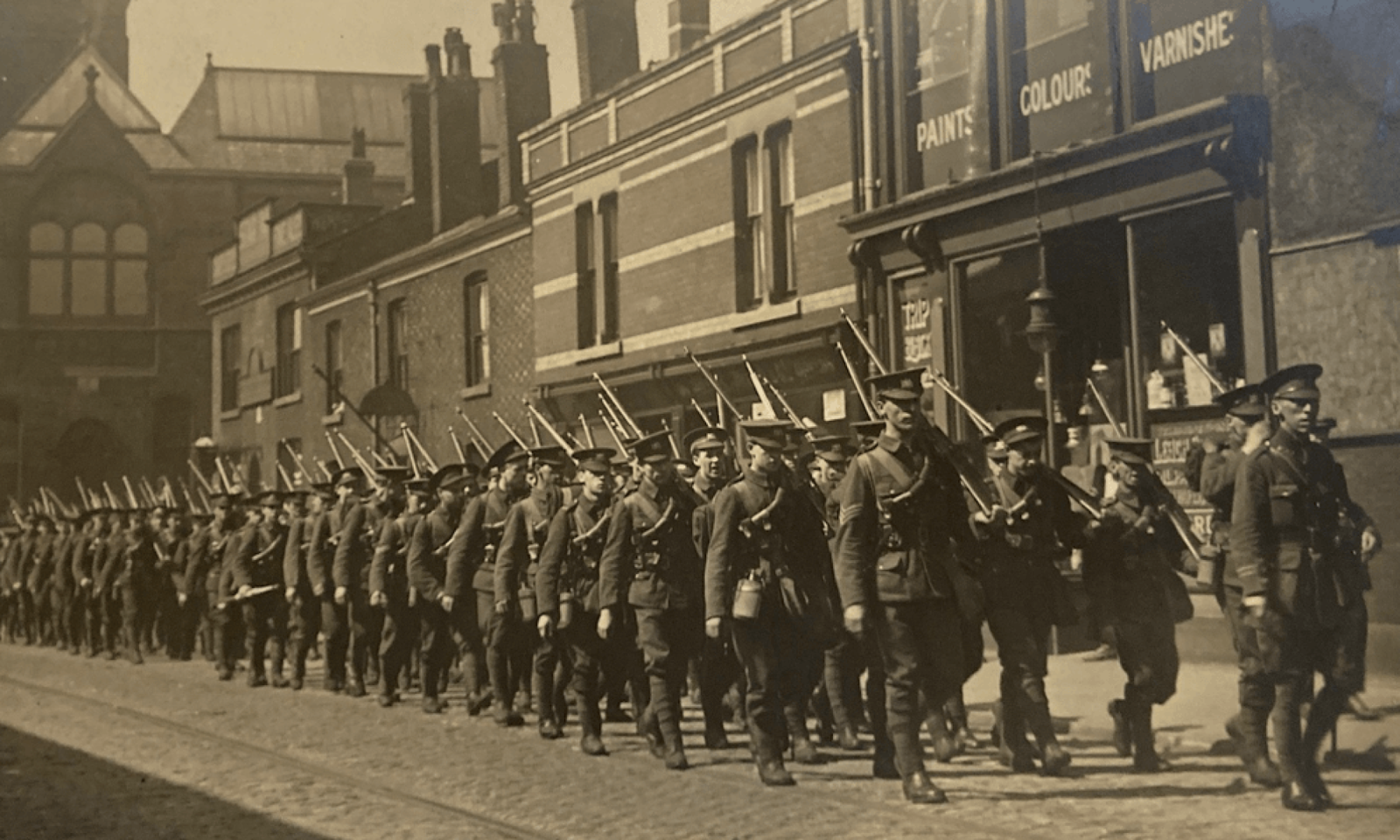
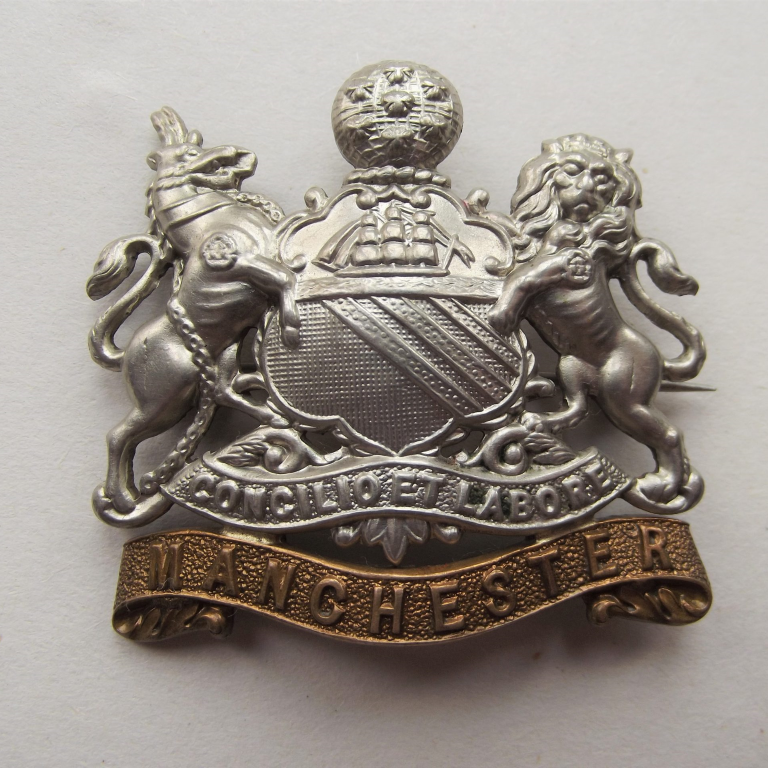
The following is a transcription of the Private Papers of Major James Franklin Bleakley, initially of the 1/10th Battalion Manchester Regiment and subsequently the 126th Brigade Machine Gun Company of the 42nd (East Lancashire) Division, compiled and written in 1919 from a diary kept during the war. The original papers at the Imperial War Museum (IWM) consist of photocopied type written text and photographs taken during his time in Egypt and Gallipoli. Since the photographs are of very low quality they have been carefully digitally restored for clarity. The transcription is provided here under Non Commercial Use License and remains the copyright of the IWM.
EXTRACTS FROM A DIARY KEPT DURING THE PERIOD OF THE GREAT WAR. 1914 – 1918.
Dealing particularly with the work carried out by the 1/10th Battalion Manchester Regiment and the 126th Brigade Machine Gun Company of the 42nd (East Lancashire) Division.
INTRODUCTION
The assassination of the Archduke Franz Ferdinand (the heir to the Austrian Throne) and his wife on June 29th. 1914, by Pan – Servian conspirators, brought to a crisis the bellicose feeling which had existed in Europe for some time, and before many weeks has passed all the great and small Powers of the civilised world were fully mobilized, and engaged in a desperate struggle for their existence, Great Britain entering the fray August 4th, 1914.
The first shots of the war were fired by Servian troops on the Danube on July 27th, 1914, and it was not until November 11th, 1918, that an armistice was declared on the Terms of Peace demanded by the Allies.
At the outset many were of the opinion that a Jar of such magnitude could not last more than a few weeks; the less optimistic prophesied a war of several years duration. However, when Lord Kitchener sent out his appeal for every able-bodied man to enlist for three years or the duration of the war, all hopes for a short war were at once dispelled.
In response to the appeal, men from all walks of life flocked to the Colours, and the British Army in August 1914, with a strength of some 130,000 regular soldiers and 230,000 Territorials, increased in strength to several millions before the termination of hostilities.
The following notes have been compiled from a diary and have been written with the object of recording the gallant work carried out by the units previously mentioned, as a stimulus to one’s memory in after years when details are apt to be forgotten.
Nasirabad (Raj.) J.F. Bleakley.
INDIA, Capt.
Nov 1919
Private Papers of Major James Franklin Bleakley
MOBILIZATION AND EMBARKATION FOR EGYPT
The 42nd (East Lancashire) Division, commanded by Major General Sir William Douglas K.C.M.G, C.B., D.S.O, was mobilized in August 1914, and the Brigades distributed as follows
MANCHESTER BRIGADE:
5th, 6th, 7th, 8th, Bn. M/cr Rgt, at LITTLEBOROUGH (Lancs)
FUSILLIER BRIGADE:
5th, 6th, 7th, 8th Bn. Lancs Fusiliers at LITTLEBOROUGH (Lancs)
EAST LANCASHIRE BRIGADE:
9th, & 10th Bn. M/cr Rgt, and 4th, & 5th, East Lancs Regt at BURY, (Lancs,)
The time here was spent in intensive training and equipping. Several regular Sergeant Instructors were posted to each Battalion and took in hand the training of the recruits. The weather was very bad, and little outdoor work could be done. The Division had volunteered for service abroad, and orders were expected daily for a move.
Movement orders were received, and Sept. 10th, 1914, found us at Southampton embarking on the Pacific Steam Navigation’s Steamer “AVON”.
Speculation was rife as to our destination, as the orders concerning the Ports of disembarkation were sealed, and had not to be opened till the convoy was on the high seas. It eventually leaked out, however, that we were going to EGYPT to relieve the regular troops there, garrison the country and complete our training.
The voyage was exceptionally interesting to many of us who were on our first venture. A daily paper was published, called “The Kernel” which gave the latest Marconi news concerning the situation in France.
On October 6th, 1914, we disembarked at ALEXANDRIA and entrained for HELIOPOLIS.
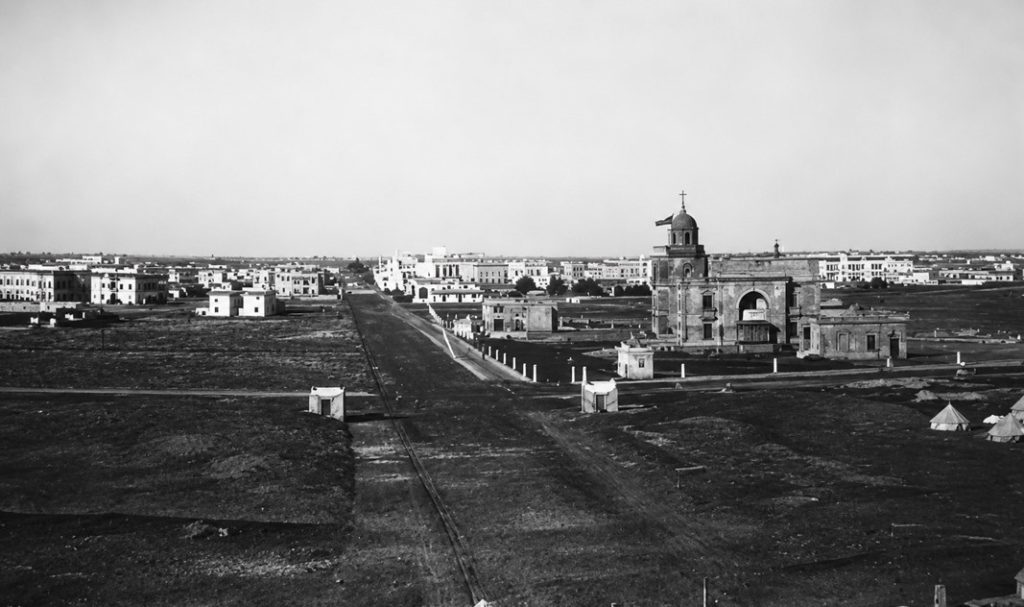
Heliopolis
The next five months were spent in intensive training at the end of which time, our men were said to be a match for any 1st Line regular unit, and keen for active service.
The Turks, about this time were preparing an advance on the SUEZ CANAL and our Fleet was engaged in trying to force the passage of the DARDANELLES, (Feb 1915).
On Sunday March 28th, 1915, the Division marched past Sir Ian Hamilton in CAIRO, Sir Ian was proceeding to take charge of the operations in GALLIPOLI, as by this time it had been realized that the passage of the DARDANELLES could not be forced by the Navy alone, and that it was necessary to have a land force operating with the Navy to make a success of the expedition.
SUEZ CANAL 1915
The Turks with the object of hampering the passage of troops and munitions to the East, and also in the hope of being able to invade EGYPT, launched an attack against The SUEZ CANAL, in Feb 1915.
Our defences were sited on the Eastern side of the Canal and close to the banks, where we awaited the Turk.
He made a heroic effort to cross the Canal, but owing to the waterless desert which he had to cross and the lack of equipment, the attack turned out a dismal failure.
The line of telegraph poles from EL ARISH to KANTARA was diverted so as to lead into one of our posts, and as the Turk had taken this, as his line of direction, he delivered himself into our hands, and suffered heavy casualties.
Captured Turkish Pontoons
Very few got away, and of those who did, many died of thirst on the way back.
The action lasted a very short time and brought to an abrupt end the Turkish effort against the Canal in 1915.
About this time (April) news was coming through in driblets about the landing at GALLIPOLI and casualties arriving at PORT SAID and ALEXANDRIA told gruesome tales of their experiences on the Beaches.
Our troops were well trained, and it was thought that if more troops were required for GALLIPOLI we might stand a chance. Our hopes were soon to be realized, for after being about a fortnight on the Canal, urgent orders were received to pack up and proceed to PORT SAID.
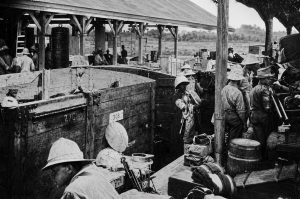
Entraining for Gallipoli at El Kantara
On May 4th, 1915, we moved to PORT SAID bivouacked the night and embarked the next day for GALLIPOLI on H.M T. HAVERFORD.
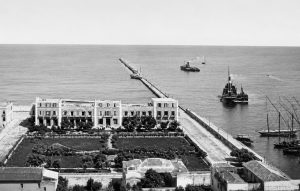
Port Said
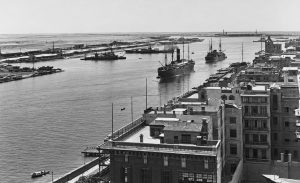
Port Said
GALLIPOLI
On May 8th we anchored in MUDROS HARBOUR and after a few hours there set sail for GALLIPOLI.
Long before land was sighted the roar of the guns was heard and the smell of the dead wafted out to us on the breeze, as a welcome to the inferno in which we were soon to find ourselves.
The din increased as CAPE HELLES was approached. The slopes of ACHI BABA could be distinctly seen suffering under a heavy bombardment of high explosive and shrapnel.
A heavy pall of battle dust and smoke hung over the land like a black mantle.
This was Sunday, May 9th, 1915, and as we spent our last few hours in the comfort of the ship, we witnessed a fierce battle ashore which was afterwards known as the “Large Advance of May 1915”.
The ship was anchored close to the Cape and a continuous stream of casualties could be seen coming down to the beach, to be taken off in lighters to the Hospital Ships.
At 5 o’clock in the afternoon of Thursday May 13th, 1915, the disembarkation at W. BEACH commenced, and by 6 o’clock we were ready to move off.
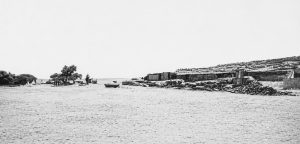
W Beach Gallipoli
To many of us, who were now on the threshold of action for the first time, the spectacle we beheld was appalling. The dead were littered all around, twisted and mangled beyond recognition. The price of the Landing had indeed been paid in full, by the blood of the finest fighting troops in the British Army.
We moved inland past the ruins of the SEDD-UL-BAHR FORT into the French Area and bivouacked the night. Unfortunately, the bivouacs were in a depression close to a battery of French 75’s which kept up a continuous fire all night. The next morning the Turkish Artillery opened fire on this battery with shrapnel, which fell on our bivouacs and inflicted many casualties before we could get clear.
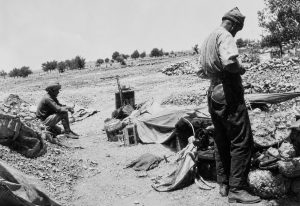
Rest Bivouac Gallipoli
We moved for cover up the valley known as “The Valley of Death“ and awaited orders.
A party of us were detailed for a fatigue in the Firing Line with the Royal Naval Division, digging communication trenches, and were subjected to a heavy shrapnel fire all day, but by the mercy of Providence the roll of wounded was only slight.
The Turkish sniper at this time was giving a lot of trouble and causing many casualties.
It was several weeks before the ground behind the Front Line was cleared of these pests. When caught they were terrible objects to look upon, and after a short inquiry usually shot. They were well concealed, with faces and hands painted the colour of the surrounding ground and foliage, had a fortnight’s rations and 2,000 rounds of ammunition.
Their favourite trick was to lie in wait for the water fatigue going to the Wells and pick them off.
At dusk on the evening of May 15th, 1915, our trenches were heavily bombarded and the Turks emerged to attack, but we drove them off with rifle and machine gun fire, killing many on their wire as they endeavoured to get back.
Sunday May 23rd, 1915, found us in the FIR TREE FIRE TRENCH with orders to go over the top and straighten out a re-entrant in the line. We scaled the parapet at dusk and moved out cautiously to the landmarks, noted in daylight and commenced to dig, only as one does when under fire. A desultory rifle fire was coming over, but we were too intent on our job to take much notice.
After about two hours’ digging, we were well under cover and by dawn had completed our task. The annoyance of the Turk at daylight on finding this new line, was evidenced by a heavy shell fire, under which several officers and men lost their lives.
We were digging all day, and at night a relief came along. We moved out in a heavy thunderstorm, floundering down the Ravines up to the waist in water. On arrival at the bivouac we found them flooded, valises soaked and had to commence digging again, to provide cover for the night.
The whole of the Peninsula was under fire from three directions, and the Turk knowing the positions of our rear bivouac almost as well as we did ourselves, directed a steady gun fire on those targets night and day, in their endeavour to weaken the morale of the troops.
After this followed a period of trench routine and preparatory arrangements for the next battle, when the whole line from the DARDANELLES to the AEGEAN SEA was to advance and which, was afterwards known as the BATTLE OF KRITHIA.
June 3rd, 1915
We used to take our lunch on a raised platform of earth in a dugout behind the line. The lunch consisted of bully beef and biscuits and cheese. After a short time, we detected an abominable smell and tried to trace the source of the same. Our C.O. who had arrived from S. Africa? suggested digging up the platform which we did and under same we found a dead body which we promptly buried. I forget the name of our C.O., but he was killed in the attack of June 4, 1915. I personally was saved by a fluke. Our machine gun officer was shot through the neck and as a result on May 6, I took over long before the fateful hour of 12 noon of 4 June. The zero hour. Two of my gun team were shot down.
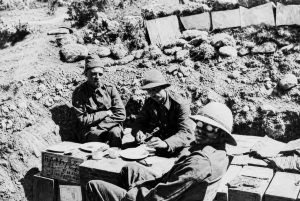
Mess Dugout Gallipoli
BATTLE OF KRITHIA
JUNE 4th, 5th, 6th 1915.
The order of battle from the right was – French Division – Royal Naval Division – Three Brigades 42nd Division and 29th Division on the left, with the East Lancs Brigade of the 42nd Division attached. The objectives were KRITHIA and ACHI ВАВА.
The Battle commenced at 11 a.m. June 4th, 1915, with a terrific bombardment on the Turkish Lines, by every gun on the PENINSULA, and every gun of the Fleet. The bombardment lifted at 11:15 am, when every man sprung on to the Firing Step cheering and waving his bayonet in the direction of the Turk, at the same time a rapid fire was opened with the machine guns. At 11.30 am, our bombardment swooped down again on to the Turkish second line of trenches and remained there till 12 noon when our assault was launched, the Artillery fire moving on and searching Points of Concentration in the Turkish back areas.
The attack on the left and centre was successful, but the French were held up against a strong Turkish Redoubt (The Haricot) and unable to progress. This left our flanks on the ACHI BABA NULLAH exposed, and we suffered heavy casualties from bomber and rifle fire.
Darkness increased our difficulties. The blazing gorse, groans of the wounded, artillery fire, rifle fire, and bombs, and the weird cheers of our troops on the right as they made assault after assault in their effort to establish the position made the place a veritable hell on earth.
Dawn (June 5th) came at last, and found our position maintained. On Saturday and Sunday June 5th, and 6th, strong Turkish counter attacks were delivered, in which they suffered heavy casualties and failed to retake the ground gained by us on June 4th.
The line was straightened out, and the usual trench warfare carried out till June 18th, when a raid was made by one of the Regiments of the Brigade from Trench H.11. This was not a success and resulted in the death of two officers and several other ranks. The raid was carried out under extraordinary and difficult conditions. It was afterwards learned that the Turks themselves were to make a raid on our at trench H.11, from which our men were to launch their attack. The Turks attack was evidently timed to commence at the same time as ours. The opposing forces met in “no man’s Land” and a hand-to-hand fight ensued, with an indecisive result.
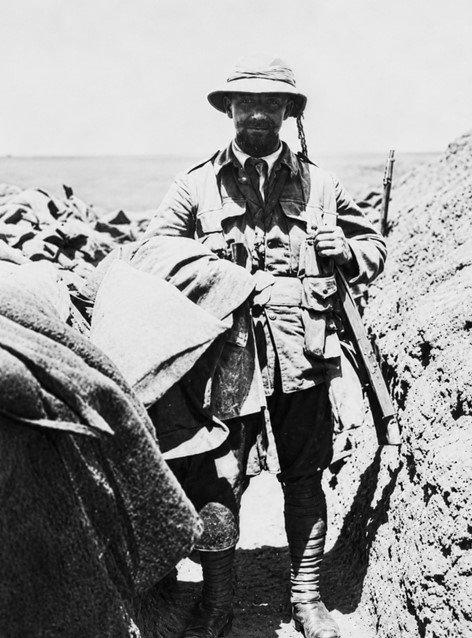
After 18 days in the Line
Our troops by this time were getting battle worn and weary, so we were sent to IMBROS for a rest and to re-equip.
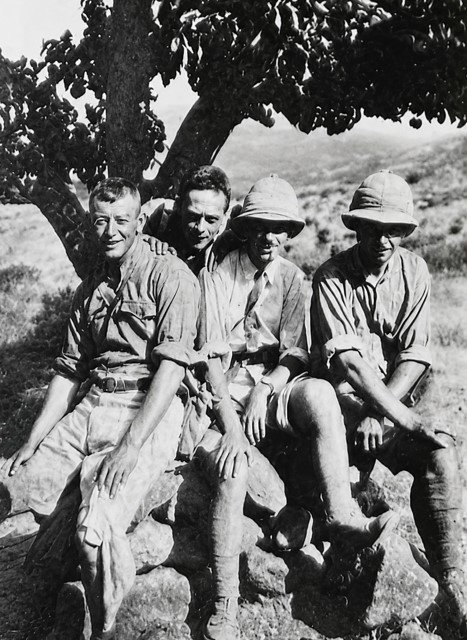
Wilkinson Lea Dr. Baird & Bleakley at Imbros
IMBROS is a beautiful and highly fertile island In the AEGEAN SEA, with PANAKIA as its capital. The population is chiefly Greek.
On Sunday July 11th, 1915, we were back again at GALLIPOLI, disembarking at V BEACH at 2 a.m. In the afternoon of the same day, we moved into the VINEYARD TRENCH OF the Firing Line.
A Close Shave
Returning from a rest on the Island of Imbros we landed on W Beach at about noon on Sunday July 11, 1915, and as there was no way of conveying our machine gun equipment to the firing line other than carrying same, the equipment was divided up amongst the gun teams and manhandled.
We reached the cliffs surrounding the beach and moved into the Achi Baba Nullah leading up to the firing line.
Desultory shell and rifle fire was coming over and we would consider ourselves lucky if we got into the line without suffering casualties.
To get from the beach to the line we had to cross about 4 miles of open country with no cover except cover from view which we got in the nullah and as this was the main artery to the line the bulk of the enemy’s fire was directed on this route.
When about halfway up the nullah we heard the report of a gun and very shortly afterwards heard the sound of the approaching shell which we realized was in a direct line with us.
We flattened ourselves out on the ground and with a terrific whirl the shell half embedded itself in the ground about us.
We were covered in dust and stones and when we rose from the debris found that the shell had failed to explode.
A close shave, thanks to a dud.
To celebrate our victory in the Persian Gulf[1], volley firing at the Turkish positions and cheering took place on July 30th, 1915. The Turk was evidently much surprised at this demonstration, and no doubt thinking an attack was pending, proceeded to bombard our Firing Line, which somewhat damped our ardour.
On August 5th, 6th, 7th, 8th and 9th, 1915, large demonstrations were carried out on the CAPE HELLES front to hold the Turkish troops in that zone and prevent them re-enforcing their troops at SUVLA BAY who were opposing the new landings of British troops in there.
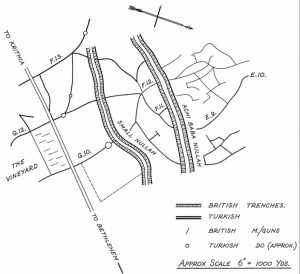
Bleakley’s Sketch Map of the Vineyard
After this, no operation of any magnitude took place until the evacuation of the Peninsula Dec 1915 – Jan 1916.
After the evacuation our troops were taken to MUDROS for a rest and then moved on to the SINAI DESERT for the protection of the SUEZ CANAL at which the Turks were preparing another thrust.
GALLIPOLI as far as we penetrated, would appear in normal circumstances to be a fertile and well developed land.
The cliffs at CAPE HELLES rise almost sheer out of the sea, there is no pier or other such means by which ships can discharge their contents. The way of getting from ship to land is by small boats. On reaching the top of the cliffs, the land stretches away in a flat saucer type formation, falling, gradually from the cliffs and rising again to the slopes of ACHI BABA. The ground which had not been disturbed by the passage of troops was covered with red poppies. At the first impression, one would take the ground to be fairly level, but on moving inland, large gullies or nulláhs are encountered, which gave us excellent cover when moving about in daylight. In the dry season the flow of water down these nullahs is very slight, in the wet season they are swept by raging torrents and practically impassable. It was for this latter reason and also on account of the poor anchorage at CAPE HELLES that the success of the campaign all depended on a quick and decisive, expedition. Once the Turk had been allowed to dig himself in, no guns we had at our disposal would move him. The Turk is an ideal soldier in defence, and an expert rifleman. In positions where our front line trenches were close to the Turk, we could clearly hear them offering their prayers to Allah.
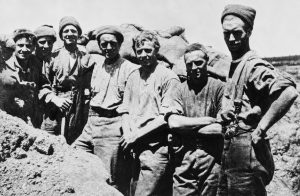
10th Manchesters’ in Reserve Trench at Gallipoli
The following is a copy of a Turkish proclamation (incomplete) to the Anglo-French Expeditionary Forces, dropped by a Turkish Aeroplane on W BEACH Cape Helles in July 1915.
PROCLAMATION TO THE ANGLO FRENCH EXPEDITIONARY FORCE.
Protected by the fire of a strong Fleet you have been able to land on the Gallipoli Peninsula on and since April 25th. Backed up by the same men of war, you could establish yourselves at two points of the Peninsula. Your endeavours to advance into the enemy’s parts of the Peninsula have come to a failure, under your very heavy losses although your ships have done their utmost to assist you, by a murderous cannonade implying an enormous waste of ammunition,
Two fine battleships the Triumph and Majestic have been sunk before your own eyes by submarine boats. All protective means against them, being found utterly insufficient.
Since those severe losses to the British Navy, your Men of War have had to take refuge, and have abandoned you to your own fate. Your ships cannot possibly be of any help to you in future, since a great number of submarines are prepared to suppress them! Your forces have to rely on sea transport for reinforcement, supply of food and every kind of war material. Already the submarines, did sink several Steamers, carrying supplies for your destination. Soon all supplies will be cut off from your landed forces. You are exposed to certain perdition by starvation and thirst, even desperate attacks will not, overt that fate from you. YOU COULD ONLY ESCAPE USELESS SACRIFICE OF LIFE BY SURRENDERING. We are assured that you have not taken arms against us in hatred. Greedy England made you fight under a contract. You may confide in us for excellent treatment, our country disposes of ample provisions. There is enough to feed you well, and make you feel quite at your comfort. DON’T FURTHER HESITATE, COME AND SURRENDER
etc., etc., copy not complete.
SINAI
and the advance upon and capture of
EL ARISH
The SUEZ CANAL was protected by a chain of posts or blockhouses, approximately 20 miles East of the Canal, stretching from SUEZ to PORT SAID, and it was at Ashton Post[2] SHALUFA near Suez that we found ourselves in February 1916.
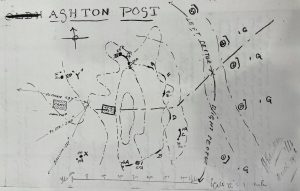
Ashton Post
The life was a pleasant change from the Peninsula, and the time was occupied with digging and wiring and generally strengthening the Post against attack.
In June 1916 we moved to EL FERDAN and in July were formed into a “flying column” with several other units at EL KANTARA and moved out into the desert to meet the Turk.
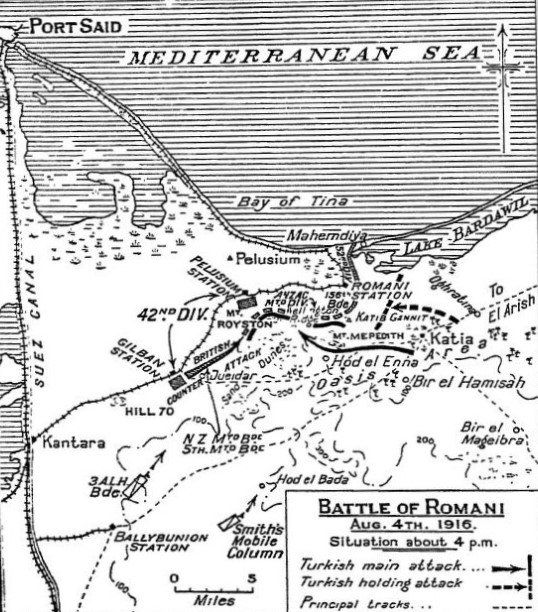
Battle of Romani – Aug 4th, 1916
The first encounter was at ROMANI which commenced on August 5th, and lasted two days, resulting in the route of the Turk. We took 4,000, Turkish prisoners in this battle and several machine gun teams manned by Germans.
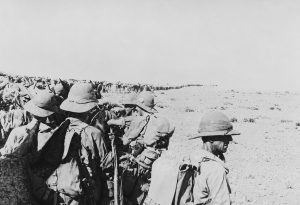
Flying Column at Romani
We followed up the Turkish retirement, and made a halt for several weeks at PELUSIUM, from which place we were able to visit the battlefields of MOUNT ROYSTON and collect some interesting souvenirs. The Australian Light Horse in this encounter had outflanked the Turk, who beat a hurried retreat leaving behind immense quantities of rifles, ammunition and camels.
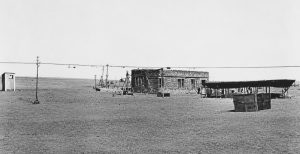
Pelusium Station
The advance East via OGHRATINA, BIR-EL-ABD and MAZAR was carried out in bounds, covering the construction of the railroad from EL KANTARA, and overcoming any Turkish opposition.
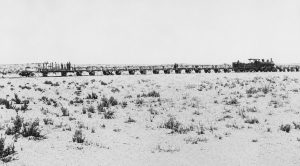
Railway at Oghratina
Christmas 1916 found us in the Advanced Guard for the attack on EL ARISH, which according to the reports of spies and aerial photographs was strongly held and surrounded by a belt of 19 redoubts.
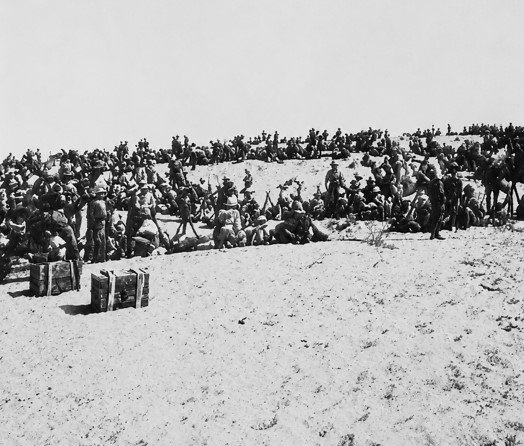
The Advance on El Arish
The advance was carried out on a wide front, the 52nd (Lowland) Division operating on the coastal sector with the 42nd Division on their right and detachments of the Imperial and Bikaner Camel Corps and Australian Light Horse guarding the right flank. Following up behind were the 53rd and 54th Divs.
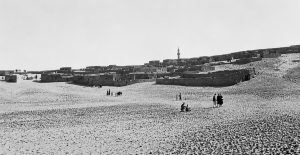
El Arish
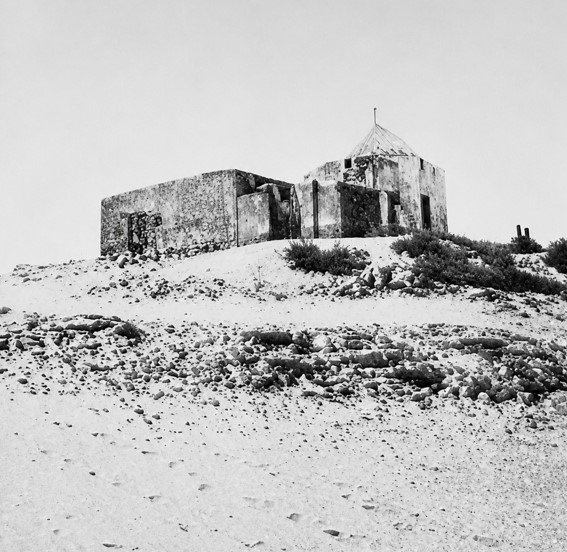
Tomb of Nebi Yasir at El Arish at El Arish
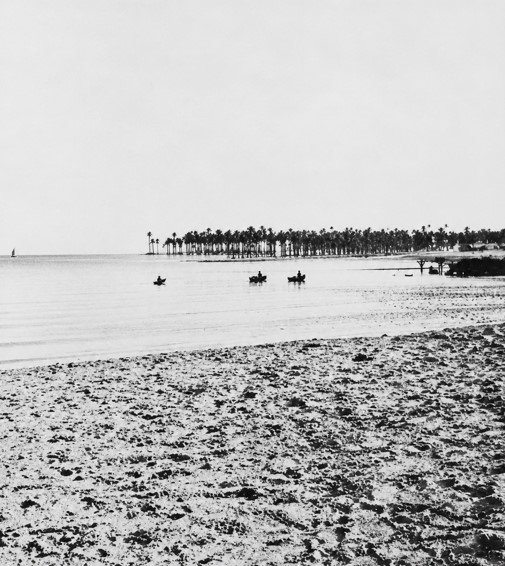
The Beach at El Arish
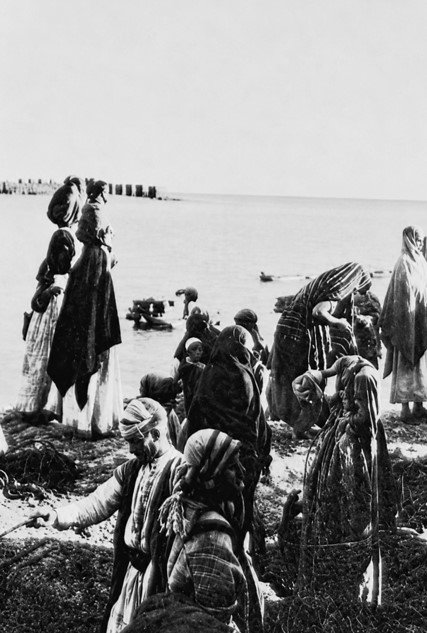
Locals at El Arish
An action was fought on the 23rd, December 20 miles South of EL ARISH in the WADHI TI ARISH in which 1,000 prisoners were taken and large quantities of war materiel.
On Christman eve 1916 the Vanguard reached a point within easy-striking distance of EL ARISH and bivouacked. Bivouac fires were permitted and a huge glow was reflected in the sky, which we afterwards heard put the fear of Allah in the Turk, for when our advance screen of cavalry reached EL ARISH they found the Turk had evacuated.
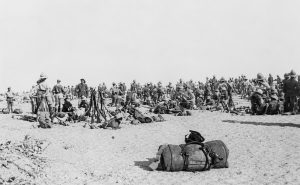
Bivouac El Arish
We occupied EL ARISH for a fortnight during which time we were bombed daily by Taubes[3] and in January 1917, received orders for France, moving to Alexandria and embarking on the captured Austrian ship “Huntspill”.
The SINAI desert from EL KANTARA to EL ARISH is an undulating waste of sand dunes, and practically waterless. The water when obtained was very brackish and totally unfit for human consumption. The horses and mules would not at first touch it, but after enduring thirst for about three days; they eventually took to it. The camel is the animal for this country and units were supplied with them for the transportation of baggage etc. Water for the troops was brought up by train and stored in tanks. A pipeline was ultimately laid from EL KANTARA giving a supply of fresh water, but this was not in operation until the Division had left SINAI.
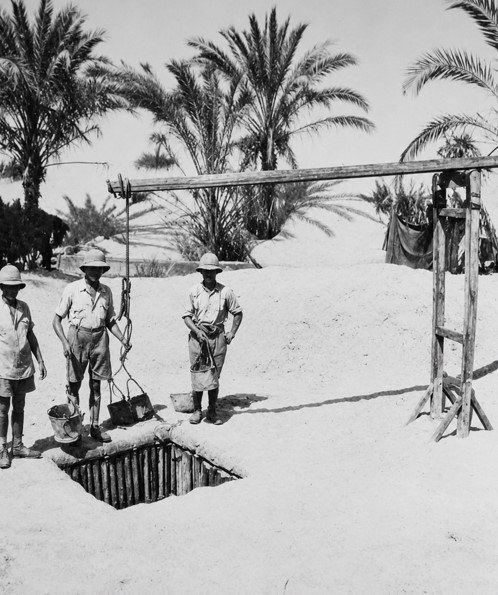
Desert Well at Oghratina
FRANCE
On the morning of March 6th, 1917, we disembarked at MARSEILLES In a heavy rainstorm and entrained for the Northern part of France.
The journey took three days; the weather was intensely cold after the climate of EGYPT and very few of the carriages could boast of a full complement of windows. On March 8th, we detrained at PONT REMY and marched eight miles to our billets at ST MAXENT Near ABBEVILE.
A party of us were detailed to be attached to the 1st Division on the Somme, and left ST MAXENT in motor busses for CORBIE from where we were guided to the Brigade Headquarters at FOUCACOURT.
The Germans had commenced to withdraw the previous day, and on parts of the front were fighting a rearguard action back to the HINDENBERG LINE. In other sectors we had lost touch with him altogether. Next day we crossed the Somme at Brie and saw PERONNE in flames.
A few days letter we were recalled to our units and moved up into, the firing line at EPEHY.
After giving up a couple of days respite to pick up the lay of the land the Brigade was ordered to attack and capture a tactical feature called “The Knoll” West of the ST QUENTIN CANAL and close to the village of VENDHUILE Which the Germans had fired.
The attack opened at dawn with a heavy bombardment and was partially successful. We established a position on the near side of the KNOLL, the party going for OSSUS WOOD were not so lucky and had to withdraw in face of superior numbers and incurred many casualties.
About this time our Regimental Medical officer Dr. Baird, was killed by the explosion of a “Booby trap” and burled in the British Cemetery, at LONGAVESNES.
Trench warfare was the order of the day now at EPEHY and on May 19th, we drew out and made for HAVRINCOURT WOOD via FINS.
HAVRINCOURT WOOD lies between METZ -EN-COUTURE and ROYALCOURT, the firing line running through TRESCAULT on the East of the wood. The Germans had felled the timber on his side of the wood giving a clear field of fire from the Chateau to the edge of the wood making it extremely unpleasant and dangerous getting into the line during the day. At night he swept the whole of the ground with machine gun fire.
On July 15th, 1917, we moved out of the Havrincourt sector and went into G.H.Q. Reserve at COURCELLES.
Towards the end of August, we were on the move again for Belgium marching from COURCELLES through BEAUMONT HAMEL to BEAUCOURT-SUR-ANCRE where we entrained. On the night of August 22nd, 1917, we detrained at PROVEN and marched into billets in the Trapiste Monastry at WATOU.
From here we moved into the Battle line at YPRES This is generally acknowledged to be the hottest part on the Western Front and as preparations were well advanced for our attack on PASCHENDALE the Germans gave us very little rest. YPRES itself was drenched in mustard gas and all ways of approach under shell fire. They also kept up continuous bombing raids day and night on our back areas and shelled transport lines with high velocity Naval shells. Our casualties were very heavy and on September 16th, we pulled out, and after two days rest marched to NIEUPORT where we relieved our 2nd, Line Division.
From NIEUPORT we side-stepped to the right into the ST GEORGES Sector. The River Yser at NIEUPORT branches off in five directions at a place known to the enemy as “FIVE BRIDGES” and the majority of these bridges had to be crossed to get into the line. The Germans had the range to a nicety and could break the bridges with minenwerfer or heavy shell at his will, and which he did throughout the day and night.
Towards the end of November 1917, we handed over this part of the line to a French Division and moved to the Bethune area, going into the firing line on each side of the LA BASSE CANAL in turn with other units of the Division.
We carried out a successful raid in January, between FESTUBERT and GIVENCHY capturing several Germans, burnt their dugouts, and came back with one casualty only.
In February 1918, the Division went into G.H.Q. Reserve and moved to billets in rear of BETHUNE.
Since the beginning of the year the Germans had been making active preparations for a great offensive, and hundreds of new gun emplacements were spotted daily by our airmen behind his lines. He carried out large raids with the object of testing our strength, for identification purposes and made destructive shoots on our back areas.
On the early morning of March 9th, 1918, we awoke to the rumble of a huge bombardment, and although we were in reserve some six miles behind the line, the windows of the Chateau were rattling in their frames with the vibration
The G.S.0. 1 of the Division rang up to say that the Portuguese had been attacked in Front of LACOUTURE, and that we were to proceed at once up the line to reinforce. Within an hour motor buses had arrived to convey us with the Machine Gun Co. to the front. On the way large columns of our troops were on the move.
This turned out to be another raid, but several days afterwards on March 21st, 1918, his great offensive commenced in earnest.
Assisted by the mist, he was able to gain an initial advantage and before many days were past, our troops on parts of the front had been driven back a matter of 30 miles. But by a system of perfectly organised withdrawals, we were able to prevent our line being broken, and forced the German to use up his reserves and turn the tables on him.
In Sept 1918, we opened a terrific offensive, from which the German was never to recover.
He was rapidly driven back, evacuated the Coast Line of Belgium, and in early November was in such a state of disorganisation and suffering from the lack of manpower that he was forced to sue for an Armistice which was declared on November 11th, 1918 at 11 a.m.
Footnotes:
[1] Nasiriyah fell to the Allies on 25 July, the Turks retreating to Kut al-Imara. This was the latest in a string of successes against Ottoman forces in Mesopotamia contrasting starkly to the failures and stalemate at Gallipoli.
[2] A series of posts were constructed on the East bank of the Suez Canal by the 42nd East Lancs Division and named after some of the hometowns of the battalions in their brigades: Ashton, Oldham, Wigan and Salford.
[3] A Taube was a type of German plane, but the name became generic for any type of German plane. At this time, the Germans were flying out of Beersheba having lost their air base at El Arish.
Acknowledgement:
This journal has been transcribed from originals held at the Imperial War Museum. The transcription is provided here under Non Commercial Use License and remains the copyright of the IWM.
The papers are catalogued here at the IWM.