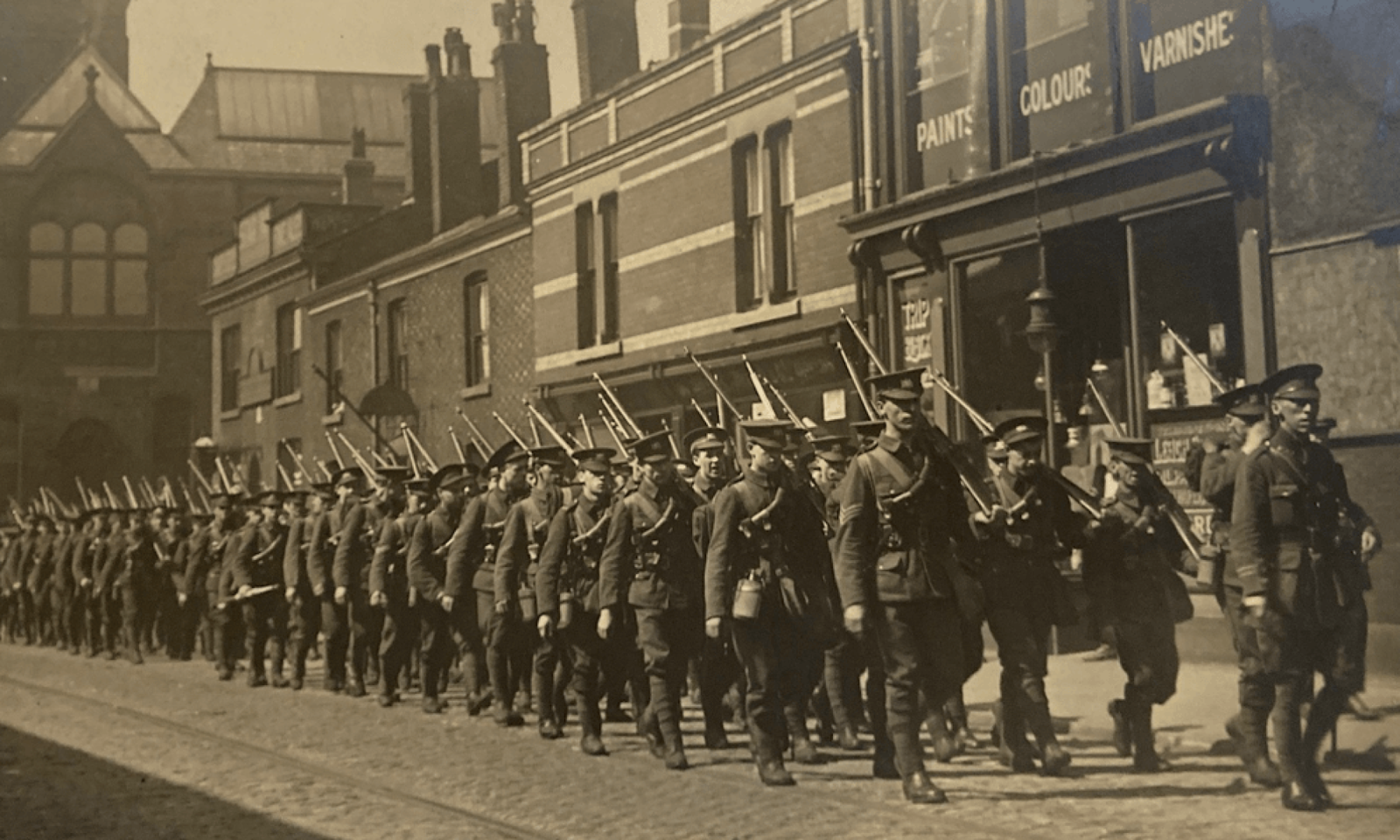
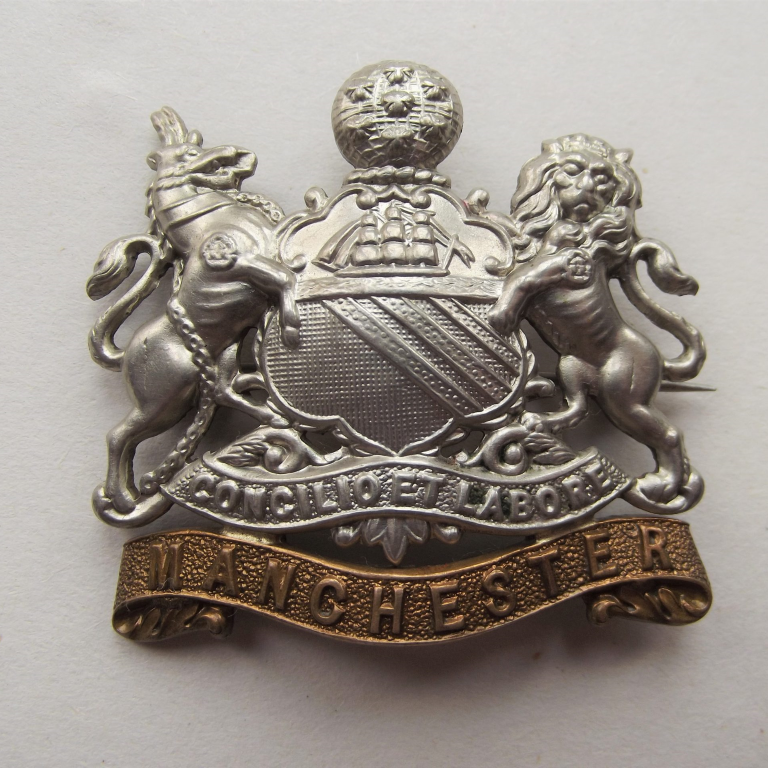
4th Bn. East Lancs Regt., 126th Brigade, 42nd (East Lancs) Division
The narrative provides a first hand account of the experiences of a soldier who formed part of the first large draft of men to go to Gallipoli from the 126th Brigade, 42nd (East Lancs) Division. The primary value is the coverage of the voyage out and participation in the Battle of Krithia Vineyard. The original papers at the Imperial War Museum (IWM) contained many place name misspellings and challenging grammar. All known errors have been corrected and the grammar has been improved where necessary for the sake of readability. A few images from the private papers of Major JF Bleakley have been inserted which were not in the original papers but as both were in the same brigade (126th) they were stationed in the same places and involved in the same actions. In the editor’s opinion, the images enhance the overall narrative for the average reader.
England, 1915
Well, first of all we set sail on the Transport ship Ionian on the second of July. We were packed like herrings in box for the boat was nothing but an old cattle boat, and as for rats it was full of them, for we could not sleep at night. We slept in hammocks slung up beside each other. Well I did not sleep down in the bottom more than 3 times during the whole of the voyage for the first night I could not sleep for the rats for they were running about and so making a squeaking noise, and bear in mind they were not above a foot over our heads all among the rafters where we had hung our packs and our rifles.
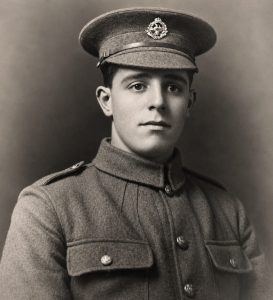
Private Albert Garner
The second night I was sleeping near the port hole as I thought it would be a little fresher but I don’t think I had been asleep more than an hour when, bang. I went up against the side of the boat with my head for the boat was tossing about from side to side and of course our hammocks were swinging also. And I was the one nearest to the side so that I could not help myself. Anyway, I determined that I would not sleep there anymore so the next night I got in the centre but I could not sleep for I was beginning to feel that sickness which often comes over you when sailing. Well by the morning I could stand it no longer and I started to be sick for 3 days and nights. I was doing nothing but vomiting and I could not eat anything. Well we were expecting reaching Gibraltar the next day and as I was picking up I was picked that day for the guard on the officers’ deck and it was here that my eyes were opened for the officers were living on the best of food and they had stewards to wait on them while we in the bottom were being treated like dogs. We came in sight of land about four in the afternoon, but the boat went slower then and we passed through Gibraltar in the dead of night. I could just see the rock looming up through the darkness on the right of the boat and I was disappointed for I had looked forward to seeing the place that is known as the key to the Mediterranean.
After this there was nothing to trouble about, for it was like a lake, and the boat made good progress. After about 2 days sailing, we sighted the coast of Africa and then we sailed along all the way up the coast. I don’t think we were above 2 or 3 miles from the coast all the time. At any rate, I don’t think, so it may have been. Well, after leaving the coast of Africa we did not see land again until we came in sight of Malta. Here we stayed about a day at Malta while some guns that were in the hold were unloaded and it was the sight of a lifetime to see the harbour and its fortifications. And besides, we saw some of the French Navy’s boats and about three submarines. When we were leaving Malta for Alexandria all the French Battleships and their bands struck up with the God Save the King and their national anthem, the Marseillaise, amid great enthusiasm while we gave cheer after cheer.
After leaving Malta a very sad thing occurred by the death of one of our lads who had been bad all the voyage. He was buried at sea the following morning with full military honours.
We landed at Alexandria safely and we expected being able to leave the boat but we were only allowed to take our kit bags off and then we had to go back again onboard. Here some of the Yeomanry troops disembarked to join their regiment that was stationed at Cairo. We stayed in harbour about a day and it was here that we saw the natives and they were treated like dogs with the policemen there for they would get them by the scruff of the neck and kick them as hard as they could and then they hurled them away from them as if in disgust at having to handle them. Well, we were told later by a sergeant of our regiment, who was in Hospital there and who came on board to speak to us, that they had to keep them under or else they would take advantage. It was here that we heard how our battalion had fared and we began to realise that we were in for a rough time.
Gallipoli
Then we sailed for the Dardanelles. After about 3 days we came to Mudros. It was here that I saw the Russian battleship which is commonly known by the troops as the packet of Woodbines because of its five funnels. We stayed about two days here and it was here that the draft for the 5th East Lancashires was taken off because their battalion was at Mudros for a fortnight’s rest. They were taken off about dinner time, and it was about 4 o’ clock when we were told to get all our packs on and rifles so as to be ready to get on to the minesweepers that were to take us to the peninsula. We were all on safely and then they started off. It was about four hours sail, and we landed at the mouth of the straits about nine o’ clock at night. It was a pretty clear night and we could see the battered forts of Sedul Bahr and we could also see the hull of the sunken battleship Majestic showing above the water. There was a light fixed there, probably to guide the boats away so that they would not collide with it.
It was here that our lot, the 4th East Lancs, were told that we were to get on to a small lighter. And it was here that we were packed so tight that we could not move an inch. We all had our full packs on and our rifle and blanket as well as having to carry 200 rounds of ammunition. We sailed about for two hours and then we were hailed from the beach. We made for the barges that were used for a landing stage and here I saw the boat that the Gurkhas came on and which had been beached. It was called the River Clyde. I felt so funny for we could hear the booming of the guns and the rattle of machine gun and rifle fire, and now and then we could see the star shells as they lit the sky up.
V Beach, Gallipoli (Major JF Bleakley Collection)
At the same time that we were landing there were some French Senegalese troops landing also and the orders were given in a whisper. It just seemed as though we were all struck dumb. We all got to the beach safely and then we were formed up and we started off. We passed through little graveyards where some of the men were buried and now and then we came across some the native troops with their mules. We went on and on getting nearer to the trenches all the time until at last we got the order to halt. And then we were taken into a small trench. It was just coming daylight and then we were told off to our different companies. I and my pal were told to join ‘A’ Company, so we were at once made as comfortable as possible by our comrades who were at the present moment resting in the dug outs, behind the firing line. As soon as it came light, we hunted around for some of the lads we knew were out here. We found them and we shook hands heartily with one another. Then they told us also how many of the lads had gone under. We knew then that we were in for a rough time.
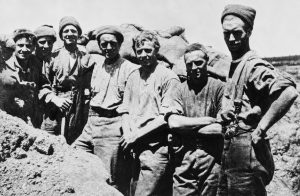
Dugouts at Gallipoli (Major JF Bleakely Collection)
It was very funny, but when it came light and the Turks could see us they sent their first shell for the day and every one of the lads who had just come ducked down in the dug outs like a rabbit in its burrow. But I will tell you candidly that I was afraid when I heard it come whistling through the air but however after a time I got quite used to it and I walked about as though there was nothing to trouble about. Well naturally with it being so hot I was always after water to drink, and it was very hot in the daytime. And the flies were very irritating for there were swarms of them and they used to get on your food when you were eating. If you were eating a biscuit it was covered with flies and I had to keep them off with one hand while I took a bite.
We were supposed to be resting while we were in the dug outs but we were taken out every day with a pick, your rifle and a rag bandolier with 50 rounds of ammunition in. We had to take our rifle with us every time we went on a fatigue duty. We used to have to dig or else widen mule trenches and make communication trenches. The place was honeycombed with trenches for it was not safe to walk about in the open when it was daylight for the Turks could see you anywhere. And they would send us a present of a shell if they saw about three or four of us together, and they used to drop too near for my liking.
We had about eight days of this and then I began to feel the strain of the hot weather and the water was bad and we did not get much to eat but a few biscuits and a bit of bacon for breakfast, and stew for dinner, and for tea jam and bread, but there was not bread very often. We had been in the dug outs just a fortnight and by this time I was feeling right done up when we got the order to move up to the reserve trenches. So, we put our kit and other odds and ends into our packs and gave our rifles a good cleaning and then had our respirators inspected, but by the way we had these inspections every day to see that we did not neglect them.
Reserve Trenches, Gallipoli (Major JF Bleakley Collection)
Battle of Krithia Vineyard
I don’t think we had been in the reserve trenches for more than an hour when the word was passed along that we must keep our heads well down as there was going to be a bombardment at two o’ clock, and by Jove it was a terrible time. It was hell upon earth. It was the first time under fire and I hoped it would be the last. It must have been awful for the lads who were in the front-line trenches. After about four hours of it the machine guns started with their awful deathlike rattle, and we knew then that our men on the left were advancing. We heard afterwards that they had taken 3 lines of trenches but were cut up by the Turkish fire.
The next day our men in the centre who were just in front of us had to advance and the bombardment was even worse than that of the previous day. The noise is awful. It very nearly drove me crazy, what with the shrapnel shell and the lyddite or high explosive shell. Oh, it’s awful. No one can think what it is like until they have been there and heard it. And after they had been bombarding about three hours the machine guns started and so our troops in the centre advanced about four hundred yards. They also were cut up with the Turkish fire but it was only what is expected for no one can advance in broad daylight under heavy fire without losing a lot of men. After the advance it was one continual line of wounded that passed by us in the reserve trenches. There were some awful sights. Well, they managed to hold the positions that they had taken and towards the morning things were a lot quieter.
Then our company was taken over on the left in a trench further back and here we got a good night’s sleep. We were in for the remainder of the day till it was just going dark and then we were told that we had to leave our packs and get a pick and the next man a spade as we had to go and dig ourselves in, in front of our firing line. We got to the firing line and we were then put in order; a man with a pick and a man with a spade and then told to dig together. We also carried our rifles and two sandbags each. Then over the top we went. We had been told to go about forty yards and then commence to dig. Well as soon as I got over the parapet I went hell for leather for the distance, but I don’t think I had got more than 15 yards from the parapet when I got caught in our barbed wire and I went over like a shot rabbit. I tore all my hands and knees, but I had not time to trouble over that. I got up and found my rifle which was about ten yards away and then I had to look for my pick. I found it at last and then I went forward for I could not find my sand bags. I got to the other lads and started to dig like mad using my hands as well and the pick for I knew that if I did not get deep enough before the morning, I should have a poor chance of coming out alive. So all through the night I went on digging until I had got about 2 feet deep and then I was able to ease off a little. It was this night our sergeant was killed and others beside him were killed for I could hear them all through the night. First one and then another scream out that they had been hit. And it was impossible to get them away and they had to lie there all through the night. Then as it was just beginning to come light I ventured to have a peep and I did get a shock for I don’t think we were more than thirty yards away from the Turkish trenches and I was expecting them making an attack on us all that day. We had to lie there all the day with nothing to eat or drink. Well, when it was going dark we started to dig towards one another so that we could crawl along when we had to leave. After about three hours, word was passed along to get ready to leave and I put on my equipment and got my rifle and pick ready for moving. At last the word came to move along quietly as possible to the end of the line and here there was a small trench, or sap, leading to the firing trench. They had been digging this in the daytime while we had been lying there.
I got safely back in the firing line with the others and then we were taken away into the reserve trenches again for about 2 days. Then we were taken back to the trench we had left and which had been made wider and deeper by the men of the Engineers, and we were in a sort of Garrison. We had not to dig at all; we were there as a guard. We were in for about five days and I will never forget the nights in that trench. We went on guard in our turns, an hour at a time and we had to keep a sharp look out all the time. I could see some of our lads and the Turks as well, lying there dead. And I was very careful to take notice of every object and its position so that the Turks could not creep out and get behind them without me noticing them. In the day time the men came to dig it and widen it. I did not get any sleep all the time I was in that trench for we had to stand too every morning with fixed bayonets so as to be ready if they made an attack.
At the same time, our men were digging, or sapping as it is called, straight towards the Turkish trenches and the Turks were sapping towards us so that they were bound to meet some time or other, and then there would have been some terrific bombing encounters. It was about tea time on the fifth day that we heard we were going to be relieved the following morning. But alas our hopes were not to be fulfilled for just when we had finished our tea the Turks started to bombard us, and it was a time for us. We had been told that we would have to hold it at all costs so we crouched down in the trench and waited. We had plenty of ammunition and we waited for the bombardment to cool down a little. As soon as this occurred, we got the order for rapid fire and we were up in a tick for knew that the Turks were massing for the attack. So I began to blaze away like mad. My rifle was well cleaned and oiled so I was not troubled much with it but it was soon red hot and it began to scorch the skin off my hands. Of course, I did not trouble about that then for I was thinking more about the Turks, whether they would advance or not, for to tell you the truth I really wanted them to come because if they had they would have been mown down with our fire.
Anyway, they came but not in the way I expected for they had got into the sap that our men had been digging, and we then got orders to retire. So, I managed to get back into the old firing line safely and I started to fire again. Then I was told that all the 4th East Lancs were wanted up the trench known as the Vineyard sap. Here all our battalion was up on the firing platform firing for all they were worth. So, I at once jumped up and began to fire also. All this time we were under heavy shell fire from the Turks and the lads were falling on either side of me for they were getting shot from all directions. And we thought it was our own men who were firing on us so the word was passed to our men in the firing line to fire half right as they were hitting us instead of the Turks. But still the lads were falling. Many of them shot from behind until it was found out that the Turks had got behind us somehow so that we had to bomb them out.
After a time, things began to be quieter and we were allowed to have a bit of rest, so many at a time, while some were on guard. I could hardly keep my eyes open by now but I did my best and went on guard when it came my turn.
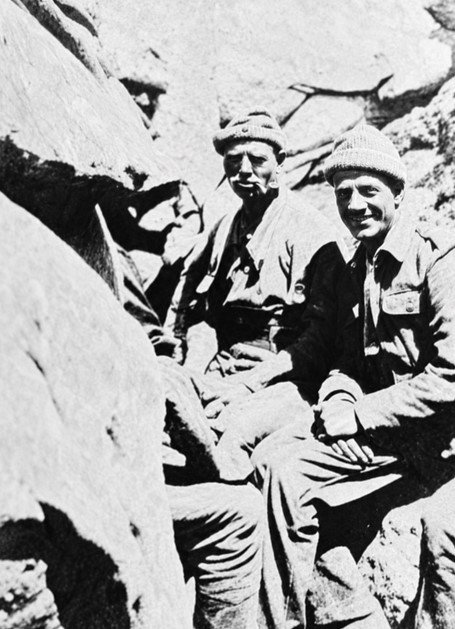
Firing Trenches, Gallipoli (Major JF Bleakely Collection)
At last, it was coming daylight and we were expecting being relieved but to cap all, when it was just coming dawn we were gathered together and then told that we would have to take back the trench that we had lost. We fixed bayonets and went back to the old firing line, over on the right about 100 yards away from the trench we were now leaving. We got in some kind of order and then we went over the top to charge. We got about 20 yards when I tumbled into a trench of some kind, but it was only a dummy trench. Then we went on again and we got lost. At last, I rambled over into our trenches where our men were. We were got into some kind of order again and over we went again. But we were not successful and we tried for a third time but no good. It was given up and we were allowed to stay where we were. It was very light by now and things were very quiet. I could stand it no longer and I went to sleep. I don’t know how long I had been asleep, but I was wakened by someone and then I heard that we were going to be relieved.
We were taken down to the reserve trenches for about an hour or two and we had something to eat. Then I was picked out to go back into the firing line. By this time our men had been able to get the Turks out by bombing them and we went back into the trench that we had lost the night before. We had to stay in here till we were relieved by the Lowland Division. When the men had just settled down in the firing line, we were told that we could go back. Other men took our place in that trench, and we went down into the dug outs for a well-earned rest.
We rested here for the night and then in the morning the roll was called and I will never forget it for there were lads missing out of every section and platoon in the battalion. It was while we were here that the next draft for us arrived and they were needed for the battalion was not more than 300 strong then.
Repatriated to England
Well, we were in these dug outs for about a week and then we moved away to Y Beach on Garrison Duty there. Here we had a very good rest and we could go into the sea for a bathe any time we wanted. From there I was sent to a bombing school not far away up the big Gulley.
I had been in about 5 days when I was taken very ill. Bear in mind I had been bad with the dysentery all through the bombardment and ever since we left the firing line. However, I was taken to the No 1 Field Ambulance and when the doctor took my temperature; I was 104. He bundled me down to the beach hospital right away. I stayed there overnight then I was taken onboard a boat that had once belonged to the Germans and had been captured by us and was being used as a hospital ship. It was called the Huntsend and I was taken to Malta, and from Malta to England.
I landed at Southampton and was then taken to the Wharncliffe War Hospital.
England, 1917
On Wednesday the 10th of January we left Ripon at 11:30am and arrived at Devonport on 11th January at 2:30am. I was then put on baggage guard, having to load the transport with the men’s kit bags. The men then proceeded to the rest camp and I went to the docks as a guard over the kit bags. We were on guard till 11:30 on the 12th of January and we were wet through as it was raining hard all through the morning.
At about 6 o’ clock we were told to go and shelter on the cruising ship Impregnable and here we got an excellent breakfast. The lads on here were just about 15 to 18 years of age and they had to crash about. They were up and doing at five o’ clock in the morning scrubbing the decks down. It was the old kind of ship and in the time of Nelson in the Trafalgar battle.
Well, at 10 o’ clock on the 12th our Company came marching up and we embarked on the HMTS Ceramic. She is a fine boat and belongs to the White Star Line. She is the largest boat that goes to Australia and she is going to Australia when she leaves us at Alexandria. There are three thousand troops on board so you can tell how we were packed together.
When all the troops were on board she was tugged out into midstream ready to leave any time. She did not leave till 5:30am on the 12th of January when as we sailed out of the docks we received a great ovation from the men employed there. After about 12 hours sailing, I began to feel very sick, then I started vomiting. I vomited twice and then got into my hammock for the night. When I woke the next morning, I felt a lot better and was able to knock about and eat a little, for after my previous experience I knew that it was better to eat and then I should not strain myself. So, I got my food down alright and it stayed down all the day. Today, when I am writing this on the 14th, I am feeling in the pink.
We have done nothing yet but lounge about the deck but every man has to wear his life belt as there is danger of being torpedoed at any time. At about 6 o’ clock this afternoon our naval men, who were on board looking after the six-inch gun, had a little bit of a practice. They dropped 4 barrels overboard and when they were about 2 miles away, they fired at them and broke them to bits. They were expert gunners and were reconned to hit twice out of three times, and by Jove they were crack gunners without a doubt.
On the 15th of January everything went on the same as usual; nothing doing, no land in sight and sailing along steadily. On the morning of the 16th, at about 8 o’ clock we sighted land which I found out to be the coast of Spain. We sailed along up the coast till we landed at Gibraltar at 12:30. We stayed in harbour till 2 o’ clock in the morning of the 17th and set sail for Malta. While at Gibraltar I saw the sight of a lifetime. It is splendid to see the barracks at night, all lit up, and to see the rock towering up in the darkness and the powerful searchlights shining right across the straights on the coast of Spain at the other side, it must be seen to be believed. Words cannot describe the beautiful picture it presented. One would think when looking at it in the dark that it was a quiet little village nestling at the foot of a mountain instead of the finest fortified place in the world.
We went sailing along up the coast of Spain all the day on 17th and at night we made a dash for the coast of Africa and on the 18th, we sailed along the coast of Algeria all the way and we were never within more than three miles from the coast all the time. Then on the 19th we hugged the coast of Africa all day and at about 3 o’ clock in the afternoon we passed a convoy of French troop ships going to Salonika. We have had three alarms today.
We landed here at Malta at 11 o’ clock on the 20th and stayed in the harbour till the 24th. While in harbour we had some splendid concerts by the sailors who were in dock, their boat being in for repairs. It was just alongside us and we did have some fine times. On the 23rd the submarine E2 came in for repairs but was called out again on the 24th. And the submarine that did such a grand job at Gallipoli which we all heard about and whose commander won the VC, the E11. She dived under 5 rows of mines and proceeded up the straits and sank a Turkish transport, the crew of this boat got over a thousand pounds per man in prize money. This boat came right alongside us.
Egypt 1917
We left Malta at 4 o’ clock in the afternoon of the 24th and landed at Alexandria at 10am on the 27th. We disembarked the same day and proceeded to the rest camp at Mustapha. We stayed there about 4 days and then I, along with 11 others of the 4th East Lancs, was picked out to proceed up the line to join the boys on the desert. We started off from Mustapha at 6 o’ clock and arrived at a place called Kantara at 6 o’ clock in the morning but bear in mind that the carriages there are not like they are in England, they are like cattle trucks and you are packed like cattle in them. Well, we were at Kantara about 3 days when the battalion came down from the desert and joined us on the 3rd of February, 1917. And as you can guess, I was busy talking all the time for a day or two. Billy and I nearly went mad when we saw one another again. I saw all the boys I knew, and I can tell you it was worth coming out if it was only to see the old pals again. I saw E. Thompson, W. Bibby, D.R. Whittaker, J. Kerr, J. Ashworth and others who I knew in the second line. It was a day, and J. Waring is with our regiment now.
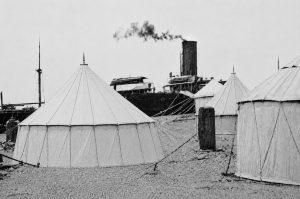
Camp at El Kantara Bridgehead (Major JF Bleakely Collection)
The battalion stayed here at Kantara for about 3 days and then we set out on a 28-mile route march to a place called Ismailia. It was to be a two days march. We stayed for the night at a place called El Ferdan and then proceeded to Ismailia the next day and arrived there at about six o’ clock at night. We then stayed here for a fortnight and handed in all our clothes and we got Winter clothes for France.
France 1917
We set sail from Alexandria on the 23rd February and landed at Marseilles on the 2nd March and then had a 50 hours train ride across France till we arrived at a place called Huppy, somewhere in France, where I found out later that we were only about 40 miles behind the Somme front.
Today everything has been the same; nothing to do. We are stationed in a barn here, 5 or 6 of us in one place, with the rats all over the place in swarms. We have heard the guns all day today on the Somme.
Today everything the same up to dinner time but after dinner we went to the nearest station which is about 6 miles from this village and we drew our steel helmets and the new short rifle and long bayonet so that we are ready for the trenches any time now.
Today the 11th of March, so Sunday, and the lads have all gone on church parade but I have to stand by my billet ready to be called upon any time as I have been chosen for a splendid billet as orderly at the Brigade Headquarters, which means that I have to leave the battalion and stay at headquarters. I shall have to take messages to and from the Brigadier General. If the Division moves up to the trenches I shall have to stay behind where the General stays so that I will always get a good night’s sleep and I shall not have to do guard [duty] all day and night through, so I think myself very lucky indeed as they called me and asked me if I could read and write well so I told them I could and that I did clerking with the battalion at Southport so that he put my name down for the job. Of course, it will be no easy job as I shall be up and down all the day carrying messages to and fro to all the battalions in our Brigade. And they include the 4th and the 5th East Lancs and the 9th and 10th Manchester Regiments so that I shall have some work to do but it is a jolly sight better than the trenches all day and night.
We left Huppy on the 24th March and marched to a place called Pont Remy and we stayed here for about 6 days. While we were at Huppy, Billy got his first stripe; he is in command of a Lewis Gun section.
Notes:
3129 [88157] Pte Albert Garner
2736 [35040] Pte William Albert Bibby
3132 [200984] Pte John Kerr
3065 [200937] Pte John Ashworth
2553 [200691] Pte Richard Duckworth Whittaker
2643 [200725] Pte Ernest Edgar Thompson
Acknowledgement:
This journal has been transcribed from originals held at the Imperial War Museum. The transcription is provided here under Non Commercial Use License and remains the copyright of the IWM.
The papers are catalogued here at the IWM.