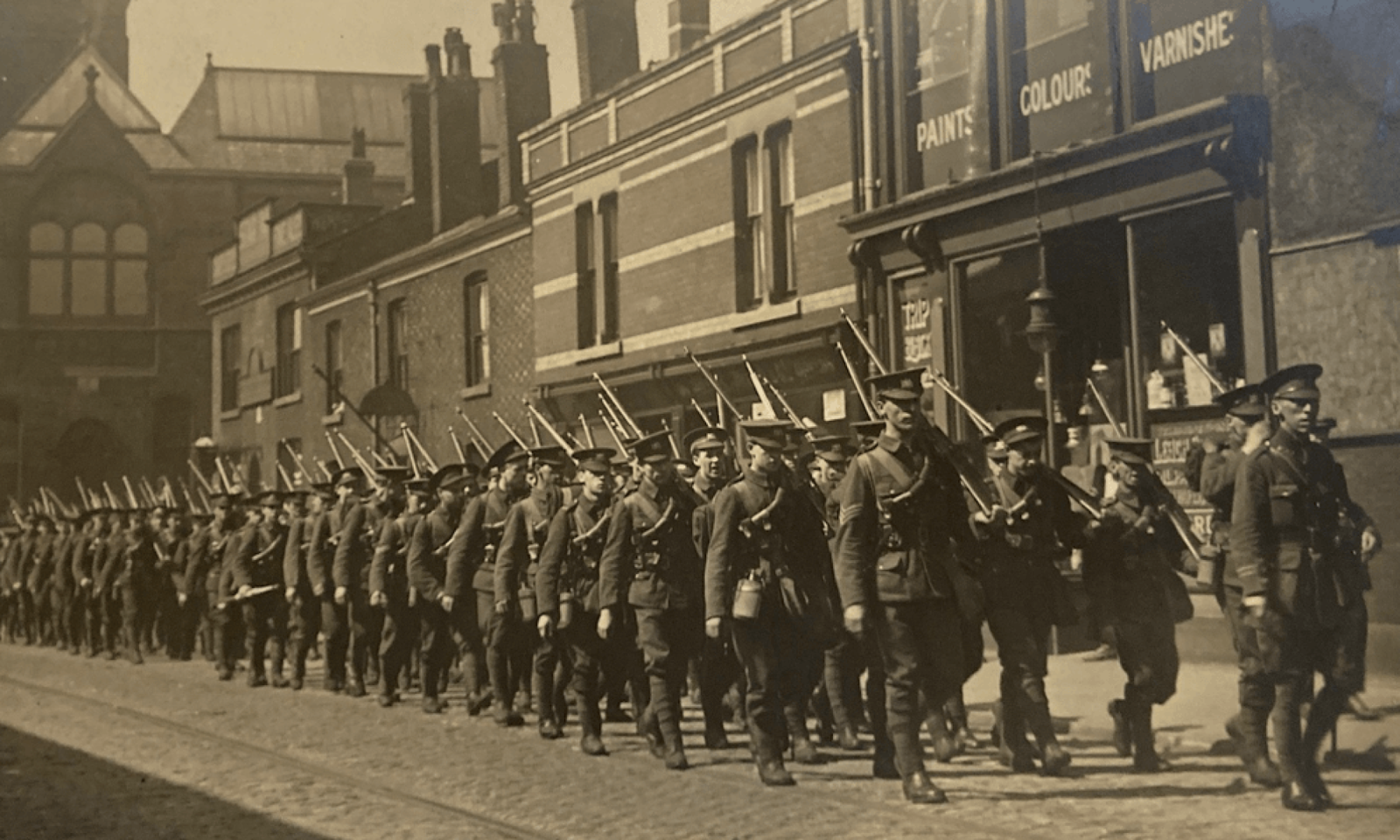
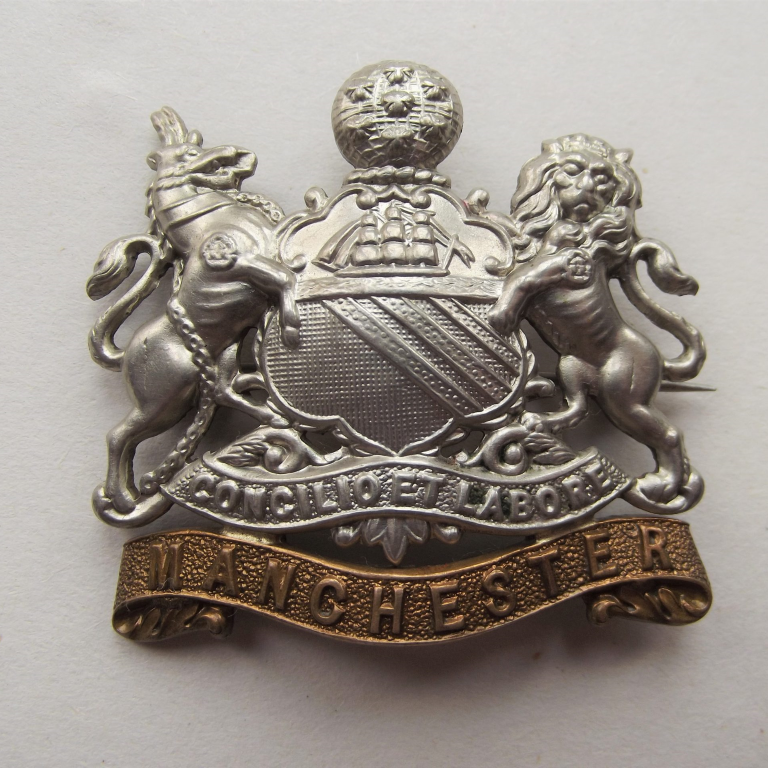
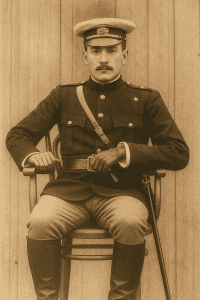
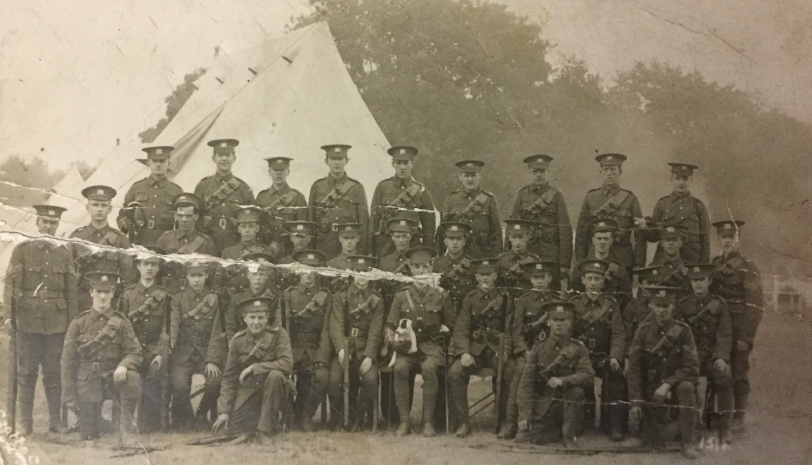
Lieutenant-Colonel Doctor Herbert Wade was the commanding officer of the 1/9th Manchesters at the outbreak of the war and landed with them at Gallipoli on May 9, 1915 as their C.O.
Doctor Herbert Wade was born in Oldham on July 2, 1865. He was the only son of Mayall and Martha Wade (née Charnley) and was born 3 years after his older sister Ester Ann Charnley Wade. Mayall Wade was an affluent Chemist & Druggist and young Wade was educated at Oldham High School and later at College in Chester.
On February 14, 1885, when he was 19 years old, he joined the 1st Cheshire & Caernarvonshire Artillery Volunteers as a private and remained with them for two years. He left England to work in Singapore in a junior civil service job and while there picked up colloquial Malay and served as a private in the Singapore Volunteer Artillery (Straits Settlements) from September 1889 to March 1893.
Returning to the UK he married Ada Neal, the daughter of the Ashton-under-Lyne Borough Comptroller, on December 23, 1893 and settled in Ashton. His son, John Mayall Wade, was born there on September 28, 1894 and his daughter, Ida Wade, was born 18 months later on March 5, 1896. Working as a librarian and a teacher, (Director of Technical Instruction), he was commissioned as a Second Lieutenant into the 3rd Volunteer Battalion, Manchester Regiment on April 11, 1900.
He rose through the ranks rapidly and just 15 months after being commissioned was promoted to Captain on July 13, 1901. Over the next few years, he passed several Army instructional courses including mounted infantry duties and musketry, (School of Musketry, Hythe Aug 21, 1908), before being promoted to Major on July 6, 1910, now in the 9th Battalion Manchester Regiment, Territorial Force, after its creation in 1908 through the Haldane Reforms. Outside of the Army his career flourished, becoming the Education Secretary of the Ashton Borough Council and he continued to live in Ashton with his wife, two children and a domestic servant. He was appointed Lieutenant Colonel and Commanding Officer of the 9th Battalion Manchester Regiment in July 1913, vice Lt.-Col. Charles Richard Wainright.
He sailed with the Battalion to Egypt in September 1914 along with his son, twenty-year-old Second Lieutenant John (Jack) Mayall Wade and his wife’s nephew, eighteen-year-old Second Lieutenant Thomas Grimshaw Hyde, both recently commissioned; his son only a week before they sailed. Lt.-Col. Wade commanded the battalion through their intensive field training and their brief role in the defence of the Suez Canal in April 1915.
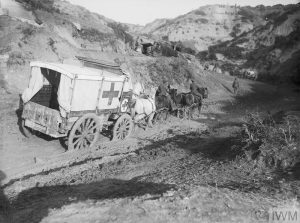
They landed at Gallipoli under fire on May 9th but just 13 days after landing in Gallipoli, on May 22, 1915, he was shot and wounded in the abdomen and thigh while stepping over some sleeping men in the firing line. The bullet entered the left groin and lodged in the middle of the right thigh near the femur but without breaking any bones. He was treated on the peninsula for two days before being medically evacuated to Alexandria where he was admitted to the 15th General Hospital on May 27th. Over the next few weeks, the wound suppurated and the pus had to be drained through several large incisions. While he was undergoing treatment in Alexandria, he learned that his son, Second Lieutenant John (Jack) Mayall Wade, had been reported missing in action on June 19th while leading his men to attack the Turkish trenches. He was medically assessed on July 9 and was given an estimated six months recovery time and granted leave in the UK to recover. Consequently, on July 17 he embarked on the Hospital Ship Asturias at Alexandria arriving in Southampton 10 days later.
In the UK he initially spent some time in the 2nd Western General Hospital on Whitworth Street in Manchester but moved to outpatient treatment by the end of August. A few weeks later he was sufficiently recovered to command the Ashton Territorials present at the military funeral of Pte. Samuel Armitage in Ashton on October 7, 1915. He was also active in recruiting efforts in Ashton throughout October and November before joining the 3/9th Battalion in Southport, on light duty, on November 19. On December 7, 1915 he was medically assessed at the 2nd Western General Hospital in Manchester and pronounced fit for General Service.
He received orders to rejoin the Mediterranean Expeditionary Force and embarked on the transport ship Llandovery Castle, at Devonport, on January 14, 1916 bound for Egypt. He rejoined the battalion on February 8, 1916 after they had evacuated Gallipoli and were guarding the Suez Canal at Shallufah. He commanded the Battalion throughout their stay in Egypt taking over temporary command of the 126th Brigade for a short period in May. He took a 3-day local leave in late October and then sailed with the battalion to France in March 1917. For distinguished services in Egypt June 1 to September 30, 1916 he was Mentioned in Despatches by General Sir Archibald Murray, K.C.B., Commander-in-Chief of the Egyptian Expeditionary Force. But he had spent the Egyptian summer in the northern Sinai as the battalion played its part in the Desert Column pushing the Turkish forces past El Arish and the heat and difficult living conditions were to take a physical toll.
He was by now almost 52 years old and less than two months after arriving in France he was taken ill and on April 27 was admitted to No 8 General Hospital at Rouen, physically breaking down due to his age and the sudden change in climate. After a few days’ rest, he embarked the transport Western Australia on the evening of May 1 arriving at Southampton the following morning. Here he was admitted to Farnborough Hill Hospital in Hampshire, the home of the Empress Eugenie but converted into an Officers’ Convalescent Hospital during the war. Three days later, he was medically assessed at Cambridge Military Hospital, Aldershot, pronounced permanently unfit for General Service and granted 3 weeks leave. Based on this diagnosis the War Office transferred him to the Territorial Reserve on June 6, 1917. He did not return to action.
He returned to his position as Director of Education at Ashton-under-Lyne and by this time was living with his wife and daughter at “Holly Bank”, Birch Polygon, Rusholme in Manchester. It was a difficult time for the family as the Turkish Foreign Office had confirmed at the end of January 1917 that they had no record of Jack Wade being held prisoner. The conclusion was clear and his son’s death was officially confirmed in due course.
On a more positive note, his daughter Ida was married in July 1918 and his grandson Helge John Neal Moe was born a year later in May 1919. That same year, Lt.-Col Wade was awarded the Territorial Decoration on July 15 and in civilian life he became a Fellow of the Chartered Institute of Secretaries.
After the war, orders to reform the regiment were received in October 1920 and Lt-Col. D. H. Wade was appointed Commanding Officer on October 29. In 1921 he was appointed as a Justice of the Peace for the Borough of Ashton-under-Lyne but his tenure as Commanding Officer of the 9th Battalion was to be fairly short-lived when he was forced to retire from the Territorial Force on January 27, 1922 having reached the age limit of 57. Subsequent to his retirement, he was granted the rank of Brevet Colonel due to his long and distinguished services.
By 1939 he had retired and he and his wife were temporarily living at Hill Top, Hale, Altrincham with Ada’s recently widowed sister, Margaret Hyde and two domestic servants. Their family home was on Mauldeth Road, Withington and they lived there with a housekeeper. When the housekeeper left in late 1949 Ada Wade became depressed and, despite their daughter temporarily coming home from Norway to help, Ada’s mental health deteriorated and she gassed herself in the oven. The inquest was held in October 1949 and the verdict rendered was suicide while the balance of her mind was disturbed.
Lt. Col. Doctor Herbert Wade died on March 14, 1954 at a private nursing home in Withington, Manchester. He was 89 years old.
Foreign gallantry awards were sometimes given as a “consolation” if a British medal was not awarded. In some cases men were recommended for a Distinguished Conduct Medal (DCM) and it was downgraded to a Mentioned in Despatches (MiD) as it passed up the chain of command. Foreign awards were slightly different in that they generally passed down the chain of command and therefore there was more certainty over their award. The Military Medal was not established until March 1916 and although it was possible to make a retrospective award, it often didn’t happen and of course was not available in 1915.
Some foreign medals seem to have been made available to the British on a reciprocal basis, and were awarded to men who were chosen by British commanders as being particularly deserving, but who did not, for some reason, qualify for a British gallantry medal.
One particular feature of some of these foreign awards (which was in effect an MiD with related medal) was that they could be awarded posthumously. The French Croix de Guerre as an example. This made it especially useful for awarding to men who had lost their lives in gallant circumstances but who fell short of the requirements for the Victoria Cross, the only British gallantry medal that could be awarded posthumously. Confusingly, one hears sometimes of apparently posthumous awards of ‘lesser’ British gallantry medals, but on investigation these turn out to be confirmations after the recipient’s death of awards for which they had already been recommended.
Pte. WILLIAM SHEEKEY (2231) 1/9th Manchester Regiment was one such man who was awarded the Silver Medal, otherwise known as the Serbian “Milos Obilic” Silver Medal of Valour. In the London Gazette, the Serbian Silver Medal was listed under the heading of “Decorations and medals conferred by HIS MAJESTY THE KING OF SERBIA” and awarded for “gallantry and distinguished service in the field” which is the only citation available. [Gazetted Feb 15, 1917]
Silver Medal Background:
Milos Obilic was a medieval Serbian knight, considered an epitome of bravery and honesty, and who, legend has it, was captured by the Ottoman Turks at the end of the Battle of Kosovo in 1389. Presented as a prisoner of war to the Turkish Sultan Murad I, Obilic produced a hitherto-hidden dagger and stabbed and killed the Sultan, an act for which Obilic was beheaded. Ever since he personified the fearless, heroic Serbian warrior, ready to sacrifice own life in face of threatening defeat.
In the summer of 1913, the Kingdom of Serbia was overhauling its gold and silver Medals for Bravery, both in design and regulations, and opted to use the name and image of the great Serbian hero, Milos Obilic, in the design.
Award Criteria:
The medal was awarded for valour on the battlefield:
The gold version of the medal could be awarded to officers for “valour tested in battle” and, in exceptional cases, to NCOs for “fearless bravery in battle”.
The silver version could be awarded to NCOs and enlisted men for “bravery in battle”.
Description:
On one side of the medal is an ideal portrait of Milos Obilic in profile, wearing his armour and, near the edge, his name in Serbian Cyrillic, ‘MИЛОШ ОБИЛИЋ’.
On the other side of the medal, a cross with a pair of diagonal swords and, in the centre, the Serbian Cyrillic text, ‘ЗА ХРАБРОСТ’, which transliterates as ‘Za Hrabrost’, and translates to ‘For Bravery’.
Serbian recipients of the Milos Obilic Medal were exempt from taxes and it was the highest ranking Serbian medal at the time, which meant that, for a set of Serbian medals, it was worn in the leftmost position of the medal group, with the lower-ranking medals in their respective, regulated order or rank, being worn to the right of the Obilic medal.
References:
‘Serbian and Yugoslavian Orders and Decorations, 1859-1941’ by Pavel Car and Tomislav Muhić, 2009.
Between 1906 and 1912 a series of sweeping changes were made to the British Army and named after the then Secretary of State for War, Richard Burdon Haldane. These “Haldane Reforms” were the first major reforms since the “Childers Reforms” of the early 1880s and were aimed to rectify shortcomings uncovered during the Second Boer War.
Along with changes to the Regular Army, the Territorial and Reserve Forces Act 1907 completely restructured the reserve forces to ensure a properly trained set of units and recruits to supplement the Regular Forces in times of war and to provide a more efficient force for home defence. The act called for the old Volunteer Force and Yeomanry to be reorganized into a new Territorial Force, administered by County Territorial Associations, and the old Militia was formed into the Special Reserve. The result was that the Territorial Force was established on April 1, 1908 and the men who joined agreed to be liable for service with the regular forces in wartime but the Act stipulated that ‘they could go abroad if they wish’.
Additionally, to help provide a ready supply of militarily trained potential officers, the Haldane Reforms also established an Officer Training Corps, (OTC), in public schools and Universities. Many of the men commissioned into the 9th Battalion Manchester Regiment immediately after the outbreak of war came directly from, or had previously belonged to, an OTC.
In Ashton, the 9th Battalion, Manchester Regiment, Territorial Force was duly formed on April 1st 1908 and the 3rd Volunteer Battalion, Manchester Regiment (VBMR) was dissolved. At that time, the “establishment”, (the official, authorized strength and structure of a military unit), of the battalion was set at 29 Officers and 980 men, as were the other 11 battalions of the East Lancashire Division. At the Annual Prize Giving Dinner for the 3rd VBMR on January 28, 1908 the commanding officer Lt.-Col. Charles Richard Wainright stated that the battalion then consisted of 927 men earning them a full capitation grant of £2,156. Indicative of the dissatisfaction that many of the ‘Old Volunteers’ felt with the new rules and requirements of the Territorial Force, by August 31, 1908 the battalion’s numbers had shrunk to just 25 Officers and 458 men.
Nevertheless, each of the NCOs and men of the old Volunteer Battalion were given the opportunity to re-engage with the new Territorial Force on April 1, 1908 and this process continued over the following weeks. New Territorial Force service numbers were assigned starting at ‘1’ and increasing sequentially based upon the date and the order in which their attestation paperwork was processed rather than by prior tenure in the Volunteers.
Thus, Cpl. Thomas Valentine who joined the 3rd Volunteer Battalion, Manchester Regiment on April 15, 1898 but did not re-engage with the Territorial Force until April 23, 1908, (22 days after the first group of men), was assigned a Territorial Force service number of 243. Whereas Sgt. Arthur Bashforth, who joined the Volunteers on March 20, 1903, (5 years after Valentine), was given a lower Territorial Force service number of 58 because he was part of the first batch of men who re-engaged with the Territorial Force on April 1, 1908.
The London Gazette belatedly announced in November 1908 that:
“Officers from the 3rd Volunteer Battalion, The Manchester Regiment, are appointed to the battalion with rank and precedence as in the Volunteer Force. Dated 1st April, 1908.”
Territorial Pre-War Training Camps
One of the requirements of service was to attend annual training camps and the following were those attended by the 9th Manchesters:
From
To
Camp Location
07-Jun-08
14-Jun-08
Ramsey (Isle of Man)
25-May-09
13-Jun-09
Salisbury Plain
14-May-10
28-May-10
Salisbury Plain
20-Aug-11
03-Sep-11
Dolphinholme, Lancs
28-Jul-12
11-Aug-12
East Marton, Yorks
10-Aug-13
24-Aug-13
Aldershot
The annual training camp for 1914 was scheduled to start on August 9, 1914 at Caernarfon, for two weeks but for obvious reasons was cancelled.
9th Battalion Annual Pre-War Training Camp, Aldershot 1913
In July 1913, Major D. H. Wade was appointed Lieutenant Colonel and Commanding Officer of the 9th Battalion Manchester Regiment, vice Lt.-Col. Charles Richard Wainright.
Pre-War Recruiting
The following table shows the “establishment” of each of the units of the East Lancashire Division and the actual numbers of men in each unit during the successful recruiting drive of January 1 to March 31, 1914.
Unit
Estab
1-Jan
1-Feb
14-Feb
31-Mar
DLOY
438
450
460
464
470
1st EL Bde RFA
595
536
535
565
593
2nd EL Bde RFA
596
589
583
638
620
3rd EL Bde RFA
595
513
540
578
611
EL Divisional RE
485
426
491
491
512
5th Batt. LF
974
761
796
900
986
6th Batt. LF
979
859
846
890
902
7th Batt. LF
977
710
802
849
889
8th Batt. LF
975
619
751
811
873
4th Batt. ELR
976
559
571
670
690
5th Batt. ELR
976
562
587
607
716
9th Batt. MR
977
579
601
804
870
10th Batt. MR
976
728
806
878
889
5th Batt. MR
980
735
771
771
795
6th Batt. MR
987
852
934
934
987
7th Batt. MR
987
899
1057
1,084
1,046
8th Batt. MR
982
692
758
819
908
EL T & S Column
488
445
459
469
473
RAMC
1,004
951
967
964
996
Totals
16,008
12,465
13,315
14,186
14,826
It was further noted that the 9th Battalion, Manchester Regiment had 11 men due for discharge prior to that year’s Annual Camp and that on aggregate the East Lancashire Division expected only 50% of those men discharged for time served to re-enlist.
ENGLAND 1914
On July 1, 1914 the 9th Battalion Manchester Regiment, Territorial Force (Ashton Territorials), found themselves still substantially below their minimum required strength of 28 Officers and 977 men having a nominal roll of only 26 Officers and 888 men, despite a recent surge of over 150 new recruits from a very successful recruiting drive at Ashton Town Hall on the evening of February 14.
When War was declared on Tuesday August 4, 1914, another wave of recruits queued up outside the Armoury on Old Street to enlist in the battalion and by Friday evening at least 94 men had joined who were later to serve overseas; almost half with prior military service and with an average age of 25 years, substantially older and more experienced than most of those who had joined in February. Around a dozen more similarly aged and experienced recruits joined during the following week.
On the 10th August, 1914 Lord Kitchener announced that the Territorial Force could now volunteer to serve overseas. The news arrived at the battalion the following morning, via telegram, and it was explained to the men that although it could mean active service, it was more likely to be garrison duty in Malta, Gibraltar or Egypt to relieve the regular Army troops currently stationed there. The men went on a short route march and after they returned the names of volunteers were taken. It was reported that 858 men indicated their willingness to serve overseas. The following day a message was received from Brigadier-General Prendergast, the commanding officer of the East Lancashire Infantry Brigade:
My Dear Colonel Wade,
I must address you a line to send you my sincere congratulations on the splendid and patriotic response the 9th Battalion Manchester Regiment has given to W.O. call for volunteers by units. I am much gratified by the results, as I feel now I shall have my brigade intact with me wherever we may have to go.
Very truly,
G. PRENDERGAST, Col.
On Saturday August 15, 1914 the complete list of officers and men of the 9th Battalion Manchester Regiment was published in the local papers of the Reporter newspaper group and is provided here. The list names around 1,000 men from Ashton, Bardsley, Limehurst, Waterloo, Hooley Hill, Smallshaw, Woodhouses, Littlemoss, Taunton, Hurst, Hurst Brook, Guide Bridge and Park Bridge along with men from the nearby towns of Dukinfield, Hyde, Stalybridge, Denton, Audenshaw, Openshaw, Droylsden, Gorton, Newton Heath, and Clayton.
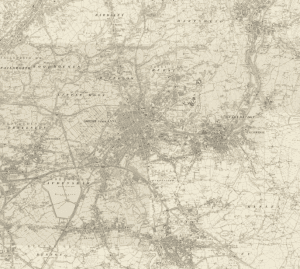
Ordinance Survey Map of Ashton and District from the 1890s
At this point, the battalion being fully up to strength, recruiting into the battalion was halted.
On Thursday August 20th, the 9th Manchesters marched into Chesham Fold Camp, Bury (a tented camp at Chesham Fold Farm). Bury was the divisional headquarters of the East Lancashire Infantry Brigade, which included, the 9th Battalion Manchester Regiment, the 4th East Lancashires, (from Blackburn, Darwen and Clitheroe), the 5th East Lancashires, (from Burnley, Accrington, Haslingden, Baccup, Padiham and Ramsbottom), and the 10th Manchesters (from Oldham), three sections Signal Company, Headquarters Company of Engineers, Lancashire Brigade Company A.S.C., Transport and Supply, and the 2nd Field Ambulance. The battalion was housed in around 100 European pattern tents pitched on the long slope of a hillock overlooking Bury.
Signallers (Attached)
The nominal roll of the battalion published in the Reporter newspapers indicated that 18 men of the No. 3 Section, East Lancashire Divisional Signal Company were attached to the Battalion for pay, rations, and discipline. These men, having arrived at Chesham Fold Camp two days earlier, now joined the battalion.
RAMC (Attached)
The nominal roll of the battalion published in the Reporter newspapers also indicated that 5 men of the Royal Army Medical Corps, Territorial Force from the 1/2nd East Lancs Field Ambulance were attached to the battalion for war service. Amongst many other routine medical and sanitary duties, their role in combat would be to man the Regimental Aid Post when the battalion was in the trenches.
Almost a week later, on Wednesday August 26th, the day after Lord Kitchener’s first address to the House of Lords as secretary of state for war, Brigadier-General Prendergast addressed the men. According to the Ashton Reporter, he asked the battalion to volunteer as a whole for any service they were asked to do not simply the garrison duty he had stated two weeks earlier. He promised them their own officers and companies and asked them “to loyally represent their dearly loved company and patriotic town of Ashton in this cruel but necessary war.”
Lt.-Col. D. H. Wade also addressed the men and exhorted them to “Be British!“. The men were then asked to show their willingness to volunteer for overseas service “anywhere” and around 70% of them showed their assent by sloping arms.
Three days later, with rumours of their imminent departure overseas becoming more concrete, a sense of urgency and reality set in. Lt.-Col. Wade again addressed the men and this time asked them in earnest, “Were they British enough” to volunteer for overseas service? The men debated amongst themselves and in the end 25 officers and 834 men gave their names. Orders were received to separate the “overseas” men from the “home service” men and a small camp of ten or eleven European pattern tents was setup a little removed from the rest of the battalion. By the evening of Monday August 31st around 25 home service men had changed their minds and re-joined the rest of the battalion.
At this point, the battalion was around 120 men and seven officers short of their full establishment.
Even though almost all the officers had volunteered, Major Edward Garside, the battalion’s second in command, at 55 evidently had failed the medical and so was not permitted to serve overseas. Additionally, Lieutenants Douglas Buchanan Stephenson and Alfred George Birchenall had not been able to join the battalion at Bury due to illness. And at camp, Captain Ralph Lees became quite ill and had to return to Ashton for an operation. Finally, Lt. George Makin, in charge of the battalion’s signallers, was also unable to serve overseas. Consequently, the following Second Lieutenants were quickly added to the battalion’s strength on September 2nd: William Hampson Lillie, Oliver Jepson Sutton, Hugh George Shatwell, John Mayall Wade (the CO’s son), Charles Earsham Cooke and Albert Edward “Ned” Stringer. Also, John Broadbent*, recently retired from the battalion, was in the process of rejoining which he officially did on September 5th. With the battalion now up to its full officer strength, Second Lieutenants Philip Sydney Marsden and Harold Edward Butterworth were added as supernumeraries.
*JOHN BROADBENT was commissioned in 1895, served in the Boer War, and reached the rank of Major before resigning his commission with the 9th Manchesters in 1912. He rejoined in 1914 at the outbreak of war, losing his rank and seniority and leaving behind a pregnant wife. He was 42 years old when he landed in Gallipoli.
To rectify the 120-man shortfall, on Tuesday September 1st the battalion sent word to Ashton that an additional 120 recruits were needed and Lt.-Col. D. H. Wade travelled from Bury to ensure they were quickly added. In the event, 125 men were recruited for the battalion in just 2 hours; 40 traveling to Bury with Lt.-Col Wade the following day and the remainder joining them on Friday. With recruiting done and departure overseas imminent, Capt. R. B. Nowell, who had been in command of the Depot at Ashton, along with QMS Thomas Burgess and the handful of others assisting them in the recruiting work joined the battalion at Bury on Saturday Sept 5th. The 120 new recruits had been required to sign their overseas paperwork (Army Form E.624) when they attested and in Bury the rest of the battalion started to sign theirs too.
A telegram, dated Saturday September 5, was received by the East Lancs Divisional Commander from Lord Kitchener:
“Inform the Division from me that I hope that they will push on hard with their training in Egypt, as, before they are ready, there will be plenty of troops from India to garrison Egypt, and I hope they will be one of the first of the Territorial Forces to join our Army on the Continent. All will depend on their fitness for service against the enemy in the Field. – Kitchener.”
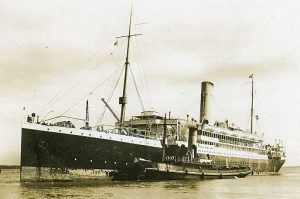
In a final two-day push, back in Ashton on Monday September 7th Lt. A.G. Birchenall and Sergeant Thomas Lord resurrected the paused recruiting effort and attested another 20 men who immediately left Ashton to join the battalion in Bury. After they arrived, seven men from the 5th East Lancs Regiment, (from Burnley), were transferred to the ranks of the 9th Manchesters at Chesham Fold and without the proper coordination with the recruiting effort in Ashton, duplicate service numbers were allocated causing much confusion 110 years later. Nevertheless, with the last-minute additions to the ranks completed, and after weeks of rumours and false starts, the battalion entrained for Southampton, bound for Egypt, on the evening of Wednesday September 9th. The following day they boarded HMS Aragon, leaving at midnight bound for Egypt.
Boy Soldiers of the Battalion
At least 28 members of the 9th Battalion Manchester Regiment who left for Egypt were, (or would have been), under the age of 17 when they landed in Gallipoli on May 9, 1915 and incredibly three of them were just 14 years old when they landed in Egypt on September 27, 1914. A detailed review of these boy soldiers can be found here.
Back in Ashton
Shortly after the 9th Manchesters left for Egypt a 2nd line battalion was formed in Ashton to receive recruits who would be trained in the UK before providing reinforcements for the overseas men. This new battalion was designated the 2/9th Manchesters and the overseas men became the 1/9th Manchesters.
Egypt 1914
The 1/9th Manchesters arrived at Alexandria on the 25th September but, due to the scale and complexity of disembarking an entire Division, did not land until September 27th. Once disembarked they were transported to the Citadel and Kasr-el-Nil barracks, Cairo. The day before they arrived at the port of Alexandria they suffered their first casualty when 18 years old Private 1705 John Bridge died of pneumonia and was buried at sea, (commemorated at the Chatby Memorial, Alexandria).
Back home in Ashton, recruiting continued at a healthy rate with more than 475 new recruits volunteering in October and November alone. These men were recruited into the newly formed 2nd line battalion, the 2/9th Battalion Manchester Regiment, whos purpose was to supply men to the 1/9th once they entered combat.
The Black Sea Raid
On October 29, 1914 two recently purchased ships of the Ottoman Empire’s navy, which were still crewed by German sailors and commanded by their German admiral, carried out the Black Sea Raid, a surprise attack against Russian ports. Russia replied by declaring war on November 1, 1914.
As a consequence, on November 1st martial law was declared throughout Egypt and Sudan. Egypt, which had been nominally part of the Ottoman Empire but under de facto British control since 1882, became a British protectorate, marking the end of the Khedivate and the establishment of the Sultanate of Egypt. On November 5th Britain and France declared war on Turkey.
Later that month the Battalion’s second death occurred when 15 year old Private 1845 Frederick Finucane died of dysentery on the 27th and was buried at the Cairo War Memorial Cemetery.
On December 14, 1914 the Battalion left Kasr-el-Nil for Abbassia main barracks.
On the 20th December the Khedive was deposed and Prince Hussein Kamel became the new Sultan of Egypt. British Troops stationed in and around Cairo lined the streets as an honour guard and a show of strength to the local populace. The contingent from the 9th Battalion taking charge of a section of Soliman Pasha Street, close to the Kasr-el-Nil barracks.
For months the Division had undergone strenuous training and by the end of 1914 the men were drilled, acclimated and thoroughly fit.
EGYPT 1915
From the beginning of 1915 the training became even more intense with long marches in the desert, in full marching order. And as part of their duties, from time to time, the East Lancs Divisional troops found themselves guarding the Suez Canal.
On January 30, 1915 the battalion moved from Abbassia and deployed to tents at Heliopolis in preparation for possible deployment to the Suez Canal.
In the early hours of February 3, 1915 12,000 Turks & Germans attacked the Canal defences South of Ismailia between Serapeum and Toussoum. They were repulsed and 1,600 prisoners taken by the Indians, Anzacs and East Lancs Division but the 1/9th were not directly involved in the hostilities. A contemporary newspaper report is provided here.
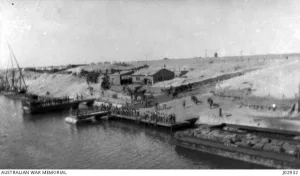
Ferry Landing at Ismailia. [Source: Australian War Memorial]
Sadly, in February and March the Battalion lost two of its senior Officers. Major WILLIAM HENRY ARCHBUTT suffered a heart attack on February 8, 1915 and Surgeon-Major ALBERT HILTON, the Battalion’s Medical Officer (M.O.), died of disease on March 4, 1915 while the 9th Battalion were under canvas at Heliopolis. Both are buried at the Cairo War Memorial Cemetery. Major Hilton was temporarily replaced as the battalion’s M.O. by Major Thomas Frankish, RAMC.
On Palm Sunday, 28th March 1915, General Sir Ian Hamilton, (the newly appointed commander of the Allied Mediterranean Expeditionary Force), reviewed the Division in Cairo. Verbal orders were received for the 9th Battalion (as part of the East Lancashire Division) to prepare to move to the Dardenelles at short notice.
According to the 126th Brigade War Diary, the 1/9th arrived, by train, at Kantarra from Cairo with 32 Officers and 912 men on April 16, 1915. They spent the rest of the month defending the Suez Canal from Turkish attack.
On the 2nd May, 1915 the 9th Battalion received their firm orders to leave for Gallipoli and were concentrated at Port Said by the evening of the 4th. On 5th May, the men of 9th Battalion (and 1/2 of the 10th Battalion) embarked on the HMT AUSONIA. The transport section which included horses, mules, one cart and two machine-gun carriages, along with the recently promoted Major RICHARD BOTTOMLEY NOWELL, Lt. JOHN BROADBENT and 26 other ranks of the 1/9th embarked on HMT COMMODORE.
Approximately two dozen men were discharged from service, (primarily due to sickness rendering them not physically fit enough to serve in combat), during the 3 months leading up to the battalion’s embarkation for Gallipoli.
Rank
No.
1st Name
MI
Surname
Discharged
Pte
2136
JAMES
DOOLEY
15-Mar-15
Pte
2213
ABRAHAM
J
HADGETT
15-Mar-15
Pte
2214
CHARLES
PARKER
15-Mar-15
Pte
2194
HARRY
SPEAKMAN
15-Mar-15
Pte
1699
ROBERT
THORNTON
15-Mar-15
Pte
1526
FREDERICK
WALLWORK
15-Mar-15
Pte
1349
ROBERT
BELL
23-Apr-15
Pte
2185
THOMAS
BOWDEN
23-Apr-15
Pte
1362
THOMAS
SMITH
23-Apr-15
Pte
2164
JAMES
ASHTON
03-May-15
Pte
2082
JOHN
A
BLACK
03-May-15
Pte
2157
SYDNEY
BURTON
03-May-15
Pte
1577
WILLIAM
CONSTANTINE
03-May-15
Pte
471
WILLIAM
FOGG
03-May-15
Pte
2023
WILLIAM
HUNTER
03-May-15
Cpl
2163
JOHN
IRVING
03-May-15
Pte
2017
ROBERT
KING
03-May-15
Pte
1912
JOHN
P
MILLWOOD
03-May-15
Pte
1707
HARRY
OLDFIELD
03-May-15
Pte
2114
BENJAMIN
RENSHAW
03-May-15
Pte
2144
LAWRENCE
SCHOFIELD
03-May-15
Pte
2233
WILLIAM
WHEATLEY
03-May-15
Pte
2215
WILLIAM
WHITTLE
03-May-15
Cpl
1992
JOSEPH
WILSHAW
03-May-15
And at least three more men were discharged after returning home from Egypt in the following months without ever serving in Gallipoli.
Rank
No.
1st Name
MI
Surname
Discharged
Pte
2188
WILLIAM
G
COLLIER
31-May-15
Col. Sgt
160
THOMAS
BURGESS
11-Jun-15
Pte
1932
JAMES
WATERS
28-Jun-15
Additionally, a member of the pre-war permanent staff of the Battalion, 2673 Col. Sgt. James Holt, returned from Egypt in March and did not land in Gallipoli. It is very likely that upon Col. Sgt. Holt’s departure, Sgt. John Alexander Christie, of the 5th East Lancashire Regiment, became permanently attached to the 9th Manchesters.
Note: First-hand, contemporaneous accounts of the battalion’s time in Egypt in late 1914 and early 1915 have been transcribed and are available here, here and here.
GALLIPOLI 1915
On the 9th May the 9th Battalion landed under heavy fire at Sedd-el-Bahr, (V Beach), and moved quickly from the beach into bivouac (the Commodore with the Transport section and Brigade HQ arriving on the 10th).
Context from Despatches:
The following short section seeks to put the landing of the 1/9th Manchesters into context from the selected despatches of Sir IAN HAMILTON, General, Commanding Mediterranean Expeditionary Force.
At the close of the ten days and ten nights described in my first despatch our troops had forced their way forward for some 5,000 yards from the landing places at the point of the peninsula. Opposite them lay the Turks, who since their last repulse had fallen back about half a mile upon previously prepared redoubts and entrenchments. Both sides had drawn heavily upon their stock of energy and munitions, but it seemed clear that whichever could first summon up spirit to make another push must secure at least several hundreds of yards of the debatable ground between the two fronts. And several hundred yards, whatever it might mean to the enemy, was a matter of life or death to a force crowded together under gun fire on so narrow a tongue of land.
The net result of the three days’ fighting had been a gain of 600 yards on the right of the British line and 400 yards on the left and centre. The French had captured all the ground in front of the Farm Zjimmerman, as well as a redoubt, for the possession of which there had been obstinate fighting during the whole of the past three days.
From nightfall till dawn on the 9th-10th efforts were made everywhere to push us back. A specially heavy attack was made upon the French.
On the 11th May, the first time for eighteen days and nights, it was found possible to withdraw the 29th Division from the actual firing line and to replace it by the 29th Indian Infantry Brigade and by the East Lancs Division, which had completed its disembarkation two days previously.
The Nominal Roll of men of the 1/9th Manchesters landing on that day included at least the following 915 men listed here.
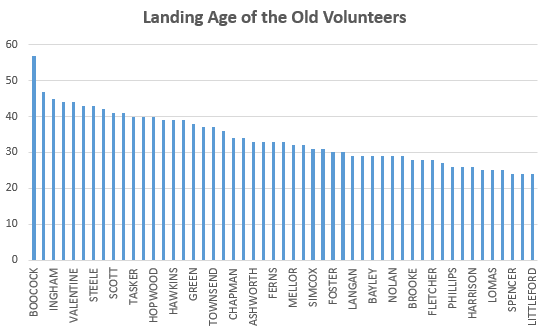
Amongst them were a number of “Old Volunteers” (men who had served with the Volunteer Force before April 1, 1908).
And the battalion’s Officers with the rank and seniority they held on landing, included:
2/Lt. J.M. Robson remained in Egypt commanding the base depot in Alexandria and did not land at Gallipoli until June 2, 1915.
Capt. F.W. Kershaw arrived with the Battalion at Gallipoli on May 9, 1915 but did not disembark and instead returned to Alexandria and was soon invalided to Malta due to sickness and did not rejoin them until June 20, 1915.
Major Thomas Frankish RAMC landed with the Battalion as their Medical Officer having been officially attached on May 5th.
Capt. F. Hamer had been assigned for duty as Adjutant and Quartermaster of the Turkish Prisoners’ Camp at Mahdi, Egypt but returned just before the battalion departed for Gallipoli and landed with them on May 9, 1914.
On May 11th, the East Lancs Division received orders to take over the front line. The 9th Battalion, as part of the 126th East Lancashire Brigade, were now in reserve positions behind the (127th) Manchester Brigade and the (125th) Lancashire Fusilier Brigade.
The 1/9th went into the line on May 21st and remained there until the 26th. At this time, the “line” was actually three lines; the firing line, the redoubt line and the support line each one further back from the Turkish trenches. Divisional orders for the 126th Brigade were to advance the line by digging new trenches under cover of darkness.
On May 23, Lt. Col. DOCTOR HERBERT WADE, commanding officer of the 1/9th, was shot by a sniper while stepping over some sleeping men. He was evacuated from the peninsula and did not return to the battalion until March 1916, when they were in Egypt. During his absence the 1/9th went through half-a-dozen temporary C.O.s. Major RICHARD BOTTOMLEY NOWELL temporarily assumed command on the 23rd. A list of all of the battalion’s COs throughout the war can be found here.
On the evening of May 23/24 the 1/5th East Lancs battalion on the right and the 1/9th Manchesters in the center both advanced 100 yards by digging a series of rifle pits but the 1/10th Manchesters on the left failed in their attempt. During the night’s digging 1358 L/Cpl. GEORGE JAMES SILVESTER saw that 1413 Pte. THOMAS PENNY had been wounded and brought him back to the trenches and then went back out and returned to digging even though he himself had been wounded. Pte. PENNY died of his wounds in hospital in Malta two weeks later.
The following day, on May 24, 2/Lt. FRED JONES was shot and killed and became the first of the 1/9th Battalion’s Officers to die in Gallipoli. He would not be the last. Also on that day, Lt. Col. ARTHUR FREDERICK EGERTON, DSO (9th Royal Scots) took over command of the Battalion.
The 1/10th Manchesters having failed to advance their line under cover of darkness were forced to try again during the day. The Divisional war diary reports that they were able to advance the firing line by 50 yards. The following day, on May 25, Lieut. ROBERT GARTSIDE WOOD brought back a wounded man of the 1/10th Manchesters but was seriously wounded in the leg. Evacuated by hospital ship to Malta, he declined to have his leg amputated en-route, and surgeons managed to save it after two operations. Lieut. WOOD was awarded the Military Cross in November 1915 for his actions that day.
On May 25th, the designation of the Division was changed and as the 42nd East Lancashire Division it took precedence in numerical order over the other Territorial Divisions since it had been the first to deploy overseas.
Meanwhile, on May 24, Lieutenant-General Sir Aylmer Gould Hunter-Weston was promoted to acting Lieutenant-General and placed in command of VIII Corps (29th Division, the Royal Naval Division, 42nd Division and the 49th Indian Infantry Brigade). On May 27 he issued orders to immediately and simultaneously advance the front line trenches across the whole of the British and French fronts to within assault distance (200 yards) of the Turkish trenches. This they mostly accomplished over the following days.
May Fatalities:
Rank
No.
Forename
MI
Surname
When
How
Pte.
1178
MATTHEW
REDFERN
23-May
DoW
Pte.
1524
JOHN
W
JENNEYS
23-May
DoW
Pte.
1809
ISAIAH
SMITH
28-May
DoW
Pte.
1690
ANDREW
GEE
30-May
KIA
Pte.
2175
FRANK
L
FAVIER
31-May
KIA
2/Lt.
FRED
JONES
24-May
KIA
Note: The primary difference between Killed in Action (KIA) and Died of Wounds (DoW) is that men designated as Died of Wounds were deaths recorded in the medical evacuation chain rather than on the battlefield. Also note that some of the men listed as Killed in Action were actually Missing in Action and their bodies were never recovered or otherwise identified.
May Casualties:
Note: The list of Casualties provided here (and in the tables below for each month) is the list of men appearing in the Times of London daily casualty lists published throughout the following month. Anecdotal evidence from local newspaper reports indicate that many more men were wounded but they are not listed here.
Rank
No.
Forename
Middle
Surname
Pte.
555
WILLIAM
BARKER
Pte.
1837
JOHN
ROBERT
NIELD
Pte.
781
HARRY
TAYLOR
Pte.
1727
ROBERT
ALLEN LEWIS
THOMAS
May Honors:
1358 L/Cpl. GEORGE JAMES SILVESTER, DCM For conspicuous gallantry and devotion to duty on the Gallipoli Peninsula. Although wounded on 20th May 1915, he continued to perform his duties, and showed the highest courage on 25th May in aiding the wounded under fire. [Gazetted Sept 15, 1915]
Additionally, 1904 Pte. J. E. TAYLOR, 1155 Pte. W. BURKE and Lt. R. G. WOOD were all recommended for gallantry for their actions on May 25th. Pte. Burke carrying Lt. RG Wood from the trench to the Field Ambulance and Pte. Taylor rescuing another man while under fire. All three men were subsequently mentioned in despatches, as reported in the London Gazette of November 5, 1915.
Field General Courts Martial:
32 enlisted men of the 9th Battalion Manchester Regiment were court martialed in Gallipoli, the first two of which were held on May 21, 1915. The range of offences was quite broad resulting in punishments ranging from the loss of one day’s pay to death. A full account of these cases is provided here.
Contradicting the implication that this group of men were somehow of low moral fiber it’s important to note that at least two of them were underage and four of them were subsequently decorated for bravery in the field. And nobody from the battalion was charged with cowardice or desertion.
June Operations:
Now that the 8th Army Corps front line had been painstakingly moved closer to the Turkish front lines, orders were issued to attack them on June 4th, the attack to be preceded by heavy artillery fire. This action was to become known as the Third Battle of Krithia. This action and the subsequent operations in June resulted in the deaths of at least 110 Officers and men of the Battalion.
Context from Despatches:
This brings the narrative up to the day of the general attack upon the enemy’s front line of trenches which ran from the west of the Kereves Dere in a northerly direction to the sea. Taking our line of battle from right to left the troops were deployed in the following order: -The Corps Expeditionnaire, the Royal Naval Division, the 42nd (East Lancs) Division and the 29th Division. The length of the front, so far as the British troops were concerned, was rather over 4,000 yards, and the total infantry available amounted to 24,000 men.
On the stroke of noon the artillery increased their range and along the whole line the infantry fixed bayonets and advanced. The assault was immediately successful.
The attack, timed for 3 p.m., was twice postponed at the request of General Gouraud, who finally reported that he would be unable to advance again that day with any prospect of success. By 6.30 p.m., therefore, the 42nd Division had to be extricated with loss from the second line Turkish trenches, and had to content themselves with consolidating on the first line which they had captured within five minutes of commencing the attack.
Although we had been forced to abandon so much of the ground gained in the first rush, the net result of the day’s operations was considerable- namely, an advance of 200 to 400 yards along the whole of our centre, a front of nearly 3 miles.
The Manchester Brigade of the 42nd Division advanced magnificently. In five minutes the first line of Turkish trenches were captured, and by 12.30 p.m. the Brigade had carried with a rush the line forming their second objective, having made an advance of 600 yards in all. The working parties got to work without incident, and the position here could not possibly have been better.
By 1.30 p.m. the whole of the captured trenches in this section had been lost again, and the Brigade was back in its original position, the ”Collingwood” Battalion, which had gone forward in support, having been practically destroyed. The question was now whether this rolling up of the newly captured line from the right would continue until the whole of our gains were wiped out. It looked very like it, for now the enfilade fire of the Turks began to fall upon the Manchester Brigade of the 42nd Division, which was firmly consolidating the furthest distant line of trenches it had so brilliantly won. After 1.30 p.m. it became increasingly difficult for this gallant Brigade to hold its ground. Heavy casualties occurred; the Brigadier and many other officers were wounded or killed; yet it continued to hold out with the greatest tenacity and grit.
The 1/9th went into the line on June 3rd and remained there until they were relieved on June 22nd.
June 7th:
The result of the recent actions were that on the morning of June 7th the 125th Brigade reported that the 1/6 Lancs Fusiliers were not able to be relieved due to a Turkish machine gun flanking their position. The Brigade proposed an attack, supported by artillery, along a line from the S.E. corner of the Vineyard to the Western Nullah. The objective of the 1/9th in the center was to capture trench G.11.
After dark on 7th June 100 men of C company of the 9th Battalion, along with two Companies of the Chatham Battalion of the Royal Marine Light Infantry, Royal Naval Division engaged in a frontal assault of the Turkish front line trenches. Although the 9th battalion succeeded in taking the Turkish trench, the Royal Naval Division failed to achieve their objective. Consequently, the 1/9th had to relinquish the trenches they had just captured at dawn.
Capt. GEORGE HAROLD OKELL and Lieut. ALBERT EDWARD STRINGER led the charge against one trench, and Capt. FRANK HAMER and 2/Lieut. JOHN (JACK) MAYALL WADE against the other trench. Capt. HAMER fell before reaching the trench. Lieut. STRINGER succeeded in reaching the trench but was subsequently killed by the enfilading fire from a machine gun. At least 20 men were killed and many more wounded.
Context from Despatches (Continued):
From the date of this battle to the end of the month of June the incessant attacks and counter-attacks which have so grievously swelled our lists of casualties have been caused by the determination of the Turks to regain ground they had lost, a determination clashing against our firm resolve to continue to increase our holding. Several of these daily encounters would have been the subject of a separate despatch in the campaigns of my youth and middle age, but, with due regard to proportion, they cannot even be so much as mentioned here.
On June 9th 2/Lt. PHILIP SIDNEY MARSDEN was reported wounded and on June 12, 2/Lt. ALLAN HARRISON HUDSON was reported missing (later reported to have been killed). Three days later Major MICHAEL HENRY CONNERY, the Battalion’s Quarter Master was slightly wounded when a Turkish shell hit his dug-out.
June 18:
An attack was planned to retake trench H.11 which had been partially re-taken by the Turks. However, 30 minutes before the attack the Turks heavily shelled the position causing the 88th Brigade to withdraw from the left. The allied attack was repulsed by the Turks who were already massed in the trenches for their own attack. They then counter-attacked causing trenches H.10 and H.11 to be entirely lost along with one machine gun and one trench mortar.
The initial attack was undertaken by B Company and included 2/Lt. JOHN MAYALL WADE and 2/Lt. ARTHUR WILLIAM FIELD CONNERY of C Company who had both volunteered to join them. Capt. HAROLD SUGDEN lead the attack and was mortally wounded. 2/Lt. WADE was seen jumping into a Turkish trench with six men and was never seen again.
The Turkish counter-attack was against a trench held by some men of C Company along with men of the 1/10th Manchesters. By the end of the fighting 2 Officers and 30 men had been killed, with dozens more wounded.
On June 22, 2/Lt. EDWARD BALMFORD and 16 men arrived from England, the first reinforcements to do so. An additional four men arriving on the 25th. The men from this draft are listed here.
The Battalion left the line on June 22nd but the next day the bivouac was heavily shelled requiring the 1/9th to move a further 600 yards back to their old bivouac but not before 9 men had been wounded. This just after they had suffered so heavily in the line.
July was a month of consolidation for the 42nd Division. The 1/9th were in the trenches from July 2 to July 18, then going to bivouac at divisional reserve. However, the number of deaths due to sickness and disease started to rise.
C company lost two Officers in early July. On July 5th 2/Lt. ARTHUR WILLIAM FIELD CONNERY was badly wounded in the mouth by shrapnel and went to hospital. Shortly after, on July 7th, 2/Lt. JOHN MATLEY ROBSON went to hospital with fever and died of enteric fever on July 17 in Egypt.
On July 10 2/Lieut. OLIVER JEPSON SUTTON and 969 Sgt. HARRY GRANTHAM made a reconnaissance at night, using string to measure their distance from their trench, and discovered that the Turks were digging to the S.E. of trench G12. They repeated their reconnaissance the following night to verify their observations.
On July 14, the recently arrived, 2/Lt. HARRY YORSTON DIXON was killed by shrapnel during an advance by 52nd Division and 2/Lt. EDWARD BALMFORD and 15 men were wounded. Two weeks later, on July 27, Lt. JOHN KNOWLES and 14 men were wounded.
On July 23, reinforcements arrived from England for all Infantry units of the 42nd Division. The 1/9th received 5 Officers and 222 men. The Officers arriving that day were:
The list of other ranks arriving that day is provided here.
July Fatalities:
Rank
No.
1st Name
MI
Surname
When
How
Pte.
2202
JACK
HAGUE
03-Jul
Fever
Pte.
1457
JOHN
BRADY
09-Jul
Fever
Pte.
419
FREDERICK
O
WYATT
12-Jul
DoW
Sgt.
1271
JAMES
TAYLOR
12-Jul
DoW
Pte.
1501
GEORGE
MARKHAM
12-Jul
KIA
Pte.
1922
EDWARD
KELLY
12-Jul
KIA
Pte.
1218
JAMES
HOLLINGWORTH
14-Jul
Fever
Pte.
1688
JAMES
WILSHAW
15-Jul
KIA
Pte.
2207
BEN
THOMPSON
15-Jul
Died
L/Cpl.
1957
JAMES
ROWBOTTOM
18-Jul
Died
Sgt.
31
THOMAS
LOMAS
22-Jul
KIA
Pte.
1557
ISAAC
WALKER
22-Jul
KIA
Pte.
1787
FRED
JONES
26-Jul
DoW
L/Cpl.
1155
WILLIAM
BURKE
28-Jul
Fever
Lt.
JOHN
M
ROBSON
17-Jul
Fever
July Casualties:
Rank
No.
Forename
Middle
Surname
Pte.
1972
GEORGE
BARRATT
QMS
5
GEORGE
BOOCOCK
Pte.
1576
WILLIAM
PETER
BRIERLEY
Pte.
2138
JAMES
GARSIDE
BROADHURST
L/Cpl.
1665
HARRY
BYROM
Pte.
2036
ALBERT
COMMERFORD
Cpl.
1120
THOMAS
FORREST
Cpl.
2127
SIDNEY
GARSIDE
Pte.
379
THOMAS
GHENTY
Pte.
1369
ALBERT
GIBSON
Pte.
1368
WILLIE
GIBSON
Pte.
1909
WILLIAM
SIMPSON
HALL
Pte.
2160
THOMAS
JACKSON
Pte.
1334
CHARLES
LEE
Pte.
2013
ARTHUR
LILLEY
Sgt.
1310
HERBERT
MORRIS
Pte.
512
JOHN
MORGAN
L/Cpl.
1313
JAMES
WILLIAM
RAMSDALE
Pte.
1271
JAMES
TAYLOR
Pte.
2086
TIMOTHY
TIPTON
Pte.
1688
JAMES
WILSHAW
Pte.
1150
FRED
ARMITAGE
Pte.
680
THOMAS
HARGREAVES
Pte.
1954
JAMES
ALBERT
TRUEMAN
Pte.
1597
ERNEST
HAWKRIDGE
Pte.
1388
WILFRED
LOCKWOOD
Pte.
1755
EDWARD
SPRAGG
Pte.
2197
SAMUEL
YARDWOOD
Pte.
2018
WILLIAM
WILLIAMS
July Honors:
969 Sgt. HARRY GRANTHAM, DCM For conspicuous gallantry and ability south of Krithia, Gallipoli Peninsula, on 10th and 11th July 1915, when making a reconnaissance of the enemy’s new trenches under very dangerous circumstances. He gained valuable information and located the hostile positions. [Gazetted Sept 15, 1915].
Capt. OLIVER JEPSON SUTTON, MC
The War Diary for the 1/9th Battalion notes that both Sgt. GRANTHAM and Capt. SUTTON were congratulated by the Division Major-General for their reconnaisance work. Capt. SUTTON was subsequently awarded the Military Cross. [Gazetted Feb 1, 1916].
August Operations:
August saw the Battalion heavily engaged in the Battle of Krithia Vineyard from the 7th – 9th August and the rigours of front line trench warfare throughout the rest of the month.
Context from Despatches:
Once the date was decided a certain amount of ingenuity had to be called into play so as to divert the attention of the enemy from my main strategical conception. This-I repeat for the sake of clearness-was: – (1) To break out with a rush from Anzac and cut off the bulk of the Turkish Army from land communication with Constantinople. (2) To gain such a command for my artillery as to cut off the bulk of the Turkish Army, from sea traffic whether with Constantinople or with Asia. (3) Incidentally, to secure Suvla Bay as a winter base for Anzac and all the troops operating in the northern theatre. My schemes for hoodwinking the Turks fell under two heads: First, strategical diversions, meant to draw away enemy reserves not yet committed to the peninsula. Secondly, tactical diversions meant to hold up enemy reserves already on the peninsula.
But upon the 6th of August attacks in the south were only to form a subsidiary part of one great concerted attack. Anzac was to deliver the knock-down blow; Helles and Suvla were complementary operations.
As the aim of my action in this southern zone was to advance if I could, but in any case to contain the enemy and prevent him reinforcing to the northwards, I persevered on the 7th with my plans, notwithstanding the counter-attack of the Turks which was actually in progress.
On the right and on the centre the first enemy line was captured, and small parties pushed on to the second line, where they were unable to maintain themselves for long. On the, left but little ground was gained, and by 11a.m. what little had been taken had been relinquished. But in the centre a stiff battle raged all day up and down a vineyard some 200 yards long by 100 yards broad on the west of the Krithia road. A large portion of the vineyard had been captured in the first dash, and the East Lancashire men in this part of the field gallantly stood their ground here against a succession of vigorous counter-attacks.
Two specially furious counter-attacks were delivered by the Turks on the 8th August, one at 4.40 a.m. and another at 8.30 p.m., where again our bayonets were too much for them. Throughout the night they made continuous bomb attacks, but the 6th Lancashire Fusiliers and the 4th East Lancashire Regiment stuck gamely to their task at the eastern corner of the vineyard. There was desperate fighting also at the northern corner, where the personal bravery of Lieutenant W. T. Forshaw, 1/9th Manchester Regiment who stuck to his post after his detachment had been relieved (an act for which he has since been awarded the V.C.), was largely instrumental in the repulse of three very determined onslaughts.
The 1/9th went into the trenches on Aug 7, remaining there until Aug 13, and were divided into two separate groups.
On Aug 22 a draft of 4 Officers and 145 men (formerly of the 2/9th Battalion) arrived from England as reinforcements for the 1/9th. The Officers arriving that day were:
Lt. WILLIAM THOMAS FORSHAW, VC For most conspicuous bravery and determination in the Gallipoli Peninsula from 7th to 9th August, 1915. When holding the north-west corner of the “Vineyard” he was attacked and heavily bombed by Turks, whoi advanced time after time by three trenches which converged at this point, but he held his own, not only directing his men and encouraging them by by exposing himself with the utmost disregard to danger, but personally throwing bombs continuously for 41 hours. When his detachment was relieved after 24 hours he volunteered to continue the direction of operations. At three times during the night of 8-9th August he was again heavily attacked, and once the Turks got over the barricade, but, after shooting three with his revolver. he led his men forward and recaptured it. When he rejoined his Battalion he was choked and sickened by bomb fumes, badly bruised by a fragment of shrapnel, and could barely lift his arm from continuous bomb throwing. It was due to his personal example, magnificent courage and endurance that this very important corner was held. [Gazetted Sept 9, 1915]
180 Cpl. SAMUEL BAYLEY, DCM For conspicuous bravery on the 7th and 9th August 1915, at Cape Helles (Dardenelles), Cpl. BAYLEY remained with Lt. FORSHAW, VC; holding a barricade for forty-one hours continuously. On the evening of 8th August his party was relieved by another unit, but he volunteered to remain on. He displayed the greatest gallantry and endurance under the most trying circumstances in repelling many severe attacks, and when the barricade was at last broken through he was the foremost in the successful counter-attack, led by Lt. FORSHAW, which regained it, and finally retained it. On being ultimately relieved he was utterly exhausted by his arduous and gallant work of bomb-throwing. [Gazetted Nov 16, 1915]
2148 L/Cpl. STANLEY PEARSON, DCM For conspicuous gallantry on the 7th and 8th August 1915, at Gallipoli, when acting as a look-out man and sniper. He displayed great bravery and skill and although enfiladed from both flanks he remained at his post and by his example gave great encouragement to all with him. [Gazetted March 11, 1916]
2103 L/Cpl. THOMAS PICKFORD, DCM For conspicuous gallantry on the 8th August, 1915, at Gallipoli, when he rallied his party, which had been driven back by bombs in the Barricade of the Vineyard, and by his bravery and example was largely instrumental in saving a precarious position. [Gazetted March 11, 1916]
1347 Pte. REGINALD POTTS
On August 12, Pte. POTTS volunteered to join the bombing party of the 1/4th East Lancashire Regiment and subsequently was issued a Congratulatory Card for gallantry. [War Diary Aug 26th]
2/Lt. CHARLES EARSHAM COOKE, MC
The Battalion War Diary notes that the Brigadier-General of the 126th Brigade personally congratulated the commanding officer of the 1/9th Manchesters on the gallant behavior of Lt. FORSHAW, 2/Lt. COOKE and the 2 platoons under them. 2/Lt. COOKE was subsequently awarded the Military Cross. [Gazetted Feb 1, 1916]
September Operations:
September brought a welcome relief from the intense fighting of previous months but for the first time the number of sick exceeded those of the killed and wounded. As the number of men reporting sick increased, the 126th Brigade began to record the numbers of sick per Battalion, starting on September 14th. In the second half of September 104 men of the 1/9th went onto the sick list.
On Sept 1, Capt. FRANK WOODHOUSE went to hospital sick.
On the evening of Sept 2, Lt. ARTHUR CLAUDE VYVYAN-ROBINSON and a party of 14 men were detailed to dig a trench joining the current Firing Line with the Northern Barricade. As they made their way in the dark they lost their bearings, going too far East, and were fired on by the Royal Naval Division. Lt. VYVYAN-ROBINSON was wounded, one man was reported missing and three were wounded. A court of enquiry was held and the details passed to the Division.
The next day, on Sept 3 at around 2pm, the Turks exploded a mine right under a sap known as FOUR HOLE POST in the Firing Line where the 1/9th were located. The explosion destroyed the Sap and 12 yards of the Firing Line, killing 2 men and wounding 3 others. Four additional men were extracted suffering from shock.
On Sept 10 Lt. Col. ROBERT WORGAN FALCON, temporary commanding officer of the 1/9th reported sick. He was replaced the next day by Major RODERICK LIVINGSTONE LEES of the 1/6 Lancs Fusiliers who had distinguished himself in August at the Battle of Krithia Vineyard.
The 1/9th went into the trenches on September 18th and remained there until October 1st. A few days later on Sept 20 Capt. GEORGE WILLIAM HANDFORTH reported sick. He was quickly followed by Lt. WILLIAM GILBERT GREENWOOD on the 22nd and by Lt. HAROLD EDWARD BUTTERWORTH on the 25th.
On Sept 27 Major RODERICK LIVINGSTONE LEES was awarded the DSO and on Sept 30 he relinquished command of the 1/9th and Major WILLIAM JAMES ANDERSON (of the 33rd Battalion Duke of Wellington’s Regiment) assumed command.
October saw the number of men reporting sick spike to 143 even as the number of killed and wounded dropped to the lowest levels of the campaign.
The 1/9th were relieved from the trenches on October 1st and moved to Divisional Reserve at GEOGHEGAN’S BLUFF. Here they were mostly engaged in fatigues supporting the extensive mining and digging work going on in the trenches. They later moved to Bivouac at GULLY BEACH.
On October 6th a small draft of 25 other ranks arrived. The following day a draft of 5 Officers from other regiments (Essex and South Lancs) arrived and were assigned temporarily to the 1/9th.
2/Lt. JOHN BROADBENT of the transport section also reported sick this day followed by Capt. DOUGLAS BUCHANAN STEPHENSON on October 10th.
On October 14th the Battalion moved back to the line; half the Battalion with the 1/10th Manchesters and half with the 1/5th East Lancs. The split made for tactical reasons to maximize the use of senior Officers and NCOs across the Brigade. A & C companies attached to the 1/5th East Lancs under Capt. FRANK WOODHOUSE and B & D companies to the 1/10th Manchesters under Capt. FREDERICK WILLIAM KERSHAW. The Battalion remained in the trenches until October 29th.
On October 16, Capt. ERIC RICHARDSON was appointed Staff Captain of the 126th Brigade and left the Battalion.
On October 19th Major WILLIAM JAMES V. ANDERSON was killed by a bomb while visiting the trenches. He was temporarily replaced by Lt. Col. GODFREY WALKER ROBINSON of the 1/10th Manchesters.
On October 22 a draft of 3 Officers and 139 men, of the 2/9th Battalion, arrived from England. The Officers arriving that day were:
The list of other ranks who landed that day is provided here.
And on October 26th a further 11 Officers arrived from England, (and 110 other ranks returning from hospital in Egypt). The Officers arriving this day were as shown below:
October brought only three fatalities at Gallipoli, Pte. Armitage dying at home from sickness contracted overseas.
Rank
No.
1st Name
MI
Surname
When
How
Pte.
1998
SAMUEL
ARMITAGE
3-Oct
Died
L/Sgt.
2139
GILBERT
HIGHAM
7-Oct
DoW
Pte.
2630
HARVEY
THOMPSON
17-Oct
KIA
Pte.
1343
TOM
HALL
20-Oct
KIA
October Casualties:
The only man listed in the following month’s London Times casualty lists was 1179 Pte. SAMUEL E. BOSNALL.
November Operations:
Disease, sickness and heavy rain that turned to snow blizzards and frost in November of 1915 created new hardships and claimed yet more casualties. The 9th Battalions numbers were dwindling fast despite three significant drafts of reinforcements from England arriving in July, August and October.
In November 117 men reported sick, a slight reduction from the previous month. Nevertheless, 3 Officers (Capt. FREDERICK WILLIAM KERSHAW, Lt. L. G. NASH, RAMC (attached) and 2/Lt. WILLIAM NEVILLE BROADBENT BURY) all reported sick on the same day, November 9th.
The Battalion moved into the line again on November 12th and remained there until November 26th. On the 15th a very heavy rainfall occurred filling some parts of the trenches to a depth of 3 feet. Despite the terrible conditions the Turks were relatively quiet until the 23rd when heavy shelling and a large number (40-50) stick grenades were fired at the trenches. 2/Lt. IRVINE DEARNALEY was killed this day.
On the 26th November the Battalion was relieved and went into Bivouac in GULLY RAVINE. A period of heavy fatigues followed for the remainder of the month. On November 29, 2/Lt. SYDNEY NAYLOR, recently arrived the previous month, was wounded.
Context from Despatches:
During the month of November, beyond the execution of very clever and successful minor enterprises carried out by Corps Commanders with a view to maintaining an offensive spirit in their commands, there remains little to record-except that an increased activity of the the Turkish artillery against our front became a noticeable factor.
On the 21st November the Peninsula was visited by a storm said to be nearly unprecedented for the time of the year. The storm was accompanied by torrential rain, which lasted for 24 hours. This was followed by hard frost and a heavy blizzard.
In December 54 men reported sick. 2/Lt. ARTHUR JAMES SOUTHCOTT reported sick on December 5th, returning to the Battalion (from 17th Stationary Hospital) on the 10th. The next day he reported sick again. In the meantime, 2/Lt. GEORGE FREDERICK BARKER, (who arrived with 2/Lt. SOUTHCOTT in November), also reported sick on December 8th.
2/Lt. LAIRD KIRWAN and 2/Lt. GEORGE GREENE-KELLY were transferred to the 1/10th Manchesters on the 8th December.
The Battalion went into the Line on December 10th and remained there until December 24th, moving to Divisional Reserve at GEOGHEGAN’S BLUFF. On December 17th Brigade Operational Order 28 was issued outlining a plan to explode a mine in front of the Turkish trenches with the objective of creating a crater. Men of the Brigade would go out the the crater and secure it by building barricades. The purpose of these small offensive operations carried out by the 52nd and 42nd Divisions was to act as a distraction during the evacuation of troops elsewhere on the peninsula.
Unfortunately, the mine that was exploded (600lbs at a depth of 40 ft) failed to produce a crater, the force of the explosion creating a ridge of earth only about 1 foot high. 16 bombers, a working party under 2/Lt. ALFRED GRAY and 26 men of B company dutifully went over the top and occupied the depression. With the Turkish trenches untouched, they were mercilessly shot at from the front and the right. Finding the position untenable the troops eventually were forced to retire. The casualties reported for the 1/9th on the day were 3 killed, 1 missing and 11 wounded. 2/Lt. GRAY, Sgt. GREENHALGH and Cpl. BARKER were mentioned in the Brigade war diary for showing “great courage and ability remaining out and covering the retirement of the parties although fired at from 12yds range.” Sgt. GREENHALGH and Cpl. DAVIS subsequently received DCMs for their acts of bravery that day.
A letter from Sgt. GREENHALGH was subsequently published in the Ashton Reporter on Saturday July 15, 1916 providing a version of the events in his own words:
“No doubt it came as a surprise at home when they heard that I had got theD.C.M. I can tell you it was a surprise to me also. The first I heard about it was in a letter I had from home, but the day following our commanding officer told me about it. As you are all wanting to know what I did to get it, I will try to tell you.
It was on the 19th December, 1915, I was ordered to take a party of men over the top, and we got to within ten yards of the Turkish trench. At the same time there was a mine blown up. It should have made a big hole in the front of the Turkish trench. The intention was for us to have got in this hole, but when we got to the place no hole had been made, and we had to lie in the open, and the Turks potting at us from ten yards away. It was a good job the Turks were nervous, or else there would have been none of us left to tell the tale.
The object was for us to get in the crater and build it up with sandbags, and then our bombers could have bombed the Turks out of their trench, but it didn’t come off as we expected. Anyway, we all got back to our trench except one poor lad who was killed.
Lance-Corporal Davies, D.C.M. was with the same party of men.”
On the 26th December, orders were received to leave the Peninsula, and on the 27th a Turkish shell made a direct hit on the Battalion bivouac killing a number of men in a cruel last minute reminder of the constant dangers they were leaving behind. Pte. Arthur Slater was buried alive and only survived because he was dug out by his comrades. The next day the 9th Battalion embarked on H.M.T. Redbreast bound for Mudros West.
Context from Despatches:
The following is taken from Sir Charles Monro’s Gallipoli Despatch, who was sent to replace the sacked Sir Ian Hamilton as Commander in Chief of the Mediterranean Expeditionary Force.
On the 8th December, consequent on your Lordship’s orders, I directed the General Officer Commanding Dardanelles Army to proceed with the evacuation of Suvla and Anzac at once.
Lieutenant-General Birdwood proceeded on receipt of his orders with the skill and promptitude which is characteristic of all that he undertakes, and after consultation with Rear-Admiral Wemyss, it was decided, provided the weather was propitious, to complete the evacuation on the night of the 19th-20th December.
On the 24th December, General Sir W. Birdwood was directed to make all preliminary preparations for immediate evacuation, in the event of orders to this effect being received.
The Divisional Order of Battle and Field State report for May 1-5t, 1915 indicates that 958 enlisted men of the 9th Battalion Manchester Regiment embarked for Gallipoli. During the campaign a series of small drafts brought and additional 524 men to replace those who had been killed or had left due to sickness or wounds. The Embarkation Return for the evacuation of the peninsula on December 27, 1915 listed just 469 remaining men. Acknowledging a handful of men who were repatriated towards the end of the campaign as time expired still leaves a staggering 68% casualty rate excluding those who were temporarily medically evacuated and returned after treatment and convalescence.
At least 192 men of the 1/9th Battalion died from the fighting, sickness or disease they were exposed to at Gallipoli. Many more men were wounded or otherwise hospitalised and approximately 100 men were awarded the Silver War Badge and discharged from service due to sickness or wounds they were unable to fully recover from.
Pte. 3765 Fred Dickinson serves as an example. He was discharged as permanently unfit for any kind of military service and awarded the Silver War Badge on March 23, 1916 suffering from Nephritis. His Service Record shows that his medical issues “originated on December 18, 1915 in Gallipoli. Sent into hospital in Cairo on account of general dropsy and discovered to be suffering from Nephritis. No history of previous illness of a similar nature. States that while on active service in the trenches he had to stand waist deep in water for a considerable time during a severe storm. Heart sounds fine but there is an accentuated sound heard at the apex. Urine contained albumen and blood is still present. Result of active service, exposure to cold and wet. Permanent [Disability].”
Pte. Dickinson only arrived in the Dardanelles on October 22, 1915 and was admitted to the Red Cross Hospital in Giza, just over two months later, on December 26 suffering from oedema to the legs (a swelling due to the accumulation of excessive fluid in the tissues). He was subsequently invalided to the UK leaving Alexandria on January 17, 1916 sailing on the Hospital Ship GLENGORN CASTLE. He was subsequently treated in the UK for 38 days at the 4th Scottish General Hospital, RAMC (Territorial Force) at Stobhill, Glasgow. He received a small, and decreasing, military pension over the next nine months following his discharge.
December Honors:
The Battalion War Diary on December 18 reports that three Congratulatory Cards from the Major-General Commanding the Division were received for:
No 5 QMS G BOOCOCK
400 Sgt. Mjr. Cook JOHN CHAPMAN
1659 Pte. P. WOODRUFF
And, in a rather belated recognition of their efforts, the Battalion War Diary for March 1916 reported that Cards of Congratulation were received from the Major-General Commanding the 42nd Division, for good work done in Gallipoli for the following men:
341 Sgt. JOHN LEE 2146 Cpl. PLATT A.
728 L/Cpl. GREEN A.
2826 Pte. SMITH A.
2231 Pte. WILLIAM SHEEKEY
2067 Pte. JOSEPH S. SWINDELLS
The 2nd-line (or reserve) Territorial Force battalions, brigades and divisions had no existence before the outbreak of the Great War.
On the 15th August, 1914, instructions were issued by the War Office to separate the home-service men of those T.F. units which had volunteered for service abroad; the home-service men were to be formed into reserve units. On the 3lst August the formation of a reserve (or 2nd-line) T.F. unit was authorized for each original (or 1st-line) unit in which 60 percent of the men had volunteered for foreign service. The title of the 2nd-line unit would be the same as that of the corresponding 1st-line imperial-service unit, and these reserve units were to be located at the peace headquarters of their 1st-line units. After being clothed, organized, and armed the reserve units would gradually be grouped into larger formations at training centres, war stations, etc. In this way the 2nd-line T.F. divisions came into existence.
The 2/9th Battalion Manchester Regiment, Territorial Force was formed at the Armoury in Ashton-under-Lyne immediately after the 1/9th Battalion sailed for Egypt on September 10, 1914. They were formed under the command of the 2nd/East Lancashire (later the 198th) Brigade, 2nd/East Lancashire (later the 66th Division) Division.
Their original purpose was as a feeding battalion for the 1/9th, providing much needed drafts of men to replace their mounting casualties in Gallipoli. In this capacity they supplied significant reinforcements for the 1/9th Battalion on three separate dates; July 23, 1915, August 22, 1915 and October 22, 1915 and through three much smaller drafts on June 22, June 25 and December 1, 1915.
The 2/9th moved from Ashton to Southport on Friday November 13, 1914, where they were billeted in digs, mainly on King Street.
They remained in Southport until May 25, 1915 when they moved to Haywards Heath, in Sussex. A little over a month later, on June 26, 1915 they made the short move to Pease Pottage and they stayed there until September 21st when they moved again, this time to Burham Camp, near Maidstone, Kent. On October 31st they moved to Crowborough Camp.
The battalion faced a number of difficulties including a dearth of trained instructors and a lack of equipment. The battalion eventually received 600-700 Japanese rifles and bayonets, and 180,000 rounds of ammunition. The Japanese rifles were retained until the end of 1915, and then they were replaced by charger-loading Lee-Enfield rifles, together with bayonets and .303″ ammunition. Shortage of technical equipment was not confined to the infantry battalions of the Division. The artillery lacked guns, with modern sights and gears, ammunition wagons, directors, telephones, and harness. Even in August, 1915, no veterinary officer was attached to any of the artillery brigades, and at this time the artillery had 1,373 horses.
Despite these difficulties the men trained as best they could, the training consisting of Squad Drill, Platoon Drill, Rifle Exercise, Care of Arms, Physical Exercises, Outpost Exercise, Company Exercise (in attack and defence), Company Exercise (in Fire Control), Judging Distance and Visual Training, etc. , Entrenching, Route Marching, Bayonet Fighting. Musketry & Lectures.
June 22-25, 1915
The first draft of men to arrive in Gallipoli from England was a small group of 16 men along with 2/Lt. EDWARD BALMFORD on June 22, 1915, as reported in the 126th Brigade war diary. Embarkation records record that 20 men embarked on the Transport SCOTIAN at Devonport on June 3 and were taken on the strength of the battalion when they sailed on June 4, 1915. Nineteen of those men are listed below.
Rank
No.
Forename
Middle
Surname
Pte
1312
GEORGE
BELL
Pte
2492
OWEN
WILLIAM
CONNOLLY
Cpl
3025
JOHN (JACK)
KELLY
Pte
2719
GEORGE
DEAN
Cpl
2765
WALTER
MICHAEL
TRACEY
Pte
3035
THOMAS
COOPER
Pte
2326
THOMAS
SMITH
Pte
2408
JOHN
LEECH
Pte
2447
ALBERT
BUTTERWORTH
Pte
2456
ARTHUR
REDFERN
Pte
2496
WALTER
LEECH
Pte
2506
EDWIN
WHITE
Pte
2689
FRANK
WRIGLEY
Pte
2718
BENJAMIN
SHATWELL
Pte
2802
REGINALD
JONES
Pte
3027
JAMES
CALDERBANK
Pte
3033
SAMUEL
STOPFORD
Pte
2605
ERNEST
SHAW
Pte
2713
JOSEPH
TAYLOR
It’s not clear which other of the men were delayed by a few days before joining the battalion but Privates Shaw and Taylor have arrival dates of June 24 and June 25 respectively.
July 23, 1915
The War Diary for the 1/9th Manchesters indicates that a draft of 222 men and five officers arrived in Gallipoli on July 23, 1915. They left Devonport on July 3, 1915 sailing on the Transport Ship IONIAN. In fact, embarkation records indicate that 227 men embarked and two disembarked at Alexandria (sick to hospital).
The following list of 224 men includes those with “disembarkation” dates of July 1 to July 23 (when they actually joined the Battalion in Gallipoli).
Rank
No.
Forename
Middle
Surname
Pte
1181
ARNOLD
OSWALD
WALKER
Pte
2269
HARRY
BERNARD
SIDEBOTTOM
Pte
2285
FRED
LATCHFORD
Pte
2374
ERNEST
HAGUE
Pte
2478
WILLIAM
PEMBERTON
Pte
2485
FRANK
CUMMINS
Pte
2613
FRANK
WARD
Pte
2617
HARRY
WAINWRIGHT
Pte
2644
ABRAHAM
PICKLES
Pte
2665
GEORGE
THOMAS
CHADWICK
Pte
2694
JOSEPH
MANCLARK
Pte
2699
ARTHUR
JEPSON
REDFERN
Pte
2702
SAMUEL
MATLEY
Pte
2728
WILLIAM
ELLIS
L/Cpl
2751
ROBERT
WRIGHT
WHITEHEAD
Pte
2756
ROBERT
ALLEN
GRAHAM
Pte
2797
JAMES
WHITE
Pte
2910
JOSEPH
ALEXANDER
WILSON
Pte
2994
ERNEST
GEORGE
ELLIS
Pte
3005
JOSEPH
HOWARD
Pte
3043
WILLIAM
POSTLETHWAITE
BIGGINS
Pte
3109
ROBERT
SWIFT
Pte
3151
JAMES
SPEEEDLES
Pte
3316
THOMAS
BUCKLEY
Pte
2256
LESTER
STAFFORD
Pte
2383
ARTHUR
STALEY
Sgt
2410
JOHN
CLAYTON
Pte
2477
JAMES
WILLIAMSON
Pte
2806
ARTHUR
FOX
Pte
3052
ARTHUR
DYBALL
Pte
3125
WILLIAM
HUNT
Pte
3175
WILLIAM
BARTON
Pte
3135
WALTER
ROGERS
Pte
2483
ALBERT
GODFREY
LEECH
Pte
2695
SYDNEY
DEVLIN
Pte
2815
HAROLD
CHATTERTON
Pte
3009
HARRY
ROBERTS
Pte
2963
ARTHUR
BROOKS
Pte
2047
HENRY (HARRY)
EDWIN
ANDERSON
Pte
1360
JOHN
LEVI
KENDALL
Pte
2883
ALBERT
LOADER
Pte
3039
GEORGE
ANDREW
BROCKLEHURST
Pte
2640
HARRY
BENNETT
Sgt
1151
JOHN
LAWLER
Pte
1213
ERNEST
HOUGH
Pte
1350
GEORGE
HENRY
WILTON
Pte
1539
MATTHEW
SHEA
Pte
1582
HENRY
DANIEL
WILSON
Pte
1697
ARCHIBALD
THOMAS
LATHAM
Pte
1752
GEORGE
EDWARD PROCTOR
WILSON
Pte
1779
CHARLES
EDWIN
WILLS
Pte
1780
RICHARD
FREDERICK
WILSON
Pte
1805
JOHN
FREDERICK
JENKINSON
Pte
1969
FRANK
THICKETT
Pte
2241
JEREMY
BARKER
Pte
2242
WILLIAM
HARWOOD
Pte
2244
ABEL
ROBINSON
Pte
2251
ROBERT
CHEETHAM
Pte
2258
ALBERT
COXON
Pte
2260
THOMAS
WELLENS
Sgt
2262
JOSHUA
HALL
Pte
2265
JOHN
WILLIAM
CAMPBELL
Pte
2271
PERCY
HARROP
Pte
2275
JAMES
WILLIAM
CHAPMAN
Pte
2293
WALTER
HARDY
Pte
2310
HEZEKIAH
HARRISON
Cpl
2322
CHARLES
EDWARD
MARLOR
Cpl
2324
WILLIAM
PARKES
CHALMERS
Pte
2328
WILLIAM
SYKES
GODDARD
Pte
2330
JOSEPH
HAROLD
CHADWICK
Pte
2337
WILLIAM
HENRY
CRANE
Pte
2341
PERCY
NICHOLSON
Pte
2344
JOSEPH
WILLIAM
HARTWELL
Pte
2345
ALFRED
HARDING
Pte
2349
JOHN
HARGREAVES
Pte
2355
WILLIAM
WALSH
Pte
2356
FRED
SMITH
Pte
2359
GEORGE
HARRY
SLATER
Sgt
2364
JOHN
REGAN
Pte
2365
GEORGE
HENRY
WALKER
Pte
2375
THOMAS
ATHERTON
Pte
2379
DAVID
OGDEN
Pte
2384
SAMUEL
KENYON
Pte
2385
FRANK
SCRAMBLER
Pte
2391
JAMES
WILLIAM
BARDSLEY
Pte
2393
FRED
HALKYARD
Pte
2399
HAROLD
CHARNLEY
Pte
2403
JAMES
MELLOR
Pte
2418
WILLIAM
SHAW
Pte
2423
JAMES
McDONALD
Pte
2425
ERNEST
BROWN
Pte
2426
ELISHA
SHELMERDINE
Pte
2427
HUGH
HARRISON
Pte
2433
SAMUEL
BUTTERWORTH
Pte
2434
REGINALD
BENNETT
Pte
2435
JOHN
WILLIAM
HOWARD
Pte
2449
JOSEPH
HIGHAM
ANDREW
Pte
2451
ARTHUR
HAYNES
Pte
2465
HARRY
CHAPMAN
Pte
2468
SAMUEL
TAYLOR
Pte
2472
ALLEN
MILLWARD
Pte
2479
TOM
KILSHAW
Pte
2488
RICHARD
O’DONNELL
Pte
2499
PERCY
TAYLOR
Pte
2514
ALFRED
WILLIAMSON
MOLYNEUX
Sgt
2533
JOSEPH
CRYER
L/Cpl
2542
JAMES
WILLIAM
BOON
Pte
2543
CHARLIE
MATLEY
Pte
2547
JOHN
HADFIELD
Pte
2574
HARRY
HARRISON
L/Cpl
2580
HERBERT
HOLDEN
Pte
2595
GEORGE
HENRY
HUNT
Pte
2596
FRED
CLAYTON
PEARSON
Pte
2598
JOHN
HULME
L/Cpl
2601
GEORGE
HEROD
L/Cpl
2607
JOHN
WILLIAM
COLLINS
Pte
2610
JOHN
MARLAND
Pte
2614
JAMES
RIDINGS
Pte
2616
JOHN
BARDSLEY
Pte
2618
LEONARD
HEROD
Pte
2625
JAMES
WALKER
Pte
2627
WILLIAM
HAGUE
Pte
2630
HERVEY
THOMPSON
Sgt
2631
HARRY
METCALFE
Pte
2645
JOHN
BENDEL
Pte
2646
CHARLES
ARTHUR
ELLY
Pte
2651
WILLIAM
O’SULLIVAN
Cpl
2657
WILLIAM
TURNER
Pte
2663
STANLEY
STRUTT
Pte
2672
ARTHUR
SLATER
Pte
2673
ERNEST
LAWTON
Pte
2676
JOHN
LEES
Pte
2678
JAMES
BOSTOCK
Pte
2680
SYDNEY
CAINE
Pte
2684
WILLIAM
POULSTON
Pte
2685
LAWRENCE
DAWSON
Pte
2687
THOMAS
ALBERT
MORRIS
Pte
2691
FRED
WARD
Pte
2704
BENJAMIN
WILCOCKSON
Pte
2725
NORMAN
REVELL
Pte
2727
GEORGE
CLARKE
Pte
2731
EDWIN
HIBBERT
Pte
2734
VICTOR
HAMER
Pte
2737
REGINALD
RAMSDEN
NEEDHAM
Pte
2742
JAMES
SPEDDINGS
Pte
2747
JOHN
MacKENZIE
Pte
2758
THOMAS
HORSFIELD
Pte
2759
JOHN (JACK)
THOMPSON
Pte
2764
EDWIN
FITTON
Pte
2766
SAMUEL
PICKFORD
Pte
2807
WILLIAM
FIELDING
Pte
2808
WILLIAM
WOOD
Cpl
2810
THOMAS
STEPHENSON
Pte
2821
ROBERT
HUNT
Cpl
2827
GEORGE
HENRY
WALTON
Pte
2828
ERNEST
RAWLINSON
Pte
2831
WILLIAM
THOMAS
LOMAS
Pte
2837
FRED
OULTON
Pte
2842
SIDNEY
ROWBOTHAM
Pte
2846
VICTOR
BRAMALL
Pte
2854
FRANCIS
PETER
HAWKINS
Pte
2859
JAMES
PHILIP
DARCY
Pte
2861
JAMES
OWEN
Pte
2863
JOHN
DENNIS
O’BRIEN
Pte
2873
JOHN
PENNINGTON
Pte
2874
JOHN
BROOKS
Pte
2875
RICHARD
HAMPSON
Pte
2878
GEORGE
BANNERMAS
CHAPMAN
Pte
2889
HUGH
BAXTER
Pte
2897
HARRY
CLEGG
Pte
2900
FRANK
WHITE
Pte
2902
RICHARD
GRAINGER
Pte
2904
WILLIAM
GILL
Pte
2905
JOHN
“FRANCIS”
CASSIDY
Pte
2916
THOMAS
HENRY
LEE
Pte
2924
JOSEPH
DAVIES
Pte
2935
JAMES
DAVIES
Pte
2946
WILLIAM
BELL
FORRESTER
Pte
2949
HERBERT
BENNETT
Pte
2952
HAROLD
CARTER
Pte
2959
PERCY
BRADLEY
Pte
2965
ISAAC
THOMPSON
Pte
2968
JOE
DOWNS
Pte
2971
ALBERT
GEORGE
HARLING
Pte
2975
FRANK
BEARD
Dmr
2978
WILLIAM
HALLATT
Pte
2983
HARRY
LEES
Pte
2984
WILLIAM
STOTT
Pte
2985
ROBERT
THEWLIS
Pte
2995
ERNEST
BENNISON
Pte
3006
ALFRED
HOBSON
Pte
3010
THOMAS
EDWARDS
THORP
Pte
3016
GEORGE
FULLARD
Pte
3017
WILLIAM
HALL
Pte
3029
TOM
ARNOLD
CARR
Pte
3036
JOSEPH
HIBBERT
Pte
3042
WILLIAM
LEECH
Sgt
3047
ROBERT
BEVAN
Pte
3048
SAMUEL
CASE
Pte
3050
HERBERT
BARDSLEY
Pte
3055
JOSEPH
BARLOW
Pte
3061
ERNEST
HARRISON
Pte
3066
WILLIAM
WALKER
Pte
3069
SAMUEL
BARBER
Pte
3078
JOSEPH
DOLAN
Pte
3079
ALBERT
PLANT
L/Cpl
3085
LEONARD
BAILEY
Pte
3086
THOMAS
SIDDALL
Pte
3089
SAMUEL
COOKE
Pte
3090
JESSE
LAWTON
Pte
3094
WILLIE
CRABTREE
Pte
3097
FRED
BROMLEY
Pte
3101
ANDREW
PEMBERTON
Pte
3118
WILLIE
BOOTH
Pte
3122
SAMUEL
BATTY
Pte
3137
JOHN
WARD
Pte
3144
WILLIAM
GREAVES
Pte
3158
FRED
SPENCER
Pte
3170
ROBERT
FOSTER
L/Cpl
3171
SAMUEL
BLEAKLEY
Pte
3178
JOSEPH
FOULKES
Pte
3181
JOSEPH
RICHARD
WEST
Pte
3200
JAMES
McNEISH
L/Cpl
3307
WALTER
BOLD
August 22, 1915
Although there is no mention of this draft in the Battalion war diary, the 126th Brigade War Diary states that a batch of 4 Officers and 145 men joined the 1/9th Manchesters in Gallipoli this day. Embarkation records show that 4 Officers and 146 men embarked the transport ARCADIAN at Devonport on August 3, 1915 bound for the Mediterranean. Disembarkation registers in Egypt record that one man disembarked in Alexandria on August 15, the day after they arrived.
The following 146 men formed this draft:
Rank
No.
Forename
Middle
Surname
L/Cpl
1452
ALVIN
SUMNER
Pte
1590
HARRY
HALLAM
Pte
2266
JOSEPH
GARFORTH
Cpl
2309
ERNEST
MALTRAVIS
RAWLINGS
Cpl
2335
HAROLD
REEVES
Pte
2336
THOMAS
BASKWELL
Pte
2436
FRANK
DUCKWORTH
Pte
2439
WILLIAM
HENRY THORPE
HAMPSON
Pte
2537
ALBERT
WINTERBOTTOM
Pte
2553
WALTER
BURTON
Pte
2561
JOHN
DALE
Pte
2688
JOHN
SAMUEL
ANCHOR
Pte
2739
JOSEPH
BOULTON
Pte
2779
ERNEST
WRIGHT
Pte
2782
WILLIAM
EATON
Pte
2847
HAROLD
COOKSON
Pte
3030
GEORGE
HARRY
MATHER
Pte
3093
LEONARD
HARROP
Pte
3113
HERBERT
HOLT
Pte
2320
EDWARD
JOHN
LEWIS
Pte
2302
CLIFFORD
PROCTOR
Pte
2558
ROBERT
KIMLIN
Pte
2716
JOHN
WILLIAM
HALL
Pte
2870
FRANK
SMITH
CHARLESWORTH
Pte
3007
HERMAN
DEAN
L/Cpl
2350
ALFRED
ADAMS
Pte
2386
AUSTIN
O’NEILL
Pte
2567
JOSHUA
HORROCKS
Pte
2549
WILLIAM
MATLEY
Pte
2624
WILLIAM
COOPER
Pte
2960
JOHN
SAMUELS
Pte
2712
ROBERT
HATTON
Pte
2339
HERBERT
DAWSON
Pte
1624
ELLIS
LEE
HARTLEY
Pte
2002
WILLIAM
TINSLEY
Cpl
2249
CHARLES
WILLIAM
JOLLY
Pte
2255
JOHN
COMMERFORD
Cpl
2270
ALFRED
ASHURST
Pte
2282
JOHN
FINUCANE
Pte
2297
SAM
MATHER
Pte
2304
PERCY
GARSIDE
Pte
2306
PERCY
RIDINGS
Pte
2314
JAMES
CLAYTON
Pte
2327
THOMAS
SMITH
Pte
2342
HARRY
GREENHALGH
Pte
2352
DANIEL
WEBB
Pte
2376
SAMUEL
JONES
Pte
2394
GEORGE
HARRY
DAVIES
Pte
2401
WILLIAM
HOWARTH
Pte
2406
JOHN
GRAVESON
HOWARD
Pte
2428
JOHN
HENRY
FERN
Pte
2432
HAROLD
MILLS
Pte
2446
ALEXANDER
GREEN
Pte
2460
HERBERT
JOSEPH
CHRISTIAN
Sgt
2475
FRANK
KERSHAW
Pte
2491
HAROLD
COLLINS
Pte
2502
JOHN
BROADBENT
Pte
2505
TOM
KENDRICK
LLOYD
Pte
2509
ROBERT
LEE
Pte
2513
JOSEPH
REYNER
Pte
2519
JOSEPH
ASHWORTH
Pte
2526
THOMAS
BESWICK
Pte
2540
WILFRED
GARSIDE
Pte
2546
ROBERT
PERRY
Pte
2563
EDWARD
HINDLEY
Pte
2572
ALFRED
HARROTT
Pte
2573
HARRY
WALMSLEY
L/Cpl
2584
FRED
SEVILLE
Pte
2599
TOM
LOWE
Pte
2603
GEORGE
HESKETH
Pte
2608
JAMES
HORROCKS
Pte
2623
WILLIAM
WOOLDRIDGE
Pte
2629
ENOCH
DENTON
Pte
2635
JOHN
COKELEY
L/Cpl
2638
FRANK
WILDE
Pte
2639
FRANK
STOCKDALE
Pte
2642
WILLIAM
BRAMALL
L/Cpl
2668
ALBERT
LEES
Pte
2710
FREDERICK
JOHN
BACON
Pte
2715
JAMES
GASKELL
Pte
2721
WILIAM
MELLOR
Pte
2723
ALBERT
HOULDSWORTH
Pte
2730
NORMAN
SIMISTER
Pte
2743
CHARLES
HERBERT
ASHTON
Pte
2744
ERNEST
SPENCER
ASHTON
Pte
2745
JOHN
HENRY
BOOTH
L/Cpl
2746
HORACE
CHARLESWORTH
Pte
2757
WILFRED
LILLEY
Pte
2771
FRANK
FELL
Pte
2788
ERNEST
WILSON
Pte
2791
AMBROSE
HUGHES
Pte
2794
WILLIAM
DIBSDALL
Pte
2804
ALFRED
BANN
Pte
2820
WILLIAM
HETHERINGTON
Pte
2829
HARRY
SHARPLEY
Pte
2830
FRED
HILL
Pte
2833
WILLIAM
EDWARD
RUSSELL
Pte
2848
WILLIAM
DOXEY
Pte
2855
ROBERT
ANDREW
Pte
2868
JOHN
HUNT
L/Cpl
2872
GEORGE
THOMAS
McGREGOR
Pte
2877
WILLIAM
JENKINSON
Pte
2911
ELLIS
BOWKER
Pte
2912
JOSEPH
BELFIELD
Pte
2915
GEORGE
WILLIAM
SISSONS
Pte
2917
ROBERT
KANE
Pte
2922
ALBERT
STOTT
Pte
2926
HAROLD
HELLIWELL
Pte
2929
OLIVER
RATCLIFFE
Pte
2931
DOUGLAS
SIMISTER
Pte
2937
CHARLES
WILLIAM
NEWCOMB
Pte
2941
JAMES
HENRY
BROWN
Pte
2943
GEORGE
WILFRED
CHANDLER
Pte
2951
EDWARD
McLOUGHLIN
L/Cpl
2955
GEORGE
ALLEN
Pte
2964
EDWARD
BAILEY
Pte
2974
ELLIS
BERTRIC
HIBBERT
Pte
2987
HAROLD
EASTWOOD
Pte
2989
JOHN
ROBINSON
ALCOCK
Pte
2999
HENRY (HARRY)
NEWMAN
Pte
3031
SIDNEY
GARSIDE
Pte
3045
FRANK
REUBEN
MARTIN
Pte
3049
PETER
EADES
Pte
3053
ARTHUR
TAYLOR
Pte
3059
FRED
PICKFORD
Pte
3062
ALBERT
HADFIELD
Pte
3072
WILLIAM
HENRY
POTTER
Pte
3081
GEORGE
GREATWICH
Pte
3102
WILLIAM
BALL
Pte
3110
JOHN
WILLIAM
JEVONS
Pte
3112
FRANK
BOTTOMS
Pte
3124
WALTER
HAGUE
Pte
3131
JOHN (JACK)
DAVENPORT
Pte
3132
SAMUEL
BENNETT
Pte
3134
BENJAMIN
JEVONS
Pte
3141
SAMUEL
LESLIE
CROOKALL
Pte
3146
WILLIAM
BIRCH
Pte
3149
FRED
GUNNELL
Pte
3154
GEORGE
HARRY
BOOTH
Pte
3169
JAMES
HULME
Pte
3187
HARRY
SUMNER
Pte
3207
ELIJAH
CURTIS
Pte
3244
ERNEST
CHADDERTON
Pte
3267
JOHN
BOWKER
Pte
3345
GEORGE
HAMBLETON
Pte
1233
JOHN
WILLIAM
SMITH
Private Smith has a Gallipoli arrival date of August 26 and so he is perhaps the man who disembarked in Alexandria, joining the battalion a few days later.
2/Lt. PERCY ASPDEN WOODHOUSE who joined the Battalion with this draft of men died of Dysentery a few weeks later on the Hospital Ship DELTA on his way back to England.
Honorary Lt. JOSEPH MICHAEL CONNERY was commissioned from the 2nd Battalion Manchester Regiment and was the son of Major MICHAEL HENRY CONNERY, the Battalion QM.
66th Division
In August the 2nd/East Lancashire Brigade was numbered the 198th Brigade and the 2nd/East Lancashire Division was numbered the 66th Division and they now formed part of the Second Army, Central Force. At this time divisional headquarters, three infantry brigades, and the engineers were at Crowborough, three of the artillery brigades were at Forest Row, and the howitzer brigade and the heavy battery were at Plow Hatch.
By the end of August all the home service men left the battalion, and only those men were retained who had Imperial Service obligations. This effectively ended the battalion’s role as an infantry feeding unit, those duties taken up by the 3/9th Battalion Manchester Regiment.
1916
At the end of 1915, they were brought up to strength from additional recruits drawn mainly from the Chester and Merseyside areas. On May 18, 1916 the battalion moved from Crowborough Camp to Colchester.
The 66th Division was transferred to Southern Army, Home Defence Force, and was entrusted with the defence of part of the East Coast. At this time, divisional headquarters, divisional mounted troops, two infantry brigades, the artillery, and the engineers were at Colchester, one infantry brigade was at Wivenhoe, and the heavy batteries (2/1/London and 2/2/London) were at Thorpe le Soken and St. Osyth. Now that it was compactly quartered, the division could soon have been brought to a high state of efficiency had it not been for the provision of large drafts for overseas. To provide even one draft of 250 trained gunners considerably delayed the preparation of the division for war.
Consequently it was the 18th January, 1917, before the War Office was able to notify G.H.Q., France, that the 66th Division would embark about the 1st March.
1917
On the 11th February, 1917, embarkation orders were received; and on the 22nd February the 66th Division was inspected at Colchester by H.M. the King. Entrainment began on the 25th, divisional headquarters started on the 28th February, and on the 1st March the division began detraining at Berguette and Thiennes. On the 16th March 1917 the move to France was completed, and the division concentrated under XI Corps, First Army.
From 26 June to 25 September they were engaged in Operations on the Flanders Coast under the command of XV Corps, Fourth Army.
On 9 October they were involved in the battle of Passchendaele, at the Battle of Poelcappelle, under the command of II Anzac Corps, Second Army.
1918
On the 19th February 1918 the 2/9th were amalgamated with the 1/9th Battalion. The 66th Division was by now under the command of XIX Corps, Fifth Army.
From 21-23 March they were involved in the Battle of St. Quentin.
On 24 and 25 March they were involved in Actions at the Somme Crossings.
And on 26 and 27 March they were engaged in the Battle of Rosières.
When the 66th Division was withdrawn from the front line, owing to the losses which it had suffered during the Battles of the Somme, the division (less its artillery) was reduced to Training Cadre from the 9th April, 1918. Many of the men from the 1/9th (and 2/9th) Battalion were assigned to other front line regiments such as the 1/Sherwoods.
Acknowledgements
The Manchester Regiment Image Archive photo above is reproduced here with kind permission of the Tameside Local Studies and Archive Centre and the Trustees of the Manchester Regiment Archive and remains under their copyright.
References:
Order of Battle of Divisions Part 2B. The 2nd-Line Territorial Force Divisions (57th-69th) with the Home-Service Divisions (71st-73rd) and 74th and 75th Divisions (History of the Great War based on Official Documents), by Major A F Becke, Pg73.
Below is the transcription of the 1/9th Battalion Manchester Regiment January to December 1916 covering their time in Egypt. At this time, the 1/9th Manchesters were part of the 126th Infantry Brigade in the 42nd Division.
The PDF version is the transcription is available to download here.
January 1916
Jan 1st – 13th, MUDROS
Battalion spent this period in elementary training, a course of instruction for junior Officers and N.C.O.s was started.
Jan 12th
Orders received to embark on H.M.T. ARCADIAN.
Jan 14th
HQs and 300 men embark on H.M.T. ARCADIAN.
Jan 15th
The Battalion sails for Alexandria.
Jan 17th
The Battalion arrives at Alexandria.
Jan 18th
The Battalion disembarks and entrains for Cairo. Trams are provided from Cairo Station to MENA CAMP.
Jan 24th
Orders received to move to TEL-EL-KEBIR, an advance party of 1 Officer and 54 other ranks.
Jan 26th
The Battalion moves to TEL-EL-KEBIR.
Jan 28th
Orders received to move to SHALLUFA.
Jan 29th
The Battalion, less transport and transport personnel, moves to SHALLUFA and on arrival sends a party of 6 Officers and 180 other ranks as outposts for the night.
Jan 30th
The day is spent in moving baggage across the SUEZ CANAL to camp.
February 1916
Feb 1st – 7th
Nothing to record.
Feb 8th
Lt. Col. D. H. WADE rejoins from England. A draft of 2 Officers, 2/Lt. SIDEBOTHAM and HENTHORNE, and a draft of 98 other ranks arrives from England. 25 other ranks from 42nd Division Base Details Camp.
Feb 9th
Nothing to record.
Feb 10th
Battalion left SHALLUFA for KABRIT less transport, 1 Officer and 50 other ranks to KABRIT SOUTH, the remainder to KABRIT NORTH.
Feb 11th – 22nd
Battalion engaged in putting the post into a state of defence.
Feb 23rd
One Company moves out 3 ½ miles to form a small post called BURNLEY.
Feb 24th
Information received that Capt. O. J. SUTTON and 2/Lieut. E. COOKE awarded the Military Cross, and L/Cpl. PEARSON and Cpl. PICKFORD the D.C.M.
Feb 24th – 29th
Work continued on defences of KABRIT.
March 1916
Mar 1st – 2nd
Work continued on defences of KABRIT.
Mar 3rd
Cards of congratulation received from Major-General Commanding 42nd Division, for good work done in Gallipoli.
341 Sgt. LEE J.
2146 Cpl. PLATT A.
728 L/Cpl. GREEN A.
2826 Pte. SMITH A.
2231 Pte. SHEEKEY W.
2067 Pte. SWINDELLS J. S.
Capt. F. W. KERSHAW rejoins Battalion from Hospital.
Mar 3rd – 17th
Batttalion on outpost duty at KABRIT and engaged in work on defences.
2/Lieut. S RUTTENAU rejoins Battalion from England.
2/Lieut. B. H. BRISTER admitted to Hospital.
Mar 18th
Draft of undermentioned Officers arrive to the Battalion:
2/Lieut. J. H. CLARKE
2/Lieut. A. M. LECKLER
2/Lieut. L. O. HARD
2/Lieut. B. S. J. BOND-ANDREW
2/Lieut. B. FREEDMAN
2/Lieut. M. J. DUNLOP
2/Lieut. E. K P. FUGE
Mar 19th – 22nd
Work on KABRIT defences continued.
Mar 23rd
Lieut. G. W. HANDFORTH rejoined battalion from England.
Mar 24th
Draft of 1 Officer (2/Lt. W. G. GREENWOOD) and 56 other ranks arrive to Battalion from England.
Mar 25th – 29th
Work on KABRIT defences continued.
Mar 30th
2 Officers, 1/Lieut. SIDEBOTTOM and 2/Lieut. HENTHORNE also 52 other ranks transferred to “A” and “B” Stoke Gun Batteries.
April 1916
Apr 1st
Battalion moved from KABRIT to SUEZ having been relieved by 9th Hants. (T.F.).
Apr 1st – 8th
Major A. E. FAWENS [FAWCUS] 1/7th Manchester Regiment taken on the strength and posted as 2nd in command.
Apr 9th – 13th
Battalion training continued, also Brigade and Divisional Training and Musketry and Grenading Training commenced.
Apr 14th
Draft from England. 60 other ranks from 3rd Battalion Border regiment arrive to the Battalion.
Apr 15th – 20th
Battalion engages in Brigade Divisional Training.
Apr 21st
Draft to Battalion from England. 99 W. O., N.C.O.s and men.
Apr 22nd – 30th
Battalion, Brigade and Divisional Training continued.
Apr 25th
Accident through bomb exploding. 2 men killed and 11 wounded, 1 subsequently dying from wounds.
May 1916
May 1st
2nd Lieut. BROADBENT rejoined from England. Lieut. J. KNOWLES attached from 11th battalion Yorks & Lancs Regiment transferred to Base Depot and struck off strength.
May 1st – 8th
Training continued.
May 9th
2nd Lieut. HARD, L. O. 14th Manchester Regiment rejoined Battalion.
May 9th – 20th
Lieut. Col. D. H. WADE takes over temporary command 126th Brigade from 18-5-1916.
Capt. F. WOODHOUSE takes over temporary command of Battalion from 18-5-1916. Major A. E. F. FAWENS [FAWCUS] on leave.
1 Officer, Lt. T. G. HYDE and 66 other ranks (Draft arrive to Battalion from England 19th May).
May 20th – 31st
Training continued. Training during month included Battalion, Brigade and Divisional Musketry, Grenading and route marching.
Several Officers, N.C.O. s and men attended courses of instruction at CAIRO.
Draft of 24 other ranks arrived to battalion from England, 22nd.
June 1916
June 1st – 5th
Battalion occupied in training, including Brigade and Divisional Training.
2/Lieut. C. E. COOKE joins Battalion from England on 3/6/16. 2/Lieut. H. E. BUTTERWORTH joins Battalion from England on 4/6/16.
June 6th
Nothing to record.
June 7th – 16th
Lieut. HYDE and 5 other ranks to Courses of Instruction at ZEITOUN. Battalion still occupied in training and men employed on hutting.
June 17th
Lieut. HYDE and 5 other ranks rejoin from Courses of Instruction at ZEITOUN.
2/Lieut. W. J. ABLITT attached 126th Infantry Brigade.
2/Lieut. G. R. BERNARD granted leave to England.
June 18th – 19th
Battalion still engaged in training. 2/Lieut. FIELDING admitted to Hospital, sick. Lieut. T. G. HYDE appointed Quarter Master.
June 20th – 21st
Battalion moved (along with rest of Brigade) to FERDAN and occupied camp on W. bank of SUEZ CANAL. Moved across on evening of 21st to Camp on E. Bank of Canal (FERDAN BRIDGEHEAD) Colonel and Company Commanders proceeded to FERDAN RAILHEAD.
June 22nd
Moved from FERDAN BRIDGEHEAD to ABU URUQ and took over defences from 9th West Yorks. 1 section of 126th Brigade Machine Gun Company attached.
June 23rd – 30th
Battalion engaged in Outpost Duty at ABU URUQ, also digging and wiring on defensive works scheme.
Major and Quarter Master M. H. CONNERY admitted to Hospital, sick 23.6.16. 126th Brigade Stokes T. M. Battery attached under 2/Lt. T. AINSWORTH. Draft of 110 other ranks arrive to Battalion from England.
July 1916
Jul 1st – 23rd
During this period, a considerable amount of work on the defences at ABU URUQ, chiefly wiring and the maintenance and improvement of existing trenches. Range marks were placed in front of all works and reserves of food, water, S.A.A. and Bombs in works completed. Night Outposts and Day Observation Posts were maintained and Night Patrols sent out to meet Patrols from 125th Brigade at BALLY BUNION. Mounted Officers went out in turn with Patrols of D.L.O.Y. Parties were marched down to Canal daily for bathing. Bombing instruction was continued. Almost all N.C.O.s and men received elementary training and Platoon teams received more advanced instruction. Hon Maj. and Quarter Master CONNERY, M. H. invalided Home 7th July, 1916. Major NOWELL, R. B. joined Battalion from England and posted as 2nd in command 20th July, 1916.
Jul 24th – 25th
Battalion relieved at ABU URUQ by Dismounted squadron of Australian Light Horse and march to FERDAN where Camp was pitched on W. Bank of Canal.
Jul 26th
Battalion was marched from EL FERDAN at 16:00. Arrived BALLAH 08:00, bivouaced on E. Bank of Canal during day. March returned at 00:15 on night of 26/27. Reached HILL 40, KANTARA about 06:30 and pitched Camp.
Jul 27th
Party of 21 W.O.s, N.C.O.s and men rejoined Battalion from Base. Leave to England continued.
Jul 31st
Battalion engaged in equipping on special establishment for Mobile Column. Also training and Rank Marching.
August 1916
Aug 1st – 3rd
Nothing to report.
Aug 4th
Party of 1 Officer (2/Lt. BOND-ANDREWS) and 75 men to Composite battalion at KANTARA.
Battalion moved to GILBAN by march route. Battalion, less C and D Companies, advance Guard to Brigade.
C and D Companies, under Major NOWELL, Right Flank Guard. A and B Companies Night Outposts at GILBAN on night of 4/5th August. Transport and men unfit to march left behind at HILL 40.
Aug 5th – 6th
Nothing to record.
Aug 7th
2 Officers and 6 men detailed as Guards to 426 Turkish Prisoners captured near KATIA and arriving at DUEDDAR about 20:00.
Aug 8th
1 Officer (2/Lt. FREEDMAN) and 30 men proceeded with Turkish Prisoners to KANTARA to rail and rejoined same evening. Battalion proceeded by rail to PELUSIUM and went into Camp N. of railway line.
Aug 9th
Battalion (along with 1/4th E. Lancs Regiment) marched to Mt. ROYSTON and searched battlefield. A quantity of Turkish arms equipment, S.A.A. etc. being collected and a few enemy dead buried.
Aug 10th
Battalion found outposts at PELUSIUM. Outpost Company, D Company.
Aug 11th – 18th
Battalion engaged in training and Route Marching. 2/Lieut. G. E. RODNELL (3/4th E. Kent Regiment) and 2/Lieut. E. E. TOWLER (10th South Lancs Regiment) posted to Battalion for duty from 13/8/16.
Battalion took over outposts at PELUSIUM for 48 hours from 07:00 on 18th. Relieved by 1/4th East Lancs Regiment on the 20th.
Aug 19th – 31st
During this period the Battalion was engaged in training and route marching (including Brigade Training) and Night Operations with occasional Route Marches to seashore for bathing. Camel loading was practiced and tents were covered with scrub to conceal them from hostile aircraft.
Battalion received first dose of inoculation against cholera on the 20th and second dose on the 29th. Part II orders contained the following entries:
Qtr. Mr. & Hon Major CONNERY – awarded Military Cross
No 1792 L/Cpl. DAVIES A. – awarded D.C.M.
No 1623 Sgt. GREENHALGH J. – awarded D.C.M.
No 1083 Pte. LITTLEFORD S. – awarded D.C.M.
September 1916
Sep 1st – 8th
Battalion engaged in training at PELUSIUM.
Sept 9th
Battalion marched to ROMANI and bivouaced for the night.
Sep 10th
Battalion marched to ER RABAH. C Company Capt. SUTTON advance guard to Division. Arrived at ER RABAH about 18:00 and bivouaced.
On morning of 11th march was resumed to OGHRATINA which was reached about 06:00, when Battalion took up No 1 Section of line extending from W. end of OGHRATINA RIDGE through HILL E. and HILL D. covered by outposts line of 1/10th Manchester Regiment.
Sep 11th – 13th
Battalion engaged in entrenchment of defensive line Outposts taken over from 1/10th Manchester Regiment on the 13th.
Sep 14th
Nothing to record.
Sep 15th
Capt. F. WOODHOUSE proceeded to BASE en route for England. 2/Lieut. A. N. LECKLER and 2/Lieut. R. J. N. DALE attached on probation to R.F.C. ABOUKIR for instruction in aviation.
Sep 16th
Battalion still engaged in entrenchment of line and providing outposts. 2/Lieut. H. G. SHATWELL takes over command and pay of D Company.
Sep 17th
1/4th Battalion East Lancs Regiment took over HILL D. Lieut. D. B. STEPHENSON rejoins Battalion from Hospital.
Sep 18th – 20th
Nothing of importance to record.
Sep 21st
Battalion relieved by 1/8th Battalion Manchester Regiment and moved into Reserve at NEGILIAT. C and D Companies, under Major NOWELL, sent to dig trenches on position S. of OGHRATINA RIDGE.
Sept 22nd – 23rd
Battalion engaged in training.
Sep 24th
C and D Companies rejoin Battalion.
Sep 25th – 30th
During this period Battalion was engaged in training, including Field Firing. Divisional Guards provided every 3 days. Course of Instruction at ZEITOUN. Party of 36 other ranks granted furlough to England. Daily Part II Orders contained the following:
No 2231 Pte. SHEEKEY awarded Silver Medal
Qtr. Mr. Hon. Major M. H. CONNERY )
No. 1623 Sgt. J. GREENHALGH ) Mentioned in despatches for
No. 1792 Cpl. A. DAVIES ) distinguished & gallant
No. 1083 Pte. S. LITTLEFORD ) conduct.
October 1916
Oct 1st
Battalion finding Divisional Duties at NEGILIAT.
Oct 2nd
Battalion took over No. 4 (Left) Sector of OGHRATINA Defences from 1/7th Manchester Regiment. C Company Outpost Company. A and B in defence line and D in reserve at Battalion H.Q.
Oct 3rd
Nothing to record.
Oct 4th
Party of 6 Officers and 167 other ranks to Change of Air Camp SIDI BISAR ALEXANDRIA. 2/Lt. BEARD F. granted five weeks leave to England left for Base.
Oct 5th
2/Lt. HAND, L. O. proceeded to Base en route for England for transfer to Royal Flying Corps.
Oct 6th – 8th
Nothing to record.
Oct 9th
Battalion moved to No. 1 (Right) Sector of OGHRATINA Defences. “B” Company on HILL E., “C” Company on OGHRATINA RIDGE, “A” Company in reserve, “D” Company at SIDI BISHR Change of Air Camp.
Oct 10th
2/Lt. GRAY A. granted 5 weeks leave to England. Left for Base.
Oct 11th
Nothing to record.
Oct 12th
Orders received for concentration of 126th Brigade near KILO 60, NEGILIAT.
Oct 13th
Battalion moved into Bivouac near KILO 60. “B” Company Outpost Company. No. 1 Section. New Outpost Line. Party of 6 Officers and 162 other ranks rejoined from SIDI BISHR Change of Air Camp.
Oct 14th
Nothing to report.
Oct 15th
Battalion (less Outpost Company) engaged in Field Firing on range N. of Railway.
Oct 16th
Route March from S.E. from NEGILIAT.
Oct 17th
Companies engaged in training.
Oct 18th
Battalion practiced in attack.
Oct 19th
Nothing to report.
Oct 20th
Battalion Route March. Detachment of D.L.O.Y. accompanied.
Oct 21st – 22nd
“D” Company relieved “B” Company (Outpost Company). Three Officers and 68 other ranks to SIDI BISHR. Change of Air Camp. Lt. STEPHENSON and 2/Lt. COOKE C.E., rejoined from ZEITOUN School of Instruction.
Oct 23rd
“A”, “B” and “C” Companies Field Firing. Major NOWELL took over temporary command of Battalion vice Lt-Col. WADE on leave.
Oct 24th
Outpost Line taken over at 17:00 by a Company of East Lancs. “D” Company withdrawn to Battalion H.Q.
Oct 25th
Battalion marched along with 1/10th Manchester Regiment to BIR-EL-ABD. Battalion on S. side of Railway with two platoons. “A” Company as R. Flank Guard. Halt for an hour, after which march was resumed and BIR-EL-ABD reached without incident, except that column halted and scattered for about 20 minutes owing to enemy aeroplane flying overhead. Battalion bivouaced N. of Railway at EL ABD for night of 25th/26th.
2/Lt. NAYLOR, S. joined Battalion from England.
Oct 26th
Orders received from Lt. Col. G. W. ROBINSON to take over R. Sector (S. of Railway) of EL ABD Defensive Line tomorrow. Lt. Col. D. H. WADE rejoined from leave. Major R. B. NOWELL relinquished temporary command of Battalion.
Oct 27th
Battalion, along with 1 section Brigade Machine Gun Company, took over R. Sector of EL ABD Defence Line, ground being vacated by various Units of 52nd Division, which had previously occupied it. “D” Company on right (Works 1-2-3). “B” Company centre (Works 4-5). “C” Company Left (Works 6-7). “A” Company in reserve.
Digging on works commenced.
Oct 28th
Two Officers and 18 other ranks left for School of Instruction ZEITOUN. 2/Lt. NAYLOR, S. admitted to Hospital.
Oct 29th
Admitted to Hospital.
Oct 30th
C. in C. visited L. of C. Post at EL ABD but did not go round the lines S. of the Railway.
Oct 31st, ABD
Turkish aeroplane flew over and dropped 4 bombs. Aeroplane again came over and dropped 4 bombs.
3 Officers and 65 other ranks rejoined from Change of Air Camp, SIDI BISHR. Lt. Col. WADE took over as L. of C. Post Defence Commander, vice Lt.-Col. G. W. ROBINSON 1/10th Manchester Regiment to hospital.
Guard of 1 N.C.O. and 6 men provided to escort party of 15 men and 48 women and children (captured Bedouins) to KANTARA.
November 1916
Nov 1st – 2nd, ABD
Battalion in Right Sector of Defensive Line at ABD. “B”, “C” and “D” Companies relieved by 1/6th Manchester Regiment. Battalion concentrated at Battalion H.Q.
Nov 3rd
Battalion engaged in training.
Nov 4th
1 Officer (2/Lt. CLARKE) and 12 other ranks to Course of Instruction at No. 3 Section Grenade School, KANTARA.
Nov 5th – 6th
2/Lt. DEMEL left Battalion for England for transfer to Royal Flying Corps.
Route March S. W. from ABD.
Nov 7th
2/Lt. AINSWORTH left base for furlough to England.
Nov 8th
Lieut. (Temp) H. H. KNIGHT and 69 other ranks (draft from England) arrived to Battalion.
Nov 9th
Battalion marched to KILO 60 (SALMANA) with remainder of Brigade.
“B” Company Advanced Guard (Capt. KERSHAW) arrived SALMANA. Enemy aeroplane passed over, flying West. Bivouaced for night 9/10th E. of Railway.
Nov 10th
Marched resumed for K.100 (ABU TILUL). 2 platoons “D” Company (Lt. ROBINSON) rearguard to Brigade.
Nov 10th, ABU TILUL
Arrived K.100. Battalion (covered by outpost line of 1/10th Manchester Regiment), took up line D.E.F. (Ref. 1/123, 0 0 Map, SABKET-EL-BARDAWIL). “A” Company on right, “B” Company in centre (HILL E.) and “C” Company on left (HILL F.). “D” Company in reserve.
Nov 11th
Battalion took over outposts on its own front from 1/10th Manchester Regiment.
Nov 12th’
Entrenchment of position proceeded with. One section 126th Brigade Machine Gun Company attached to Battalion.
Nov 13th
Section Commander (Maj. Gen. SIR W. DOUGLAS) visited line occupied by Battalion.
Nov 14th – 16th
Nothing to record.
Nov 17th
Rifle and Lewis Gun practice from Trenches. 2/Lt. F. BEARD rejoins from furlough to England. 2/Lt. DALE, R. J. N. reposted to Battalion from Royal Flying Corps, (admitted Hospital from R.F.C.).
Nov 18th
Nothing to record.
Nov 20th
36 other ranks rejoined from Composite Battalion.
Nov 21st
Serge clothing taken into wear. Route march of men rejoining from Composite Battalion.
Nov 22nd
Major T. E. HOWORTH rejoins from England. By order of 126th B.O.E. he is detailed for duty with 1/5th East Lancs Regiment. 2/Lt. O. S. NEEDHAM rejoins from ZEITOUN.
Nov 23rd
2 Officers (2/Lt. ROBINSON, B. F. and 2/Lt. CLARKE, J. H.) and 8 other ranks to Courses of Instruction at ZEITOUN.
Nov 24th
Battalion moves to MAZAR and takes up defensive position, its right resting on left of 1/5th East Lancs Regiment and with 1/10th Manchester Regiment on its left, Line is covered by Outposts provided by “C” Company. “A” Company is on right of Battalion Sector, “B” Company in centre and “D” Company on left.
Nov 25th – 27th
Nothing to record.
Nov 28th
100 N.C.O.s and men sent for disinfection by steam disinfector at MAZAR station.
Nov 29th
200 N.C.O.s and men sent for disinfection.
Nov 30th
200 N.C.O.s and men sent for disinfection. Companies in defence line take over their own outposts. “C” Company withdraws into local reserve at Battalion H.Q.
December 1916
Dec 1st, MAZAR
Battalion still occupying defensive positions N. of railway.
Dec 2nd – 3rd
Nothing to record.
Dec 4th
2/Lt. W. G. GREENWOOD attached to Canal Transport Corps for Course of Instruction.
Dec 5th – 6th
Nothing to record.
Dec7th
2/Lt. W. W. QUINNEY, 10th Lancs Fusiliers, and 2/Lt. J. CARREY, 15th King’s Liverpool Regiment, posted to the Battalion.
Dec 8th – 9th
Nothing to record.
Dec 10th
New identity discs (green) received and issued to all ranks.
Dec 11th
New flashes issued to all ranks, to be worn on shoulders of S.D. Jackets. Major T. E. HOWORTH rejoins from 1/5th East Lancs Regiment and takes over command of “C” Company vice T. Capt. O. J. SUTTON.
Battalion Route March, direction – bearing of 7 degrees from Battalion H.Q. Firing practice for Reserve Lewis Gunners from a point due N. of FLAG HILL.
Dec 12th
“C” Company relieved “B” Company in Defense Line. “B” Company moved into local reserve at Battalion H.Q. 2/Lt. R. J. N. DALE rejoined from Royal Flying Corps.
Dec 13th
Nothing to record.
Dec 14th
Battalion took part in tactical exercise in which 42nd and 52nd Divisions and ANZAC MTD DIVN were engaged. Defensive line taken over by 10th Manchesters on 13-12-16 and held by that unit until re-occupied by Battalion on 14-12-16 on conclusion of operations.
Dec 15th
Nothing to record.
Dec 16th
Brigade order received from Battalion to move into Divisional Reserve at point J.5 – 3.4 on reorganization of MAZAR defences. Battalion concentrated at Battalion H.Q. and moved to pt J.5 – 3.4 move being completed by 17:00.
Dec 17th
Orders for move effected yesterday, cancelled. Battalion moved back to position vacated on 16.12.16 and reoccupied defensive line. Distribution as before, viz. “A” Company on Right, “C” in Centre and “D” on Left (each Company finding its own outposts). “B” Company in reserve at Battalion H.Q. Move completed by 12:00.
Dec 18th
2/Lt. ROBINSON, B. F. and 2/Lt. CLARKE, J. H. and 6 other ranks rejoined Battalion from ZEITOUN School of Instruction.
Dec 19th
Capt. D. HOW 2nd Battalion Royal Welsh Fusiliers, joined Battalion.
Dec 20th
Battalion concentrated at Battalion H.Q. for move to KILO 128 along with all other units of Division. Bivouac at KILO 128 for night of 20/21st.
Dec 21st, KILO 128
Orders received to return to MAZAR. 50 camels handed over to Camel Transport Corps. March to MAZAR. Arrived MAZAR and went into bivouac N. of 126th Brigade H.Q. Battalion part of Divisional Reserve.
Below is the transcription of the 1/9th Battalion Manchester Regiment War Diary from May to July 1917 covering their arrival in France up to the time that Arthur Slater was wounded and evacuated to England. At this time, the 1/9th Manchesters were part of the 126th Infantry Brigade in the 42nd Division.
The PDF version is the transcription is available to download here. The Ancestry version is available here (requires a subscription to Ancestry.com).
March 1917
Mar 1, MOASCAR
Battalion entrains 22:00 departing for ALEXANDRIA 22:50. Capt. D. HOW leaves to rejoin his unit in EGYPT.
Mar 2, ALEXANDRIA
Arrive ALEXANDRIA 06:00. Embark on H.M.T. ARCADIAN with 1/5th EAST LANCS REGT and details amounting to 106 Officers, 14 WOs, 2,237 OR. Col. D. H. WADE appointed O.C. troops.
Mar 3, H.M.T. ARCADIAN
Remain alongside Quay at ALEXANDRIA.
Mar 4, H.M.T. ARCADIAN
Sail from ALEXANDRIA with escort.
Mar 5, H.M.T. ARCADIAN
Inspection by commander and O.C. Troops, and Boat Deck parade.
Mar 6, H.M.T. ARCADIAN
Customary inspection by Commander and O.C. Troops. Test alarms 09:30. Medical Inspection.
Mar 7, H.M.T. ARCADIAN
Arrive MALTA and anchor in ST PAUL’S BAY. Depart with escort of one Destroyer & one sloop.
Mar 8, H.M.T. ARCADIAN
Boat deck parade cancelled on account of rough weather.
Mar 9, H.M.T. ARCADIAN
Boat deck parade cancelled on account of rough weather. Anchor off CORSICA (PORTO VECCHIO).
Mar 10, H.M.T. ARCADIAN
14:00 Depart PORTO VECCHIO. 17:00 Practice alarm given by escort. Stand to dismissed 17:45. 21:00 The escort sloop “CYCLAMBEN” moves off to starboard and tackles two submarines. 14 shots fired to starboard about 2 miles distant. Believed one submarine sunk.
Mar 11, H.M.T. ARCADIAN
09:30 H.M.S. CYCLAMEN rejoins. Three cheers given by troops for H.M.S. CYCLAMEN. 14:00 Arrive MARSEILLES. Extra blanket issued to each man. 18:30 1/9th Manchesters disembark and entrain. 22:00 Depart MARSEILLES.
Mar 12, ORANGE
04:00 Halte Repas 1 hour ORANGE. Rations issued for the day also hot water for tea.
09:30 Halte Repas 1 hour MACON. Hot water issued at each “Halte”
18:30 Halte Repas 1 hour LES LAUMES
Mar 13, MONTEGREAU
04:00 Halte Repas 1 hour MONTEGREAU. Rations issued for the day. Owing to the darkness this was found to be a difficult process. A “Halte” assayed for later, after daybreak, would have been more satisfactory.
11:00 Halte Repas JUVISY, near PARIS. Fresh orders were not issued. See Appendix.
17:06 Halte, 1706-1815 EPLUCHES. Hot water provided.
Mar 14, PONT REMY
10:30 Arrive PONT REMY (Sq K.6, Ref Map 1/100,000 ABBEVILLE 14). Tea provided to the A, B & C Companies by Y.M.C.A. 07:30 Arrive Billeting Area. Roads in muddy condition. March with halt of 15 minutes at the hour, as different from short halts at the hour and the half hour, customary with the Division when in EGYPT. Guides meet the Battalion. At station to take Companies to their areas.
A, B, C & HQ billet in DOUDELAINVILLE (Sq J.6). D Company billet in WARCHEVILLE (Sq J.6). Transport at POULTERE (Sq J.6). Brigade. HQ at LIMERCOURT VALMA (Sq J.6). Men billeted in barns & outhouses. Warned that inhabitant not “over friendly” but find them obliging. 2/Lieut. G. E. HAYWARD from 3rd reserve unit & 2/Lieut. E. JAMES posted to battalion.
Mar 15, DOUDELAINVILLE
Battalion. Marches to PONT REMY by companies to draw rifles. Many men done up after this march of 18 miles. 2/Lieut. M. J. DUNLOP & 5 NCOs proceed for course of instruction in rifle grenades.
Mar 16, DOUDELAINVILLE
Training commences. Preparation of dummy & live training pits for bombing commences on Battalion. Training Ground (Sq J.6 ¼ mile S. E. of “S” in POULTIERES). Lectures to Officers and NCOs. Steel helmets issued to Officers & OR. 10 O. R. proceed on leave to ENGLAND.
Mar 17, DOUDELAINVILLE
Training continued. C Company commence digging a “Cruciform” trench. Rolls of specialists for training prepared for 100% over establishment.
2/Lieut. J. CARREY appointed 126 Brigade. Salvage Officer.
2/Lieut. J. R. TOMMIS attached to 42 Division Sig. Company for instruction.
COL. D. H. WADE, Capt. F. W. KERSHAW, C.S.M. NEWTON & 2 ORs attached 1st Div. for instruction in Trench Warfare.
MAJOR R. B. NOWELL and remainder of Advance Party who left Battalion at EL ARISH 31.1.17 rejoin Battalion from 1st Division.
Mar 18, DOUDELAINVILLE
Divine Service volountary. Conference of Company Commanders on New Formation (W.O. pamphlet SS 144)
Mar 19, DOUDELAINVILLE
Route march by Companies. Dress fighting order. Training under Company arrangements.
Mar 20, DOUDELAINVILLE
Companies and specialists engaged in Training. Message from MAJOR GEN DOUGLAS received.
Mar 21, DOUDELAINVILLE
Lecture to Battalion on Bayonet Fighting by Capt. BROWN superintendent of gymnasia, III Corps followed by demonstration of Bayonet Fighting. C & D Companies. Proceed to hot water baths at HUPPY. Lt J. CARREY admitted Hospital. Salvage Officer vice 2nd Lt. J. G. E. HAYWARD appointed acting 126 Brigade. Salvage Officer vice 2nd Lt. J. CARREY.
Mar 22, DOUDELAINVILLE
COL. D. H. WADE, Capt. F. W. KERSHAW, C.S.M. NEWTON & 2 ORs due to return from 1st Division and another party to proceed but these arrangements cancelled owing to advance made on III Corps front. A & B Companies. proceed to baths at HUPPY. Lectures on gas to Companies. during morning. Practice bomb throwing for C & D Companies. Visit of MAJOR GENERAL MITFORD to Battalion. Orders received for reorganization of Battalion in New Formation.
Mar 23, DOUDELAINVILLE
Battalion engaged in training and in reorganizing platoons. To be Temp Cpts., Lt. T.G. HYDE 22 Aug, 1916, LT W. H. LILLIE Dec 4th, Lt. O. J. SUTTON, Dec 4th (London Gazette March 1, 1917). Lt. Col. WADE & Capt. KERSHAW arrive from 1st Division.
Mar 24, DOUDELAINVILLE
Route march through OISEMENT. Inspection by Brigade. GEN TUFFNELL of Battalion in New Formation. 11pm Summer Time adopted throughout France.
Mar 25, DOUDELAINVILLE
10am Parade Divine Service.
Mar 26, DOUDELAINVILLE
Training in Billet Area.
Mar 27, DOUDELAINVILLE
Battalion proceeds by Companies. to HUPPY for bathing. A & D Company practice attack in New Formation. Squads of 10 practice rapid wiring.
Mar 28, DOUDELAINVILLE
2/Lt. QUINNEY and 104 O.R. proceed to Musketry School PONT REMY (Sq K.6). B Company fill in bombing pits and trenches near ST. MAXENT. Other Companies. engaged in training. Billeting parties proceed to BELLEFONTAINE (Sq K.6) and BAILLEUL (Sq K.6) to arrange billets for Battalion for 30th inst.
Mar 29, DOUDELAINVILLE
9am Lecture to Battalion on Gas by Divisional Gas Officer. 10am Fitting of Box Respirators. 10am to 3pm Bombing Pit and Trenches.
Mar 30, DOUDELAINVILLE
Move to new billeting area. A Company BELLEFONTAINE (Sq K.6). C, D & HQ at BAILLEUL (Sq K.6). B Company and Transport at Chateau, 1 kilo S of BAILLEUL. OR billeted in barns and outhouses. Capt. D. B. STEPHENSON, Lt. ROBINSON, 2 Lt. B. FREEDMAN rejoin from leave.
Mar 31, BAILLEUL
9:15 am Battalion route march through HUPPY (J.6). Specialists train under Specialist Officers. Capt. D. B. STEPHENSON takes over command of D Company, vice Capt. W.H. LILLIE reported to A Company (see entry 19.2.17).
April 1917
April 1, BAILLEUL
Divine Service, voluntary. Major T. E. HOWORTH proceed to Course of Instruction for Company Commanders at MONTIGNY.
April 2
C & D Companies proceed to musketry range at PONT REMY (Sq K6) for musketry practice. A Company proceed for musketry training afternoon but turned back on account of heavy rains. A & B Companies engaged in training & lectures.
April 3
All Companies proceed to Range for musketry practice. S.A.A. drawn on Range. Lieut. Col. WADE & 7 O.R.s proceed on leave to UK Major R.B. NOWELL takes over command of Battalion in absence of Lt. Col. WADE.
April 4
All Companies proceed to Range for musketry practice. Orders received to proceed to mess area by march route, 42 to 45 miles. These orders cancelled & orders received for Battalion to proceed by rail on the 7th inst. Transport to proceed by road.
April 5
Companies engaged in training. 5 O.R.s proceed on leave to UK. 2/Lt. QUINNEY & 102 O.R. return from Musketry Camp PONT REMY.
April 6
Battalion engaged in training. Capt. F. W. KERSHAW proceed to Course of Instruction for Company Commanders at MONTIGNY. Major T.E. HOWORTH returns from course & is ordered to remain in PONT REMY & rejoin Battalion at station on the 7th inst. Lt. R. J. N. DALE & 2 NCOs proceed in advance of Battalion as billeting party. 5 ORs proceed on leave to UK.
6:30am. Transports proceed by road to MORCOURT (Sq H2) by following route. Depart BAILLEUL 6:30am. Rendezvous LONGPRE proceed first day to SAINT SUAVIER (Sq C1), 7th inst. to HAMEL (Sq G2) via AMIENS (Sq D2), 8th inst. to MORCOURT (Sq H2).
April 7
6:30am. 2/Lieut. W. G. GREENWOOD departs in charge of 126 Brigade Motor Convoy to MORCOURT. Major T.E. HOWORTH rejoined Battalion.
10:00am. Battalion entrains at PONT REMY station & proceeds to LA FLAQUET (Sq I2) for MORCOURT.
5:30pm. Battalion billeted in “French” huts. Orderly room in house at MORCOURT. Allotment of leave to UK 7th inst. to 12th inst. 2 Officers & 42 OR (7 per diem).
April 8, MORCOURT
2/Lieut. R.J.N. DALE and Sgt. CHORLTON (Sgt. in charge of scouts & snipers) proceed to Course of Instruction at ARMY TELESCOPIC SIGHTS SCHOOL.
3pm Divine Service (EASTER Sunday). Orderly room moved from village to small wooden hut near the Battalion billets. 11am Transport arrives.
April 9
10:00am. All Officers & NCOs & 1 platoon per Company witness demonstration by a platoon from the 4th East Lancs Regiment of the Normal Formation. Remainder of Battalion route march during morning & proceed to Baths at MORCOURT during afternoon. S.A.A. rifle issued 120 rounds per man.
April 10
2/Lt. E. K. P. FUGE proceeds on leave to UK. 9:30am. Battalion practice attack in Normal Formation by Companies and Half Battalion. Orders received to move on 11th inst. Party proceeds to draw establishment of MILLS grenades for Battalion & to wait at ECLUSIER (Sq J1) till Brigade arrives.
April 11, MORCOURT
Move to FEUILLERES (Sq H1) by march route in open formation – 100 yards between platoons – via CAPPY and ECLUSIER (Sq J1).
2/Lieut. L.W. PICKFORD joins Battalion at CAPPY from 3rd/8th Reserve Battalion Manchester Regiment. Battalion billeted in village in cellars and dugouts. Billets poor owing to battered condition of village. Many billets wet first night on account of heavy fall of snow and rain. Blankets arrive by Motor Transport2am 12th inst. owing to bad roads.
April 12, FEUILLERES
Battalion engaged in training. Capt. F.W. KERSHAW rejoins. Lt. B. F. ROBINSON rejoins from Dive School which is broken up & where he had been appointed instructor (March 31st). 2/Lt. T. AINSWORTH proceeds to Trench Mortar School. Capt. G.W. HANDFORTH proceeds to Course of Instruction for Company Commanders at MONTIGNY. Fall of snow during afternoon: many dugouts unfit to use on account of water leaking in.
April 13
Companies engaged in training rapid loading attack by platoon from trenches. Specialist training including live throwing for bombers. Orders received to be ready to move forward to CARTIGNY (Sheet 18 Sq A2) 17th inst. in trenches 18th inst.
2/Lt. J.H. CLARKE proceeds on leave to UK.
April 14, FEUILLERES
Companies engaged in training practice in Normal Formation. Bombers practice live throwing. Stores overhauled in order to reduce amount of baggage. 11am Transport inspected by Divisional Train at HERBECOURT (Sq K1).
April 15
9:30am. Lieut. Col. WADE rejoins from leave to UK. Companies engaged in training during morning. Divine Service cancelled on account of inclement weather.
April 16
Training during morning. Preparations made for early move following morning. Baggage to be sent by Motor Transport dumped at HERBECOURT (Sq K1).
April 17
Battalion moves to CARTIGNY (Sheet 18 Sq A2). Rendezvous 7:30am Cross Roads HERBECOURT. Order of March 9th Manchester Regiment, Brigade HQ, Machine Gun Company, Trench Mortar Battery, 5th E. Lancs. Col. WADE commanded column on the march owing to absence of Brigadier in the line. Route HERBECOURT, BIACHES, crossing the SOMME by the FAUBERG de PARIS bridge to PERONNE. After leaving PERONNE the Battalion marched independently to CARTIGNY via DOINGT. Every village devastated accommodation very poor accordingly. Billets at CARTIGNY where Battalion stayed the night fairly good compared with billets of previous nights.
2/Lt. RUTTENAU proceed on leave to UK. 2/Lt. DALE returns from Courses. Capt. STEPHENSON proceeds to Course of Instruction for Company Commanders at MARTIENY. D Company supply working party of 100 OR to work at CATELET (sq A2).
April 18. CARTIGNY
9:30am. Battalion, less D Company, move to MARQUAIX (Sq A1) & go into billets. Accommodation very poor. All ranks again warned of danger from traps laid in billets, serious accidents having occurred with the last few days in neighbouring villages with bombs and timed explosions.
D Company remains in billets at CARTIGNY to provide working parties for CATELET. Owing to there being only 2 Officers in D Company, 2/Lt. QUINNEY and 2/Lt. KNIGHT are attached.
April 19, MARQUAIX
A & B Companies provide 110 ORs each to work under 5th Royal Sussex Regiment at VILLERS FAUCON (Sq B1) reporting 8am. C Company provide 130 OR for work on roads under 5th Royal Sussex Regiment at ROISEL (Sq B1). Orders received for working parties on roads for 20th inst.
April 20, MARQUAIX
Orders for working parties cancelled & orders for move received.
10:30am. A & B Companies (Major HOWORTH & Capt. KERSHAW) proceed to EPEHY (Sheet 62 C F 1)
11:00am. C Company (Capt. HANDFORTH) & HQ proceed to VILLIERS-FAUCON (E22 28)
A Company occupy BROWN reserve line along railway embankment (F1 d). B Company n billets & huts in village (F1 c) under 143rd Brigade.
Capt. STEPEHENSON rejoins at CARTIENY.
April 21, VILLERS-FAUCON
D Company proceeds from CARTIGNY to VILLERS-FAUCON. A Company manned reserve line at dawn. B Company in Support to them. Working parties provided from all Companies. C Company in afternoon repairing Coon Road (F 8 a). This party shelled at 3pm. D Company at night repairing level crossing (F 1 b). Party under Major NOWELL marking out tasks at (F 1 b) shelled 3pm.
All Officers ordered not to occupy houses or cellars on account of danger from mines. Search made for traces of mines or traps.
Battalion remains under orders of G.O.C. 143rd Brigade until relief completed on 22nd inst. C.O. ordered to prepare scheme for capture of Spur at (X29 d) & (X30 c) by one Battalion at dawn in near future.
April 22, EPEHY
Battalion takes over the line from 4th East Lancs Regiment during night 22/23.
Battalion Boundaries, Right: E 23 d 57 to F8 c 83 – MAYE COPSE (incl. to Brigade on right) – about 200 NW of TOMBOIS FARM – canal at A3 a 08.
Left: Level Crossing at F1 b 53 along the track to X 27 b 99 thence in a straight line through X 24 central. Boundary adjusted 25th inst. 10pm.
Piquet Line runs from TOMBOIS FARM (F11) – junction of dotted lines at F4 d 99 – LITTLE PRIEL FARM. CATELET COPSE – thence along the old German wire following approximately the dotted line through “O” of TANGELLO RAVINE (X 15 d). This line to be held as a line of resistance.
Support Line. Through SART FARM (F 17 a) – No 13 COPSE (at F4 a 26) – X 27 Central. The second line of resistance, known as BROWN LINE, runs through LEMPIRE (F 15 b) – MAY COPSE (F q c) in front of MALASSES FARM (F 8 b) continuing just in front of railway line to X 25 Central.
Posts taken over from 4th East Lancs as follows:
F4 b 8.7 LITTLE PRIEL FARM No 2 A Coy HQ & 2 platoons. Major HOWORTH
F5 c 36 SUNKEN ROAD TRNCH No 1 A Coy 3 Sections. Lt. K KNIGHT
F5 c 91 A Coy 1 section
X29 d 24 QUARRY No 3 A Coy 1 platoon. Lt. COOKE
X28 c 96 CATELET COPSE B Coy HQ. Capt. KERSHAW
X28 a 74 No 5 B Coy 1 platoon. Capt. MAKIN
X29 b 33 OSSUS WOOD POST No 4 B Coy 1 platoon. Lt. QUINNEY
X22 d 75 No 7 B Coy 1 platoon.
X23 c 97 GRAYS POST No 6 B Coy 1 platoon. Lt. GRAY
Support Line
F3 b 72 12 COPSE S2 C Company 1 platoon. 2/Lt. BURY
F4 a 28 13 COPSE S3 C Company 1 platoon. 2/Lt. BUTTERWORTH
X27 c 66 14 COPSE S5 C Company 1 platoon
X27 a 28 REDRUIN C Company 1 platoon. 2/Lt. RODMELL
BROWN LINE. HQ (F7 b 79). Posts at (F8 d 18), (F8 a 86), (F2 c 45). D Company Capt. STEPHENSON. 1 platoon billets at MALASSLES FARM (F8 b 19). 3 platoons in Railway Embankment. Battalion HQ at EPEHY (F1 c 55). Major R.B. NOWELL’S HQ at 13 COPSE (F3 a 99).
All reliefs carried out during early part of night without incident except relief of GRAYS POST (X23 c 97) which was not found until 3:30am. 23rd inst. while searching for trench, party was observed by enemy, machine guns fired on it causing 3 casualties & the loss of a Lewis Gun.
1/10th Manchesters on Left. Gloucester Regiment on Right. Patrols enter OSSOS WOOD. Wiring done in BROWN LINE.
Night 23/24, EPEHY
At dawn the 4th East Lancs Regiment attacked the Spur at X 2 d & X 30 c and gained their objectives, capturing trenches at both positions. Operations were assisted by attacks on the KNOLL (A 1 d) & GILLEMONT FARM by troops on our right. Divisional Cavalry cooperated with our troops, advancing between LITTLE PRIEL FARM & CATELET COPSE.
April 24
9:30am. HOSPICE CAMUS, EPEHY (F1 a b5) blown up probably by enemy delayed mine.
Lt E.K.P. FUGE returns from leave to UK.
Night 24/25
Operations of the morning to be continued, the 1/5th East Lancs to attack he KNOLL from the NW and W.
8:45pm. 4th East Lancs driven out of trench (F 6 a) by German counter attack& retire on LITTLE PRIEL FARM. The 4th East Lancs ordered to withdraw to No 13 COPSE. The attack of the 5th East Lancs timed for 11pm delayed till situation cleared up. 5th East Lancs attack about 2am but are not successful. Reported that KNOLL was taken by Brigade on Right. C Company provide artillery scout of 2 sections at F 3 d 88. Patrols penetrated OSSUS WOOD to about 300 yards & were digging in but were forced to retire. Sniping post established 50 yards from West end of WOOD & on Southern edge of WOOD. Enemy Machine Guns known to be in OSSUS WOOD but not located.
April 25/26, EPEHY
126 Brigade Operation Order No 8 received. Inter Brigade Boundary adjusted & posts at X 28 a 74 2 & 75 taken over by 1/10th Manchester Regiment. Attempt to relieve 2/Lt. GRAY at GRAYS POST (X 23 c 97) unsuccessful owing to difficulty in finding post. REDRUIN and 14 COPSE.
Capt. STEPEHENSON & 2 platoons, D Company relieve 4th East Lancs in SPUR POST dug by 4th East Lancs on morning of 24th inst. and held by 3 Officers & 60 O.R. when 4th East Lancs fell back on evening of 24th. Relief takes place without incident.
Lt. SHATWELL & 2 platoons, D Company, attack Old GERMAN TRENCH about (F 6 a 56) find trench strongly manned by enemy & are forced to withdraw. Heavy barrage shell fire causes casualties including 2/Lt. E.K.P. FUGE wounded.
R.E.s assist in wiring and consolidating trenches.
Hostile shelling continues intermittently during night & following day on LITTLE PRIEL FARM and CATALET COPSE and No 12 COPSE.
Capt. KERSHAW moves B Company HQ to sunken road just N. of CATALET COPSE because of heavy shelling. SUPPORT Trench S1 established at (F 4 a 88) on sunken road. New Battalion boundary to the N. is as follows. Level Crossing in F 1 b b3 – through X 28 Central – and X 24 c Central.
April 26
2/Lt. B.F. ROBINSON proceeds to CORPS SCHOOL as Instructor.
3pm. QUINNEY’S POST (OSSUS WOOD POST X 29 b 33) shelled.
4pm. House in EPEHY (F 1 a 65) near site of explosion of 24th inst. blown up probably by enemy delayed mine. This house was suspected & men had been warned to keep away from it.
2/Lt. GREENWOOD proceeds on leave to UK.
April 26/27 Night, EPEHY
Battalion relived in Front Line and Supports by 1/4th East Lancs Regiment; completed about midnight. GRAY’S POST (x 23 c 97) relived at 2am by 1/5th East Lancs Regiment. After preparations for relief had been made by Capt. KERSHAW, a tape being laid from the trench to sunken road at X 22 c Central.
A & D Companies occupy BROWN LINE under Major HOWORTH.
B & C Companies occupy billets in EPEHY.
April 27
Lt. Col. D. H. WADE to hospital sick. Major R. B. NOWELL takes over command of Battalion.
April 28
Battalion relieved by 1/5th Manchester Regiment and proceeds to camp at BUIRE (62 c J 27)
April 29
Battalion moves to MARQUAIX & occupies billets vacated on April 20th. As cellars are not to be occupied many fresh billets have to be improvised.
April 30
10pm. Village shelled, one shell falling in billet near HQ & killing three police. Billets inspected by Brigade Gen TUFNELL. Battalion resting & constructing billets.
May 1917
May 1, MARQUAIX
A Company work on roads near TINCOURT (J24). Remaining Companies training during morning and afternoon. Lt. Col. D. H. WADE invalided home.
May 2, MARQUAIX
Companies engaged in fatigues and Training. 2/Lt. H. H. KNIGHT proceeded to hospital sick.
May 3, MARQUAIX
8am – 4pm. B Company works on roads near TINCOURT. Other Companies proceed with training under programmes compiled by O.C. Companies. Rifle grenadiers practice “live” firing under 2/Lt. RODMELL. Lieut. J. H. RAWLINGS, Adjutant, proceed to hospital sick. Capt. O. J. SUTTON appointed Adjutant.
9am. Major R. B. NOWELL and party of Officers inspect front line held by 1/5 Lancs Fusiliers to be taken over by 1/9th Manchester Regiment (F18 center). Orders received that 1/9th Manchester Regiment will relieve 1/5 Lancs Fusiliers in right sector of Brigade Front on night of 5th / 6th.
5pm. Capt. D. B. STEPHENSON and party of Officers & signalers proceed to 1/5 Lancs Fusiliers for attachment in Front Line for night of 3rd / 4th.
May 4, MARQUAIX
9am – 4:30pm. A Company working party under orders of ? MAJOR VILLERS FAULON (E23).
8am – 4pm. B Company provide small fatigues & guards & remainder continue training.
8am – 4pm. C Company working party on roads – RONSSOY – EMILIE
8am – 4pm. D Company working party on roads – LONGAVESNES – EMILIE
May 5/6, MARQUAIX
Battalion relieves 1/5 Lancs Fusiliers in front line in the Right Sub Sector of the Right Sector commencing at dusk. C Company ordered to sit at MARQUAIX till next day.
Boundaries:
Right North of MALAKOFF FARM
Left Southern Point of CONSSOY WOOD to the BROWN LINE at F22 b 3.
Thence in a straight line through figure 13 of A13.
May 5, MARQUAIX
Battalion on right 6th North Staffs. Battalion on Left 1/10th Manchester Regiment.
Capt. HANDFORTH returns from leave UK. 2/Lt. FREEDMAN returns from Course of Bombing.
May 6/7, (F23 c 0.7)
10pm. C Company (Capt. HANDFORTH) relieves right Company of 1/5 Lancs Fusiliers in Front Line. 2/Lt. W.N.B. BURY proceeds to Course of Instruction at FOUCAUCOURT.
Boundaries adjusted as follows. Left through (F17 c 1.0) in a straight line through A13 central. GILLEMONT FARM and trenches handed over to 1/10th Manchester Regiment.
Tasks mentioned in Special Instructions (Appendix 2) carried out.
Para 1 by “C” Company (Capt. HANDFORTH) with 3 platoons “D” Company. This RIFLE PIT TRENCH consolidated as far as (F29 b 8.5) without hostile interference.
Para 2 by Lieut. R.J.N. DALE. No snipers or machine guns seen.
Para 3 by B Company (MAJOR HOWORTH). This task met with opposition from hostile machine guns & a number of casualties occurred including Lt. C.E. COOKE wounded. Small posts for 3 men each established on each side of QUENNEMONT FARM ROAD about 80 yards out. Many acts of gallantry performed during the night in bringing in wounded notably by Pte. H. HOLDEN 350077 and 350149 Pte. KINSELLA and others. Lt. C. E. COOKE to hospital wounded.
Para 6 by A Company party under Lt. CLARKE & almost completed.
May 8/9, (F23 c 0.7)
Battalion on right (6th N. Staffs) to attack trenches on our direct right. 1/9th Manchester Regiment to cooperate by advancing along RIFLE PIT TRENCH & linking up. The Battalion on right fails to reach its objective and patrols sent out by us fail to obtain information for that reason. Lt. T. AINSWORTH in charge of patrol along RIFLE PIT TRENCH discovers it occupied by the enemy decides to withdraw. Lt. H.G. SHATWELL as Liaison Officer with the 6th North Staffs finds difficulty in obtaining information, (see Appendix H).
May 9/10, (F23 c 0.7)
Battalion relieved by 1/4 East Lancs Regiment & takes over from 1/4 East Lancs in reserve at TEMPLEUX QUARRY (62c F27c). B Company tactical reserve Company.
May 10, TEMPLEUX QUARRY
Battalion in Support. Night working parties amounting to 300 O.R. found by Battalion.
May 11, TEMPLEUX QUARRY
Battalion in Support. Night working parties amounting to 300 O.R. found by Battalion.
May 12, TEMPLEUX QUARRY
Battalion in Support. Night working parties amounting to 300 provided. B Company sent to reinforce 1/4 East Lancs 10:30pm. Ordered to return 1:30 am not having been required. Lt. P. S. MARSDEN returns from hospital. Lt. GREENWOOD returns from leave UK.
May 13, TEMPLEUX QUARRY
Battalion in Support. Lt. SHATWELL proceeds to Course at Divisional Gas School. 2/Lt. CLARKE to course of Bombing. 2/Lt. KNIGHT returns from hospital. Capt. LILLIE proceeds on leave to UK. 2/Lt. K. FUGL invalided home.
May 13/14, TEMPLEUX QUARRY
Battalion relieves 1/4 East Lancs Regiment in Right Sub Sector of the Right Sector commencing at dusk. Situation unchanged on this front since the Battalion was relieved there by the 1/4 East Lancs Regiment on night of 9/10th.
Heavy downpour of rain about 3:30am making communication very difficult along roads and trenches. Much work done in clearing trenches of mud & in draining.
Disposition of Companies as in Appendix 5. 4 platoons on outpost line. 3 platoons in each strong post. 3 platoons in intermediate posts.
May 14/15, (F23 c 0.7)
Patrols sent out by all Companies. Work carried on with communication trench to RIFLE PIT TRENCH, improving RIFLE PIT TRENCH & strong points A, B & C also sap head from C Strong Point.
May 15/16, (F23 c 0.7)
Patrols sent out. 2 dead Germans buried, identification of one reported. Work of previous night continued.
May 16/17, (F23 c 0.7)
Large hostile working party strength about one company discovered by patrol in dead ground in front of B Strong Point. Other attempts to disburse this party not being successful artillery was brought to bear on it about 3am.
May 17/18, (F23 c 0.7)
Battalion relieved by 1/6th D.G. (Carbineers) & marches to billets in VILLERS FAUCON after a hot meal at TEMPLEUX QUARRY. Relief completed about 11:30pm on return of patrols which had been sent out by each Company.
May 18, VILLERS FAUCON
Billets inspected by Brigade. GEN TUFNELL.
May 19, VILLERS FAUCON
4:50pm Depart VILLERS FAUCON. Arrive EQUANCOURT (57C SE V 10a 3-8). 21 tents and 85 tarpaulins put up by 1/4 East Lancs for the use of 1/9 Manchester Regiment.
May 20, EQUANCOURT
4pm Depart EQUANCOURT. Arrive BERTINCOURT (57c SE P.7) and go into billets chiefly ruined buildings made habitable with tarpaulins & repairs done by troops previous to our arrival.
May 21, BERTINCOURT
Lt. H. SHATWELL returns from Divisional Gas course.
May 21/22, BERTINCOURT
7pm Depart BERTINCOURT. Billets to be taken over by 11th Rifle Brigade. Battalion Relieves 11th Rifle Brigade. in Reserve S. end of HAVRINCOURT WOOD. Battalion HQ at (57c SE P18 d q.6). B & C Company HQ in METZ (57c SE Q20). A & D Company HQ (57c SE P19 c).
May 23, HAVRINCOURT WOOD (P 18 d q.6)
Lt. QUINNEY returns from leave U.K.
May 23/24, HAVRINCOURT WOOD (P 18 d q.6)
Companies. working from dusk to dawn on new Reserve Trenches between BEAUCAMP (q 12 c) and TRESCAULT (Sq Q 4) and at A Companies new position in Q 17 a & c.
A Company’s trenches are now at Q 17 a & c
B Company’s trenches are now at Q 21 c & Q 20 c to METZ – TRESCAULT Rd
C Company’s trenches are now at Q 20 c from METZ – TRESCAULT Rd to Q 14c 3.4
D Company’s trenches are temporarily at Q 13 d, c & a
9:30pm – 10:15pm Gas alarm
Q 20 c to METZ – TRESCAULT Rd
May 24, HAVRINCOURT WOOD (P 18 d q.6)
Lt. T. G. HYDE proceeds on leave to UK. Lt. H. SHATWELL takes over duties of A/Quartermaster during his absence. Lt. C. E. COOKE dies of wounds. 2/Lt. RUTTENAU to Lewis Gin Course, ETAPLES.
May 24/25, HAVRINCOURT WOOD (P 18 d q.6)
Night. Companies. working on trenches between BEAUCAMP and TRESCAULT and in Q 11 c and d. Trenches dug in sections of 20 yards.
May 25/26, HAVRINCOURT WOOD (P 18 d q.6)
Work continued from previous night. 350077 Pte. A. HOLDEN awarded Military Medal for gallantry on night of April 25/26 in bringing in wounded (D.R.O. 24/5/17).
May 26/27, HAVRINCOURT WOOD (P 18 d q.6)
Battalion relieves 1/5 east Lancs Regt. In left Sub Sector.
Boundaries Right: TRESCAULT – RIBECOURT Road Q 4 & Q 5
Boundaries Left: Stream Q 4 a 49 to Q4 a 40 thence to Q4 b 0.0 – Q4 central
HAVRINCOURT WOOD (Q 14 d 1.9)
B Company (Capt. KERSHAW) & D Company (LT MARSDEN) In front line. Work to be concentrated on front line & support line, both of which require much deepening.
May 27, HAVRINCOURT WOOD (Q 14 d 1.9)
Lt. Col. E. C. LLOYD 1st R.I.R. reports to take over command of Battalion.
May 27/28, HAVRINCOURT WOOD (Q 14 d 1.9)
Situation quiet. Work concentrated in front line. A Company & B Company primarily working parties from Reserve.
7am. HAVRINCOURT CHATEAU (K 27 d) blown up by enemy. This has been used as a German O.P.
May 28/29, HAVRINCOURT WOOD (Q 14 d 1.9)
Work continued on front line & Supports & good progress made. Patrols sent out. One with orders to reach German wire. This patrol is stopped by M.G. fire 600 or 700 yards from our line.
May 28, HAVRINCOURT WOOD (Q 14 d 1.9)
Capt. W.H. LILLIE returns from leave UK. & takes over command of right Company subsector.
May 29/30, HAVRINCOURT WOOD (Q 14 d 1.9)
Work on front line & Supports.
1:00am. Patrol composed of Lt. P.S. MARSDEN and 3 privates is fired on & Lt. P. S. MARSDEN and one of the men hit, both in the abdomen. The two remaining privates drag back the wounded Officer & man some distance & then obtain a stretcher & some assistance. Lt. P.S. MARSDSEN dies an hour after he is brought in and the private some hours later.
May 30, HAVRINCOURT WOOD (Q 14 d 1.9)
Lt. RODMELL proceeds on leave to UK. Construction of new Battalion. HQ proceeds with at Q14 5.9. 2/Lt. A. S. NEEDHAM to course of instruction in bombing.
May 30/31, HAVRINCOURT WOOD (Q 14 d 1.9)
New work commenced in front by 1/9 Manchester Regiment & 1/5 E Lancs Regiment with the final instruction of making a front line moving forward from the right of the Left Battalion sector through FEMY WOOD (57 c NE K34 central).
Firing Trench facing East q5 a 4.0 to Q5 a 4.2 with T. head & wired. A Company under Major HOWORTH.
head about 150 yards out with communication Trench Q 4 b 5.1 Dug by 1/5 East Lancs Regt.
head at Q4 a 6.4 about 200 x out with ammunition trench. Dug by 1/5 East Lancs Regt.
The three “T” heads were garrisoned & held during the day 31st No 1 under O.C. D Company, Nos 2 & 3 under O.C. B Company.
One platoon of C Company under 2/Lt. GREENWOOD relieves platoon of 1/10 Manchester Regiment in small trench in Reserve Line, Q 10 a 5.4 to Q10 a 7.3.
May 31/1 June, HAVRINCOURT WOOD (Q 14 d 1.9)
Work continues on the three T. heads commenced previous evening. Artillery & MG fire brought to bear to prevent enemy digging in FEMY WOOD. Officers patrol sent out to establish control of ground in FEMY WOOD believed to be in occupation by enemy & to keep his patrols back. 2/Lt. FREEDMAN and 12 OR with Lewis Gun go out along line running North from Q4 central, they enter FEMY WOOD & discover large working party about Q4 b 0.9 to Q4 b 5.9. 2Lt. FREEDMAN extended his patrol & fired on the party, returning when all ammunition expended.
TRESCAULT heavily shelled, 7.7s from 1:30am to 2:30am.
June 1917
June 1/2, HAVRINCOURT WOOD (Q 14 d 1.9)
Work continued on three trenches in front of our line. In the outer trench a new T head dug & garrisoned about 70 yards further out. 2/Lt. CLARKE goes out to Eastern edge of FEMY WOOD & attempts to dig in but was prevented by enemy fire.
June 2, (Q 15 a 0.7)
10:00am. Battalion. HQ transferred to new position about Q15 a 0.7
June 2/3, (Q 15 a 0.7)
6:00pm. Scouts attempt to reach FEMY WOOD from left but are seen & fired on. They succeed by crawling from old German Sap about 200 yards. Scout Cpl. Returns and reports scouts in position. Platoon ?, B Company under 2/Lt. GRAY, goes out at about 9:30 & occupy pit 80 yards from FEMY WOOD. They remain (2Lt. GRAY & 16 O.R.) during the day.
Work continued on left Sap.
June 3, (Q 15 a 0.7)
2/Lt. H. E. BUTTERWORTH returns from leave in the UK.
June 4, (Q 15 a 0.7)
Work continues on Saps. 2/Lt. WILLIS reports for duty from 8th Reserve Battalion.
June 5, (Q 15 a 0.7)
Battalion relieved by 1/7 Lancs Fusiliers and go into billets at RUYAULCOURT. Capt. O.J. SUTTON goes on leave to UK.
June 6, RUYAULCOURT
Arrive RUYAULCOURT at 2:00am. Go into tents & billets. Battalion resting.
June 7, RUYAULCOURT (P15 b 9.8)
Whole Battalion on working parties.
June 8, RUYAULCOURT (P15 b 9.8)
B, C & D on working parties. A Company dig in second line HAVRINCOURT WOOD (P11 b).
June 9, RUYAULCOURT (P15 b 9.8)
A Company dig in second line HAVRINCOURT WOOD (P11 b). Father BULLOCK reports as R.C. Chaplain.
June 10, RUYAULCOURT (P15 b 9.8)
B, C & D on working parties. A Company move into second line, left sector. Capt. F. W. KERSHAW proceeds on Lewis Gun Course to LE TOUQUET. 2/Lt. PICKFORD proceeds on Lewis Gun Course to LE TOUQUET.
June 11, RUYAULCOURT (P15 b 9.8)
B, C & D on working parties. Capt. LILLIE attached to 126 Brigade Head Quarters.
June 12, HAVRINCOURT WOOD (P18 d 7.3)
B, C & D move into intermediate line, right sector A move into second line, right sector.
Battalion HQ at Q18 d 7.3
A Company HQ at Q18 d 4.5
B Company HQ at Q15 a 4.5
C Company HQ at Q14 a 9.5
D Company HQ at Q8 d 6.2
June 12/13, HAVRINCOURT WOOD (P18 d 7.3)
Lt. SHATWELL proceeded to 42 Divisional Gas School as Instructor.
80 men permanent working party.
100 men digging ammunition trench METZ – TRESCAULT road Q9 d – Q10a
2/Lt. A. GRAY proceeds on 3 days leave to PARIS.
June 13/14, HAVRINCOURT WOOD (P18 d 7.3)
Working parties on communication trench METZ – TRESCAULT Road.
June 14, HAVRINCOURT WOOD (P18 d 7.3)
2/Lt. W.N.B. BURY rejoins from course. 2/Lt. G.E. RODMELL rejoins from course.
June 15, HAVRINCOURT WOOD (P18 d 7.3)
Capt. REDMOND proceeds UK on 10 days leave.
June 16, HAVRINCOURT WOOD (P18 d 7.3)
Relieved by 1/4 E.L. Regt. Into billets at YTRES
June 17, YTRES (P26 a)
Church parade. Presentation of Military Medal to Cpl. EASTWOOD by MAJOR GENERAL MITFORD. 2/Lt. GREENWOOD proceeds 42nd Division Bombing school BVS. 2/Lt. D. NEEDHAM rejoins from course.
June 18, YTRES (P26 a)
Battalion in training. 2/Lt. CAREY rejoins from hospital.
June 19, YTRES (P26 a)
Capt. O.J. SUTTON rejoins from leave to UK. 2/Lt. A. GRAY rejoins from leave to PARIS. A & B on rifle range YTRES (P19 b). C & D training.
June 20, YTRES (P26 a)
Battalion training area billets.
June 21, YTRES (P26 a)
2/Lt. E. TOWLER proceeds on short leave to UK.
June 21/22, YTRES (P26 a)
Battalion relieves 1 / 4 E. Lancs Regt. As Right Reserve Battalion in HAVRINCOURT WOOD.
Battalion Headquarters Q18 d 7.3. A Company & C Company Q14 a 9.5 in camp. B & D Companies in INTERMEDIATE LINE, Q6 d. All Companies on working parties at night. B & D Companies constructing trench for burying cable. C Company digging on FRITH ALLEY, Q4 d 4.3. A Company digging communication trench Q2 d.
June 22, HAVRINCOURT WOOD (Q18 d 7.3)
Capt. F. W. KERSHAW and 2/Lt. PICKFORD return from courses of instruction. Lt. H. BUTTERWORTH reports for course of instruction.
June 22/23, HAVRINCOURT WOOD (Q18 d 7.3)
3 Companies working on construction of BAZOOZA AVENUE, Q4 c 4.7 to Q3 d 4.3 from 9:30pm to 3am.
June 23/24, HAVRINCOURT WOOD (Q18 d 7.3)
Working parties comprising the whole Battalion less 2 platoons garrison INTERMEDIATE line work on FRITH ALLEY and communication trench Q2 d.
June 24/25, HAVRINCOURT WOOD (Q18 d 7.3)
Same working parties as previous night. Advance party sent to line.
June 25/26, HAVRINCOURT WOOD (Q18 d 7.3)
Battalion relieves 1/5 East Lancs Regiment on Right Battalion sector (TRESAULT) in position of line taken over by Battalion May 26/27.
Disposition of Companies. C, A & D in front line, B Company in support. Battalion on Left, 1/10th Manchester Regiment.
Major T. E. HOWORTH wounded slightly remains on duty. 2/Lt. W.N.B. BURY sick to hospital (June 25).
June 26, HAVRINCOURT WOOD (Q18 d 7.3)
Capt. HANDFORTH proceeds to Course of Instruction III Army School.
June 26/27, HAVRINCOURT WOOD (Q18 d 7.3)
Work concentrated on deepening new line (see sketch map Appendix 5) on joining up rifle pits between parts A & B, B & C, & deepening Saps B & C. Front patrolled; Enemy reported in Southern part of FEMY WOOD. Battle HQ situated Q10 d 4.4 in dugout.
June 27/28, HAVRINCOURT WOOD (Q18 d 7.3)
Work continued on same trenches, & front patrolled. Lt. H. BUTTERWORTH rejoins from Course of Instruction.
June 28/29, HAVRINCOURT WOOD (Q18 d 7.3)
Work of deepening trenches joining rifle pits, wiring & draining continued. Front patrolled. Draining & Clearing of Trenches employs large proportion of garrison.
June 30/1, HAVRINCOURT WOOD (Q18 d 7.3)
Clearing trenches, widening & deepening of Saps and front line & joining up rifle pits in front line carried on. 2/Lt. RUTTENAU and patrol proceed to FEMY WOOD with orders to assist raiding party of 1/10th Manchester Regiment raiding chalk pits (K34 c 5.3). Night passed quietly all parties returning without casualties.
Note on Map Coordinates:
Upon a close examination of map reference points it is obvious that some of the coordinates listed in the Battalion war diary for June 1917 are incorrect. The 42nd Division war diary includes a map (Sheet 57C SW) with brigade and divisional boundaries drawn for early June 1917. The 1/9th Manchesters were part of the 126th Bde. which occupied the right (Trescault) sector of the division (along with the 125th Bde.), while the 127th Bde. occupied the Left sector.
On June 12, 1917 the Battalion occupied a position in Brigade reserve with Battalion HQ located at “P 18 d 7.3” according to the note in the LH margin. But in the body of the war diary it notes that Battalion HQ was located at “Q 18 d 7.3” and A Company was located at “Q 18 d 4.5”. In the RH margin, the entry that day refers to Divisional Order 14, Appendix IV. Plotting the position of “P 18 d 7.3” puts Battalion HQ in the reserve area of the 126th Brigade Sector whereas plotting a position of “Q 18 d 7.3” puts the Battalion HQ several kilometers outside and to the west of the Divisional boundary; a location that makes no operational sense. A review of Divisional Order 14 clearly shows that Battalion HQ would be located at “P 18 d 7.3”.
The Battalion moved to billets in Ytres on June 16 , being relieved by the 1/4th East Lancs, and subsequently moved back to the line on the evening of June 21st relieving the 1/4th East Lancs but the war diary now references Battalion HQ at “Q 18 d 7.3” once again. There is nothing to indicate that the 1/4th East Lancs moved during these 5 days. The war diary entry also references Order Number 15A. These orders do not provide any map references but they do indicate that the Battalion would be located close to Metz and provides a schedule for bathing. “P 18 d 7.3” is ¼ mile from Metz, whereas “Q 18 d 7.3” is around 3 miles away.
Of all remedies, sulphur is generally acknowledged to be the most efficient, and by reason of its procurability and cheapness it was especially suited for the extensive requirements of the army.
During the war many preparations of sulphur were tried. After experiment the old-fashioned plan of inunction with the B.P. ointment was found to be the most satisfactory, although good results were obtained with sulphur in other forms, such as Vlemingkx’s solution*. Reference may be made to the “sulphur vapour treatment,” for it obtained a certain vogue. A number of instances of the after results came under observation. It proved an unsatisfactory and unreliable form of treatment; cure was uncertain, and severe secondary dermatitis common.
The treatment of scabies as adopted by MacCormac may be outlined as follows. On the first day the patient was thoroughly rubbed with soft soap for fifteen minutes. He then entered a warm bath where he lay for twenty minutes; during the last five minutes the infected sites were gently scrubbed with a soft brush. This procedure was designed to open up the burrows and expose the acari and ova. Steam or shower baths could not accomplish this satisfactorily and were therefore unsuitable. After drying, a liberal quantity of sulphur ointment (B.P.) was rubbed over the whole body below the neck, special attention being paid to the hands, feet, and penis. This inunction was repeated on the second and third days. On the fourth day, but not before, the patient was given a second bath and supplied with clean clothing and bedding. Such articles as socks, wrist straps, gloves, and the string of identification discs also required disinfection.
This routine procedure was successful in the vast majority of cases. Occasionally, it caused some degree of dermatitis, a condition easily allayed by simple ointment or dusting powder. This dermatitis was of importance; it usually made its first appearance five to seven days after sulphur treatment had been completed and was associated with itching, and therefore occasionally led to the false conclusion that relapse had occurred.
It should be noted that the preliminary bath was solely intended to expose the parasite and ova, therefore no disinfectant had to be added. In applying the sulphur preparation the whole body below the neck had to be treated, otherwise a few insects might escape destruction, with consequent re-infection. The sulphur ointment was employed on three days only; further application was unnecessary and might cause severe dermatitis. Finally, unless all contaminated material was disinfected, relapse was probable.
In 1918 a pamphlet on scabies was issued to the army. While it represented the result of much careful investigation reference may be made to it since it differed in certain respects from what has been said above. Moreover, dermatologists will hardly concur in the recommendation that the parasiticide liquor calcis sulphuratae should not be allowed to run on to the glans penis. This was a region very commonly found to be infected and therefore required special attention in treatment.
The severe type of scabies commonly met with in France required 31-7 days for cure as against three days for the average early case. But these severe types were in themselves evidence that disease had been present for a considerable time during which the infected man was capable of contaminating others. Early detection, therefore, not only shortened the period of treatment but also served as a means of preventing the spread of disease. Such early detection demanded first, familiarity on the part of the medical officer with the prevalent and unusual type of scabies; and secondly, the provision of sufficient opportunities for complete inspection. Early treatment was complementary to early diagnosis and was of equal importance. It has been shown that 30-29 days elapsed before a man affected with skin disease reached the base. Where treatment was carried out near the front area this figure was reduced, but, on the other hand, the more accessible the unit the less adequate must the means of treatment be unless this duty was undertaken specially. The provision of scabies hospitals for each army corps would seem to satisfy all requirements under conditions of active service, for they would afford early and skilled treatment, thereby both shortening the period of treatment and limiting the opportunities for spreading infection.
* Vleminckx’ solution isan orange-colored solution containing sulfides of calcium made by boiling a mixture of hydrated lime and sublimed sulfur in water and applied externally as a topical antiseptic and scabicide. Also called Sulfurated Lime Solution.
Below is the transcription of the 1/9th Battalion Manchester Regiment War Diary, May to December 1915 covering their time in Gallipoli. At this time, the 1/9th Manchesters were part of the 126th Infantry Brigade in the 42nd Division.
The PDF version of the transcription is available to download here. The Ancestry version is available here (requires a subscription to Ancestry.com).
MAY 1915
May 1st
KANTARA. SUEZ CANAL. Preparatory measures taken for a move.
May 2nd
Order received for Brigade to concentrate at PORT SAID on Tuesday evening 4/5/15.
May 3rd
Recalled Capt. Hamer from PO War Camp MEADI. Joined 11:30pm.
May 4th
Battn. left KANTARA for PORT SAID. Bivouacked close to Railway Station.
May 5th
Embarked on H.M.T. AUSONIA.
2 Officers (Maj. NOWELL O.C. Troops and 2nd Lt. BROADBENT, Transport Officer) with 26 Other Ranks embarked on H.M.T. COMMODORE along with Horses, Mules and 1 Cart M.G. Carriages.
May 6th
All quiet at sea. Iron ration issued.
May 7th
2 platoons 13 & 14 told off to double up on deck with Rifles & ammunition to help repel attack by torpedo boats. Ammunition up to 200 rounds per man served out.
May 8th
Arrived off CAPE HELLES and witnessed general advance by own troops.
May 9th
Battalion landed at SEDD-EL-BAHR and was first under shell fire. HMHT COMMODORE arrived. Battalion moved from beach to bivouac.
May 10th
Another change of bivouac.
May 18th
Bn moved to a fresh bivouac, which afterwards came to be regarded as its permanent bivouac.
May 21st
Battalion moved into Redoubt Trenches.
May 22nd
Lt. Col. D. H. WADE wounded. Major NOWELL assumes command.
May 23rd
A digging party establishes a line of rifle pits 100 yards in front of the fire trench. Lance Cpl. SILVESTER “C” Coy brings in Pte. PENNY wounded, on his back, and returns to his duty.
May 24th
Congratulatory telegram received from Major-General DOUGLAS commanding the Division on good work done by battalion. Lt. Col. EGERTON D.S.O. from G.H.Q. takes over command. “C” Company advances & consolidates advanced position. 2nd Lieut. F. JONES killed. Weather very wet.
May 25th
“C” Company continues consolidation. Battalion relieved & returns to Bivouac. Lt. R. G. WOOD wounded in attempt to rescue wounded man of 1/10 Manchester Regt. from their advanced trench. Weather very wet.
May 26th
Battalion in bivouac. Orders received for batt. to be attached – 2 Companies Indian Bde. 2 Companies 87th Bde.
May 27th
Batt. attached to Bdes. Of 29th Division, left bivouac 7am HQGS remain in Bivouac.
May 29th
C & D Companies returned to HQGS in the evening.
JUNE 1915
June 1st
A & B Companies rejoined from Indian Bde. at 1pm.
June 3rd
Battalion advanced to 3rd line trenches.
June 4th
Heavy bombardment of enemy position by Army & Naval guns commences 11am. Advance of the whole Army Corps continues until nightfall 8pm. Batt. in divisional reserve.
June 5th
Fighting still continues. Batt. constructing redoubts.
June 7th
C Company charges Turkish trench, relinquished after general attack at 7pm. Capt. F. HAMER, 2/Lt. A. E. STRINGER killed; 13 other ranks reported missing, 3 killed and 25 wounded.
June 9th
Major NOWELL assumes command and battalion goes to the firing line.
June 12th
Batt. returns to Redoubt Line.
June 13th
2/Lt. A. H. HUDSON killed.
June 15th
Batt. returns to the fire trenches.
June 18th
Attack made on Turkish trenches in KRITHIA NULLAH by B Company and portion of C Company under Capt. SUGDEN, directed by Lt. Col. J. RYE 1/10th Manch. R. Strong enemy attack met with and attack fails to take Turkish trench.
Capt. H SUGDEN mortally wounded. Lt. J. M. WADE wounded and missing; 17 other ranks reported missing, and 33 wounded, 9 killed.
June 20th
Capt. SUGDEN dies in hospital.
June 22nd
Batt. relieved in trenches & returns to Bivouac.
June 29th
Bivouac heavily shelled with H. E. from Asiatic side.
JULY 1915
July 2nd
Batt. moves to trenches in Australian Line.
July 7th
Batt. moves to ESKI LINE. (Major R. P. LEWIS attached E. A. left on 6th).
July 10th
Batt. returns to the firing line.
July 12th
Lt. SUTTON & Sgt. GRANTHAM congratulated by Maj-Gen. for reconnaissance work.
July 13th 2/Lt. H. Y. DIXON attached, 11th York & Lancaster Regt. killed by shrapnel during advance by 52nd Division. 2/Lt. E. BALMFORD, wounded.
July 14th
Batt. moves back to Redoubt Line.
July 16th
Lt. Col. R. W. FALCON assumes command.
July 18th
Batt. relieved by 38th Bde & returns to Bivouac.
July 23rd
5 Officers and 222 other ranks from 2/9th Bn. Manch. R. Capt. D. B. STEPHENSON, 2/Lt. W. M. BARRATT, Lt. S. W. RUTTENAU, 2/Lt. H. INGHAM, 2/Lt. W. G. GREENWOOD.
AUGUST 1915
Aug 7th
Battalion divided.
Right Half Battalion.
Headquarters arrived in Redoubt Line at 7am and were attached to 125th Brigade. Two platoons under Lt. SUTTON proceeded to reinforce firing line on the right at 14:30 o’ clock. Shortly after arrival, Lt. SUTTON was wounded by shrapnel and eventually had to go back to Clearing Station. At 15:18 two platoons under Lt. FORSHAW and with 2/Lt. COOKE proceeded to reinforce advanced line near the vineyard.
Aug 8th
Early this morning (8th) an advanced party of 12 men, 7 killed and 5 wounded, were reinforced by Lt. FORSHAW and the trench held. The above are all A Company.
The remaining Company under Capt. KERSHAW with Lt. VYVYAN-ROBINSON went up to the old firing line about 17:30 and took up position with old ACHI BABA NULLAH on right and point where F12 joins firing line on left. Capt. KERSHAW assumed command of the two platoons of A in addition to his three platoons. Lt. ROBINSON and one platoon having been sent off to W of No7 SAP.
Lt. FORSHAW reports about 07:30 that 1 and 2 platoons A Coy had had about 25 casualties (one man killed).
Aug 7th Left Half Battalion.
A reinforcement of 100 rifles of C Company under Lt. PORTER with 2/Lt. RUTTENAU sent up to the firing line on the extreme left of the 127th Brigade. Lt. PORTER was shortly after hit in the fire trench and died of his wounds. Shortly after an attack was arranged on a Turkish Redoubt to the left of H 11 b. The attack was not carried out but about 16 men of C Company led by 2/Lt. RUTTENAU advanced but being unsupported had to fall back again – all these men were hit, 2/Lt. RUTTENAU having 2 grazes, which hit his clothes without wounding him. Later in the afternoon Major R. B. NOWELL commanding left half battalion was wounded in the arm by a bullet, when in the Redoubt Line and was compelled to withdraw to Clearing Station, leaving Capt. WOODHOUSE in command. 50 more men were sent later from C Coy. to join the rest of C Coy. in the fire trench in the left and 100 men of C and D under Lt. HANDFORTH were sent across KRITHIA NULLAH into the Redoubt Line, under the orders of O.C. 1/6th Manchester R. leaving Capt. WOODHOUSE and about 2 men in the Redoubt Line W of KRITHIA NULLAH.
Aug 7th & 8th Machine Guns.
The three regimental machine guns under Lt. KNOWLES were posted in the HORSESHOE line. At mid-day on the 7th Lt. STOTT acting B.M.G.O. reported that Corporal HOWARD had been doing very good work. At night 2 guns were moved up OXFORD ST to trench near the French, 1 gun remaining in the HORSESHOE Redoubt. 3 casualties reported on the morning of the 8th.
Aug 8th
Orders were received at mid-day that the battalion was to be redistributed under the orders of the G. O. C. 127th Brigade – C and D Companies up to a strength of 250 rifles took over the firing line W of the KRITHIA NULLAH, A Company and the balance of the men returned into the Redoubt line with Headquarters.
August 9th
At 9am Lt. FORSHAW returned to Headquarters and was relieved temporarily by 2/Lt. COOKE. Lt. FORSHAW was quite done up and covered with bomb-fumes – he had been hit by a shrapnel-case and had been fighting practically for 2 days and nights without ceasing. He had shown extraordinary bravery and had by his personal example been the cause of the Vineyard trenches G.12 being retained by us – he had been assisted by 2/Lt. COOKE, who had also done extremely good work together with 2 platoons of A Company who had all behaved extremely gallantly. The B.G. of the 126th Brigade personally congratulated the commanding officer on the gallant behavior of Lt. FORSHAW, 2/Lt. COOKE and the 2 platoons under them. The following congratulatory messages were received from the 8th Army Corps commander and from the Brigadier-General 126th Brigade:
To G.O.C.
126 Bde. D20 9th
Tell O.C. 9th Machs to let his officers and men know that I have only just heard the part they took in action 7th and 8th. I congratulate you and them including the 4th E. L. on the splendid gallantry, initiative and endurance they have shown and I shall have the greatest pleasure in bringing to notice their gallant conduct.
From (sig) Maj. Gen. DOUGLAS
O.C. 9th Manchesters
16:30 I should like to add my appreciation of the fine fighting qualities shown by your officers and men in the vineyard. They did splendidly.
Sig HAMPDEN. Brig. Gnl.
Cmdg 126 Inf Bde
Also from 125th Bde for Lt. FORSHAW attached here.
Further casualties make the total 1 officer and 10 men killed, 1 man missing, and 2 officers and 80 other ranks wounded.
A party of 41 men of B Company originally intended to garrison duplicate firing line E. of NULLAH were diverted and sent off to the vineyard trench on the evening of the 8th and remained there holding the trench until the evening of the 9th until they were relieved having sustained 14 casualties.
Aug 10th
Redistribution of 250 rifles on the W. of the NULLAH took place, leaving 50 rifles in the firing line, 95 in the duplicate firing line, 70 in the support line, and remaining 35 rejoined Headquarters in the Redoubt line.
Aug 12th
Headquarters and 160 rifles went into the firing line on the left sub-section on E. of KRITHIA NULLAH. At 7pm the Turks made a strong demonstration by rifle fire and shelling but did not attack. The actual attack was made on the vineyard. Pte. POTTS (No 1347) volunteered to join the bombing party of the 1/4th East Lancashire Regt. up the W. sap of the vineyard.
Aug 13th
2/Lt. COOKE and a bombing party went up the W. sap of the vineyard and rejoined the battalion at 10 o’ clock. At 10:30 Headquarters and A & B Companies were relieved and returned to bivouac: the rest of the battalion following during the day.
Total casualties from the 7th to the 13th were killed 17, missing 1, wounded 69, slightly wounded 17, making a Total 104.
Aug 19th
The battalion moved to a new bivouac on GULLY BEACH.
Aug 25th
The battalion moved up into the trenches.
August 18th
G.H.Q. wires Inform No 180 Cpl. S BAYLEY 9th Manchester Regt. that the General Commanding has awarded him the Distinguished Conduct Medal in recognition of his gallantry on night Aug 8/9th.
RICHARDSON Capt.
For Staff Capt. 126 Inf. Bde.
Aug 26th
Congratulatory card for gallantry issued to No 1347 Pte. R. POTTS.
SEPTEMBER 1915
Sept 10th
Batt returns to bivouac. Following telegram received:-
It is with much pride and gratification that I repeat the following message from G. O. C. in Chief & G.O.C. 8th Army Corps. Lieut. FORSHAW really deserved the coveted prize that he has won for gallantry and I feel sure it will be followed by heroism of other Officers, N.C.O.s and men resulting in similar recognition. Message begins.
Following received from G.H.Q. please convey to Lieut. WILLIAM T FORSHAW 1/9th Manchester Regt. 126th Inf. Bde. 42nd Div. congratulations of Commander in Chief on the well deserved award of the Victoria Cross gazette Sept 9th. The Lieut. General commanding 8th Army Corps also desires to add his hearty congratulations both to Lieut. FORSHAW & to 1/9th Manch. Regt.
Signed Major General DOUGLAS
Sept 11th
Lt. Colonel R. W. FALCON invalided. Major R. L. LEES assumes command. Following telegram received:
On behalf of 125th Bde. I desire to express to Lieut. W. T. FORSHAW my hearty congratulations on the grant to him of the Victoria Cross. The Brigade will ever remember with gratitude the invaluable assistance he gave us in the Vineyard.
O. C. 125th Bde.
Sept 12th
102 men under Capt. F. WOODHOUSE left for training camp at IMBROS. W. J. ABLITT 2/Lieut. and Acting Adjutant admitted to hospital.
Sept 18th
Batt moved up into the trenches. The G.O.C. in Chief visited the trenches.
Sept 9th
102 men under Capt. G. W. HANDFORTH proceeded to the Light Training Camp, IMBROS.
Sept 19th
Capt. G. W. HANDFORTH admitted to hospital sick.
Sept 30th
Major R. L. LEES, D.S.O. relinquished command of the batt. Major W. J. V. ANDERSON assumed command.
OCTOBER 1915
Oct 1st
The batt. moved into Divisional Reserve at GEOGHEGAN’S BLUFF.
Oct 2nd to 6th
Nothing to record. Every available man was on fatigue for 6 hours a day during the week.
Oct 7th
Five new Officers join the batt. from England and are posted to companies as follows:
2 Lieut. G R. BERNARD 12th Essex Regt.
2 Lieut. G. F. BARKER 12th Essex Regt.
2 Lieut. A. J. SOUTHCOTT 12th Essex Regt.
2 Lieut. L. KIRWAN 10th South Lancs Regt.
2 Lieut. G GREEN KELLY 10th South Lancs Regt.
Oct 8th
The batt changes with 1/10th Bn. Manch. R. and goes into bivouac on GULLY BEACH south of GULLY RAVINE. A sharp rainstorm with heavy wind from the sea came on about 7pm and owing to no preparation against bad weather having been made for infantry, all troops got wet.
Oct 9th
Temp Capt. D. B. STEPHENSON goes to hospital sick.
Oct 11th
Weather broke again about 1-30pm when a sharp shower came down. Troops did not get very wet and the sun which came out very strongly dried clothes and blankets.
Oct 14th
Orders received that two companies to be attached to 1/5th E. Lancs Regt. and Batt HQ and two companies to 1/10th Bn Manch R. for tactical purposes. The object being to economise in Senior Officers and senior N.C.O.s. A & C Companies under Capt. WOODHOUSE proceed to 1/5th E. Lancs Regt.: B & D Companies under the command of Capt. KERSHAW to 1/10th Bn Manch R. The Transport, orderly room staff and quartermaster dept are kept intact. The batt moves up to the trenches attached as above.
Oct 16th
Capt. KERSHAW with 95 men return from Light Training Camp at IMBROS.
Oct 18th
Weather conditions wet.
Oct 19th
Major W. J. ANDERSON killed in action by a bomb whilst visiting the trenches. Lt. Col. G. W. ROBINSON 1/10th Bn Manch R. is placed temporarily in command by Brigadier General.
Oct 22nd
Weather very bad. Draft arrived from England 3 Officers and 134 O.R. 2 Lieut. ROBINSON. 2 Lieut. DEMEL & Lieut. AINSWORTH. No senior N.C.O.s sent with the draft.
Oct 23rd
9-30pm message received from Brigade Major 126th Inf. Bde. that the artillery had seen Turks massing for an attack in GULLEY RAVINE. All troops stood to arms. About 10-30pm information arrived that these men were two large working parties which were endeavouring to mend parapet of enemy trenches knocked down by artillery during the day.
Oct 24th & 25th
Nothing to report.
Oct 26th
11 Officers arrive from England from 2/9th Bn. Manch R. Owing to the fact that they are junior to two officers of the 1/9th Batt who are still here and are still 2nd Lieuts. Some of these new officers have to relinquish temporary rank and become 2nd Lieuts.
2nd Lieuts. BURY, W. B., NAYLOR S., DEARNALEY I., BRISTER J. F., NEIDHAM O.S., FIELDING P. P., HAMPSON F. C., BEARD F., DALE R. J. N., TOMMIS, J. R. GRAY A.
Oct 27th & 28th
Nothing to record.
Oct 29th
Batt was relieved in the trenches by 1/8th Bn Manch R. & 1/6th & 1/5th Bns. Manch. R. All the draft proceeded to GULLY RAVINE where a training camp for the drafts of the Brigade has been formed the men not being properly disciplined nor having been sufficiently trained in musketry for active service.
Oct 30th & 31st
Nothing to record.
Appendix 1 CASUALTY REPORT FOR THE MONTH
Summary of Killed, Wounded, Missing and Sick to Hospital for Month Ending Oct 31st 1915.
Officers Other Ranks
Total Killed 1 Total Killed 3
Wounded Nil Wounded 10
Missing Nil Missing Nil Sick to Hospital 2Sick to Hospital 114 Total 3 Total 127
NOVEMBER 1915
Nov 1st to 8th
Weather conditions good. Very large fatigue parties. Nothing to record.
Nov 9th
Captain KERSHAW and 2nd Lieut. BURY to Hospital. Lieut. NASH, RAMC.
Nov 10th
Training camp finished. Weather broke in night and heavy rain fell.
Nov 11th
Nothing to record.
Nov 12th
Battalion moved to the trenches to the left subsection and took over from S. E. Mounted Brigade.
Nov 13th
Enemy bombed persistently but were stopped by our bombers.
Nov 14th
Nothing to record.
Nov 15th
Very heavy thunderstorm accompanied by hurricane from sea. Came on about 7pm. There being no shelters, troops in sub section reserve got wet through. The men in the fire trenches kept fairly dry owing to the parados protecting them. As the trenches are entirely undrained they were in a very bad condition underfoot. 52nd Division attacked and took trenches in the centre.
Nov 16th
Turks counter attacked 52nd Division in the centre, all quiet on our front.
Nov 17th
Another heavy rainstorm. Conditions similar to the 15th.
Nov 18th
German aeroplane flying low over our lines. Small gun of the enemies close up to trenches damaged parapet of firing line by direct fire. No casualties. Two yeomanry hit in MULE TRENCH by shell case.
Nov 19th & 20th
Nothing to record.
Nov 21st
Great number of large grenades sent over, some 70 in the night.
Nov 22nd
Nothing to record.
Nov 23rd
2nd Lieut. I. DEARNALEY killed near BOYES PT.
Nov 24th & 25th
Considerable shelling and large grenades by evening.
Nov 26th
Battn. relieved by South East Mounted Brigade and went into bivouac in GULLY RAVINE. Most of the men put under cover in winter quarters but very crowded.
Nov 27th to 30th
Very heavy fatigues. Very few men available for making winter quarters, owing to extremely large fatigues. Weather very cold, several degrees of frost being registered.
DECEMBER 1915
Dec 1st
Fatigues heavy. Draft of 7 N.C.O.s & men arrived from England. Machine Gunners.
Dec 2nd to 6th
Fatigues very heavy. All men who were not out on fatigue were engaged in making winter quarters.
Dec 7th
6 men arrived from Hospital. Nothing of importance to record.
Dec 8th & 9th
Fatigues very heavy. Work on winter dug-outs continued.
Dec 10th
Battalion relieved S. E. Mounted Brigade in the left sub-section. Enemy shelled the MULE TRENCH during the move and several casualties ensued.
Dec 11th
Nothing to record.
Dec 12th
Enemy quiet, weather conditions good.
Dec 13th
Patrols out from beach and also from NE corner of FUSILIER BLUFF report no movement of the enemy and that the front line trench is very thinly held.
Dec 14th
Nothing to record.
Dec 15th
Work on trenches continued and good progress made.
Dec 16th
Nothing to record.
Dec 17th
Two forward saps started from the N.E. corner of FUSILIER BLUFF towards a crater made by a mine explosion. The idea being to seize the crater in two days time and hold as a bombing station.
Dec 18th
Saps towards crater going on well but do not look as if they will reach by the crater 14:00 tomorrow. Three congratulatory cards from the Major General Commanding, received for:-
No 5 QMS G BOOCOCK
400 Sgt Mr Cook JOHN CHAPMAN
1659 Pte. P. WOODRUFF
Dec 19th
Morning quiet. In the afternoon a small action took place at 14:15, a large mine was exploded about 30 yards from the N.E. corner of FUSILIER BLUFF and immediately after 5 smaller mines. It was expected that this mine would form a large crater and a party was told off to occupy this. The party consisted of 16 bombers, a working party under 2nd Lieut. GRAY and 26 men of ‘B’ Coy. All went exactly as ordered and the men went over the parapet in a splendid manner, but unfortunately the mine failed to form a crater and when the men got out there was no cover at all and the Turkish trench being intact the enemy fired deliberately from loop holes at the party. 2nd Lieut. GRAY stayed out until it became evident that nothing could be done when he gave the order to retire. The enemy shelled the MULE TRENCH and our Support Line very heavily whilst the action was in progress but did little damage. Our casualties amounted to 3 killed, 1 missing, 11 wounded. The night passed quickly.
Dec 20th
Appended messages marked A, B, C & D received. Nothing of importance to record.
Dec 21st
Weather broke about 12:00 and heavy rain fell.
Dec 22nd & 23rd
Nothing to record.
Dec 24th
Battalion relieved and went into Divisional Reserve at GEOGHEGAN’S BLUFF.
Dec 26th
Orders received to leave the Peninsula on the 27th.
Dec 28th
Battalion left the Peninsula embarking on H.M.T. REDBREAST at 23:00.
Dec 29th
Battalion arrived at MUDROS WEST and went into camp.
Dec 30th & 31st
Battalion spend these two days in cleaning up and transferring baggage.
Appendix 1 – CASUALTY REPORT FOR THE MONTH
Summary of Killed, Wounded, Missing and Sick to Hospital for Month Ending Dec 31st 1915.
Officers Other Ranks
Total Killed Nil Total Killed 15
Wounded Nil Wounded 31
Missing Nil Missing Nil Sick to Hospital 2Sick to Hospital 63 Total 2 Total 109
Appendix 2 – MESSAGES
Copy Messages
A
To 126 Bde
B. 40920th
8th Corps have received following wire from GENERAL BIRDWOOD commanding Dardanelles Army last night begins: –
Many congratulations on your success today which has been of greatest assistance. Please thank 52nd and 42nd Divisions from me for their good work. I hope their casualties were only small and am anxious for early details. All goes well elsewhere. Ends. Inform troops.
From 42nd Division
To 126 Bde
B. 41020th
8th Corps have received following wire from General BIRDWOOD commanding the Dardanelles Army after hearing of repulse of counter attack, begins: –
Well done 42nd & 52nd Divisions. Ends.
B
To 9th Man 20th
I am sorry you had bad luck yesterday. I know that the men did very well and I wish them better luck next time.
General DAVIS
C
From: Major General HUGHES
To 126th Inf. Bde.
19th Dec
I congratulate the Brigade on the way in which the attacking party went out. Had the mine formed a crater across Turkish trenches as intended, I feel sure our men would be holding it now. I am also very pleased with the steadiness of all ranks in the trenches under shell fire. I shall be glad to hear if any wounded men still out, are got in tonight.
D
Brigadier General G.S. McD ELLIOT, Commanding 126th Inf. Bde.
19-12-1915
The Brigadier is very pleased with the behavior of all ranks today. Everything went off exactly as arranged, except that after the explosion there was no crater to occupy, and the operations fell through. This was no fault of the Brigade. The Brigadier feels sure that all ranks will not be disheartened by lack of success today, and will always respond cheerfully and bravely to the call of duty, as they did today.
Sanitation was a huge issue in World War One. Soldiers in the trenches, both on the Western Front and in Gallipoli, living for months (and years) in difficult circumstances contracted various infestations and diseases related to the unsanitary conditions. Pte. Arthur Slater was twice hospitalized for scabies and men were also hospitalized for lice infestations. In such cases, apart from medically treating the patient, it was also necessary to disinfect their clothes and personal effects. The Thresh Disinfector was used for this purpose.
In Mesopotamia, disease (at least in the early years) was almost as dangerous to the health of the soldiers as the Turks. The war diary of the Assistant Medical Director Services, Basra makes mention of Thresh Disinfectors being ordered, arriving and being distributed to the various camps used by the troops.
Some History
In 1870, Washington Lyon was working in the field of chemical disinfectants and served as the chair of his local sanitary committee. He took an interest in the process of vermin disinfection which lead to his high pressure Steam Disinfector patent ten years later.
In 1904, John Thresh, of the Thresh Disinfector Company of 66 Victoria Street, Westminster, London, took out a patent for an improved Disinfector – a device by which low pressure steam was used to disinfect bedding and clothing. Hot air was also created within the appliance, enabling drying of the contents to also take place. These disinfectors, sometimes mounted on wheels, were supplied to the War Office as well as Crown Agents for sale and use across the colonies. The appliances were made in Keighley, West Yorkshire.
Thresh Disinfectors used a calcium chloride solution to create steam that could penetrate materials at lower pressures than previous methods and could complete disinfection in as little as fifteen minutes. The basic process was as follows. First, infected materials including clothing, sheets, and mattresses were wheeled into the chamber and the chamber door was closed, providing an airtight seal. Next, low-pressured steam entered the interior chamber through the inlet valve, penetrating materials inside at a high, constant temperature. Finally, the steam was blown off the materials with hot air and the other chamber door was opened to wheel the materials out. The entrance and exit were separated to prevent contact between infected and disinfected materials.
The War Diary for the HM HT Guildford Castle cover November 1914 to January 1919 (although there is a large gap between Dec 1916 and Aug 1917). A summary of the logs for 1915 is below:
HS Guildford Castle
23-08-15 Arrived Alexandria
29-08-15 Left Alexandria
31-08-15 Arrived Mudros
01-09-15 Left for Imbros
02-09-15 Arrived Imbros. Took on board 670 cases.
05-09-15 Mudros. Handed over 670 cases to SS Scotian, Sumila(?) & Hospitals on shore
06-09-15 Suvla. Commenced to take in cases.
08-09-15 Left for Mudros arriving at 6pm with 557 cases onboard
09-09-15 Left for Malta
11-09-15 Arrived Malta. Disembarked all cases.
17-09-15 Arrived Mudros.
21-09-15 ANZAC Beach. Left with 600 cases onboard.
22-09-15 Mudros. Left to Alexandria with 520 cases onboard 120 being on decks
25-09-15 Alexandria. Arrived in dock. Disembarked all cases.
29-09-15 Embarked 384 sick & wounded. Left for Southampton.
06-10-15 Gibralter. Arrived – only waiting long enough to hand over embarkation stats.
11-10-15 Southampton. Arrived in dock disembarked all sick & wounded.
12-10-15 London. Arrived in East India dock. Repairs & Alterations.
25-10-15 London. Left East India dock anchored for the night off the NORE.
27-10-15 Boulogne. Arrived in dock. Took on board 75 Indian troops destined for India & 300 for Marseilles. Left for Marseilles.
02-11-15 Marseilles. Arrived in dock. Disembarked 300 Indian cases for General Hospital. Took onboard 130 Indians for Alexandria.
10-11-15 Alexandria. Arrived in dock. Disembarked all 205 cases.
16-11-15 Mudros. Arrived in harbour.
20-11-15 Mudros. Left for Suvla.
23-11-15 Suvla. Left for Mudros with 410 sick & wounded onboard.
24-11-15 Mudros. Left for Malta.
27-11-15 Malta. Arrived in harbour. Disembarked 224 cases likely to be well in six weeks & took on 210 cases for England.
28-11-15 Malta. Left for Southampton.
Next entry in the Guildford Castle’s log is August 1916