2/Lt. Arthur James Southcott

Arthur James Southcott was born on July 18, 1895 in Woodford, Essex to Arthur Southcott, a civil servant at the royal mint and Annie Southcott (née Pattison). He was educated at The Cooper’s Company School, in London, and by 1911 was living in Woodford with his parents, his younger brother, Walter Roy Southcott, and a domestic servant. His father passed away on January 31, 1912.

Shortly after the outbreak of war, on September 3, 1914, he left his civilian job as a shipping clerk and joined the 9th (County of London) Battalion, London Regiment (Queen Victoria’s Rifles) as a Rifleman (#3177), undergoing 3 months basic training at Crowborough and Fleet. On November 5, 1914 the 1/9th London Regiment landed at Le Havre and went into the trenches at Neuve Eglise on November 29th recording their first casualties on December 4th. On December 31st they occupied the trenches again and the following day Rifleman Southcott sprained his back and was medically evacuated to England leaving France on January 5, 1915. Back in England he was assigned to the 2/9th Battalion while he recovered and there was granted a commission as a temporary Second-Lieutenant on March 27, 1915 with the 12th (Service) Battalion, The Essex Regiment.

He deployed to Gallipoli, and on October 7, 1915 was attached to the 1/9th Battalion, Manchester Regiment along with 4 other junior officers from the Essex and South Lancashire Regiments. There is no official mention of his movements or activities at Gallipoli save for a reference to reporting sick to hospital on December 4-8, 1915. He rejoined the Battalion on December 9th but two days later was admitted to the 17th Stationary Hospital at Cape Helles suffering from Diarrhea. He was medically evacuated to England on January 3, 1916 from Mudros sailing on the hospital ship Britannic and arrived at Southampton on January 9th, by now diagnosed with gastritis and enteritis.

He was given a month’s convalescent leave and on Feb 12, 1917 was pronounced fit for home service. A month later the Army medical board passed him fit for general service.

He deployed to France and was attached to the 10th Battalion, The Essex Regiment who at the time were part of the 53rd Brigade in 18th (Eastern) Division. They had taken heavy casualties in July at the Battle of Delville Wood and again in September at the Battle of Thiepval Ridge but on October 17, 1916 they were taking over the lines near Courcelette (S.W. of Bapaume).  The battalion war diary simply states, “No 2 Platoon of “A” Company on reaching the BAPAUME POST was knocked out by a bomb from enemy aeroplane”. But a first-hand account of the incident provides more detail:

Account of Incident of Bomb from Enemy Aeroplane on morning of 17th October – by the [3] survivors:

“On the morning of the 17th inst. we were being marched up the BAPAUME ROAD in our platoon under 2/Lt. A. J. Southcott the platoon commander. When we reached the point on the road formerly known as BAPAUME POST a very heavy bomb fell and exploded about 3 yards to the left of the centre of the platoon. This was at about 5:40am when the light was poor and there was a heavy mist issuing from the river. All the platoon were rendered casualties except ourselves. Officer (2/Lt. A. J. Southcott) wounded. Other ranks: 1 killed and 17 wounded.

We were marching at ease at the time and were singing so no one either heard the aeroplane or the noise of the bomb descending. After the explosion we immediately commenced to bandage the wounded and some 3 or 4 minutes after the explosion we saw the aeroplane hovering fairly low little distance to the right, where it dropped another bomb. There were lights and fires burning in the camps both on the right and left of the road where the bombs were dropped.”

2/Lt. Southcott was struck by a fragment of bomb shrapnel which entered the lower part of the right buttock passing through the rectum from which it passed 3 days later, which can’t have been pleasant. He was medically evacuated to England on the Asturias embarking at Le Havre on October 20 and disembarking at Southampton on the 21st where he was transported to London and admitted to Lady Mountgarret’s Convalescent Hospital for Officers. The wound became septic but healed reasonably quickly but he then developed Gastritis and Enteritis as he had before in Gallipoli. It was not until June 16, 1917 that he was finally pronounced fit for general service again whereupon he proceeded to the 27th Training Reserve Battalion, Harwich Fortress at Dovercourt, Essex.

On June 7, 1918 he suffered the humiliation of a Field General Court Martial, accused of Drunkenness at Felixstowe on May 13. He pleaded Not Guilty but was found Guilty and severely reprimanded. He relinquished his commission and left the Army on February 23, 1919 retaining the rank of Lieutenant.

In 1920 he applied to the War Office for his medals and the contact address was later amended from his mother’s home in Essex to that of the Militia Council Headquarters, in Ottowa, Canada. He officially emigrated to Canada in March 1923 and became the head clerk at an aircraft engine manufacturer called Armstrong-Siddeley, (later to become Hawker-Siddeley), in Ottowa. Lt. Arthur James Southcott died suddenly on June 31, 1935 and is buried in the Beechwood Cemetery, Ottowa. He was 39 years old.

2/Lt. Laird Kirwan

Laird Kirwan was born on April 14, 1894 in London to John William Kirwan, a successful wholesale Jeweler, and Caroline Marian Kirwan (née Collins). He was the youngest of six children although his older brother Howard had died shortly after birth when he was just 7 months old. In 1911 he was living with his parents and four older sisters in Islington.

One month after the outbreak of war, on September 5, 1914, Laird joined the Honorable Artillery Company as a Private (#1931) and was assigned to Number 2 Company, 2nd Battalion. He was granted a commission as a temporary Second Lieutenant with the 10th Battalion, The Prince of Wales’s Volunteers (South Lancashire Regiment) on January 26, 1915.

He deployed to Gallipoli, and on October 7, 1915 was attached to the 1/9th Battalion, Manchester Regiment along with 4 other junior officers from the Essex and South Lancashire Regiments. There is no official mention of his movements or activities at Gallipoli with the 9th Manchesters and on December 8, 1915 he was transferred and attached to the 10th Manchesters along with another subaltern, 2/Lt. George Greene-Kelly, who had arrived with him on October 7.

2/Lt. Kirwan remained with the 10th Manchesters as they evacuated the Gallipoli Peninsula and moved to Egypt. On March 30, 1916 he was transferred and attached to the 6th Battalion, South Lancashire Regiment who were in Mesopotamia and formed part of the 38th (Lancashire) Infantry Brigade of the 13th (Western) Division. 2/Lt. Kirwan embarked at Port Suez on April 9th and disembarked at Basra on April 24th. This was 5 days before the fall of Kut Al Amara which no doubt delayed his passage up river to join his new battalion. Consequently, he spent some time at Basra before joining the Battalion at Sheikh Sa’ad on June 19th where he was immediately put in command of a company, relinquishing command 5 days later. On July 9, 1916 he went sick to hospital where he stayed for a week before rejoining the battalion.

After the debacle of Kut-Al-Amara, Lieutenant-General Sir Stanley Maude, formerly commander of the 6th South Lancs’ own 13th (Western) Division, was made commander of all Allied forces in Mesopotamia in late July 1916. He embarked upon a 7-month period of re-organizing and re-supplying his forces while steadily improving the lines of communication and medical and port infrastructure at Basra. In December 1916 he launched a new campaign whose goal was to capture Baghdad, which he did on March 11, 1917.

Shortly after the start of the campaign, on January 11, 1917, 2/Lt. Kirwan was transferred to “G” Stokes Mortar Battery and periodically served as second in command of the battery throughout his time with the battalion, temporarily assuming the rank of Lieutenant during those periods. Over the next 3 months the battalion took part in a series of minor battles including the capture of the Hai Salient, the capture of Dahra Bend, the Second Battle of Kut, the passage of the Diyala River and the fall of Baghdad. A month after it was all over, on May 16, he proceeded to Basra to commence home leave to England sailing on the transport Sofala. While in England, the War Office extended his leave and so he did not return to Basra until September 26, 1917 sailing from Bombay to Basra on the transport Torilla.

By this time the battalion was north of Baghdad at a small town called As Sindiyah, on the East bank of the Tigris and it took 2/Lt. Kirwan two weeks to reach them, rejoining the “G” Stokes Mortar Battery on October 9th at Tuwair (an even smaller town on the West side of the Tigris). As was not uncommon, a few weeks after returning from leave the change of climate and harsh living conditions caused him to report sick to hospital on November 25th and after a month in a field hospital went to an Officers’ Convalescent Hospital in Baghdad where he remained until December 28, 1917, rejoining the battalion at As Sindiyah. The commander of the Mesopotamia Expeditionary Force, Lt.-General Sir Stanley Maude was not so lucky, he contracted cholera around the same time and died in Baghdad on November 18.

2/Lt. Kirwan remained with the battalion until August 1, 1918 when he was attached to the 31st Wing of the Royal Air Force as an “Observer” joining the 30th Squadron at Baqubah, North West of Bhagdad. Three weeks later, on August 20, 1918, his Army service record states that he was “Accidentally Killed” on flying duty but his RAF record was subsequently amended to state that he in fact died of wounds sustained on flying duty, and was designated a “Battle Casualty”.

2/Lt. Laird Kirwan was 24 years old. He is buried in the Baghdad (North Gate) War Cemetery, Iraq which is also the final resting place of Sir Stanley Maude.

2/Lt. George Frederick Barker

George Frederick Barker was born in 1884, in Brentwood Essex to Frederick Inkerman Barker, (a blacksmith and farrier) and Kate Barker (née Monsear). George was the oldest of four children and the only son. His father died in 1903 and by 1911 he was living with his widowed mother and three sisters and employed as a school teacher for the Poplar Guardians (a poor house which built a training school for around 700 pupils in 1906/07 at Hulton in Essex). He was reportedly a fine athlete playing both football and cricket at a high amateur level in Brentwood.

He was commissioned as a temporary second lieutenant on December 5, 1914 and underwent his basic training with the 12th Battalion, The Essex Regiment. During this time, in the latter half of 1915, he married Lydia Laura Horwood. He deployed to Gallipoli, and on October 7, 1915 was attached to the 1/9th Battalion, Manchester Regiment along with 4 other junior officers from the Essex and South Lancashire Regiments.

There is no official mention of his movements or activities at Gallipoli save for a reference to reporting sick to hospital on December 8, 1915, most likely the 17th Stationary Hospital at Cape Helles. He remained in Hospital for six weeks until he was medically evacuated to Malta, disembarking on January 21, 1916 and diagnosed with Rheumatic Fever. There he was admitted to the Blue Sisters Hospital the following day. Two weeks later, on February 5th, he embarked on the Hospital Ship Aquitania bound for England via Naples.

On September 1, 1916 he was promoted to acting Lieutenant in the Training Reserve and remained so until February 16, 1917 when he relinquished his acting rank of Lieutenant and reverted to temporary 2nd Lieutenant. A week later he joined the 3rd (Reserve) Battalion, The Essex Regiment at Felixstowe, on February 22, 1917. The 3rd Essex was a depot and training unit and he remained there until he was passed fit for active service. Two months later he sailed to France and joined the 2nd Battalion, The Essex Regiment on April 22, 1917 while they were in billets at Beaufort-Blavincourt, a few kilometers West of Arras. The timing was not good as the Battalion was engaged in the Second Battle of Arras and both sides were suffering heavy casualties.

A week after his arrival, the Battalion moved into the front lines at 8pm on April 30, 1917. There they were subjected to enemy artillery and sniper fire and took several casualties. On May 3rd they were directly involved in an attack against the German positions and suffered 5 killed, 96 wounded and 106 missing other ranks with 2 officers killed, 8 wounded and 4 missing. The following day the battalion moved back to the support line. On May 10th they moved towards the front lines again when they supported an attack by the 11th Brigade. By this time the Battalion HQ was located in a cellar at Fampoux. On May 12th they were in the front lines again supporting an attack by the 10th and 11th Brigades. The battalion started to pull out during the evening and was fully relieved at midnight. The scale of the battalion’s casualties over the past month is made evident by an excerpt from the war diary entry for May 12:

“Only 4 Officers came out of the line with the Battalion out of 25 who had been with them this tour. 2 Officers wounded. 2/Lt. G. F. Barker killed.”

Temporary Second Lieutenant George Frederick Barker was killed in action on May 12, 1917 at Fampoux, France. He was 33 years old. His wife was notified by telegram 6 days later:

War Office Telegram to Mrs. Lydia Laura Barker

He is buried in the Saint Nicolas British Cemetery, Arras and commemorated at the Ilford War Memorial Hall.

2/Lt. George Robert Bernard

George Robert Bernard’s childhood is shrouded in mystery and intrigue. By his own account, he was born on September 5, 1887 at 9 Young Street, Kensington and was the only son of George Arthur Bernard, a Stockbroker, and Madame Felice Bernard and was educated at Emanuel School, Wandsworth. However, there is no independent surviving corroborating evidence of any part of that narrative.

Indeed, George himself was unable to find any such birth record at Somerset House when he searched for it in 1914. But what George did not know is that there is a birth record for George Robert Wallendorff, born on September 5, 1887 at 9 Young Street, Kensingnton to Alexandrine Françoise Wallendorff, a 28 year old dressmaker, previously living in Paris, who signed her name as the anglicized “Fanny Wallendorff”. No father was named on the birth certificate, which was registered six weeks later, and a hand written note implies that the baby was adopted.

George Robert Wallendorff Birth Certificate

Three years later, a court dressmaker called Madame Fanny W. Dubois, the same age as Fanny Wallendorff, was living at the same Kensington address. So, it would appear that George Robert Bernard may have actually been the illegitimate son of Alexandrine Françoise Wallendorff, (who later reinvented herself as Madame Fanny W[allendorff] Dubois), and was adopted shortly after his birth by Madame Felice Bernard.

But whatever the truth surrounding his early life actually is, he was clearly raised as an affluent and well educated young man and from 1911 his story is clear.  By 1911 he was renting a flat in Pimlico and working as a clerk in the pensions department of the Board of Trade, (whose responsibilities later fell to the Ministry of Labour, after it was established by the New Ministries and Secretaries Act of 1916).

In 1914 he was still working at the Board of Trade and was Secretary to the Local Juvenile Advisory Committee, Shoreditch Labour Exchange.  It’s likely that this is how he met and became friends with the Rev. Robert Robertson Hyde, Chaplain at the Royal London Ophthalmic Hospital, City Rd London, and a lifetime advocate for juvenile welfare.

At the outbreak of war, he secured permission from the Board of Trade “to serve with His Majesty’s force for the duration of the war” and subsequently joined the newly formed 18th Service Battalion, Royal Fusiliers, as a Private (3720) on Sept 15, 1914 and underwent basic training at Epsom. The 18th Royal Fusiliers were also known as the 1st Public Schools Battalion, part of the University and Public Schools (UPS) Brigade. Most of the men were educated at public schools and many were subsequently offered commissions. George was quickly singled out for promotion and on November 30, 1914 was appointed temporary 2nd Lieutenant in the 12th Battalion, The Essex Regiment.

All candidates nominated for a temporary commission were required to provide a signed certificate of good moral character for the prior 4 years from “a responsible person”. In George’s case, his friend the Rev. Hyde attested to George’s character indicating that he had known him since 1909. His educational reference was provided by the Oxford educated private Chaplain to Maurice George Carr Glyn J.P. then living at Albury Hall, Much Hadham, Hertfordshire. Providing further evidence of George’s privileged and socially well connected upbringing.

He deployed to Gallipoli, and on October 7, 1915 was attached to the 1/9th Battalion, Manchester Regiment along with 4 other junior officers from the Essex and South Lancashire Regiments. At this point in the campaign on Cape Helles, the positions of the Allies and the Turks were essentially fixed and well dug in. The primary means of attrition on both sides was through the digging of mine shafts and galleries under the enemy’s lines and exploding large amounts of munitions. Consequently, in mid-August the 8th Army Corps, under the command of Major Henry William Laws, formed a Mining Company with 4 platoons, each with 1 Officer and 2 Mining Squads of 2 NCOs and 24 men. Each Division in the Corps was required to contribute a platoon and the 42nd Division, of which the 9th Manchesters were a part, duly complied. 2/Lt. Bernard became temporarily engaged in the Divisional support of these mining operations and a letter from Capt. Oliver Jepson Sutton to his father relating to events in October, and published in the Ashton Reporter on November 27, 1915, highlighted the dangerous nature of the work:

Yesterday, whilst waiting for dinner, an explosion took place underground. I went off to find out where it was, and after travelling along the trench some way, found a man coming out of a shaft. He was a bit shaky, and said he had heard a man shouting below. I could get no candles or lamps, so I doubled back to the dugout and got the lamp you sent me. Without a light it was no use going down because the mines are complicated, and I had not been in before.

Wandering about below I came across the new sub., Bernard, and in a few moments, we discovered one of the men gassed and unconscious. It was hard work carrying him out, as the roof was very low, but we managed to get him to the shaft, and there he was hoisted out. He came round in a few hours, and is now none the worse for his experience. No damage was done to the mine, but the gas from an explosion 20 yards away was forced through the ground into our mine, and was too much for the man.

Throughout October and November, the demand for more personnel to support the expanding scope of the Mining Company’s offensive activities steadily increased and the 8th Army Corps made a request to GHQ for the addition of subalterns to each platoon in order to bring the operational structure more in line with that of the Tunneling Companies of the Royal Engineers, which had just started operating in Europe. Since the requested subalterns from England were not forthcoming, 2/Lt. Bernard became one of those subalterns already at Gallipoli who was attached to the 8th Army Corps Mining Company. On the evening of November 28, 1915, he was involved in the incident that would eventually see him awarded the Military Cross, on June 3, 1916. In the early morning hours of November 29th, the following signal was sent to 8th Army Corps HQ:

From OC 8th Corp Mining Coy

29 Nov, 1915

Fusilier Bluff borehole exploded under Turkish gallery from which gas was issuing last night. After firing, Lt. McNamara and two miners entered No 2 shaft to investigate and were immediately overcome with gas, presumably the gas produced by explosion of ammonal. Lt. Bernard attempted rescue and was also overcome. Regret to report Lt. McNamara and one miner died. Others have recovered.

Back in England, the 254th Tunnelling Company, Royal Engineers was formed. They sailed for Gallipoli and arrived at Cape Helles on December 7, 1915 where they quickly absorbed the personnel of the 8th Army Corps Mining Company, Major Laws, DSO assuming command as he was more experienced than the Tunnelling Company CO. A week later, most of the Divisional personnel temporarily attached to the Mining Company were allowed to return to their battalions and 2/Lt. Bernard re-joined the 9th Manchesters. But he had performed his duties with the 8th Army Corps Mining Company admirably and they would not forget him.

2/Lt. Bernard left the Gallipoli peninsular with the 9th Manchesters on December 28, 1915 and went with them to Egypt where he continued to serve until he was granted one month’s home leave to England, embarking at Alexandria on June 18, 1916. Back in England he stayed with his friend the Rev. Robert Robertson Hyde at St Mary’s Clergy House, Provost Street, Hoxton. On July 1st he married Eleanor Bertha Taylor at St. Mary’s Church and Rev. Hyde performed the marriage ceremony. George and Eleanor had a productive honeymoon; their son Geoffrey George Bernard being born 9 months later on April 24, 1917. George also produced a short manuscript, “Extracts from the Letters of a Temporary Tunneller” providing an account of his work with the 8th Army Mining Company and pulled from his letters home to Eleanor from Gallipoli. But before he could return to Egypt, he was seconded to the Royal Engineers by the War Office and attached to the 256th Tunnelling Company which had just been formed, and deployed to France in July.

He sailed to France and joined the 256th Tunnelling Company, Royal Engineers on August 21, 1916 while they were at Agnez-lès-Duisans, near Arras. Six months later, on February 12, 1917, 2/Lt. Bernard was transferred to the 254th Tunnelling Company, East of Bethune, arriving there on February 18. Seven weeks after arriving, in the early morning hours of April 8, 1917 at 2:15am, 2/Lt. George Robert Bernard was shot by a sniper’s rifle bullet and killed in action while working on wire entanglements on top of Willow Mine dump. He was buried the next day in the Bethune Town Cemetery, along with 6 other ranks of the 254th Tunnelling Company who also lost their lives the previous day when they were buried in a covered approach to Willow Mine that suffered a direct hit by a German Trench Mortar.

The following obituary appeared in the April 16, 1917 edition of the London Times:

Times Obituary, April 16, 1917

2/Lt. Bernard was just 29 years old. Killed in Action two weeks before the birth of his son. 2/Lt. George Robert Bernard, M.C. is commemorated on the Board of Trade War Memorial, the Memorial to the Staff of the Ministry of Labour and at Emanuel School.

Acknowledgements:

Many thanks to Emanuel School for their patience and their assistance in uncovering the murky details of George’s birth and (probable) adoption.

1/9th Battalion Manchester Regiment in France 1917-18

March 1917:

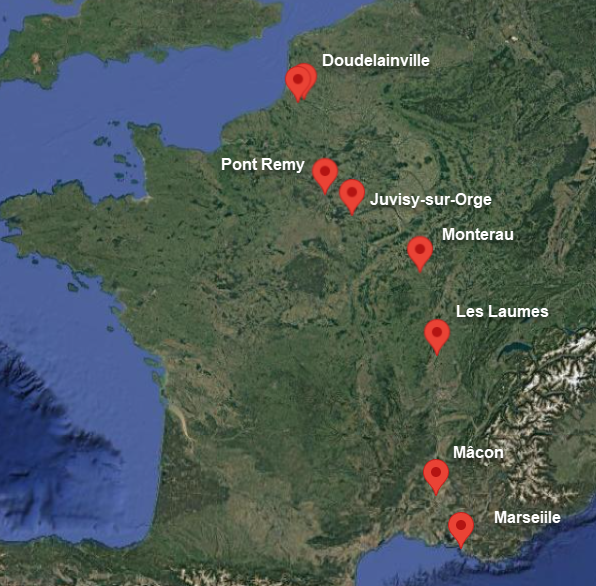
On the 4th March, 1917 the 9th Battalion embarked on HMT Arcadian bound for France. They disembarked at Marseilles on 11th March and moved by train to Pont Remy, arriving there on the 14th March. From Pont Remy the 42nd Division was moved to an area ten miles east of Amiens, there the 9th Battalion was issued with rifles and steel helmets. They began training on the tactics of trench warfare, trench digging, route marches were also the order of the day.

Marseille
March 11, 1917: His Majesty’s Transport ARCADIAN arrived at Marseille.
Mâcon
March 12: 09:30 Halte Repas 1 hour MACON.
Les Laumes
March 12: 18:30 Halte Repas 1 hour LES LAUMES.

9th Manchesters France March 1917

1/9th Manchesters France March 1917

Monterau
Mar 13: 04:00 Halte Repas 1 hour MONTEREAU.
Juvisy-sur-Orge
March 13: 11:00 Halte Repas JUVISY, near PARIS.
Pont Remy
Mar 14: 10:30 Arrive PONT REMY.
Doudelainville
March 14: A, B, C & HQ billet in DOUDELAINVILLE (Sq J.6). D Company billet in WARCHEVILLE (Sq J.6). Transport at POULTERE (Sq J.6). Brigade. HQ at LIMERCOURT VALMA (Sq J.6). Men billeted in barns & outhouses.

On the 21st March, 1917 Private ARNOLD PEARSON (351087 formerly 2787) was killed in action. He is commemorated at Pozieres Memorial.

April 1917:

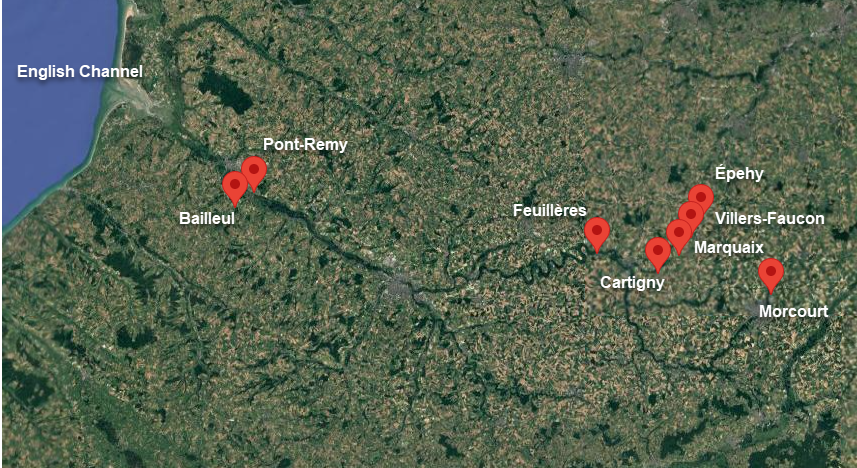
The Battalion moved to Haquaix on 18th April, and on the evening of 22nd April they took over a section of the front line and support line at Epehy; the first time they had been in the front lines since Gallipoli.

Bailleul
April 1: Divine Service, voluntary. Major T. E. HOWORTH proceed to Course of Instruction for Company Commanders at MONTIGNY.
Pont-Remy
April 7: 10:00am. Battalion entrains at PONT REMY station & proceeds to LA FLAQUET (Sq I2) for MORCOURT.
Morcourt
April 7: 5:30pm Battalion billeted in “French” huts. Orderly room in house at MORCOURT.
Feuillères
April 11: MORCOURT. Move to FEUILLERES (Sq H1) by march route in open formation – 100 yards between platoons – via CAPPY and ECLUSIER (Sq J1).

1/9th Manchesters France April 1917

1/9th Manchesters France April 1917

Cartigny
April 17: Battalion moves to CARTIGNY (Sheet 18 Sq A2). Rendezvous 7:30am Cross Roads HERBECOURT. Route HERBECOURT, BIACHES, crossing the SOMME by the FAUBERG de PARIS bridge to PERONNE. After leaving PERONNE the Battalion marched independently to CARTIGNY via DOINGT. Every village devastated accommodation very poor accordingly.
Marquaix
April 18: 9:30am. Battalion, less D Company, move to MARQUAIX.
April 29: Battalion moves [from Epehy] to MARQUAIX & occupies billets vacated on April 20th.
Villers-Faucon
April 20: 11:00am. C Company (Capt. HANDFORTH) & HQ proceed to VILLIERS-FAUCON (E22 28).
Épehy
April 22: EPEHY. Battalion takes over the line from 4th East Lancs Regiment during night 22/23.

April Casualties:

Rank No. 1st Name MI Surname Died Cause
Pte. 351494 WILLIAM NALLY 24-Apr KIA
Pte. 351324 JOHN W JEVONS 25-Apr KIA
Pte. 351625 HARRY LORD 25-Apr KIA
Pte. 352320 SAMUEL LORD 25-Apr KIA
Pte. 350582 HENRY McCLUSKEY 29-Apr KIA
Pte. 350809 JAMES McDONALD 29-Apr KIA
Pte. 351976 ROBERT CAMPBELL 29-Apr KIA
1/9th Manchesters Casualties April 1917

May 1917:

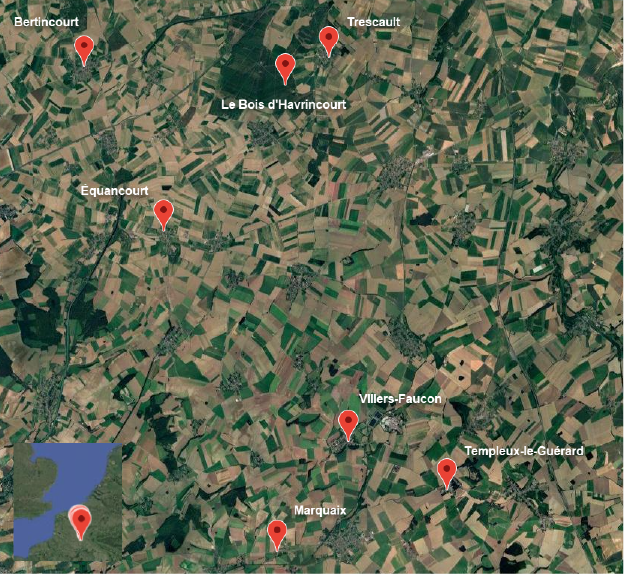
The Battalion moved to billets in Marquaix; the same ones they had occupied earlier in April. They moved into the front line on May 5th. On the evening of May 6th, 2/Lt Cooke was mortally wounded.  The Battalion went into reserve on the evening of May 9th, moving to Templeux Quarry, and returning to the line again on May 13th. They were relieved on May 17th and marched to billets at Villers Faucon.

On May 19th they moved to Bertincourt, via Equancourt, and went into billets. They moved into the reserve line at Havrincourt Wood on May 21st and spent their time digging and consolidating trenches. Two days after 2/Lt. Cooke died of wounds on May 24th, Pte. Harry Holden was awarded the Military Medal, most likely for carrying him back to safety.

On the evening of May 29, 1917 a patrol composed of Lt. Phillip Sydney Marsden and 3 privates was fired on by the enemy. Lt. Marsden and one of the men were hit, both in the abdomen. The two remaining privates carried back the two wounded men 300 yards under fire and then obtained a stretcher and some assistance. Lt. Marsden died an hour after he was brought in and the private some hours later.

Marquaix
May 1: A Company work on roads near TINCOURT (J24). Remaining Companies training during morning and afternoon. Lt. Col. D. H. WADE invalided home.
May 6/7: Many acts of gallantry performed during the night in bringing in wounded notably by Pte. A. HOLDEN 350077 and 350149 Pte. KINSELLA and others. Lt. C. E. COOKE to hospital wounded.
Templeux-le-Guérard
May 9/10: Battalion relieved by 1/4 East Lancs Regiment & takes over from 1/4 East Lancs in reserve at TEMPLEUX QUARRY (62c F27c).
Villers-Faucon
May 17/18: Battalion relieved by 1/6th D.G. (Carbineers) & marches to billets in VILLERS FAUCON after a hot meal at TEMPLEUX QUARRY.
Équancourt
May 19: 4:50pm Depart VILLERS FAUCON. Arrive EQUANCOURT (57C SE V 10a 3-8). 21 tents and 85 tarpaulins put up by 1/4 East Lancs for the use of 1/9 Manchester Regiment.

1/9th Manchesters France May 1917

1/9th Manchesters France May 1917

Bertincourt
May 20: 4pm Depart EQUANCOURT. Arrive BERTINCOURT (57c SE P.7) and go into billets chiefly ruined buildings made habitable with tarpaulins & repairs done by troops previous to our arrival.
Le Bois d'Havrincourt
May 21/22: 7pm Depart BERTINCOURT. Billets to be taken over by 11th Rifle Brigade. Battalion Relieves 11th Rifle Brigade. in Reserve S. end of HAVRINCOURT WOOD.
Trescault
May 31: TRESCAULT heavily shelled, 7.7s from 1:30am to 2:30am.

May Casualties:

Rank No. 1st Name MI Surname Died Cause
Pte. 350681 JEREMY BARKER 6-May KIA
Sgt. 351175 THOMAS H LEE 6-May DoW
Pte. 350431 WILLIAM HANDLEY 7-May KIA
Pte. 350627 STANLEY PEARSON 7-May KIA
Pte. 350840 HERBERT CHRISTIAN 7-May KIA
L/Cpl. 351697 STANLEY GREEN 7-May KIA
Pte. 352014 JAMES HOWARD 7-May KIA
Pte. 352409 THOMAS HARRISON 7-May KIA
Pte. 350297 JOSEPH GEE 8-May DoW
Pte. 352432 FREDERICK CLARKSON 8-May KIA
Pte. 351648 FRANK SHEPHERD 9-May KIA
Pte. 352238 EDWARD SKIRVIN 9-May DoW
Pte. 351774 THOMAS NORMAN 10-May DoW
Pte. 351372 ROBERT FOSTER 14-May DoW
Pte. 350379 ROBERT AL THOMAS 15-May KIA
Pte. 350298 HERBERT POTTER 29-May KIA
Pte. 350454 TOM FIELDING 30-May DoW
Lt. CHARLES E COOKE 24-May DoW
Lt. PHILLIP S MARSDEN 30-May KiA
1/9th Manchesters Casualties May 1917

June 1917:

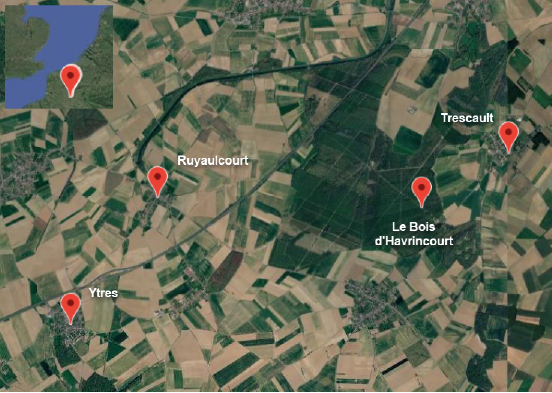
The Battalion was in the line at Havrincourt Wood at the start of the month being relieved on June 5th and moving to Ruyaulcourt. They moved back into the line at Havrincourt Wood from June 12-16, moving to Ytres when relieved. They spent time training at Ytres before returning to the reserve line at Havrincourt Wood on June 21st.

The Battalion remained in the line for the remainder of the month and whilst there all companies were engaged in the digging of firing and communication trenches at night under cover of darkness.

Le Bois d'Havrincourt
May 21/22: 7pm Depart BERTINCOURT. Billets to be taken over by 11th Rifle Brigade. Battalion Relieves 11th Rifle Brigade. in Reserve S. end of HAVRINCOURT WOOD.
Trescault
May 31: TRESCAULT heavily shelled, 7.7s from 1:30am to 2:30am.

1/9th Manchesters France June 1917

1/9th Manchesters France June 1917

Ruyaulcourt
June 5: Battalion relieved by 1/7 Lancs Fusiliers and go into billets at Ruyalcourt.
Ytres
June 16: Relieved by 1/4 East Lancs Regiment. Into billets at YTRES.

June Casualties:

Rank No. 1st Name MI Surname Died Cause
L/Cpl. 350567 THOMAS ASHCROFT 3-Jun KIA
Cpl. 350351 JOSEPH WILDE 3-Jun KIA
Pte. 352196 WILLIAM RAWSON 20-Jun KIA
Cpl. 350520 ARTHUR SPURRETT 26-Jun KIA
Pte. 351936 ARTHUR HAGGER 30-Jun KIA
1/9th Manchesters Casualties June 1917

July 1917:

The Battalion went into a reserve area on 9th July, undertaking various training exercises and rest.

July Casualties:

Rank No. 1st Name MI Surname Died Cause
Cpl. 350512 RAYMOND GIBSON 3-Jul KIA
Pte. 351171 ELLIS BOWKER 3-Jul KIA
Pte. 351716 TOM MOSS 3-Jul DoW
Pte. 352313 STANLEY BUCKLEY 3-Jul KIA
Pte. 375895 BERTRAM ATKIN 4-Jul KIA
Pte. 400212 JOHN MURPHY 23-Jul DoW
Pte. 400602 JOHN H MARSH 23-Jul KIA
Pte. 400720 ALFRED A OVERTON 23-Jul DoW
2/Lt. BERTIE FREEDMAN 3-Jul DoW
1/9th Manchesters Casualties July 1917

August 1917:

On the 22nd August they were entrained, bound for Ypres, and suffered only one death, Private JOSEPH REYNER (350880) who died of wounds on August 30, 1917 and is buried at Ruyaulcourt Military Cemetery.

1/9th Manchesters Casualties Aug 1917

September 1917:

In September the 42nd Division took over a sector almost a mile in width, enduring appalling conditions due to bad weather and constant heavy enemy shellfire.

September Casualties:

Rank No. 1st Name MI Surname Died Cause
Pte. 351748 CYRIL J WELFORD 1-Sep KIA
Pte. 352074 WILLIAM BRADBURY 1-Sep KIA
Pte. 352672 HARRY LUNN 2-Sep KIA
Pte. 350646 GEORGE ROBSON 3-Sep KIA
Pte. 352013 MICHAEL ROGAN 5-Sep KIA
Pte. 376856 JOSEPH E SELLERS 6-Sep KIA
Pte. 51426 WILLIAM SINCLAIR 11-Sep KIA
Pte. 34276 SETH WALLEY 12-Sep KIA
Pte. 352239 HERBERT WOOD 12-Sep KIA
Pte. 351685 JOSEPH LINDLEY 13-Sep KIA
Pte. 350290 THOMAS GASKELL 14-Sep KIA
Pte. 35481 JAMES W SMITH 14-Sep KIA
Pte. 51422 GEORGE BELL 14-Sep KIA
Pte. 350993 STANLEY STRUTT 14-Sep KIA
Cpl. 350522 WILLIAM SMITH 15-Sep KIA
Pte. 376681 FRANK DYSON 16-Sep DoW
C.S.M 350051 WILLIAM BIRCHALL 25-Sep DoW
1/9th Manchesters Casualties Sept 1917

The 9th battalion left the front line at the end of September and took over the coastal defence at the Nieuport front, under constant shellfire and aerial attack. In December the battalion went into the line near Bethune with the 10th battalion.

During this period the following casualties were recorded:

Rank No. 1st Name MI Surname Died Cause
Pte. 50293 SIDNEY WATSON 24-Oct KIA
Pte. 351696 JOHN H MOORES 24-Oct KIA
Pte. 351732 WILLIAM BOURNE 24-Oct KIA
1/9th Manchesters Casualties Oct 1917
Rank No. 1st Name MI Surname Died Cause
Pte. 351273 WILLIAM LEECH 3-Nov KIA
Pte. 351909 THOMAS BLAZE 3-Nov KIA
Pte. 351224 ELLIS HIBBERT 6-Nov DoW
Pte. 350869 WALTER LEECH 8-Nov DoW
Pte. 350538 THOMAS BUTLER 12-Dec KIA
1/9th Manchesters Casualties Nov 1917

1918
The battalion moved to Gorre on the 24th January where trench warfare continued with raids from both sides. In a raid on the 11th February, 1918 the battalion went over the top in a successful action in the sector opposite Festubert, with artillery stopping any German escape or reinforcements.

On the 15th March the battalion was withdrawn to the Busnes/Burbure/Fouquieres area. The army was going through a dramatic reconstruction at this time with brigades being reduced from 4 to 3 battalions. Some 260 officers and men of the 9th joined with the 2/9th while 210 others joined the 1/5th and the 1/6th. Other men were used to supply drafts to under strength battalions, like the 1st Notts & Derby Regiment.

Those left in the battalion remained as a training cadre. In August 1918 they absorbed the 13th Manchesters and were later reconstituted as the 9th battalion. They ended the war in Soire le Chateau near Avesnes.

Note: Much of the original text for 1918 was taken from the www.themanchesters.org and is their copyright.

Commanding Officers
A list of the Battalion’s Commanding Officers in World War One can be found here.

1/9th Manchesters 1914-15

1/9th Manchesters 1916-17


1/9th Battalion Manchester Regiment in Egypt 1916-17

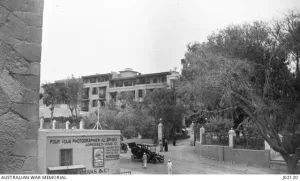
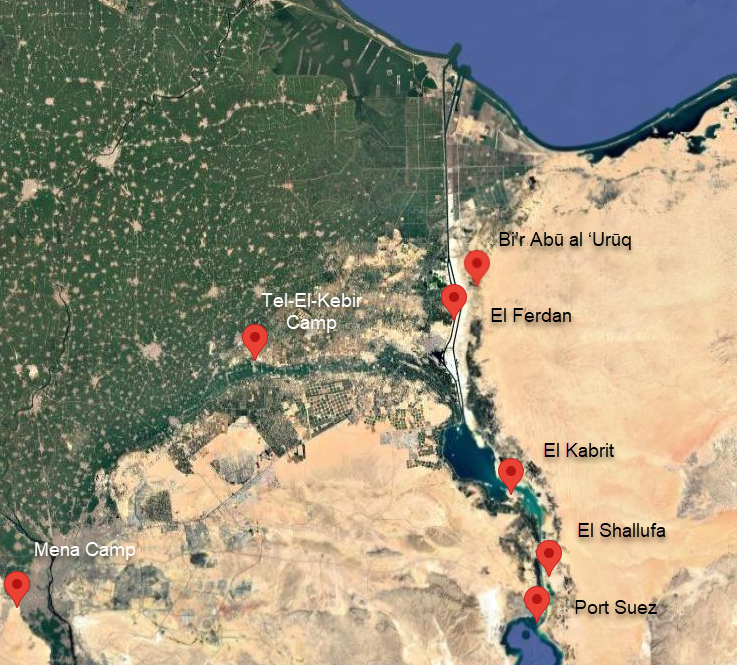
The 9th Battalion left Mudros in early January and landed at Alexandria on January 17, 1916. They were taken by train from Alexandria to Cairo and from Cairo Station to Mena Camp by tram. Mena Camp was situated about 10 miles West of the centre of Cairo just on the outskirts of the city and took its name from Mena House, an old hotel located near the Giza pyramids.

Mena House Hotel

Mena House Hotel, Giza

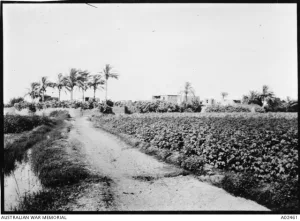
A week later they moved to Tel-el-Kebir which is located about 68 miles north-north-east of Cairo and 25 miles West of Ismailia.

Tel el Kebir

Tel el Kebir

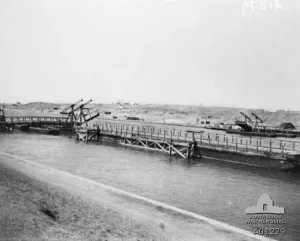
Shortly after, they moved to El Shallufa on the Suez Canal, making camp on the East of the canal.

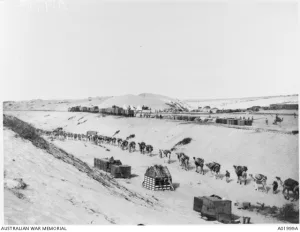
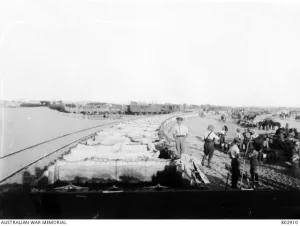
Cantilever bridge at Shallufa

Cantilever bridge at Shallufa

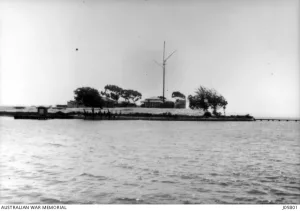
On February 10th they moved again to El Kabrit, about 20 miles north of Suez where they remained for some time.

Kabrit South Pilot Station

Kabrit South Pilot Station

Mena Camp
The battalion traveled by train from Alexandria to Cairo and then by Tram to Mena Camp by the Giza Pyramids, arriving on January 18, 1916.
Tel-El-Kebir Camp
The battalion traveled from Mena Camp, Cairo to Tel-El-Kabir on January 26, 1916.
El Shallufa
The battalion traveled to El Shallufa on the Suez Canal on January 29, 1916. Crossing the canal the following day.

Battalion Locations January to June 1916

Map: Battalion Locations January to June 1916

El Kabrit
The battalion moved to El Kabrit on February 10, 1916 and spent their time putting the post into defensive order.
Port Suez
On April 1, 1916 the battalion moved from El Kabrit to Suez where they remained until mid June undergoing training with the rest of the 42nd Division.
El Ferdan
On June 20, 1916 the battalion, along with the rest of the 126th Brigade, moved from Suez to El Ferdan.
Bi’r Abū al ‘Urūq
The battalion moved from El Ferdan to Bi’r Abū al ‘Urūq on June 22, 1916 and remained there for a month. During this period, a considerable amount of work on the defences at ABU URUQ, chiefly wiring and the maintenance and improvement of existing trenches. Range marks were placed in front of all works and reserves of food, water, S.A.A. and Bombs in works completed. Night Outposts and Day Observation Posts were maintained and Night Patrols sent out to meet Patrols from 125th Brigade at BALLY BUNION. Mounted Officers went out in turn with Patrols of D.L.O.Y. Parties were marched down to Canal daily for bathing. Bombing instruction was continued. Almost all N.C.O.s and men received elementary training and Platoon teams received more advanced instruction.

January – June was spent rebuilding the Division by the addition of new recruits from England and soldiers rejoining from hospital to replace those lost in Gallipoli and the longest serving Territorials whose time had expired. The battalion was engaged in improving the canal fortifications needed to protect the Southern route across the Sinai from raiding parties (since no large army could cross quickly without first building rail and water supplies).

There were 3 routes across the Sinai; the Northern Route which covered El Arish to B’ir Qatia to El Qantara (known as Kantara to the Allies); the Central Route (which followed the Ismailia to Maghara Road), and the Southern Route. Militarily, each route had a base of operations which were El Qantara, El Ferdan and Shallufa respectively. Since the central and southern routes were impassible to a large force without first building supply lines these two routes were defended by the Allies from small raiding parties through a three tier defence of an outpost approximately 7 miles out from the canal, with a second outpost 3 1/2 miles out and a bridgehead at the canal itself. Much effort was spent consolidating these outposts and linking them together via signals and other communications.

Beginning in January 1916, a new railway was constructed, by the British and Egyptian allied ‘Egyptian Expeditionary Force’ (EEF), from El Qantara to Romani, and was planned to continue eastward through the Sinai to El Arish and Rafa on the border with the Ottoman Empire. A water pipeline and telegraph line were simultaneously constructed along the same route by the Royal Engineers.

April (Suez):

In April the Battalion moved south to Suez and began to engage in divisional training and route marches. On April 26th the Battalion suffered 2 fatalities and several wounded during a training exercise when a bomb exploded accidentally. And the next day a man was accidentally killed when he was shot as another man cleaned his weapon which accidentally discharged.

June (Abū al ‘Urūq):

By the end of June, 17 Officers and around 500 Other Ranks had joined (or rejoined) the Battalion. The Battalion was then effectively back to full strength.

MOVING A WATER-TANK AT EL FERDAN

Moving a Water-Tank at El Ferdan

In late June the Division moved to El Ferdan, and then to Abū al ‘Urūq, to assist with the fortifications of the central route since they were now fully recovered and acclimated to the harsh desert conditions and summer heat. Fortification work and training continued throughout July until the 23rd.

July (El Qantara):

In July, intelligence reports indicated a large Turkish force, led by German Officers, was making its way Westwards from El Arish along the Northern Route. 8th Corp, to which the 42nd Division belonged, was transformed into a Mobile Column and sent to meet this force which was moving towards the Suez Canal.

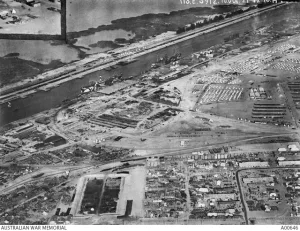
Kantara

Aerial View of Kantara

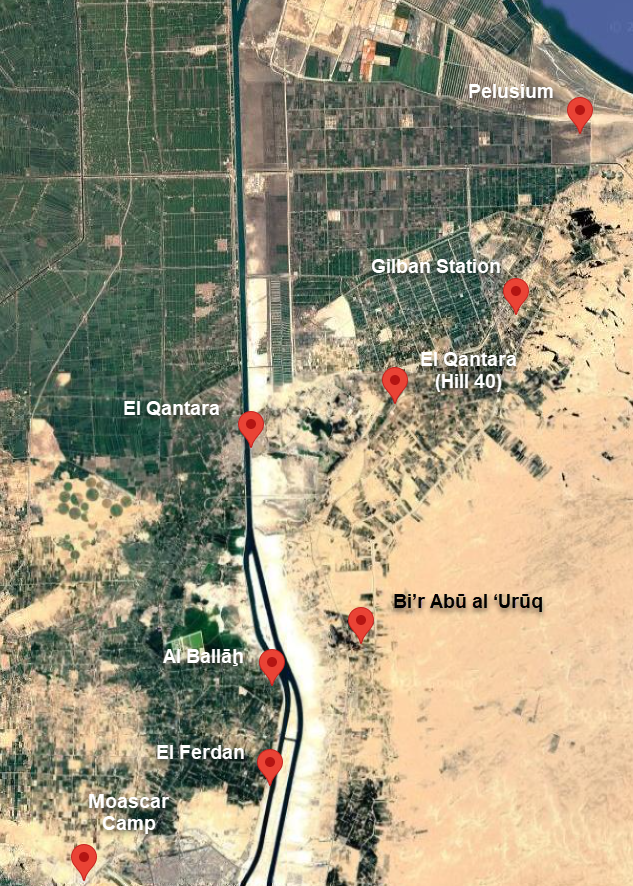
On July 25th, the Battalion marched overnight from Abū al ‘Urūq to El Ferdan, so that they could cross the canal, and then the following night made their way to El Qantara (and on to Hill 40), via Al Ballāḩ. Soldiers considered not fit enough for the upcoming difficult desert marches were left at El Qantara. At this point the Battalion was re-equipped to operate as a Mobile Column.

Bi’r Abū al ‘Urūq
The Battalion was based at Abū al ‘Urūq throughout July 1916.
El Ferdan
The battalion marched overnight from Bi’r Abū al ‘Urūq to El Ferdan on July 26, 1916.
Al Ballāḩ
July 26, 1916 the battalion marched from El Ferdan to Al Ballāḩ and rested until late evening.
El Qantara
The battalion passed through El Qantara on its way to defend the Norther Route across the Sinai in August 1916, and returned to El Qantara, before marching to Moascar Camp, in mid February 1917.

Battalion locations July to August 1916

Map: Battalion Locations July to August 1916

El Qantara (Hill 40)
The battalion arrived, by route march, at El Qantara July 27, 1916 and then moved out to Hill 40.
Gilban Station
The battalion marched to Gilban (Gelbana) Station, which was on the newly constructed railway, on August 4, 1916.
Pelusium
August 8, 1916 the Battalion moved by rail to Pellusium where they made camp north of the railway.
Moascar Camp
The Division arrived at El Qantara by train in early February 1917 and then marched to camp at Moascar, just west of Ismalia. They left Moascar Camp for Alexandria by train on March 1, 1917 to sail for France, leaving Egypt on March 4th.

August (Pelusium):

On Aug 4th the Battalion marched to Gilban, which was a station on the newly constructed railway along the Northern Route.

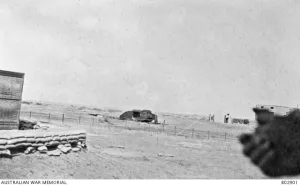
Wrecked Mk IV British tank at Gilban Station

Wrecked Mk IV British tank at Gilban Station

The rest of the Division entrained to Hill 70 from where the 127th Bde marched across the desert to support the Anzacs at the Battle of Romani. The 126th Bde moved to Pelusium by train on August 8th where they were held in Corps reserve.

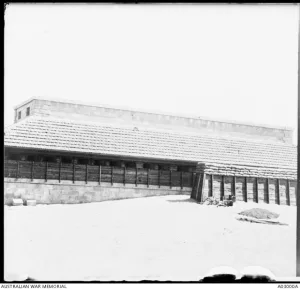
Railway Station at Pelusium

Railway Station at Pelusium

The Battalion remained at Pelusium for the rest of August engaged in outpost duty, training and route marching.

Romani
The battalion marched to Romani on September 9, 1916 and camped for the night.
Er Rabah
The battalion marched from Romani to Er Rabah on September 10, 1916.
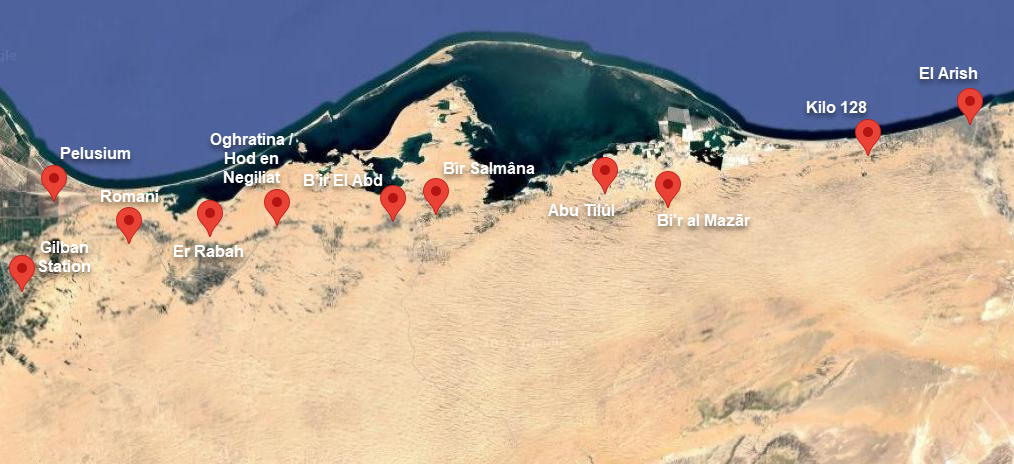
Oghratina / Hod en Negiliat
The battalion marched from Er Rabah to Oghratina on the morning of September 11, 1916 where they took their position on the outpost line. At this time, the reserve was located slightly North at Hod en Negiliat. They remained at Oghratina for about 2 weeks.
B’ir El Abd
The battalion marched to B’ir El Abd on October 25, 1916.
Bîr Salmâna
The battalion marched from B’ir El Abd to Bîr Salmâna (Kilo 60) on November 9, 1916.

Battalion-Locations-August-1916-to-March-1917

Abu Tilûl
The battalion marched from Bîr Salmâna to Abu Tilûl (Kilo 100) on November 10, 1916.
Bi'r al Mazār
The battalion marched from Abu Tilûl to Bi’r al Mazār on November 24, 1916. A steam disinfector was brought to al Mazār station and the battalion was disinfected over the course of 3 days.
Kilo 128
The battalion marched to Kilo 128 on December 20, 1916 and spent the night there but returned to Bi’r al Mazār the following day as the Turks had fled El Arish.
El Arish
The battalion marched to El Arish in mid January 1917 and spent two weeks there before returning to El Qantara by train in early February 1917.

September (Oghratina):

After the allied victory at Romani, defence turned into offence and the railway and water pipes were slowly extended eastwards.  The 42nd Division was pushed out ahead to protect the new construction from raiders who were mainly Bedouin tribesmen allied with the Turks.

Supply Depot near Oghratina

Supply Depot near Oghratina

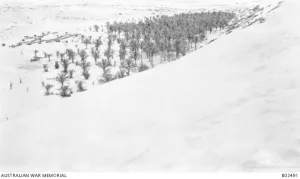
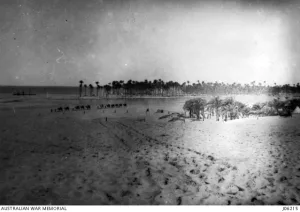
The Battalion marched to Romani on Sept 9th and then on to Er Rabah the following day and Oghratina, which was considered to be the outpost line, on the 11th. On Sept 21st they moved into reserve at Hod en Negiliat, (a “hod” is a plantation of date palms).

Camel train carrying supplies at Negiliat

Camel train carrying supplies at Negiliat

The Battalion went back into the line at Oghratina on October 2nd and remained there until October 24th during which time they were engaged in training and route marches once again.

October & November (Bîr el-‛Abd):

In October the railway reached Bîr el-‛Abd (30 miles East of Romani) and the Battalion marched there from Oghratina on October 25th. In November it reached Bîr Salmâna and Abu Tilûl before arriving at Al Mazār.

Al Mazār

Al Mazār

The Battalion marched to Kilo 60 (Bîr Salmâna) on November 9th and then on to Kilo 100 (Abu Tilûl) the following day. Two weeks later, the Battalion marched to Al Mazār on November 24th. Here the Battalion spent 3 days being disinfected using a mobile system sent out by rail especially for the troops who had been living under canvas since arriving in Egypt.

December (Al Mazār):

In December an offensive was launched against the Turks at El Arish but by the time the Corps was ready to engage, the Turks had fled. The Battalion marched to Kilo 128 on December 20th in preparation, but were ordered to return to Al Mazār the following day.

1917 (Moascar):

The 42nd Division marched into El Arish in mid January 1917 and spent two weeks there by the sea.

Wadi El Arish

Wadi El Arish

But at the end of January they were ordered back to the Suez Canal in preparation for their imminent deployment to France. The Division arrived at El Qantara by train in early February and then marched to camp at Moascar. They left Moascar for Alexandria by train on March 1st to sail for France on March 4th.

Casualties:

Throughout their time in Egypt, during 1916 and 1917, there was little danger from hostile forces, their main threat being sickness and disease brought on by unsanitary conditions and the harsh summer climate of the Sinai desert.

Rank No. 1st Name MI Surname When How
Pte. 2088 WILLIAM H COOKE1 19-Jan Died
Pte. 1744 ANTHONY SHERIDAN 25-Feb Sickness
Pte. 3260 JAMES W MANSFIELD1 7-Apr Sickness
Pte. 2327 THOMAS SMITH 26-Apr Bomb
Pte. 3244 ERNEST CHADDERTON 26-Apr Bomb
Pte. 3483 JOHN HEGGINBOTTOM 27-Apr Shot
Pte. 3029 TOM A CARR 2-May Died
Pte. 2341 PERCY NICHOLSON 13-May Died
Pte. 3987 HARRY H KERRICK 28-Oct Sickness

Note 1: These men died and were buried in the UK (St. Paul’s Church Stalybridge and Dukinfield Cemetery respectively) and so it is highly unlikely that they served in Egypt in 1916.

On March 4, 1917, the same day that the Battalion embarked for France, the final Egyptian casualty, Private JAMES KERR (1984), died of pneumonia in Hospital in Ismailia.  He was buried at the Ismailia War Memorial Cemetery.

Honors:

During 1916 several Officers and men were officially recognized for their long exemplary service and for individual acts of bravery in Gallipoli as prior recommendations worked their way through the honours process.

On January 28, 1916 the following men of the 1/9th Manchester Regiment were mentioned in despatches for their part in the Battle of Krithia Vineyard.

Second Lieutenant (temporary Captain) O. J. Sutton
Lieutenant W. T. Forshaw, V.C.
Second Lieutenant C. E. Cooke.
No. 180 Sergeant S. Bayley.
No. 2103 Corporal T. Pickford.
No. 2148 Lance-Corporal S. Pearson.
No. 1294 Private F. Chevalier.
No. 1160 Drummer H. Broadhurst.

In February, information was received that Capt. O. J. SUTTON and 2/Lieut. E. COOKE had each been awarded the Military Cross, and L/Cpl. PEARSON and Cpl. PICKFORD the D.C.M.

In August the Battalion received orders which in part contained the following entries:

Qtr. Mr. & Hon Major CONNERY                – awarded Military Cross
No 1792               L/Cpl. DAVIES A.               – awarded D.C.M.
No 1623               Sgt. GREENHALGH J.     – awarded D.C.M.
No 1083               Pte. LITTLEFORD S.       – awarded D.C.M.

1792 L/Cpl. A. DAVIES, DCM
For conspicuous gallantry when covering a retirement under a very heavy fire at a few yards range. [Gazetted June 21, 1916 for the actions of December 19, 1915]

1623 Sgt. JAMES GREENHALGH, DCM
For conspicuous gallantry when covering a retirement under a very heavy fire at a few yards range. [Gazetted June 21, 1916 for the actions of December 19, 1915]

1083 Pte. SAMUEL LITTLEFORD, DCM
For conspicuous gallantry in flinging a lighted bomb over the parapet, and thus probably saving many casualties. He was himself wounded in the arm by the explosion. [Gazetted June 21, 1916]

Desert Glossary:

Sabkha:                A salt flat with a thin crust and very muddy underneath.

Hod:                      A planting of palm trees, a palm grove.

B’ir:                        A well from which water can be pumped to the surface.

Kathīb:                 A large sand dune or other elevation less than 300m.


1/9th Manchesters 1914-15

1/9th Manchesters 1917-18

Aspinall-Oglander

Military operations : Gallipoli. Vol. 2.
by Cecil Faber Aspinall-Oglander; A F Becke.

Chapter XIII. The Action of the 6th/7th August at Helles

It has already been shown that Sir Ian Hamilton’s plan demanded nothing more from the VIII Corps at the opening of the August offensive than a series of holding attacks.

The initial attack was to be a small operation to flatten out the Turkish salient astride the two forks of Kirte Dere. This entailed the capture of a network of short trenches and strongpoints, on a frontage of approximately one mile. Owing to the limited amount of artillery available, the operation was divided into two halves. The northern half of the objective was to be captured by the 88th Brigade (29th Division) on the evening of the 6th. The southern half would be taken by the 125th and 127th Brigades (42nd Division) on the morning of the 7th. Both attacks would be supported, under corps arrangements, by every gun and howitzer that could be brought to bear, and also, under divisional arrangements, by fire from massed machine guns.1 Naval support would be available once more, for the sailors, rising as usual to the occasion, had organized a squadron of special ships, more or less immune to submarine attack, to help the army with their fire2.

It was expected that by this method of dividing the operation into two halves the weight of artillery available would enable both parts of the objective to be taken with comparatively little trouble; and in full anticipation of success, the VIII Corps had completed plans for further and more extended operations to be undertaken on subsequent days. So great, indeed, was the confidence at corps headquarters that the intentions of the Commander-in-Chief with regard to the limited role of the VIII Corps were apparently overlooked, and on the morning of the 6th August a special corps order referred to the early capture of Krithia and Achi Baba:

The attack today is the first stage of operations which will, it is hoped, at last carry us on to the position for which all ranks have so hardly fought since the landing … It is now the beginning of a fresh year of war, and it is hoped that the advance of the VIII Corps will be the turning-point, and the capture of Krithia and Achi Baba the first steps towards the final victory.

These were rash words. In point of fact, the amount of high-explosive shells at Helles was entirely inadequate for the first day’s task.

Here it should be noticed that since the invaliding of General Hunter-Weston the VIII Corps had had only a titular commander. It was commanded for a few days in July by General Stopford, who had only just arrived from England and knew nothing of local conditions. After Stopford’s departure to open his own corps headquarters at Imbros, Major-General Douglas of the 42nd Division had assumed temporary command.3 Thus throughout the preparations for the attack, and during the actual fighting on the 6th and 7th of August, an unusual amount of authority was wielded by the senior staff officer of the corps, Br-General H. E. Street, who had been General Hunter-Weston’s right-hand man since the 25th April. This very capable officer had one blind spot: he could not bring himself to admit the increasing difficulties that confronted the troops at the southern end of the peninsula.

The function of a staff officer is to assist his chief, and to advice when asked to do so, but the responsibility for decisions belongs to the chief alone. For this reason a staff officer’s opinion is often more care-free than that of a commander, and many a chief of staff might find his confidence abating were he to suddenly find himself placed in high command.

For the attack on the afternoon of the 6th August, Br.-General D. E. Cayley (88th Brigade) had the 4/Worcestershire on the right, the 2/Hampshire in the centre, the 1/Essex on the left, and the 1/5th Royal Scots in brigade reserve. The task of the Worcestershire was limited to the capture of the Turkish front-line trench H.13. It was a difficult task, however for here the breadth of No Man’s Land was at least 300 yards, and the assaulting troops were likely to be enfiladed from both flanks. To protect their right as much as possible, it had been arranged that one battalion of the 42nd Division (the 1/5th Manchester Regiment) should simultaneously advance against two small trenches on the right bank of West Krithia Nullah,4 called H.11a and H.11b.

Order of Battle
From Military operations : Gallipoli. Vol. 2, Aspinall-Oglander

The task of the 2/Hampshire, in the centre of the line, was more difficult still. The battalion’s objective included two lines of trenches and a formidable strong-point. On the left, the 1/Essex had a shorter distance to go and could attack its objective from two sides. But the Essex too had a double row of trenches to capture, including a small redoubt.

The heavy artillery was to begin a slow bombardment at 2:20pm; the field artillery and the machine guns were to join in an hour later; and the infantry assault was to be launched at ten minutes to four.

The morning of the 6th August was fine and clear, with scarcely a breath of wind. The 1/5th Manchesters had moved into the front line overnight, and soon after daybreak the 88th Brigade filed up the communication trenches to relieve the 86th Brigade in the battalion sectors known as Hampshire Cut, Essex Knoll, and Worcestershire Flat.5

By 8am the assaulting troops were all in their assembly positions, and then followed a wait of over seven hours for the moment of assault to arrive. The day was oppressively hot, and there was little or no shade. All ranks, however, were in good spirits. In the 88th Brigade the three assaulting battalions had lately been brought up to war strength with well-trained drafts from home,6 and each battalion was going into action with 24 officers and over 800 men. Encouraged by this recent accession of strength, braced by their short rest at Mudros, and heartened by the corps belief that Achi Baba could really be captured at last, the “old hands” of the brigade were quietly confident about the relatively small task required of them that day.

The Turks had been unusually quiet of late in the Helles sector, and their only activity since the beginning of the month had been a half-hearted raid on the British line at Fusilier Bluff on the morning of 2nd August. But their silence can now be explained: they were saving ammunition for the big attack they had long been warned to expect. No hint had yet reached them that an attack at Helles was imminent, but all preparations had been made to meet eventualities and the Turkish battle-front in the south was well organized and prepared.7 It is now known, moreover, that the trenches astride the Krithia nullahs were regarded by the Turks as the most likely locality for a small British attack.

Within a few seconds of the opening of the British bombardment it was answered by heavy and sustained fire from the enemy’s batteries.8 Considerable casualties were sustained in the crowded British trenches; all the telephone lines from battalion to brigade were cut; communication trenches were badly knocked about; and two British guns were put out of action. General Davies,9 who was watching the operation as a spectator, has placed it on record that, fresh from the Western front, he was “horrified” at the total inadequacy of the British “bombardment”.

Punctually at 3:5opm the infantry surged forward to the assault. For the first few seconds all appeared to be going well. The troops in the centre disappeared over the low crest about 50 yards beyond the British line with practically no loss; the Essex on the left and the Manchesters on the right were seen to reach the nearest Turkish trenches with hardly a casualty; and watchers in the rear were soon reporting that the objectives had all been taken.

But the truth, as soon realized by 88th Brigade headquarters, though not by higher formations till many hours later, was altogether different. The strength of the Turkish defensive organization had been gravely miscalculated. A few minutes after zero hour the 88th Brigade had been shattered.

By a counter-attack from West Krithia Nullah the Manchesters on the right were soon driven from the trench which they had captured. On the left the Essex came under a withering fire as soon as they tried to move forward from the Turkish front line, and after losing very heavily, especially among their officers, were forced to give ground.

In the centre, long before the Worcestershire and the Hampshire could cross the broad expanse of No-Man’s Land in front of them, the Turks had re-manned their positions,10 and the troops were met by a devastating machine gun fire from the front and both flanks. Very few unwounded men succeeded in reaching the enemy’s trenches, and those who did were soon attacked by overwhelming numbers. At the end of an hour the only British still holding out in this part of the line were 30 men of the Worcestershire under a sergeant. Their numbers dwindled and after nightfall the twelve survivors withdrew to their own lines.

The Turkish position was now everywhere intact except in the extreme left, where some of the Essex, under Captain H. R. Bowen, clung to a corner of H.12a till relieved an hour before dawn by two platoons of the Dublin Fusiliers.

The casualties of the 88th Brigade amounted to nearly 2,000 out of the 3,000 engaged.

Br.-General Cayley was early conscious of the failure of the attack; but, in the absence of detailed news, his reports were not credited, and at divisional and corps headquarters it was long before this grave situation was fully realized.11 So few officers amongst the attacking troops were still alive that no messages were coming in, and it was only when wounded and unwounded began to trickle back after dark that it became possible to piece together an intelligible story from their disjointed and contradictory reports.

At 7pm, believing that the Essex and Worcestershire were in possession of a large portion of their objectives, General de Lisle decided to capture the intervening portion of the Turkish line, including the strong-point to the left of the Worcestershire objective, with a night attack by the 86th Brigade.12 Thereupon the Brigadier of the 86th went forward to the advanced headquarters of the 88th, sent for the commanders of the Royal Munster and Royal Dublin Fusiliers, and told them to take their battalions to the old British front line, and to be ready to assault at 9:30pm, after a short artillery bombardment; the actual hour of attack to be notified later. At 8:30pm, it was decided to postpone this attack till half past ten. Orders to this effect reached the battalions concerned at nine o’clock.

Up in the front line, however, and in all communication trenches, the situation was chaotic, and it was impossible to form up for attack. The trenches were blocked with wounded, and by this hour only 50 men of the Munsters had reached the front line. To Lieut.-Colonel G. W. Geddes, commanding that battalion, it was clear that an attempt to attack could only end in failure, and he assumed the responsibility of reporting this to the brigade:

O.C. 1/Royal Munster Fusiliers to Brigade-Major 86th Bde.

9:10pm. I can only get one company into the front line. There is no room to get another man in owing to congestion due to number of wounded Worcestershires who are coming in over the parapet every minute. Apart from that, both Hants and Worcs officers report that position to be taken will be bound to entail enormous losses and that the result will be very doubtful of success. Am I to continue (preparations for) attack? I have informed O.C. Dublins.

The brigade-major replied:

The attack will take place as stated in my B.M. at 10:30pm. The fact of another regiment being unable to take the enemy’s trenches is no reason for the Royal Munster Fusiliers being unable to take them.

The brigade-major’s irony, however, had no effect on the battalion commander, who by this time was evidently more sure than ever that, at all costs to himself, he must get the attack postponed. At 10pm he wrote again:

The chaos is indescribable. I have only 50 men of my battalion with me. I cannot state when I shall be ready to attack. The firing line is subjected to heavy rifle and machine-gun fire. The left of the Worcestershire is uncertain. I have informed the Dublins I am not ready to attack, and not to do so till I inform him that I am.

This message had some effect. At 10:42pm the 86th Brigade replied:

My B.M. 2050 is cancelled. The time for attack will be given later, but it will not be before midnight. Meanwhile the men should take as much sleep as possible.

By this time important information had been gained by the 1/5th Manchesters on the right. Earlier in the evening that battalion had been ordered to make another effort to gain its morning’s objective, and to link its left with the Worcestershire in H.13. The new effort to gain H.11b had ended in another failure, but a daring reconnaissance had subsequently discovered that H.13 was occupied throughout its length by Turks, and the officer in charge of that reconnaissance, on his way back across No Man’s Land had fallen in with the small party of Worcestershire who at that moment were slowly creeping back to the British line.

On receipt of this news General de Lisle decided at 3:15am that the projected attack by the 86th Brigade, already twice postponed, should be finally abandoned.

This was a wise decision. An attack that night on the unbroken Turkish line would probably have ended in the destruction of the 86th Brigade, and in the resulting confusion the British trenches in that sector would have been dangerously exposed to counter-attack by the Turks. In point of fact the Turks did attack from H.12a at daybreak; they drove in the small party of the Royal Dublin Fusiliers holding a corner of that trench, and obtained a footing in Hampshire Cut. But they were ejected, and the line was restored by the Dublins, supported by two companies of the Lancashire Fusiliers, at a cost to these two battalions of 240 casualties.

The first report to reach G.H.Q. of the utter failure of the Helles attack was a message from VIII Corps received at 6:35am on the 7th. The news was a bitter disappointment; but the message added that the second half of the attack, by the 42nd Division, had not been cancelled. This was taken to mean that there was no cause for anxiety, and Sir Ian Hamilton did not intervene. Certainly an attack by the 42nd would minimize the risk of the 29th Division being counter-attacked while its line was still disorganized; and, provided the situation at Helles was well in hand, the VIII Corps could best assist the northern operations by continuing to press the Turks in the southern zone.

Unfortunately for the British, however, their sacrifice at Helles the previous evening had not achieved the results hoped for. It is now known that Liman von Sanders, in view of the serious threat at Anzac and Suvla, decided at daybreak on the 7th that risks must be accepted at Helles, and ordered the Southern Group Commander – despite the latter’s vehement protests – to send his reserve division to reinforce the norther zone with all possible speed.

The frontage to be attacked by the 42nd Division, temporarily commanded by Major-General W. R. Marshall, measured only 800 yards, but as the division was far below its war strength the attack was to be made with two brigades in line. The 127th (Manchester) Brigade (Br.-General Hon. H. E. Lawrence) was on the left, the 125th (Lancashire Fusilier) Brigade (Br.-General H. C. Frith) on the right, and the 126th Brigade (Br.-General Viscount Hampden) in divisional reserve. The objective of the division was the main Turkish support line, F.13 – H.11b. The enemy’s defensive system in this part of the line was very intricate, and there was a labyrinth of small trenches near the Krithia nullahs, on the front of the 125th Brigade.

The arrangements for the attack, which was launched at 9:40am, were similar to those described for the 86th Brigade. There was a similar artillery preparation, a similar massing of machine guns to support the advancing troops; and some recently arrived trench mortars, under Captain T. Syers, R.A., were to join in the preliminary bombardment. The plan had been carefully explained to all ranks, and no step neglected that could help to ensure success.

But the results of the attack were as disappointing as those of the day before. On the left, the 127th Brigade could make no progress, and by noon, after suffering heavy casualties, the troops were back in their old lines. Early in the afternoon Br.-General Lawrence was obliged to report his brigade as temporarily unfit for further offensive effort. Its total strength amounted to only 28 officers and 700 men, or roughly that of a battalion.

On the right, where the Turkish position was weaker, the four battalions of Lancashire Fusiliers at first made some progress, and small parties of the 1/6th and 1/7th Battalions, under Major W. J. Law, succeeded in reaching the enemy’s second line. But the Turks drove them back with a counter-attack, and by midday the only portion of the captured position still in British hands was a small vineyard west of the Krithia road, behind the Turkish front line, and a short length of trench on either side of it. During the afternoon further efforts were made by the Fusiliers to recapture some of the lost ground, but in each case they were again forced to retire.

Trench Map August 7th, 1915
42nd Division War Diary

At nightfall the troops in the vineyard were still holding out gamely, but everywhere else the 125th Brigade was back in its own lines. The divisional commander at first ordered a withdrawal from this advanced and very exposed position in the vineyard. The trenches were narrow and blocked with dead and wounded, and very difficult to hold. Moreover, the position was a pronounced salient, protected on one side by only a few posts, and General Marshall feared that if the garrison was eventually driven out, the troops holding his old front line might become involved in the retirement. On learning, however, that the abandonment of the vineyard would mean leaving a number of wounded men behind, and that the officer in command was sure he could hold it, he gave him permission to try.

Not only that night but for several days the Turks made constant efforts to recapture this outlying point, but parties of the 1/6th and 1/7th Lancashire Fusiliers, reinforced later by detachments from the 1/6th East Lancashire and the 1/9th and 1/10th Manchesters,13 continued to defend it with great determination, and it was eventually incorporated in the British line.14

But the attack on the 7th had again been very costly. The casualties of the 42nd Division amounted to over 1,400 men in the two attacking brigades. In less than 24 hours, in a limited attack on a front of one mile, three brigades of the VIII Corps had lost nearly 3,500 of the 4,000 officers and men which an earlier calculation had laid down as the maximum that the whole corps could afford to lose in a series of operations to help the main offensive.15 The omens from the Helles sacrifices had not been propitious.

The full extent of these losses was not yet dreamed of at corps headquarters. But, on hearing at midday on the 7th of the almost complete failure of the 42nd Division attack, Sir Ian Hamilton determined that no further risks must be run by the Helles garrison. The vital consideration now was that the VIII Corps must not be allowed, by further costly attacks, to jeopardize its ability to hold its existing positions without outside help. Orders were issued that the Helles garrison was to undertake no more offensive operations till the march of events in the north had automatically weakened the Turkish southern line.

Next morning, as the operations planned by General Douglas were deemed to have ended, General Davies assumed command of the VIII Corps.

For the rest of August – and indeed, as events subsequently shaped themselves, for the rest of the campaign – the British and French troops in the south were destined to make no further serious attacks.16 The Turks similarly remained on the defensive, and, except that the 52nd Division succeeded in straightening out its line to the west of the vineyard in November, the opposing fronts at Helles remained virtually unchanged from the 8th August till the final evacuation exactly five months later.

Despite the failure of the operations at Helles, it is now known that they were not without their effect on the commander of the Turkish Southern Group, and that the VIII Corps staff on the 8th August were closer than they knew to the realization of their hopes. Wehib Pasha, as we have already seen, had protested strongly against the withdrawal from his command of his only reserve division. On the following day his German Chief of Staff took so serious a view of the danger to the Southern Group of losing its communications, that he personally urged Liman von Sanders to abandon the southern zone, including Achi Baba, and to transfer all the troops south of Kilid Bahr to the Asiatic shore “while there is still time to extricate them”.

But Liman von Sanders was made of sterner stuff. He replied that not one yard of ground was to be surrendered voluntarily, and the Chief of Staff was replaced.

Notes:

    1. The artillery available amounted to four 60-pounders, 16 howitzers, eighty-four 18 pounders, and ten 15 pounders, in addition to six French howitzers and a Brigade of 75’s. The 91st Heavy Battery R.G.A. (four 60 pounders) and the LXVI Brigade R.F.A. (sixteen 18 pounders) had reached Helles in the latter half of July, but all the guns of the former were out of action owing to trouble with recoil springs. [back]
    2. This squadron, commanded by Rear-Admiral Stuart Nicholson, comprised the blistered cruiser Edgar, five monitors and five destroyers, and mounted a total of 21 heavy and 24 light guns. [back]
    3. Lieut.-General F. J. Davies, the corps commander designate, reached Imbros on 5th August, but as operations were imminent, the Commander-in-Chief decided that he should not assume command till the first battle was over. [back]
    4. The two branches of Kirte Dere – known as West and East Krithia Nullahs – were both about 15 to 30 feet wide, with steep banks, in places from 10 to 20 feet high. The beds of these nullahs were practically dry. [back]
    5. From an early date the VIII Corps adopted a very convenient method of naming the Turkish trenches. These were numbered serially, with a distinctive alphabetical prefix to denote the area to which they belonged. But no similar system was used for the British line, and the student who is accustomed to any of the orderly systems eventually evolved in France is bound to be somewhat confused by the names on the Gallipoli trench diagrams. An attempt to describe the derivation of British trench names would need a book to itself, and it must suffice to say here that at Helles each battalion sector of the front line was generally given a distinct name. These would often be taken from the name given to some point in the sector by the troops who originally occupied it. Looking at the map today it is easy to imagine that names like “Border Barricade” and “Hampshire Cut” commemorate brave deeds by the regiments concerned, but it is not so easy to realize that they designated portions of fire trench. But in 1915 the position of all these trenches was well known to the troops at Helles, with plentiful sign-posts for the new comers, and the name of, say, “Essex Knoll” for a fire trench caused no more confusion than that of Haymarket or Knightsbridge for a London street. [back]
    6. No drafts had arrived for the 1/5th Royal Scots (T.F.), and this battalion still consisted of only two companies. [back]
    7. The Turks appear to have been holding their southern front with 5 divisions, (4 in line and 1 in support), totaling about 40,000 rifles. A sixth division was in reserve near Serafim Farm. [back]
    8. The Turks claim to have had 62 field and mountain guns in action, and 32 medium and heavy pieces. [back]
    9. The commander designate of the VIII Corps. [back]
    10. During the bombardment the garrisons of the trenches had taken cover in the deep nullahs. [back]
    11. Corps headquarters had informed divisional headquarters that they knew the Turkish front line had been captured, as their forward observation officers could see the British “metal disks” all along the trench. Actually the wearers of these disks were dead. [back]
    12. The 86th Brigade was in divisional reserve. The 87th Brigade was holding the line on Gully Spur. The 52nd Division and Royal Naval Division were in corps reserve. [back]
    13. W. T. Forshaw, 1/9th Manchesters, was awarded the V.C. for conspicuous gallantry. [back]
    14. The northern edge of the vineyard was lost again on the 12th, and a trench dug across its centre became the British front line. [back]
    15. Casualties:                           Officers                Other Ranks
      29th Division, 6th August                 54                           1,851
      42nd Division, 6th, 7th Aug               80                           1,482
      According to Turkish official figures the Turkish losses in the south, 6th-13th August, amounted to 7,510. [back]
    16. For gallantry during a bombing affray on 13th August, Pte. D. R. Lauder, 1/4th R. Scots Fus., was awarded the V.C. [back]
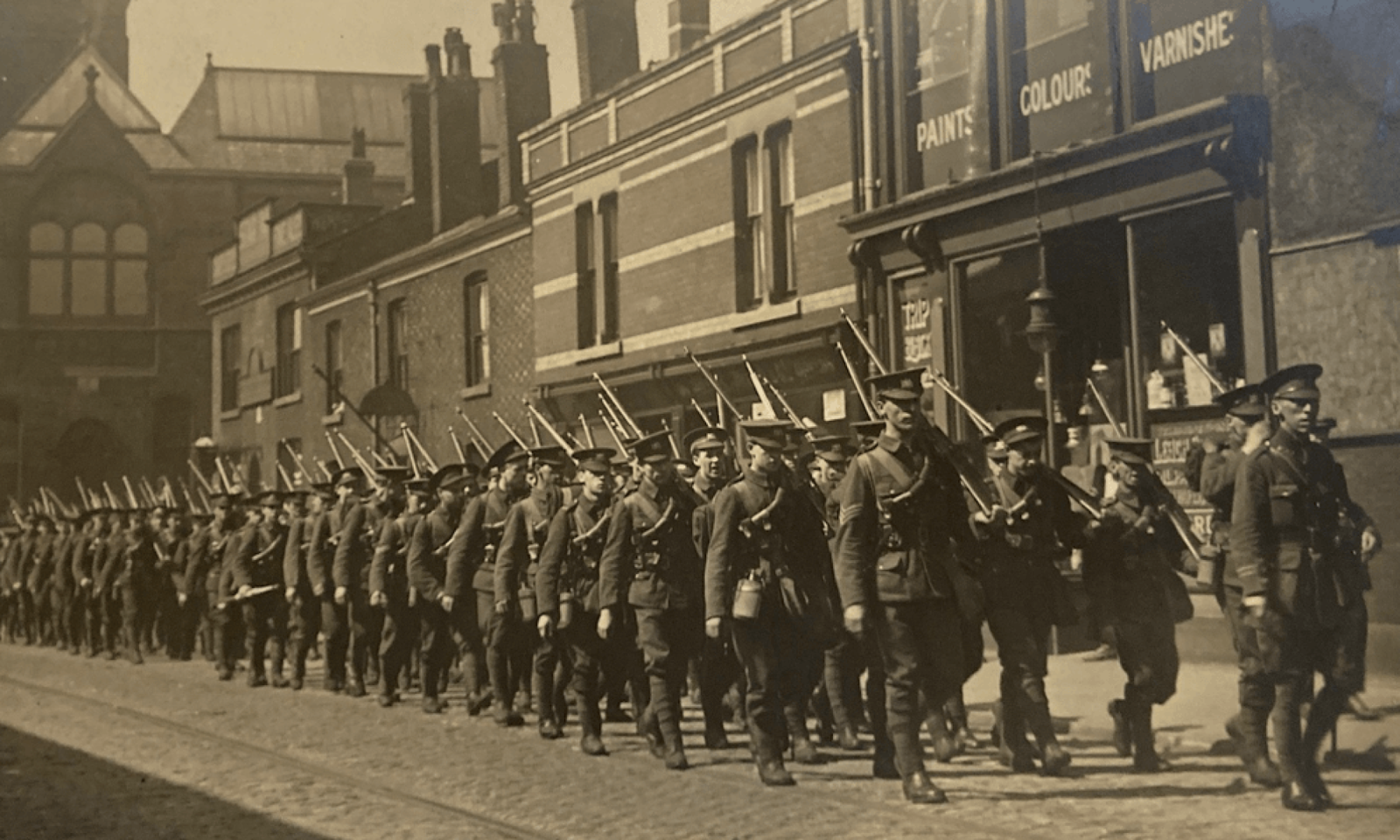
The 42nd (East Lancashire) Division

Battle of the Vineyard, August 6–7, 1915.

Pages 43-47

On July 24, Major-General Douglas had assumed temporary command of the 8th Corps until August 8, the command of the Division during that period being taken by Major-General W. R. Marshall.

On August 6 the period of comparative inactivity came to an end. The primary purpose of the Gallipoli campaign was to obtain possession of the Narrows, and thus secure command of the Dardanelles and cut off communication with the Asiatic shore. It had been hoped to achieve this by pushing forward from the south, but the original force had been far too small for the purpose. During May, June and July the Turkish garrison had been much increased, and also the supply of guns and shells, and the defences on Achi Baba greatly and most ably strengthened, whereas the British reinforcements and drafts to fill the gaps had been relatively small. There was little prospect of success by a frontal assault from Helles, and the loss that would be incurred by a futile attempt would cripple the Allies and remove all chance of ultimate success. The Commander-in-Chief decided upon an attempt to reach the Narrows at Maidos, five miles across the peninsula from Anzac, the formidable Sari Bair range intervening. A new landing was to be made on August 6 and 7 at Suvla Bay, a few miles to the north of Anzac cove, and it was hoped that the force landed here would seize the northern slopes of the Sari Bair range, while the troops from Anzac would storm the central and southern heights. On August 6 an attack was to be made from the right of Anzac in order to divert attention from both the landing and the true objective; and a vigorous offensive was ordered at Helles, with the object of containing as large a Turkish force as possible within the southern area and of drawing their reserves from the north. There appeared to be good prospects of a decisive success, and hopes were high.

The line of trenches from the Achi Baba Nullah to the Krithia Nullah (both inclusive) was held by the 125th Brigade on the right and the 127th on the left, the 126th being in reserve. The French were on the right of the 125th Brigade and the 29th Division on the left of the 127th Brigade. The 5th Manchesters, who were acting in conjunction with the 88th Brigade (29th Division) had for objective a Turkish trench on the right of that Brigade. The bombardment began at 2.30 p.m. on the 6th, and soon H.E. shells could be seen bursting in the trench which the 5th had been ordered to take.

Order of Battle
From Military operations : Gallipoli. Vol. 2, Aspinall-Oglander

At 3.50 p.m. they attacked, but on reaching the objective, found that they had been enticed into a dummy trench, without cover, and exposed to enfilade fire. To prevent the right flank of the 29th Division being left “in the air,” Captain Fawcus, commanding the first line of the 7th Manchesters, was ordered, about 8 p.m., to get into touch. Arriving at a trench which he expected to find occupied by the 88th Brigade, he called out: “Are the Worcesters there?” and was heavily fired upon. Moving to the left he still found the enemy in occupation of the trench, and fell back. On his way to rejoin the second line he came across a small party of the Worcesters and took them with him. The two parties regained the firing-line in the small hours of the morning, having lost 40 men out of 200. That Captain Fawcus returned safely was amazing, his clothes being riddled with bullets.

A few hours later the Battle of the Vineyard began, the bombardment by British and French batteries opening at 8.10 a.m., and increasing in intensity at nine o’clock when the naval guns joined in. The fire on the trenches south-east of Krithia Nullah was both heavy and accurate, but the trenches within the triangle formed by the fork of the nullahs suffered but little. Half a battalion of the 126th Brigade [9th Manchesters] was attached to the 125th Brigade on the right, and another half-battalion [9th Manchesters] to the 127th Brigade on the left. One battalion of the 126th Brigade was to hold the original line. Two batteries of machine-guns assisted by bringing a cross fire to bear on the enemy’s trenches.

At 9.40 a.m., the troops went forward with their usual dash, wearing tin back-plates that could be seen by the artillery “spotters”. On the right, the Lancashire Fusiliers gained their first objective, but the 5th and 8th found that their portion was merely a very shallow trench raked by enfilade fire. Parties of the 6th and 7th reached their second objective, but enfilade fire and superior numbers compelled them to fall back. One of the few officers to reach this objective was Major W. J. Law, 7th Lancashire Fusiliers, who took part in all the subsequent fighting in the Vineyard. Soon after 11 a.m. portions of the first objective were retaken by a strong Turkish counter-attack, but the Vineyard remained in our hands.

The 5th and 7th L.F. made a gallant effort to recover what had been lost and were partially successful. At 1.30 p.m. another enemy counter-attack in close formation was caught by our guns and brought to a standstill. The Turks suffered severely in counter-attacks upon the Vineyard, and for some hours gave up the attempt in this quarter, but resumed it late at night with no more success.

The 5th and 8th L.F. reoccupied a portion of their first objective in the evening. Parties of the 4th East Lancashires and 10th Manchesters gave great assistance both in attack and defence. On the left, the Manchesters showed similar dash and determination, but owing to the greater difficulties of the ground between and about the nullahs and to the intricacy of the Turkish trench system, which, with the nests of machine-guns, had escaped our shells, they were unable to hold any of the trenches taken in the initial assault, and their losses were grievous, the attacking lines being mown down by the enemy’s machine-guns.

The casualties during the two days were: –

Officers Other Ranks
Killed 20 203
Wounded 36 770
Missing 24 511

The result was that a tactical point of some importance had been won and held by the tenacity of the 125th Brigade, and that a large Turkish force had been pinned down when urgently needed in the north. The Turks had, indeed, been massing troops in front of the Division as they had intended to attack our lines in force, on the 6th or 7th of August. Sir Ian Hamilton telegraphed to the Corps Commander: “Your operations have been invaluable, and have given the Northern Corps the greatest possible help by drawing the main Turkish effort on yourselves. I was sure you were ready for them tonight. Well done, 8th Corps.”

But though the sacrifice had not been altogether in vain, the advance from Suvla Bay and Anzac had failed, and the conquest of the Dardanelles seemed more remote than ever. And yet for one half-hour it had seemed so near! Of all the many lamentable tragedies of the campaign surely the most dramatic, the most appealing, was that on Chunuk Bair, at dawn on the 9th of August, when companies of the 6th Gurkhas and 6th South Lancashires had stormed the cliffs and driven the Turks headlong before them. From the top of the saddle they looked down upon the promised land. Below them the goal – Maidos, and the Narrows! The way lay open and victory was in sight – was already achieved !-and the Turkish Army in the south would be cut off ! But these four hundred men alone of all the Allied troops that landed on the peninsula were destined to view the promised land. Flushed with triumph, Gurkhas and Lancastrians intermingled raced down the slopes after the fleeing Turks. And then the blow fell – truly a bolt out of the blue — a salvo of heavy shells crashing with infernal accuracy into the midst of them, mangling and destroying the exulting victors. Where that salvo came from will probably never be known with certainty, but there can be little doubt that the shells were British. The remnants of the little force could only make for shelter; there was no shelter in front, and the chance had gone, never to return.

To return to the 42nd Division. In and about the Vineyard held by the 6th and 7th Lancashire Fusiliers, the fighting surged and swayed for several days. The Turk fought gamely, with grim determination, and the casualties on both sides were heavy. The C.O.s of the two battalions had been ordered to remain at their Headquarters in communication with the Brigadier, and the Adjutants, Captains Spafford and Gledhill, held on tenaciously. Spafford was killed, and the order to retire was sent, but Gledhill’s pertinacity got this order withdrawn, and the Vineyard was held. A successful and very gallant stand against great odds was made by “A” Company, 9th Manchesters, on the nights of August 7–8, when the first V.C. awarded to the Division was won by Lieutenant W. T. Forshaw, who was in temporary command of the company. Two M.C.s and two D.C.M.s were also won by the company. Forshaw was holding the northern corner of this small oblong with a bombing party when he was attacked by a swarm of Turks who converged from three trenches. For the greater part of two days he kept them at bay, and even threw back, before they had time to explode, the bombs they threw at him. In the words of the Official Report-

“He held his own, not only directing his men and encouraging them by exposing himself with the utmost disregard of danger, but personally throwing bombs continuously for forty-one hours. When his detachment was relieved after twenty-four hours, he volunteered to continue the direction of operations. Three times during the night of August 8–9 he was again heavily attacked, and once the Turks got over the barricade; but after shooting three with his revolver he led his men forward and recaptured it. When he rejoined his battalion he was choked and sickened by bomb fumes, badly bruised by a fragment of shrapnel, and could barely lift his arm from continuous bomb throwing.”

On the 8th and 9th the 126th Brigade relieved the 125th and continued the struggle, and Lieutenant S. Collier, 6th Manchesters, gained the M.C. for a good bit of work on the right of the Vineyard. A trench held by a group of men of the 126th Brigade was fiercely attacked by enemy bombers, and its capture appeared certain. Collier, however, organized and led the defence, and though he had never before handled a bomb, he displayed much aptitude with this weapon; and in spite of persistent attacks, continued throughout the night, the Turks were beaten off. On the night of the 12th the enemy attacked in mass and captured the Vineyard, but the next day were bombed out of it, and it was finally consolidated and held. Throughout the operations the Divisional Engineers had worked and exposed themselves as fearlessly as ever. Their services were continuously in demand, and they had never been found wanting. The bulk of the work on this occasion had fallen on the 1st Field Company. The Signal Company, too, had proved how competent all its branches were. Much of its work is not done in the limelight, and it may be mentioned that the average number of messages passing through the Signal Office daily had been about three hundred. In times of stress this number was greatly increased.

On August 13, the 42nd Division was relieved in the trenches and went into Corps Reserve. The following 8th Army Corps Special Order was issued next day: –

“The 42nd Division has now been withdrawn into Reserve after having been in the firing-line for three months without relief. During this time the Division has taken part in three big attacks, and has been subjected to the continuous strain of holding, improving and extending our line and communications under constant fire.

Though some units have distinguished themselves more than others, the Division has, throughout this arduous period, displayed a dash in attack and a spirit of determination and endurance in defence which is worthy of the best traditions of the British Army. The persistence with which the enemy were held off during the recent determined attack, and part of the ground lost gradually recovered in face of strong opposition, was a fitting conclusion to the period during which the Division has been in front line.

The Lieut.-General Commanding wishes to express to Major-General Douglas and his staff, as well as to all ranks of the Division, his appreciation of their good work, and he looks forward to seeing them again display the same soldierly qualities in active operations against the enemy at an early date.”

Capt. Richard Percy Lewis

Richard Percy Lewis was born on March 10, 1874 in Paddington, London to Richard and Eliza Mary (née Kinglake) Lewis. Richard Lewis was a successful barrister and his son Richard Percy Lewis had an older sister, Louisa Mary Kinglake Lewis, and a younger brother, John Alexander Kinglake Clayton Lewis. In 1881 the family was living in Gloucester Place, Paddington with four live-in domestic servants.

He was educated at Winchester College (1887-92) and then University College, Oxford (1894-96) and was said to be one of the finest wicket-keepers of his generation, playing for Oxford University, Surrey and Middlesex.

Lt Col Richard Percy Lewis

During the Boer War he was commissioned as Second-Lieutenant in the 14th Middlesex (Inns of Court) Rifle Volunteer Corps, on August 4, 1900. In October 24, 1900 he was awarded a commission in the Devonshire Regiment, a line regiment when another second-Lieutenant was killed in action, thus creating a vacancy. He was promoted to Lieutenant on April 4, 1903.

After the war, he was attached to the 1st Battalion King’s African Rifles January 12, 1904 to June 24, 1907, and took part in the Nandi Expedition of 1905-1906 where he was mentioned in despatches (of Edgar G. Harrison, Lieutenant-Colonel, Commanding Nandi Field Force, February 28, 1906).

Lieutenant R. P. Lewis, (The Devonshire Regiment), 1st K.A.R., as Signalling Officer to the Field Force, by his keenness and hard work was able with slender means and in spite of many difficulties to obtain excellent results. Many of the signallers employed were recruits with but little training, but even with such material Lieutenant Lewis was able to keep numerous posts going and to link up the various units of the force by helio and lamp.

After his spell in Africa, he was seconded for service with the Egyptian Army, on 20th August 1908, and stationed as an intelligence officer in Cairo. Whilst serving in Egypt he suffered a succession of personal blows as his sister, brother and mother all died in 1911, 1912 and 1913 respectively, (his father having died many years before). Meanwhile his career progressed and he was promoted to Captain on December 16, 1911.

The 9th Battalion Manchester Regiment landed in Egypt on September 25, 1914 and spent the next six months training for war. They landed at Gallipoli on May 9, 1915 but were short of senior officers, two majors having died in Egypt.

Captain Lewis joined the 42nd Division in Gallipoli on May 31, 1915 and was initially posted to the 10th Battalion Manchester Regiment but four days later, on June 4th, he was made a temporary Major and attached to the 1/9th Battalion.  He was wounded about a month later, on July 6th, and subsequently left the 9th at that time.  But during his short spell with them he was involved in the bloodiest month of the Gallipoli campaign for the 9th Battalion when they were involved in two separate bayonet charges against the Turks.

On November 4, 1916 he was appointed Brigade-Major, leaving the position on April 24, 1917. And on May 8, 1917 was made acting Lieutenant-Colonel while commanding the 10th Battalion Manchester Regiment. He was not to hold this position long because he died of wounds at Ypres on September 9, 1917 during a heavy bombardment between the village of Frezenberg and Westhoek. He is buried in Grave I.A.57 of the Ypres Reservoir Cemetery.

“It was during one such bombardment that Lt-Colonel Lewis was killed. Battalion HQ was housed in a cellar of a ruined farm house known as Kit and Kat. The position lay on what in more peaceful times had been the minor road running between Frezenberg and Westhoek. Lewis was hit by a shell splinter when giving orders to a runner and died shortly afterwards. His body was taken back to Ypres and buried in the burgeoning cemetery near to the tumbled central square.”

Excerpted from “Amateur Soldiers” by K. W. Mitchinson. ISBN-13: ‎ 978-0951809891.

Perhaps because he no longer had any living immediate family members, he made a number of bequests to the Devonshire Regiment including £2,000 for the “benefit and comfort of the officers and men during the war, and thereafter for the widows of the men”.  The rest he left to his cousin Evelyn, the daughter of his mother’s younger sister. Lieutenant-Colonel Richard Percy Lewis was 43 years old.

Belle Vue Pyrodramas

Several of the letters published in the Ashton Reporter from the men of the 9th Battalion Manchester Regiment make reference to “Belle Vue”, which was a famous local amusement park in West Gorton, Manchester. For example, take the letter written by Private Tom Littleford, to his mother, and published in the Reporter on Saturday July 17, 1915:

 “Private Jas. Ryder has had one or two narrow escapes. One day, when they were taking us in the trenches, a bullet took his hat straight off his head, and another bullet lodged in the overcoat, which was strapped on his back. Both night and day shrapnel shells are bursting around us. Talk about Belle Vue, it isn’t in it. When we were at home they called the Territorials England’s last hope, but we are England’s first aid at present”.

But in this case, the references to Belle Vue were specifically comparing the real world experience of battle they were now witnessing first-hand to those re-enacted in “Pyrodramas” at Belle Vue that they and their friends and family had seen together in happier times.

Belle Vue Main Entrance 1953
Courtesy Chetham's Library, Manchester

The founder and driving force behind Belle Vue was John Jennison (1790-1869) who bought the original 36 acre site, off Hyde Road and Kirkmanshulme Lane. Belle Vue opened in 1836, expanded over time and eventually occupied 165 acres. At the height of its popularity, 2 million people visited every year.

Belle Vue Plan 1892
By Foreign and Commonwealth Office Collection (Contributed by: The University of Manchester, The John Rylands University Library)

In 1851, Jennison, visited the Great Exhibition in London and whilst there, paid a visit to Surrey Zoological Gardens. It was here that he witnessed a ‘stupendous Diaphanic Panopticon’, which portrayed the horrors of war. Described in publicity of the time as a ‘gigantic panorama’ it measured 200 feet in length, and had figures 15 feet in height, and ‘was ‘the first ever attempted.’ Constantly looking for new ways to attract the public, on his return to Manchester Jennison formulated a plan to dramatically increase the quality, and expand the scale and visual impact of his own static panorama displays.

Edwardian Visitors to the Static Panorama
Courtesy Chetham's Library, Manchester

He envisioned large firework shows presented against the backdrop of a huge painted canvas representing a famous historical or contemporary event. He hired George Danson, (of Messrs. Danson), who had created the Surrey Zoological Gardens panorama which so impressed him, to come to Manchester and create the sets for the Belle Vue Pyrodramas. Danson constructed enormous backdrops, 300 feet wide and 60 feet high, hand-painted in the open air by professional artists who, for the rest of the year, worked in the Royal Opera House and the theatres of Covent Garden and Drury Lane. These backdrops were then installed on the “firework island” that formed the setting for the dramatic orchestrated shows, punctuated by fireworks and acted out by ever larger casts of actors. So successful were the Pyrodramas that Danson, and his sons, Thomas and Robert Danson, would come back to Manchester and paint them for each of the next 44 years.

Belle Vue Zoological Gardens Handbill, 1900 Season
Courtesy Chetham's Library, Manchester

Pyrodramas were included in the price of admission and visitors could watch from what used to be an open air dance floor or could pay extra to watch from an elevated viewing platform. The Pyrodramas were spectacular and turned out to be immensely popular, watched by tens of thousands each year, and their addition as an attraction in the zoological gardens helped secure the financial future of Belle Vue.

Battle of Blenheim, 1907 Season
Courtesy Chetham's Library, Manchester
« of 4 »

The first of the Pyrodramas was “The Bombardment of Algiers” in 1852 and the sequence of shows through 1926 are outlined below:

List of Representations at Belle Vue Manchester from 1852-1924
Courtesy Chetham's Library, Manchester
Year Pyrodramas
1852 The Bombardment of Algiers
1853 The Storming of Seringapatam
1854 Burning of Moscow
1855 Siege of Sebastopol
1856 The Storming of Malakoff
1857 The Siege of Gibraltar
1858 The Storming of Delhi
1859 The Temple of Janus
1860 The Storming of the Badajoz
1861 The Emperor’s Palace & the City of Pekin
1862 The Battle of the Nile
1863 The Relief of Lucknow
1864 The Siege of Charlestown
1865 Earthquake at Lisbon
1866 Carnival of Rome
1867 Storming of St. Jean d’Acre
1868 Battle of Trafalgar
1869 Storming of Magdala
1870 Capture of Quebec
1871 Bombardment of Strasburg
1872 Napoleon Crossing the Alps
1873 The Spanish Armarda
1874 Battle of Waterloo
1875 Capture of Coomassie
1876 The Prince at Calcutta
1877 The Fall of Alexinatz
1878 The Fall of Plevna
1879 The Afghan War
1880 Burning of the Tuilleries (City of Paris)
1881 Battle of Navarino (Fought in 1827)
1882 Carnival of Venice
1883 Battle of Tel-el-Kebir (Egypt)
1884 Siege of Constantinople, 1453
1885 Siege and Defence of Khartoum
1886 Storming of San Sebastian
1887 City of London
1888 Siege of Malta
1889 Storming of the Bastille
1890 Storming of Cairo
1891 Battle of Inkerman
1892 Battle of Cape St. Vincent
1893 American Indian War
1894 Siege of Granada
1895 Storming of Port Arthur
1896 Battle of Alma
1897 Matabele War
1898 Storming of Dargai
1899 Battle of Omdurman
1900 Siege of Ladysmith
1901 Siege of Pekin
1902 Battle of Paardeberg
1903 Capture of Gibraltar
1904 Attack on Port Arthur
1905 Battle of Mukden
1906 Storming of the Kashmir Gate, Delhi (1857)
1907 Battle of Blenheim, Aug 13th, 1704
1908 Defence of Mafeking
1909 Bombardment of Alexandria
1910 Battle of Manchester
1911 The Relief of Lucknow
1912 Burning of Hankow
1913 The Balkan War – Battle of Lule Burgas
1914 The Battle of Kandahar
1915 The Battle of the Marne
1916 War in Flanders
1917 The Battle of the Ancre
1918 The Fight for Liberty
1919 Mons 1914-1918
1920 The Capture of Jerusalem
1921 Chinese War – Storming of the Taku Forts
1922 Storming of Kotah (Indian Mutiny 1858)
1923 The Redskins
1924 Mexico
1925 The Cannibals
1926 Reign of Terror

By 1923 the themes of the Pyrodramas changed from well-known military actions to less militaristic depictions, not wholly surprising after a run of 70 consecutive annual shows, and perhaps reflecting a change in public appetites after the great war. The last Pyrodrama produced at Belle Vue was “Robin Hood” in 1956.

In 1925, Belle Vue Zoological Gardens was sold to a London-based syndicate and during the 1950s it was purchased by the hotel and catering conglomerate, the Forte Group. As anyone of a certain age from Manchester can tell you, Belle Vue continued to be quite a popular local destination and an amusement park, miniature railway and speedway racing were added to the list of attractions. But by the 1970s, Belle Vue entered a death spiral as other more popular public attractions became available and attendances dwindled. Belle Vue finally closed for good in 1979.

References:

[1.] Chetham’s Library, Manchester
[2.] “The Belle Vue Story”, by Robert Nicholls. ISBN: 9781852160708