Lance-Corporal Albert Davies, DCM

Albert Davies was born on July 7, 1896 in Dukinfield, Cheshire. His father, James Davies, was a miner from Wales who had married Priscilla Mills of Dukinfield, whose father was also a miner. Albert was the oldest of four boys with an older sister and two younger sisters. The family lived in Dukinfield for several years before moving to Wales. By 1911 the family had moved back to Ashton under Lyne and Albert was working as a felt hatter, probably in one of the many hat manufacturers in Denton.

In February 1914, the 9th Battalion Manchester Regiment was under strength and so a big recruiting drive at Ashton Town Hall was organized for the evening of Saturday February 14. Albert likely attended that night but like several others decided to attest a little late into the evening and was instead told to report to the Armoury on the following Monday. This he duly did and was the first of that group to sign his papers that day. By this time, he had changed professions and was working at the Victor Mill in Stalybridge.
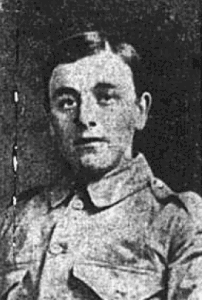
L/Cpl. Albert Davies

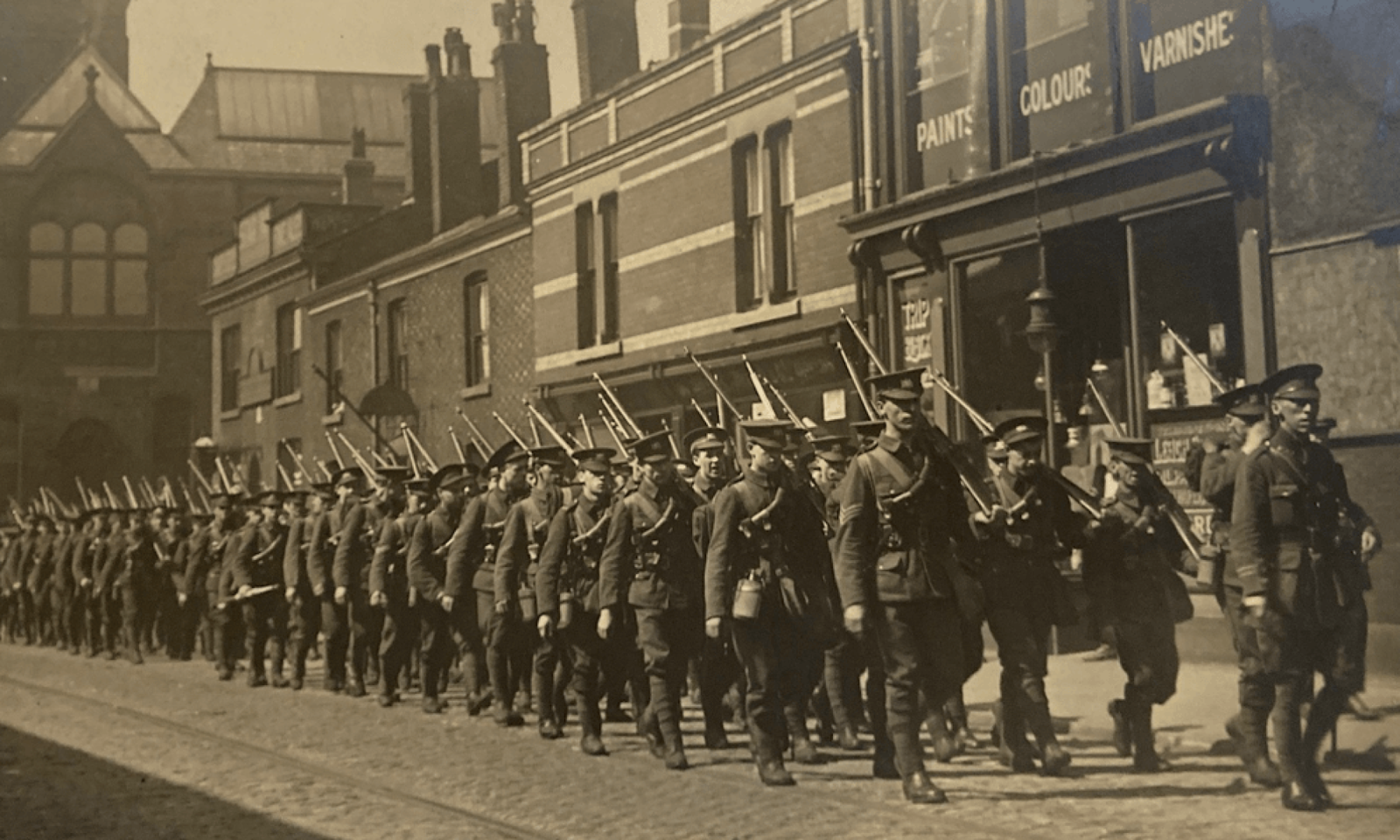
At the outbreak of war, the battalion was mobilised and on August 20, 1914 they marched into Chesham Fold Camp, Bury. Throughout August around 100 new recruits were added, many of whom had previously served with the battalion in the pre-war years. On September 1, 1914 another 100+ men were added, many of whom were friends and family of the existing members of the battalion. On Wednesday September 9 the battalion entrained to Southampton and at midnight the following day sailed for Egypt. In Egypt the men were drilled, trained and worked hard to build fitness and endurance. Additionally, the old eight Company model (A-H) was replaced with a four Company model (A-D), 4 platoons in each Company and 4 sections in each platoon.

The battalion landed at Gallipoli under shell fire on Sunday May 9, 1915 and at that time Albert Davies was an 18-year-old Lance-Corporal a couple of months shy of his 19th birthday. Consequently, according to Army Regulations he should have been held back in Egypt or deployed in reserve away from the firing line. Needless to say, he wasn’t but managed to survive the dangerous and difficult conditions of Gallipoli. But a few weeks after he passed his 19th birthday he was brought before a Field General Court Martial and charged under section 9 of the Army Act 1881 with “disobedience” to a Sergeant. He was found guilty and awarded 3 months of field punishment number 2, implying that the charge against him was not one of wilful disobedience which would have carried a harsher sentence. He completed his sentence on December 9, 1915 and the following day the battalion deployed from Corps Reserve to the trenches.

By late December, the Allies made the decision to evacuate the Peninsula and operations switched to disguising the intent to leave through a number of small distracting operations. The battalion war diary for December 19, 1915 is unusually expansive:

Morning quiet. In the afternoon a small action took place at 14:15, a large mine was exploded about 30 yards from the N.E. corner of FUSILIER BLUFF and immediately after 5 smaller mines. It was expected that this mine would form a large crater and a party was told off to occupy this. The party consisted of 16 bombers, a working party under 2nd Lieut. GRAY and 26 men of ‘B’ Coy. All went exactly as ordered and the men went over the parapet in a splendid manner, but unfortunately the mine failed to form a crater and when the men got out there was no cover at all and the Turkish trench being intact the enemy fired deliberately from loop holes at the party. 2nd Lieut. GRAY stayed out until it became evident that nothing could be done when he gave the order to retire. The enemy shelled the MULE TRENCH and our Support Line very heavily whilst the action was in progress but did little damage. Our casualties amounted to 3 killed, 1 missing, 11 wounded. The night passed quickly.

Corporal James Greenhalgh was interviewed by the Ashton Reporter newspaper and explained what happened that day (as published in the Ashton Reporter on July 15):

“It was on the 19th December, 1915, I was ordered to take a party of men over the top, and we got to within ten yards of the Turkish trench. At the same time there was a mine blown up. It should have made a big hole in the front of the Turkish trench. The intention was for us to have got in this hole, but when we got to the place no hole had been made, and we had to lie in the open, and the Turks potting at us from ten yards away. It was a good job the Turks were nervous, or else there would have been none of us left to tell the tale.

The object was for us to get in the crater and build it up with sandbags, and then our bombers could have bombed the Turks out of their trench, but it didn’t come off as we expected. Anyway, we all got back to our trench except one poor lad who was killed.

Lance-Corporal Davies, D.C.M. was with the same party of men.”

In fact, when 2nd Lieut. Alfred Gray gave the order to retire, Sgt. Greenhalgh and L/Cpl. Davis stayed exposed, just 10-12 yards away from the Turkish trench, and covered the other men’s withdrawal while under heavy fire, only returning to safety themselves after their party had been able to return to the Allied trenches.

On June 2, 1916 the London Gazette announced the award of the Distinguished Conduct Medal to Sgt. Greenhalgh and the London Gazette of June 21 carried the following citation:

1792 L/C. A. Davis, 9th Bn., Manch. R., T.F.

For conspicuous gallantry when covering a retirement under very heavy fire at a few yards range.

The annotated D.C.M. listing does not provide much additional information but the long-forgotten administrative code of “B1-131” directly links this award with that of (now Sergeant Greenhalgh.
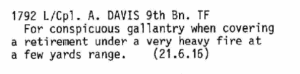
Albert Davies DCM Citation

2/Lt. Alfred Gray, who was commanding the small group of Manchesters, was eventually awarded the Military Cross, in May 1919, for “gallant and distinguished services in the Field” but there is little doubt that this action, on this day, was a significant contributing factor to his award.

Unlike most of the other DCM winners of the 9th Manchesters Albert was not interviewed by the local newspapers but on June 10, 1916 the Ashton Reporter published a few lines from his mother:

When a “Reporter” representative saw Mrs. Davies, the mother of Lance-corpl. Albert Davies, also referred to the fact that it was her son’s 20th birthday, and she was quite pleased at the birthday present the King had announced for her son. He is still in Egypt and she has not seen him since he left Ashton in September 1914, a long and anxious time for a mother. Nothing would give her greater pleasure than to hear that the Ashton territorials had been given a richly deserved holiday, and to see her boy’s face once again. Mrs. Davies is not alone by any means in expressing such a sentiment. Her son has not given any inkling of the way in which he earned the decoration. Before the war Lance-corpl. Davies worked at the Victor Mill, Stalybridge, and his former workmates are highly delighted at the honour gained by their old associate.

After Gallipoli, Albert deployed to Egypt with the battalion and then subsequently to France. In late 1917 he was seriously wounded and medically repatriated back to Ashton under Lyne, where on Saturday December 15, 1917 the Ashton Reporter published a brief update but by now the interest in his DCM exploits had passed.

Lance-corpl. Albert Davies, of 55 William Street, Ashton, and formerly of 90 Hertford Street, is in the Richmond House Hospital suffering from wounds. He is 21 years of age, and was awarded the D.C.M. in December 1915, for conspicuous bravery.

After he recovered, he joined the Labour Corps and was discharged on February 14, 1919 receiving a war pension for disability. On Valentine’s Day 1920 he married Lillian May Wagstaff and they had four children over the next six years raising their family in Ashton. Albert Davies, DCM died in Ashton in 1953, he was just 56 years old.
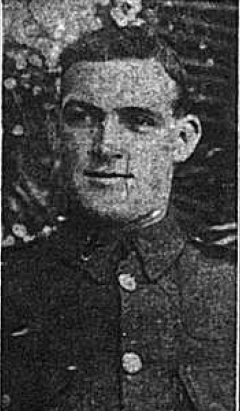
Sgt. Harry Grantham, D.C.M.

Harry Grantham was born on March 10, 1890 in Ashton under Lyne to Joseph and Ellen Grantham (née Gaskell). He was the oldest of three boys, brothers William and Joseph, and the younger brother of Adelaide Grantham. His father was a cotton minder when Harry was born but later became a labourer on the railways.

On March 11, 1906, when he turned sixteen years old, he joined the 3rd Volunteer Battalion Manchester Regiment which was re-designated the 9th Battalion, Manchester Regiment, Territorial Force in 1908.  Appointed Lance Corporal in May 1910 he was promoted to Corporal in July 1911, when he was 21 years old. In June he was one of the less than 30 men of the Ashton Territorials selected to attend King George V’s coronation in London as a member of the composite battalion representing the East Lancs Division. In his civilian life he was living with his family in Ashton and working as a piecer at a Cotton Mill.

By 1914 he had switched employers and was now working for Messrs. R.A. Barrett and Co. a mineral water business owned and run by the Makin family, two of the brothers being officers in the 9th Battalion. He was also a Primo of Victory Lodge, The Royal Antediluvian Order of Buffaloes (R.A.O.B.) being one of the largest fraternal movements in the United Kingdom. In the Territorials, he was by now a Sergeant in A Company, one of whose officers was his employer, Lieutenant Frederick Arthur Makin.

Harry Grantham
Sgt. Harry Grantham, D.C.M.

At the outbreak of war, the 9th Battalion, Manchester Regiment was mobilised and on August 20, 1914 they marched into Chesham Fold Camp, Bury. Throughout August around 100 new recruits were added, many of whom had previously served with the battalion in the pre-war years. On September 1, 1914 another 100+ men were added, many of whom were friends and family of the existing members of the battalion. On Wednesday September 9 the battalion entrained to Southampton and at midnight the following day sailed for Egypt. In Egypt the men were drilled, trained and worked hard to build their fitness and endurance.

The battalion landed at Gallipoli under shell fire on Sunday May 9, 1915 and at that time Harry Grantham was a 24-year-old Sergeant in A Company.

On the evening of July 10, 1915 Lieut. Oliver Jepson Sutton, on his own initiative, conceived the idea to make a reconnaissance, and voluntarily undertook to carry out this highly dangerous duty. He was accompanied by Sergeant Harry Grantham. They discovered that the Turks were digging to the S.E. of trench G.12 and reported their findings. They were asked to repeat their reconnaissance the following night to verify their observations, which they duly did. In Harry’s own words:

“Lieut. Sutton and myself went out two nights in succession, July 10th and 11th. We each took a piece of rope with us, attached to our wrists and to the parapet of our trench. We pulled it along with us until we reached the Turkish trenches, and so were able to measure the distance between our trenches and theirs. The Turks saw us, but we ran about five or ten yards, and then lay flat on the ground among dead Turks. It was somewhat exciting, especially when they fired at us, but luckily we were missed. Both General Prendergast and General Douglas congratulated us.”

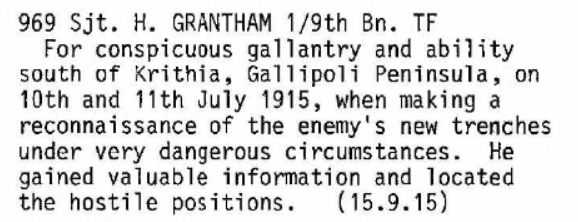
The September 15, 1915 London Gazette carried the following citation:

969 Sjt. H. GRANTHAM 1/9th Bn. Manchester Regiment, TF

For conspicuous gallantry and ability south of Krithia, Gallipoli Peninsula, on 10th and 11th July, 1915, when making a reconnaissance of the enemy’s new trenches under very dangerous circumstances. He gained valuable information and located the hostile positions.

Harry Grantham DCM Citation

On August 8, 1915 the battalion took part in the Battle of Krithia Vineyard. Lieut. W.T. Forshaw won the Victoria Cross and three N.C.O.s won the Distinguished Conduct Medal. As a Sergeant in “A” Company, Harry was necessarily involved in the Battle of Krithia Vineyard and the October 16, 1915 Ashton Reporter carried an interview which described what happened to him in the Vineyard Trench:

“Sergeant Grantham was shot in the neck by a bullet in the ‘Vineyard’. He can just remember being taken on a stretcher to a French hospital ship, and thence on another hospital ship to Alexandria, and from there to the New Zealand hospital at Port Said. Although the bullet was extracted soon after the injury, the poison from the bullet got into his gums, and caused a number of abscesses, and he had to undergo an operation and have the abscesses treated, and five teeth extracted. He arrived at Devonport last week. He was taken on to Birmingham, where he arrived on Wednesday night, and was given permission to return home on Saturday.”

The No. 1 New Zealand Stationary Hospital, New Zealand’s first overseas hospital in the war, arrived in Port Said on 1 July 1915. In mid-1915, there were no antibiotics and sepsis (also known as blood poisoning) was a significant post-surgical risk, especially with battlefield wounds. Treatment was rather basic; antiseptics were used to clean the wounds and deep surgical incisions were used to drain the pus from infected parts of the body. In Harry’s case, since he was hit in the neck the blood poisoning manifested in his mouth and the only viable treatment was to surgically remove the affected teeth and drain the abscesses. It cannot have been a pleasant experience.

He left Port Said for the UK on September 16, 1915 onboard the hospital ship Runic and by mid October he was back in Ashton. A few weeks later was sufficiently recovered from his wounds to attend the event at Ashton Town Hall when Lieut. W. T. Forshaw, V.C. was granted the freedom of Ashton. Sgt. Grantham subsequently spent time with the 3/9th Battalion at Codford camp for several weeks prior to rejoining the 1/9th Battalion in Egypt. embarking the H.T. Aragon at Devonport on April 4, 1916, rejoining the battalion at Suez on April 21st. After serving in Egypt for almost a year he deployed with the battalion to France in March 1917.  On July 6, 1917 Company Sergeant Major (CSM) George Newton was accepted for a commission and left the battalion for officer cadet training in the UK. Harry was appointed acting CSM (Warrant Officer Class II) to fill the gap. He was promoted to WO II and appointed CSM a month later.

On August 1, 1918 he left for England as a candidate for a commission. Arriving in Ashton he did not waste any time and  married his long-time fiancé Annie Victoria Norton on September 1st.

He then attended No 2 Officer Cadet Battalion at Cambridge commencing November 5, 1918. And, having been demobilised, on March 13, 1919 the April 26, 1919 London Gazette carried the following announcement regarding his commission:

The undermentioned Cadets to be temporary 2nd Lieutenants under the provisions of the Royal Warrant dated 30 December 1918, promulgated in Army Order 42 of January 1919: —
Manch. R.
17 Mar. 1919.
Harry Grantham, D.C.M

Although Harry was awarded a commission, he was attending his training course when the armistice occurred on November 11, 1918 and was consequently swept up in the terms of “Army Order 42 of January 1919”. This allowed the officer training cadets that successfully graduated to serve as officers but made it clear that these were not regular commissions since they carried with them no pay, allowances or pensions normally granted to officers.

Army Order 42 of 1919 states:

Whereas We deem it expedient to regulate further the future grant of commissions to officer cadets during the period of the present war, Our Will and Pleasure is that such cadets as, on or after January 1, 1919, have completed a satisfactory course of training, may be granted Special Reserve, Territorial Force, or temporary commissions, but that they shall not be entitled to any outfit allowance, gratuity, pay or any other emoluments as officers in respect of the grant of such commissions. On leaving the Army, or on being demobilised, they shall receive such gratuities as they would be eligible for as warrant officers, non-commissioned officers and men had they not been granted a commission.

In February 1920, Harry was awarded the Territorial Force Efficiency Medal having more than surpassed the requirement of 12 years continuous service, (where embodied service counted double). And in October that same year, the 9th Battalion Manchester Regiment was re-formed and many former Officers, NCOs and men of the 1/9th Battalion re-joined.

Outside the military, on August 1, 1921 his first son, Harry Grantham Jr., was born. Two years later on November 13, 1923 his second son, Joseph Grantham, was born and named after his grandfather, who sadly died three years later.

Having resigned his temporary commission, Harry rejoined the 9th Manchester as Sergeant on February 20, 1925 and was promoted to his old rank of Company Sergeant Major (WO Class II) on February 21, 1928. On May 16, 1930 a small contingent of officers, warrant officers and non-commissioned officers from every regular and territorial battalion of the Manchester Regiment paraded at Buckingham Palace to mark the appointment of His Majesty King George V as Colonel-in-Chief of the Manchester Regiment. Harry Grantham was selected to be one of the eight representatives of the 9th Battalion.

On March 20, 1934 he was appointed Regimental Quarter-Master-Sergeant (R.Q.M.S.) upon the retirement of R.Q.M.S. Lee. In 1937 he became eligible for the Territorial Efficiency Medal for another 12 years of continuous service and his medal group, held by the Museum of the Manchester Regiment, shows that he was awarded it.

During the inter-war years, Harry became heavily involved with the 9th Battalion, Manchester Regiment Old Comrades Association and on May 11, 1937 the London Gazette carried the following announcement concerning Harry with regard to an award for services to the Territorial Army:

The KING has been graciously pleased, on the occasion of His Majesty’s Coronation, to give orders for the following promotions in, and appointments to, the Most Excellent Order of the British Empire. To be Additional Members of the Military Division of the said Most Excellent Order: —

No. 3520365 Warrant Officer Class II, Regimental Quarter-Master-Sergeant, Harry Grantham, D.C.M., 9th Battalion, The Manchester Regiment, Territorial Army.

He was now Regimental Quartermaster Sergeant Harry Grantham, M.B.E., D.C.M. and just entering his 32nd year of service with the Territorials. I January 1938 he was granted the right to continue in the Territorial Army up to the age of 50, under authority of the 42nd East Lancs Division. In June 1939 he was under canvas with the 9th Battalion again at their annual summer camp at Aldershot, one year short of his mandatory retirement from the service at 50 years of age.

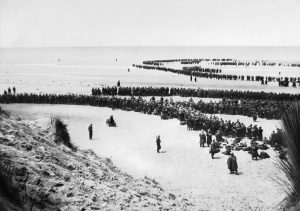
At the outbreak of World War 2,  Harry was mobilised with the battalion and deployed overseas with the British Expeditionary Force in France on April 15, 1940. 47 days later he was one of 68,014 men evacuated from Dunkirk on Friday May 31, 1940 at the peak of Operation Dynamo.

Dunkirk Evacuation
Dunkirk Evacuation. See page for author, Public domain, via Wikimedia Commons

Back in the UK he continued to serve in an operational role, thus earning the 1939-45 Star and associated WW2 medals, and the Defence Medal for non-operational home service. In fact he was posted to Ireland from April 3 to October 7, 1941 before returning to England. He was finally demobilised and discharged from service on September 8, 1943.

After the war, Harry continued his work with the Old Comrades Association. Harry Grantham, M.B.E., D.C.M. died in Ashton in 1959. He was 69 years old.

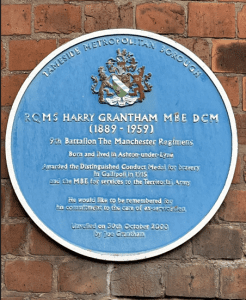
Harry Grantham Blue Plaque

On October 30, 2000 a Blue Plaque commemorating him was unveiled in Ashton under Lyne by Joe Grantham. The plaque indicates that Harry wanted to be remembered for his commitment to the care of ex-serviceman.

Lance-Corporal Stanley Pearson, DCM

Stanley Pearson was born on June 18, 1882 in Ashton under Lyne to George and Helen Rachel Pearson (née Ormond). He was the middle of three children with an older sister Ellen and younger sister May. George Pearson was working as a Colliery Manager when Stanley was born but by 1891, he had started a business as a Coal Merchant. He was also commissioned in the militia and by 1894 was an honorary Major in the 4th Volunteer Battalion, the Cheshire Regiment, based at Stockport.

By 1901 Stanley was 18 years old and working as a clerk in his father’s coal business and George Pearson was promoted to Lieutenant-Colonel and made commanding Officer of the 4th Volunteer Battalion, the Cheshire Regiment. Around this time Stanley joined his father’s battalion and went on to serve 12 years before leaving. George Pearson resigned his commission in 1904 retaining the rank of Colonel and became active in the volunteer movement in Stalybridge.

Lance-Corporal Stanley Pearson, D.C.M.

By 1911 Stanley Pearson was employed as a salesman in his father’s business and was living with his parents, younger sister, (who was just about to be married), and a domestic servant. The business had evolved from retail, (Coal Merchant), to wholesale and George Pearson gave his profession as a “Coal Factor” and started to travel more. On January 4, 1912 Stanley Pearson married Mary Ann Mills and they made their home on Stanley Street, Newton Heath, west of Ashton under Lyne. A little over a year later, on May 6, 1913, their son George Stanley Pearson was born, four days after the death of his grandfather George Pearson. And the day before George Stanley Pearson’s 1st birthday his grandmother died.

Shortly after the outbreak of war, Stanley joined the 9th Battalion Manchester Regiment, Territorial Force as a Private (2148) on Tuesday September 1, 1914 at Ashton. At least one hundred men attested this day, and at that time the intent was for the battalion to take the most experienced and able-bodied men, deferring the others until later in the month, as they knew they were shortly to leave for overseas. Thomas and the others quickly joined the battalion at Chesham Fold Camp in Bury and a week later they entrained for Southampton and boarded HMS Aragon, leaving at midnight September 10, bound for Egypt.

In Egypt the men were drilled, trained and worked hard to build their fitness and endurance. Additionally, the old eight Company model (A-H) was replaced with a four Company model (A-D), 4 platoons in each Company and 4 sections in each platoon. The battalion landed at Gallipoli under shell fire on Sunday May 9, 1915 and at that time Stanley Pearson was a 32-year-old Private with “A” Company.

On August 8, at the start of the Battle of Krithia Vineyard, the battalion went into the trenches and Stanley Pearson was a freshly promoted Lance-Corporal. “A” and “B” Companies with the (125th) Fusilier Brigade, and “C” and “D” Companies with the (127th) Manchester Brigade. 2/Lt. Oliver Jepson Sutton took two platoons of “A” company up to the firing line and was almost immediately wounded. Reinforcements were called for and so Lt. Forshaw and 2/Lt. Cooke took the other two platoons of “A” Company to the firing line. What happened to him there can be understood from Lance-Corporal Thomas Pickford’s account, given to the Ashton Reporter on March 18, 1916:

“We captured the trench after the Turks had been bombed out, and for 26 hours we held it, and were continuously engaged in repulsing fierce attacks. It was a difficult position to hold, because three Turkish saps converged into it. As senior N.C.O. in the trench, I told Stanley Pearson and four of the boys to hold one of the saps, and to keep up a continuous fire, and so keep the Turks back at that point. We had to watch the two other saps. The Turks came right at us. It was a scrap! Bombs were bursting all around us. Some of the boys in their excitement caught the Turkish bombs before they exploded, and hurled them back again. They did not always manage to catch them in time, and three of them had their hands blown off. What made the position worse was that as soon as we had entered the trench a bomb laid out six of us. I was one of them. I bandaged up my leg, and bandaged up the others, and sent them back to hospital. I carried on, that is why I was recommended for the D.C.M. Lieutenant Forshaw did not know that I had not gone to hospital. He was amazed when he came near. ‘Why, I thought you had gone to hospital’ he said. ‘No sir,’ I answered, ‘we were short of men.’

Anyway, I was telling you about the fight. The Turks were at us all the time. Pearson did splendidly, and kept his men there. He fought cooly, and kept picking off the Turks. He was a smart and good lad. We hadn’t much time to waste, I can tell you, for the Turks were determined to get the trench back. Lieutenant Forshaw was in command of the whole of the firing line in the trench, which was in a very dangerous part of the Vineyard. We had to hold the place at all costs. There were 300 men on our right, and had we lost the position the Turks could have taken them prisoners. By holding on we saved a very good position. We refused to be driven out. At one moment the Turks drove us out of one traverse, but we barricaded it up with sand-bags, and they never budged us any further, for we stuck it until we were relieved. Lieutenant Forshaw, I gave you my word on it, did very well. His example repeatedly put new courage into us. It was the first time he had been in such close fighting. He threw the bombs as well as us. At one time he came to me and said, ‘How are you getting on Corporal? Do you think you can manage?’ I said ‘I think so,’ he replied, ‘You are a plucky corporal, you are doing well.’ He well earned his V.C., and I was proud of the chance later to tell the general, (or give evidence, as they call it), about him, which led to his recommendation for the V.C. One thing he did was very fine. Just after we had got the parapet up three Turks got over, and made a rush for Sam Bayley, but Lieut. Forshaw coolly shot all three with his revolver.”

The Army’s wheels can sometimes move slowly and the despatch from General Sir Ian Hamilton of December 11, 1915 covering the fighting in Gallipoli in August was not published until January 6, 1916. Subsequent to that, on January 28, 1916 the London Gazette published the list of names to be mentioned in despatches and they included all of the main players from the 1/9th Battalion Manchester Regiment in the Battle of Krithia Vineyard:

Second Lieutenant (temporary Captain) O. J. Sutton.
Lieutenant W. T. Forshaw, V.C.
Second Lieutenant C. E. Cooke.
No. 180 Serjeant S. Bayley.
No. 2103 Corporal T. Pickford.
No. 2148 Lance-Corporal S. Pearson.

A few days later on February 2, the London Gazette published the names of the men who had been awarded the Distinguished Conduct Medal and on March 11 the Gazette published the citations of those awards:

2148 Lance Corporal S. PEARSON, 1/9th Manchester Regiment. T.F.

For conspicuous gallantry on August 7th and 8th 1915, at Gallipoli, when acting as a look-out man and sniper. He displayed great bravery and skill, and although enfiladed from both flanks he remained at his post, and by his example gave great encouragement to all with him.

He was wounded in late November or early December and medically evacuated off the peninsula. By late October 1916 he was sufficiently recovered and back in Ashton where he was made a presentation at Ashton Town Hall in recognition of his being awarded the D.C.M. earlier in the year.

After rejoining the 3/9th (Reserve) Battalion he rejoined the 1/9th Manchesters who by March 14, 1917 were at Pont Remy, South of Abbeville, in northern France. In April the battalion moved around 100km East to Epehy where they went into the line. In early May they moved 10km South West to Marquaix where on the evening of May 6th and into the early morning of May 7th “B” Company, under Major Howorth, was responsible for carrying out the following special order:

Two small posts are to be established on either side of the road running from locality b. to QUENNEMONT FARM, one on either side of the road, and joined up. This should be undertaken as a very minor operation, with only sufficient men to dig a rifle pit on each side and then connect up. The object should be to advance these posts a short distance every night without attracting the enemy’s attention; and connect them up from behind with a communication trench.

Lt. Charles Earsham Cooke commanded the party and they were met with heavy resistance from German machine guns resulting in many casualties, prompting several acts of heroism bringing wounded men in under fire.  Lt. Cooke was wounded and evacuated to Hospital in Rouen where he later died from his wounds. Stanley Pearson, D.C.M. was killed in action. He was 34 years old, dying less than 2 weeks before his 35th birthday.

He is buried in the Templeux-Le-Guerard British Cemetery, plot II. E. 32. and commemorated on the Ashton under Lyne War Memorial.

Corporal Samuel Bayley, DCM

Samuel Bayley was born in Stalybridge on June 10, 1885 to James and Sarah Bayley (née Gee). He was the youngest of three children, his two older sisters, Esther and Mary Ann being four and six years older than him respectively. Sam grew up in Stalybridge, on the border of Stalybridge and Dukinfield, and prior to the war he had lived in the same house since birth. By 1901 Sam had left school and was working as a piecer in a cotton mill while his father James Bayley was employed as a Carter.

His mother died in 1908 and around this time he joined the 9th Battalion Manchester Regiment. By 1911 he was living with his widowed, and now out of work, father and his sister Esther (‘Esty’) and was still working as a piecer. Outside of work he was a member of the Ebenezer Particular Church, on Cross Leach Street, Stalybridge and a goalkeeper for the Sunday School football club.

Corporal Samuel Bayley, D.C.M.

At the outbreak of war, the battalion was mobilised and on August 20, 1914 they marched into Chesham Fold Camp, Bury. Throughout August around 100 new recruits were added, many of whom had previously served with the battalion in the pre-war years. On September 1, 1914 another 100+ men were added, many of whom were friends and family of the existing members of the battalion. On Wednesday September 9 the battalion entrained to Southampton and at midnight the following day sailed for Egypt. In Egypt the men were drilled, trained and worked hard to build fitness and endurance. Additionally, the old eight Company model (A-H) was replaced with a four Company model (A-D), 4 platoons in each Company and 4 sections in each platoon.

The battalion landed at Gallipoli under shell fire on Sunday May 9, 1915 and at that time Samuel Bayley was a 29-year-old Corporal with “A” Company, No 1 Platoon.

On August 8, 1915 the battalion took part in the Battle of Krithia Vineyard. Lieut. W.T. Forshaw won the Victoria Cross and three N.C.O.s won the Distinguished Conduct Medal. In Forshaw’s own words …

“On the morning of August 8th progress had been made along a sap parallel to a gully, and the whole of a trench which ran at right angles from each side of the saphead that had been captured and occupied. I and about twenty men were instructed to hold a barricade at the head of the sap. Facing us were three converging saps held by the Turks, who were making desperate efforts to retake this barricaded corner, and so cut off all the other men in the trench. The Turks attacked at frequent intervals along the three saps from Saturday afternoon until Monday morning, and they advanced into the open with the objective of storming the parapet. They were met by a combination of bombing and rifle fire, but the bomb was chief weapon used both by the Turks and ourselves”

“We just went at it without a pause while the Turks were attacking, and in the slack intervals I put more fuses into bombs. I cannot imagine how I escaped with only a bruise from a piece of shrapnel. It was miraculous. The Ashton men supported me magnificently. They adapted themselves very quickly to this method of fighting, and they stuck to the work doggedly, notwithstanding our loses. The attacks were very fierce at times, but only once did the Turks succeed in getting right up to the parapet. Three attempted to climb over, but I shot them with my revolver. On the Saturday evening a young officer came to the parapet and held up his hands, he seemed to be perfectly dazed, and we took him prisoner. All this time both our bomb throwing and shooting had been very effective, and many Turkish dead were in front of the parapet and in the saps. The attack was not continuous, of course, but we had to be on the watch all the time, and so it was impossible to get any sleep.”

At the end of 24 hours the Ashton men were relieved by a detachment drawn from other battalions, but Lieutenant Forshaw volunteered to continue to lead the resistance. His offer was accepted, and Corporal Bayley remained with him. More attacks were repulsed during the Sunday afternoon and night, and at the end of the struggle, Lieutenant Forshaw rejoined his battalion in condition of almost complete exhaustion. He was afterwards told that the number of bombs thrown by his men and two other detachments in the trench during the weekend was no fewer than 800.

“We decided that we would hold on to the position whatever it cost us for we knew what it meant to us. If we had lost it the whole of the trench would have fallen into the hands of the enemy. I had half of the men with me, and the other half I placed along the trench with a subaltern [2/Lt. C.E. Cooke]. The Turks were at it for all they were worth, and they had sap heads right up to my position; but I had a fine supply of bombs, which, by the way, had been made out of jam tins by our Engineers. Obliging little fellows, those Engineers! Fortunately, we had no fewer than 800 of those bombs, but we got rid of the lot during the greatest weekend I have ever spent.”

“Three times during the one night the Turks made tremendous efforts to get over the parapet, and once they succeeded, but not one of them got back again. We were too busy during the night to look after their dead bodies, but we found them lying at the bottom of the trench next morning. They were armed with rifles and bayonets, and huge men they were. Three of these big, dark-skinned warriors appeared. Immediately one made a move for a Corporal [Sam Bayley] who was digging a hole from which to fire during the night. I saw the Turk make for him with his long bayonet, and I straightaway put a bullet through him from my useful Colt revolver. My weapon was a very fine friend to me during those thrilling minutes. A second Turk came for me with his bayonet fixed, evidently with the object of covering his pal, who was making for the box of our bombs, but I managed to put them both out of action. They never came over the barricade again; but realising as they did what position meant, they kept up the fusillade during the whole of the night.”

Writing on August 10th Corporal Bayley described the Congratulatory Card he received from Sir John Francis Davies, commanding 8th Corps, (which he subsequently mailed to his sister Esty):

“We have had it rough again for two nights, but I am proud to tell you I am quite safe, although I have had many narrow escapes. I have the pleasure to tell you that I have had a bit of honour attached to my name. Myself, and a few men and the Captain held a trench which was almost impossible to hold, but we stuck it like glue, in spite of the Turks attacking us with bombs. I can tell you I accounted for a few Turks. Our Captain has been recommended for the V.C. and I hope he gets it because he was very determined to hold the trench till the last man was finished. But we did not lose many. Our Captain has not got over it yet, but it is only his nerves that are shattered a bit, and he will soon be with us again. I have been congratulated by Sir John Francis Davies, commanding the 8th Corps. You will find it enclosed.

“To No 180 Corpl. BAYLEY, 1/9th Manchester Regiment … I congratulate you heartily on being awarded the Distinguished Conduct Medal for your gallant conduct in the field – Lieut. General Sir Francis Davies, commanding 8th Corps.”

A few months later, on November 16, 1915 the London Gazette published the following D.C.M. citation:

180 Corporal S. Bayley, 1/9th Battalion, Manchester Regiment, T.F.

“For conspicuous bravery on the 7th and 9th August, 1915, at Cape Helles (Dardanelles). Corporal Bayley remained with Lieutenant Forshaw, V.C., holding a barricade for forty-one hours continuously. On the evening of the 8th August his party was relieved by another unit, but he volunteered to remain on. He displayed the greatest gallantry and endurance under the most trying circumstances in repelling many severe attacks, and when the barricade was at last broken through, he was the foremost in the successful counter-attack led by Lieutenant Forshaw, which regained it, and finally retained it. On being ultimately relieved he was utterly exhausted by his arduous and gallant work of bomb-throwing.”

And belatedly, on January 28, 1916, the London Gazette published the list of the names of the officers and men whose services General Sir Ian Hamilton wished to mention in connection with the operations described in my despatch of 11th December, 1915

Manchester Regiment (Territorial Force)
No. 180 Serjeant S. Bayley.

Additionally, for his actions at the Vineyard, he was awarded a field promotion to sergeant.

On January 8, 1916 his sister Esty received a letter from him informing her that he was 10-days on a hospital ship after being wounded in both legs from bomb throwing around the middle of December.

Since there is no surviving service record, there is no precise timeline of Sergeant Bayley’s subsequent movements but there are some things that can be reliably inferred. His medal roll does not list the six-digit service number that was assigned to each of the men in February 1917. However, his pension ledger index card does list this number (350018) and this indicates that in February 1917, when the six digit numbers were assigned, he was still serving 9th Battalion, Manchester Regiment.

On Saturday April 14, 1917 a presentation of an inscribed gold watch was made to him at the Cross Leech Street Baptist School, Stalybridge, an institution he had been associated with for many years including playing as goalkeeper for the Church Sunday School team. The Stalybridge Reporter noted that he was home on furlough and this was his first visit home since being awarded the DCM.

He was quite the celebrity. Two days earlier, on Thursday April 12, The Young Men’s Society at the Ebenezer Baptist Sunday School presented him with a “handsome pocket wallet”. And the following Monday, April 16, at the Navigation Inn, Robinson Street, Stalybridge, the Women’s Picnic Club presented him with a silver cigarette case, and his aunt, Sarah Bayley, presented him with a checque.

To understand the end of his service it’s useful to review the surviving pension record of Sergeant Titus Knight Broadley Cropper. Sgt. Cropper was repatriated from Gallipoli suffering from dysentery and after recovering was deployed to the Regimental Command Depot at Heaton Park. He remained there for the duration of the war until he was transferred to the 8th (Reserve) Battalion, Manchester Regiment at Hunmanby, near Filey. On October 2, 1918 he was transferred to the 2/1st Shropshire Yeomanry, at the Curragh, County Kildare and given the service number 160758. Sergeant Bayley was transferred with him and was given the service number 160757. Sgt. Cropper was medically assessed at the Rath Camp, at the Curragh, on January 15, 1919 and was demobilised on February 22, 1919. It’s reasonable to assume that Sgt. Bayley followed a similar course and timeline.

Sgt. Bayley’s pension ledger index card shows that he applied for a disability pension but was rejected. As a D.C.M. recipient he was entitled to a flat payment of £20 or, if eligible for a disability pension, a weekly payment of 3sh 6d. Clearly, over time, the weekly pension was a financially better option and presumably this is at least partly why he applied for it.

After he was demobilised he married Alice Malinda Bowker, in Ashton, on September 4, 1920 and by this time he was working as a labourer at Broadbent & Sons Iron Foundry but prior to the marriage was still living with his sister Esty in Stalybridge, his father now deceased.

Samuel and his wife made their home in Stalybridge, next door but one to his old family home and his sister. But on August 22, 1924 Samuel Bayley, D.C.M. died suddenly at the age of 39 of chronic nephritis and secondarily from uraemia.

Lance-Corporal Thomas Pickford, DCM

Thomas Pickford was born in Audenshaw on July 25, 1882 to Mathew and Martha Ann Pickford (née Greenwood); impressively he arrived the day after their marriage. He was the oldest of six children and his father was employed as a Brewer’s Drayman. The family settled in Ashton, where Thomas was educated at Trafalgar School, and by 1901 Thomas was 18-years-old and had joined his father as a Carter.

Around this time, he joined the 3rd Volunteer Battalion, the Manchester Regiment which in 1908 became the 9th Battalion Manchester Regiment, Territorial Force. He served with them for some time but did not re-enlist when his time was up. In 1908 he married Ada Ann Clough and by 1911 they were living at 130 Wellington Street, Ashton with Ada’s son and daughter from a previous relationship and their own two infant daughters. Thomas was still working as a Carter but by now was employed by Noel Duncan Braithwaite, a local Coal Merchant and sergeant in the 9th Battalion Manchester Regiment.

His brother William Pickford joined the regular Army as a Private with the 5th (Princess Charlotte of Wales’s) Dragoon Guards and was stationed at Aldershot by 1912. War was declared on August 4, 1914 and by now Thomas’s first son, Joseph Pickford, had been born less than six months earlier. On August 11, 1914 his youngest brother, John Pickford, attested with the 11th Battalion Manchester Regiment. Four days later, his brother William deployed to France with the 5th Dragoon Guards.

Lance-Corporal Thomas Pickford, D.C.M.

With his two brothers and his employer already mobilised, and himself a former militia man, the pressure on Thomas to attest must have been overwhelming and he re-joined the 9th Battalion Manchester Regiment, Territorial Force as a Private (2103) on Tuesday September 1, 1914 at Ashton. At least one hundred men attested this day, Thomas being one of the very first to do so. At that time, the intent was for the battalion to take the most experienced and able-bodied men, deferring the others until later in the month, as they knew they were shortly to leave for overseas. Thomas and the others quickly joined the battalion at Chesham Fold Camp in Bury and a week later they entrained for Southampton and boarded HMS Aragon, leaving at midnight September 10, bound for Egypt.

In Egypt the men were drilled, trained and worked hard to build their fitness and endurance. Additionally, the old eight Company model (A-H) was replaced with a four Company model (A-D), 4 platoons in each Company and 4 sections in each platoon. The battalion landed at Gallipoli under shell fire on Sunday May 9, 1915 and at that time Thomas Pickford was a 32-year-old Private with “A” Company. His section N.C.O. was 19-year-old Lance-Corporal Gerald Massey and his Platoon commander was 19-year-old 2nd Lieutenant Charles Earsham Cooke. On the morning of June 20, Gerald Massey was shot in the head and killed by a Turkish sniper when he peered above the parapet. Thomas was promoted to Lance-Corporal to fill the now vacant position and took the trouble to write to Gerald’s parents and the letter was published in the Ashton Reporter of August 21, 1915:

“I was your late son’s friend; he was my section commander and I have now got his place, but I would rather he had been spared. He had a very nice grave behind the firing line. I helped to bury him. Our minister prayed very nice over him. I placed a cross on his grave. I remain, yours, Tom Pickford.”

On August 8, at the start of the Battle of Krithia Vineyard, the battalion went into the trenches. “A” and “B” Companies with the (125th) Fusilier Brigade, and “C” and “D” Companies with the (127th) Manchester Brigade. 2/Lt. Oliver Jepson Sutton took two platoons of “A” company up to the firing line and was almost immediately wounded. Reinforcements were called for and so Lt. Forshaw and 2/Lt. Cooke took the other two platoons of “A” Company to the firing line. The recently promoted Lance-Corporal Thomas Pickford was with 2/Lt. Cooke.  What happened to him there is best understood from his own account, given to the Ashton Reporter on March 18, 1916:

“We captured the trench after the Turks had been bombed out, and for 26 hours we held it, and were continuously engaged in repulsing fierce attacks. It was a difficult position to hold, because three Turkish saps converged into it. As senior N.C.O. in the trench, I told Stanley Pearson and four of the boys to hold one of the saps, and to keep up a continuous fire, and so keep the Turks back at that point. We had to watch the two other saps. The Turks came right at us. It was a scrap! Bombs were bursting all around us. Some of the boys in their excitement caught the Turkish bombs before they exploded, and hurled them back again. They did not always manage to catch them in time, and three of them had their hands blown off. What made the position worse was that as soon as we had entered the trench a bomb laid out six of us. I was one of them. I bandaged up my leg, and bandaged up the others, and sent them back to hospital. I carried on, that is why I was recommended for the D.C.M. Lieutenant Forshaw did not know that I had not gone to hospital. He was amazed when he came near. ‘Why, I thought you had gone to hospital’ he said. ‘No sir,’ I answered, ‘we were short of men.’

Anyway, I was telling you about the fight. The Turks were at us all the time. Pearson did splendidly, and kept his men there. He fought cooly, and kept picking off the Turks. He was a smart and good lad. We hadn’t much time to waste, I can tell you, for the Turks were determined to get the trench back. Lieutenant Forshaw was in command of the whole of the firing line in the trench, which was in a very dangerous part of the Vineyard. We had to hold the place at all costs. There were 300 men on our right, and had we lost the position the Turks could have taken them prisoners. By holding on we saved a very good position. We refused to be driven out. At one moment the Turks drove us out of one traverse, but we barricaded it up with sand-bags, and they never budged us any further, for we stuck it until we were relieved. Lieutenant Forshaw, I gave you my word on it, did very well. His example repeatedly put new courage into us. It was the first time he had been in such close fighting. He threw the bombs as well as us. At one time he came to me and said, ‘How are you getting on Corporal? Do you think you can manage?’ I said ‘I think so,’ he replied, ‘You are a plucky corporal, you are doing well.’ He well earned his V.C., and I was proud of the chance later to tell the general, (or give evidence, as they call it), about him, which led to his recommendation for the V.C. One thing he did was very fine. Just after we had got the parapet up three Turks got over, and made a rush for Sam Bayley, but Lieut. Forshaw coolly shot all three with his revolver.”

The Army’s wheels can sometimes move slowly and the despatch from General Sir Ian Hamilton of December 11, 1915 covering the fighting in Gallipoli in August was not published until January 6, 1916. Subsequent to that, on January 28, 1916 the London Gazette published the list of names to be mentioned in despatches and they included all of the main players from the 1/9th Battalion Manchester Regiment in the Battle of Krithia Vineyard:

Second Lieutenant (temporary Captain) O. J. Sutton.
Lieutenant W. T. Forshaw, V.C.
Second Lieutenant C. E. Cooke.
No. 180 Serjeant S. Bayley.
No. 2103 Corporal T. Pickford.
No. 2148 Lance-Corporal S. Pearson.

A few days later on February 2, the London Gazette published the names of the men who had been awarded the Distinguished Conduct Medal and on March 11 the Gazette published the citations of those awards:

2103 Lance-Corporal T. Pickford, 1/9th Battalion, Manchester Regiment, T.F.

For conspicuous gallantry on the 8th August, 1915, at Gallipoli, when he rallied his party, which had been driven back by bombs in the Barricade of the Vineyard, and by his bravery and example was largely instrumental in saving a precarious position.

Thomas Pickford's Annotated D.C.M. Citation

L/Cpl. Pickford had been wounded in the leg during the battle and after it was over, he was medically evacuated to hospital. By late January 1916 he was back in Ashton recovering, and had time to visit Trafalgar School Ashton, of which Captain Ralph Lees of the 2/9th Manchesters was headmaster and where he was formerly a pupil.

Sometime between August 1916 and February 1917 he was sufficiently recovered to be transferred to the King’s Liverpool Regiment as Private (310177) along with several other men of the 9th Manchesters (310176—310178 being former 9th Battalion Manchester Regiment N.C.O.s). Pickford was attached to the 1/5th Battalion of the 165th (Liverpool) Brigade and 55th (West Lancashire) Division, in XIX Corps. By July 1917 they were at Pilckem Ridge, Belgium and Thomas had become a father for the fourth time when his youngest daughter, Martha Ann Pickford, was born on May 19, 1917.

On July 31, 1917 the battle of Pilckem Ridge commenced which marked the start of the 3rd Battle of Ypres. Although the Allied attack started well, by the early afternoon the Germans counter-attacked just as the rain started to fall reducing visibility. The 39th Division on the XIX Corps’ left flank was pushed back to St Julien, exposing the left flank of the 55th (West Lancashire) Division, just as it was attacked frontally by six waves of German infantry. Attempts to hold the ground, now turned to mud, failed and the reserve brigades of the 55th (West Lancashire) and 15th (Scottish) Divisions were rolled up from North to South but were either overrun or forced to retreat. The British eventually stopped the German advance with artillery and machine-gun fire in the early evening hours.

The 1/5th Battalion King’s Liverpool Regiment had attacked at 3:50am and by the end of the day had suffered other ranks casualties of 105 wounded, 26 killed and 45 missing. Thomas Pickford was reported wounded and missing on July 31, 1917. His body was never found and so his widow was not officially notified of his death until September 18 and Form 104-76, “Death notification of a married man sent from the Territorial Force Record Office to the War Office”, was only received four months later, on January 28, 1918. Army paperwork satisfied, a weekly pension of 33sh 9d was paid commencing April 16, 1918; this to cover Thomas’ widow and six dependents. It’s not clear whether this included the 6d per day pension she was also entitled to for Thomas’ D.C.M.

Thomas Pickford was now declared officially dead, killed in action on July 31, 1918 just five days after his 35th birthday. He is commemorated on the Menin Gate and on the Ashton Under Lyne Civic Memorial.

Sergeant James Greenhalgh, DCM

James Greenhalgh was born on February 11, 1897 in the port city of Ancud on Chiloé Island, Chile. His father, Daniel Greenhalgh, was employed by the Pacific Steam Navigation Company and later became the chief of claims at the port of Valparaiso. Upon his father’s death, James and his older brother William came back to England and were adopted by their uncle John Ralph Greenhalgh, the head teacher of a school in Audenshaw and a member of the Lancashire Education Committee.

By 1911, James and William were living in Audenshaw and were both employed as Fitters at W.J. Bates & Co. Engineering Works in Denton, James as a 14-year-old apprentice. In February 1914, the 9th Battalion Manchester Regiment was under strength and so a big recruiting drive at Ashton Town Hall was organized for Saturday February 14. It was widely advertised and James decided to beat the rush and attested on February 9th when he was just 2 days short of his 17th birthday. At 5ft 9” tall he was bigger than many of the recruits who would be attesting at the weekend and after 3 years of living with his uncle and aunt, both school teachers, he was better educated.

Sergeant James Greenhalgh, D.C.M.

At some point after he attested, and before the outbreak of war, he changed from manual to clerical work being employed in the accounting department of Beyer Peacock’s engine works at Gorton. Outside of work he was a Sunday school teacher at the Wesleyan Sunday School, Hooley Hill, and a member of the Y.M.C.A. Denton Road, Audenshaw.

At the outbreak of war, the battalion was mobilised and on August 20, 1914 they marched into Chesham Fold Camp, Bury. Throughout August around 100 new recruits were added, many of whom had previously served with the battalion in the pre-war years. On September 1, 1914 another 100+ men were added, many of whom were friends and family of the existing members of the battalion. On Wednesday September 9 the battalion entrained to Southampton and at midnight the following day sailed for Egypt. In Egypt the men were drilled, trained and worked hard to build fitness and endurance. Additionally, the old eight Company model (A-H) was replaced with a four Company model (A-D), 4 platoons in each Company and 4 sections in each platoon.

The battalion landed at Gallipoli under shell fire on Sunday May 9, 1915 and at that time James Greenhalgh was an 18-year-old Private with “B” Company. In June he was severely wounded in the neck and shoulder by a Turkish bullet while deepening a sap and was medically evacuated to hospital in Malta. After he recovered, he returned to Gallipoli and was subsequently promoted to Corporal. In November he was promoted to Sergeant and later that month was again wounded, this time not so severely, when he was struck in the face by shrapnel. He was treated in the field and did not leave the battalion.

By late December, the Allies made the decision to evacuate the Peninsula and operations switched to disguising the intent to leave through a number of small distracting operations. The battalion war diary for December 19, 1915 is unusually expansive:

Morning quiet. In the afternoon a small action took place at 14:15, a large mine was exploded about 30 yards from the N.E. corner of FUSILIER BLUFF and immediately after 5 smaller mines. It was expected that this mine would form a large crater and a party was told off to occupy this. The party consisted of 16 bombers, a working party under 2nd Lieut. GRAY and 26 men of ‘B’ Coy. All went exactly as ordered and the men went over the parapet in a splendid manner, but unfortunately the mine failed to form a crater and when the men got out there was no cover at all and the Turkish trench being intact the enemy fired deliberately from loop holes at the party. 2nd Lieut. GRAY stayed out until it became evident that nothing could be done when he gave the order to retire. The enemy shelled the MULE TRENCH and our Support Line very heavily whilst the action was in progress but did little damage. Our casualties amounted to 3 killed, 1 missing, 11 wounded. The night passed quickly.

In James’ own words (as published in the Ashton Reporter on July 15):

“It was on the 19th December, 1915, I was ordered to take a party of men over the top, and we got to within ten yards of the Turkish trench. At the same time there was a mine blown up. It should have made a big hole in the front of the Turkish trench. The intention was for us to have got in this hole, but when we got to the place no hole had been made, and we had to lie in the open, and the Turks potting at us from ten yards away. It was a good job the Turks were nervous, or else there would have been none of us left to tell the tale.

The object was for us to get in the crater and build it up with sandbags, and then our bombers could have bombed the Turks out of their trench, but it didn’t come off as we expected. Anyway, we all got back to our trench except one poor lad who was killed.

Lance-Corporal Davies, D.C.M. was with the same party of men.”

In fact, when 2nd Lieut. Alfred Gray gave the order to retire, Sgt. Greenhalgh and L/Cpl. Davis stayed exposed, just 10-12 yards away from the Turkish trench, and covered the other men’s withdrawal while under heavy fire, only returning to safety themselves after their party had been able to return to the Allied trenches.

On June 2, 1916 the London Gazette announced the award of the Distinguished Conduct Medal to Sgt. Greenhalgh and the London Gazette of June 21 carried the following citation:

1623 Sjt. J. Greenhalgh, 9th Bn. Manch. R., T.F.

For conspicuous gallantry when covering a retirement under very heavy fire at a few yards range.

The annotated D.C.M. listing does not provide much additional information but the long-forgotten administrative code of “B1-131” directly links this award with that of Lance-Corporal Davis.

James Greenhalgh Annotated DCM Citation

2/Lt. Alfred Gray, who was commanding the small group of Manchesters, was eventually awarded the Military Cross, in May 1919, for “gallant and distinguished services in the Field” but there is little doubt that this action, on this day, was a significant contributing factor to his award.

James Greenhalgh served with the 9th Battalion for the duration of the war, serving in Egypt and France, and was demobilised on February 27, 1919. On April 9, 1925 he married Emily Louisa Mantle in Ashton and by 1939 they had moved to Liverpool and ran a small grocery shop, on Finvoy Road. Eventually, they retired to a small bungalow close to the sea at Abergel, North Wales. James Greenhalgh, D.C.M. died on April 17, 1976, a month before the death of his wife. He was 79 years old.

Lance-Corporal George James Silvester, DCM

George James Silvester was born on September 7, 1894 in Ashton under Lyne. He was the oldest son of Alfred Edward and Sarah Silvester (née Mellor) who had married the previous year and made their family home at 227 King Street, Hurst, Ashton. Alfred was an educated man who was employed as a Clerk in a Cotton Mill Warehouse in Ashton and would eventually become an undermanager at the Mill.

George was educated at Hurst British School and, according to the headmaster J.W. Spencer, took the efficiency and progress prize each year he attended. By 1911 he was living with his parents, his brother Kenneth and younger sister Phyllis and working as a weaver at a cotton mill. His sister Isabel Fanny Silvester having died just under a year after she was born in 1896.

On November 25, 1912, a few weeks after his 18th birthday, he joined the 9th Battalion Manchester Regiment, Territorial Force as a Private (1358). At 5ft 8” tall he was bigger and better educated than many of the other enlisted men and so although younger than the old hands, was at some point promoted to Lance-Corporal. His career also progressed outside of the military becoming an Overlooker at Messrs. Whittaker’s Mills, Queen Street, Hurst.

Corporal George James Silvester, D.C.M.

At the outbreak of war, the battalion was mobilised and on August 20 they marched into Chesham Fold Camp, Bury. Throughout August around 100 new recruits were added, many of whom had previously served with the battalion in the pre-war years. On September 1, 1914 another 100+ men were added, many of whom were friends and family of the existing members of the battalion. On Wednesday September 9 the battalion entrained to Southampton and at midnight the following day sailed for Egypt. In Egypt the men were drilled, trained and worked hard to build fitness and endurance. Additionally, the old eight Company model (A-H) was replaced with a four Company model (A-D), 4 platoons in each Company and 4 sections in each platoon.

The battalion landed at Gallipoli under shell fire on Sunday May 9, 1915 and at that time George Silvester was a 20-year-old Lance-Corporal with “C” Company. Two days later he became the first recorded casualty of C company when he was hit in the leg by a stray bullet while the battalion was while the battalion was in brigade reserve in a line of trenches known as Backhouse Post trenches. He was treated at the field ambulance and remained with his unit.

On May 21 the battalion moved into the Redoubt Line trenches and the following day Lt-Col. D.H. Wade, the battalion’s commanding officer, was shot and wounded in the thigh while stepping over some sleeping men. Major Nowell assumed temporary command of the battalion. By the following evening, May 22, A and B Companies were in the firing line with C and D Companies in the reserve line. In preparation for the Third Battle of Krithia, the Allied forces started to undertake a series of coordinated and stealthy night operations to advance and straighten the firing line so that they could reach within striking distance of the Turkish positions. This night, a coordinated action was planned involving the 1/9th Manchesters in the centre, the 1/5th East Lancs on the battalion’s right and the 1/10th Manchesters on their left. The basic idea was to create a series of disconnected “firing pits” which could later be joined together to create a new “fire trench”. It was hard and dangerous work and many, if not all, of the men that went out that night were volunteers.

In the 9th Manchesters’ section, at least 32 men, (4 per platoon from C and D Companies), formed a digging party and a further 16 men were detailed to form a covering party. The covering party advanced first and took up position about 50 yards in front of the intended new line of trenches. They doubled out carrying rifle, bayonet, rations and half-filled sand bags for a semblance of cover. After a pause to allow enemy fire to die down, the digging parties went forward, carrying full entrenchment kit and supplies, spade, rifle, bayonet, rations and also with half-filled sandbags. The Turks became aware of the activity as soon as the covering parties left the Redoubt Line and opened fire but after a short time the firing stopped, the covering parties having been ordered not to return fire. However, as soon as the digging parties made their advance the Turks open a heavy fire which continued throughout the night causing a number of casualties.

Lance-Corporal Silvester, in the digging party and still carrying his wound from a few days earlier, saw that (1413) Pte. Thomas Penny had been wounded and crawled out to him under heavy fire and brought him 120 yards back to safety. He may have then repeated the act for two other men but regardless, when he had finished bringing in wounded men, he crawled back out and resumed digging.

Four months later, the Ashton Reporter carried a large article about several men of the 1/9th Battalion who had been recommended for decorations for their actions at Gallipoli, one of who was Lance-Corporal Silvester:

On the evening of May 25th Lance Corporal Silvester, Lance Corporal Wilde and a working party of about 30 soldiers were engaged in straightening up the line of trenches, when the enemy opened up with heavy fire. The working party lost five men killed and wounded. Silvester, although wounded, continued to carry out his duties and showed the highest courage in aiding the wounded under fire. By daybreak, they had achieved their objective, and were safely dug in.

Sergeant-Drummer Stopford, also of C Company and a neighbour of Silvester’s from Hurst, wrote a letter home to his wife where he said:

“I am very pleased to tell you that Sergt. Grantham and Corpl. Silvester have been awarded the Distinguished Conduct Medal for bravery in the trenches. … Corpl. Silvester got his for going out three times and carrying in wounded comrades under a heavy fire.”

In a letter home to his family near the end of July, Lance-Corporal Silvester said:

“It is quite true that I have been recommended for some decoration, but I can’t say whether I shall get it or not. Major Nowell (commanding officer) sent for me last week, and told me he was doing all he could to get it for me, and that General Prendergast [42nd Division CO] had promised to do what he could. I hope I shall get it as I know how you will feel.”

And around a week later in a letter dated August 8 he added:

“No doubt you will know by now that I am Corporal Silvester D.C.M. … The name of the man I carried was Private Penny. I am sorry to say he died of his injuries about a month later. I have not received the medal yet, I have it to come, but I am entitled to wear the ribbon now. I dare say it will be in the Reporter about the affair, but I don’t want to brag about it.”

Lance Corporal Silvester was awarded the DCM and was promoted to Sergeant.  The following citation was published in the London Gazette on September 15, 1915, a week after his 21st birthday:

For conspicuous gallantry and devotion to duty on the Gallipoli Peninsula. Although wounded on the 20th May he continued to perform his duties, and showed the highest courage on 25th May in aiding the wounded under fire.

It’s worth noting that the dates given in the official citation do not exactly match the dates provided contemporaneously from war diaries, personal diaries and letters home from the front. The balance of evidence shows that the dates in the official citation are wrong.

But before he was awarded the DCM, Cpl. Silvester was wounded for a second time. His name was present on the July 26, 1915 London Times Casualty List along with a number of other killed and wounded men of the 9th Manchesters. Unlike when he was wounded on May 11, this means that he left the peninsula for hospital treatment. In fact, in his letter home written “near the end of July”, excerpts of which were published in the Ashton Reporter, he references that he had been wounded twice and that “Jim Taylor’s son was in the same ward as myself”. It’s likely that Cpl. Silvester received a sufficiently serious but not life-threatening wound early in June, (perhaps in the bayonet charge of June 7), was medically evacuated to Egypt and returned to Gallipoli a few weeks later. If so, he was in good company. One other man also named on the same casualty list was 1192 Corporal Harry Trunkfield who was shot through the thigh on June 9th and medically evacuated to a hospital at Alexandria. By August 7 he was back in the thick of things at Gallipoli in the battle of Krithia Vineyard and subsequently received a congratulatory card from Major General Douglas for his actions that day.

On December 24, 1915 Sgt. Silvester was medically evacuated from Gallipoli after suffering his third wound of the campaign; a gunshot wound to the back. Unfortunately, this wound was far more serious than the previous two and it effectively marked the end of his military combat service. He spent several months recovering in hospital in Malta before becoming fit enough to embark for England on April 4, 1916. He arrived in the UK during the week of April 9th and received treatment at Whitchurch, Glamorgan before returning to Ashton on Thursday May 25, 1916.

Back in Ashton he was, quite rightly, treated as a hero and minor celebrity and on June 3 was presented with a gold watch by the overlookers and weavers of Messrs. Whittaker’s Mill, Hurst where he had been employed as an overlooker before the war. The watch was engraved “Presented to Sergt. G. Silvester, D.C.M., by the weavers and overlookers at Whittaker’s Mill, in commemoration of his gallantry.”

He underwent a long recovery but at some point after July 1917 he was pronounced permanently unfit for General Service but fit for home service. He transferred to Fort George, Guernsey as (2302) Sergeant-Instructor to the 2nd (Reserve) Battalion Royal Guernsey Light Infantry which was formed to receive and train recruits as replacements for casualties in the 1st Battalion which was then serving in France.

He must have impressed his superior officers because in May 1918 he was recommended for a commission in the regular forces and submitted his papers in early June. He was accepted and ordered to report to No 15 Officer Cadet Training battalion at Gidea Hall, Romford on July 5, 1918. He graduated in February 1919, his confidential report noting that he was “Conscientious and Hardworking. Rather unpolished but trustworthy and quiet in manner and should make a sound and reliable officer.”

He was duly commissioned as a temporary 2nd Lieutenant, effective March 3, 1919, to the 2nd Royal Guernsey Light Infantry Reserve of Officers. But since the war was now over, he returned to Ashton and resumed his civilian life. In May, the National Federation of Discharged and Demobilised Sailors & Soldiers wrote to the War Office on his behalf requesting a pension payment of 6d per day in respect of his DCM. This was refused on the grounds that he had not been discharged on disability pension and so was required to accept only the £20 lump sum gratuity.

In October 1920 the 9th Battalion Manchester Regiment was re-formed and many former Officers, NCOs and men of the 1/9th Battalion re-joined. George Silvester was appointed Company Sergeant-Major but he was not a well man and on August 13, 1921 he died of Bright’s Disease at Ashton District Infirmary. He had been at Caernarfon Camp with the 9th Battalion and was taken ill there. Returning to Ashton on August 13th he was attended by a local Doctor and immediately moved to the Ashton Infirmary where he died shortly after admission. He was buried at Hurst Cemetery the following Wednesday, with his mother who had died in February that same year, and with his infant sister Isabel who had died in 1897. There was a large attendance at the funeral, the bearers being six sergeants of the 9th Battalion. The firing party was under the command of another battalion sergeant and the Last Post was sounded as he was laid to rest. George James Silvester, DCM was just 26 years old.

A year after his death, the London Gazette incongruously announced that he had relinquished his commission in the Reserve of Officers on completion of service on September 1, 1922 retaining the rank of Second Lieutenant. His gravestone at Hurst Cemetery records him for posterity as DCM winner and Company Sergeant Major in the 9th Manchester Regiment.